Neuralink-Class Implantable Neural Interface Market Size, Scope, Revenue Report 2026 to 2035
What is Neuralink-Class Implantable Neural Interface Market Size?
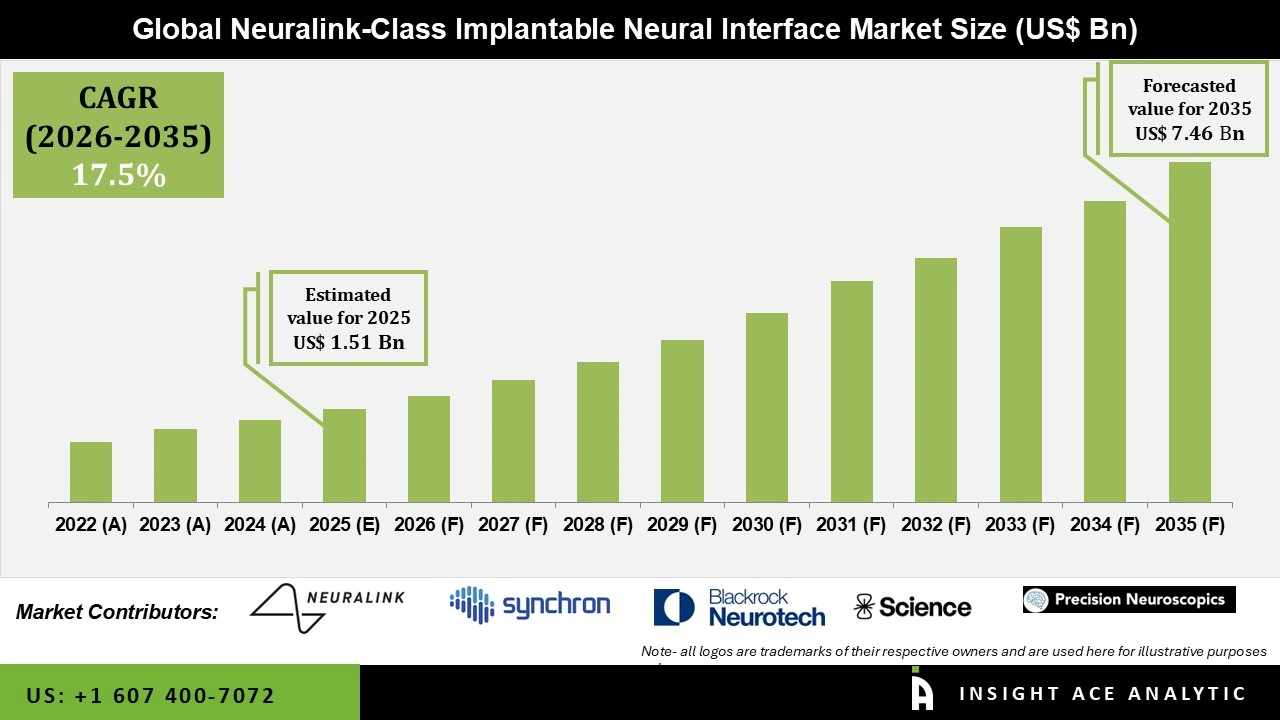
Global Neuralink-Class Implantable Neural Interface Market Size is valued at USD 1.51 Bn in 2025 and is predicted to reach USD 7.46 Bn by the year 2035 at a 17.5% CAGR during the forecast period for 2026 to 2035.
Neuralink-Class Implantable Neural Interface Market Size, Share & Trends Analysis Distribution by Type (Partially Implanted, Fully Implanted, and Electrocorticography (ECoG) Arrays), Application (Epilepsy Management, Paralysis & Motor Restoration, Psychiatric Disorder Treatment, and Speech Restoration), End-user (Neurology Clinics, Defense & Military Research, Academic Medical Centers, and Consumer Wellness), and Segment Forecasts, 2026 to 2035.
Neuralink-class implantable neural interfaces are sophisticated brain-computer interface (BCI) systems that use ultra-thin implanted electrodes and neural signal processing technology to provide direct communication channels between the brain and external devices. These devices monitor, decode, and sometimes even stimulate brain activity, making it possible for applications like helping paralyzed people regain their ability to communicate, managing prosthetic limbs, treating neurological conditions, and maybe improving cognitive engagement with digital systems. To provide high-resolution brain monitoring and response, they usually include implanted chips, flexible electrode threads, wireless data transmission, and artificial intelligence-driven signal interpretation. The Neuralink-class implantable neural interface market is expanding more quickly due to growing developments in neurotechnology, miniaturization, biocompatible materials, and machine learning.
The Neuralink-class implantable neural interface market is being driven by the increasing need for sophisticated brain-computer interface technologies, which allow direct brain-to-external device connection for therapeutic and assistive applications. Implantable neural interfaces are becoming more popular as neurological conditions such as paralysis, epilepsy, Parkinson's disease, and spinal cord injuries become more common. These interfaces can help restore motor functioning, communication, and sensory capacities. Furthermore, the development of extremely advanced neural implants with enhanced precision and long-term usefulness is being accelerated by continuous advancements in microelectronics, biocompatible materials, artificial intelligence, and wireless data transfer. Moreover, the growing emphasis on next-generation human-machine interface, neuroprosthetics, and cognitive augmentation is contributing to the Neuralink-class implantable neural interface market's expansion.
In addition, the ongoing advancements in minimally invasive insertion methods and growing research in high-bandwidth neural communication systems are expected to influence the Neuralink-class implantable neural interface market. The growing investments from both public and private organizations, as well as regulatory backing for innovative medical devices, are anticipated to further boost the Neuralink-class implantable neural interface market growth. Additionally, the market is moving toward sophisticated implantable platforms made for particular neurological and cognitive applications, which reflects a move toward high-performance, tailored neural interface solutions. The Neuralink-class implantable neural interface market is anticipated to rise significantly in the upcoming years due to advancements in precision neuroengineering and increased awareness of the possibilities of implantable neural interfaces.
Competitive Landscape
Which are the Leading Players in Neuralink-Class Implantable Neural Interface Market?
- Neuralink
- Precision Neuroscience
- Synchron
- Blackrock Neurotech
- Science Corporation
- Paradromics
Market Dynamics
Driver
Growing Incidence of Neurological Diseases
The Neuralink-class implantable neural interface market is primarily driven by the growing incidence of neurological illnesses and the growing need for cutting-edge brain-computer interface technologies. Implantable neural interfaces that can restore communication, motor control, and sensory functions are in high demand due to the rising incidence of paralysis, spinal cord injuries, Parkinson's disease, epilepsy, and neurodegenerative illnesses. Furthermore, the creation of more accurate and long-lasting devices is made possible by the quick developments in biocompatible implant materials, microelectronics, neural signal decoding, and artificial intelligence. Innovation in this discipline is being further accelerated by increased financing from research institutions, neuroscience startups, and technology companies. Additionally, increasing interest in neuroprosthetics and next-generation human-machine interfaces is broadening the range of possible uses, promoting sustained worldwide market expansion.
Restrain/Challenge
High Cost and Technological Complexity
The Neuralink-class implantable neural interfaces' high cost and technological complexity continue to be significant barriers to market expansion. Commercialization barriers are raised by the substantial expenditure needed in research, clinical trials, advanced manufacturing, and regulatory permissions to develop these systems. Furthermore, invasive neurosurgery is another aspect of implantation operations that raises questions about patient safety, long-term biocompatibility, infection risks, and device reliability. Public acceptance and regulatory supervision are also hampered by ethical concerns about cybersecurity, neural data privacy, and cognitive improvement. The Neuralink-class implantable neural interface market is further hampered by the lack of payment support and the requirement for specialist healthcare infrastructure, especially in developing nations.
Fully Implanted Segment is Expected to Drive the Neuralink-Class Implantable Neural Interface Market
The Fully Implanted category held the largest share in the Neuralink-Class Implantable Neural Interface market in 2025 because there is a growing need for long-term, minimally invasive brain-computer interface systems with improved performance and safety. Since they eliminate the need for external hardware connections, increase patient mobility, lower the danger of infection from percutaneous components, and allow for continuous brain stimulation and monitoring, fully implanted systems are becoming more and more popular. Furthermore, the creation of complex, completely implanted devices is being aided by developments in wireless power transfer, biocompatible materials, high-density electrode technologies, and tiny electronics.
Paralysis & Motor Restoration Segment is Growing at the Highest Rate in the Neuralink-Class Implantable Neural Interface Market
In 2025, the Paralysis & Motor Restoration category dominated the Neuralink-Class Implantable Neural Interface market driven by growing initiatives to help people with neurodegenerative diseases, stroke, and spinal cord injuries regain their freedom and mobility. In Neuralink-class implantable neural interface market, implantable neural interfaces are becoming more popular because of their ability to decipher brain signals and provide direct control over assistive technology, prosthetic limbs, and even the reactivation of damaged motor pathways. Moreover, innovation in paralysis therapy applications is being accelerated by growing developments in neural decoding accuracy, brain-computer interface algorithms, and implanted electrode technologies.
Why North America Led the Neuralink-Class Implantable Neural Interface Market?
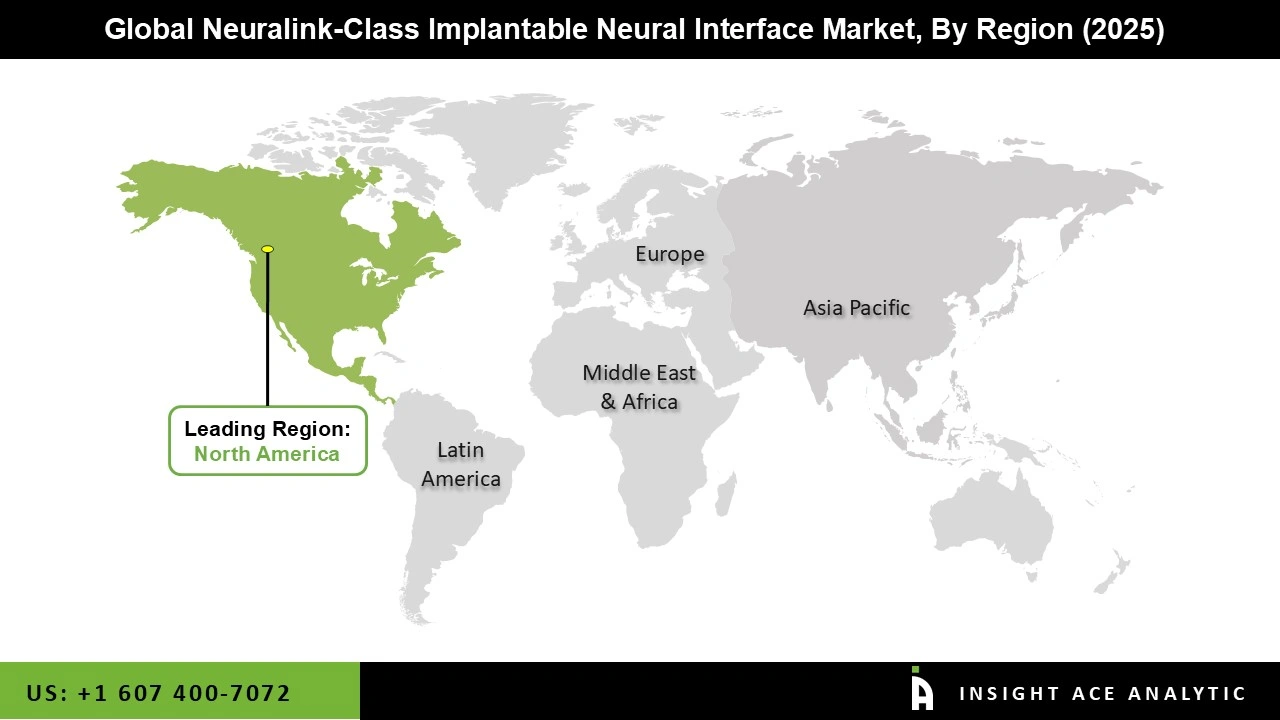
The Neuralink-Class Implantable Neural Interface market was dominated by North America region in 2025 because of the region's top brain-computer interface developers, great technological innovation, and substantial financing for neuroscience research. The region gains from a state-of-the-art healthcare system, a rise in the usage of neurotechnology solutions, and an increase in funding from both private businesses and government-funded research initiatives centered on neurological conditions and neuroprosthetics.
Additionally, the need for sophisticated implantable neural interfaces for therapeutic and restorative applications is growing because of the increasing incidence of paralysis, neurodegenerative illnesses, and spinal cord injuries.
Neuralink-Class Implantable Neural Interface Market Report Scope:
| Report Attribute | Specifications |
| Market size value in 2025 | USD 1.51 Bn |
| Revenue forecast in 2035 | USD 7.46 Bn |
| Growth Rate CAGR | CAGR of 17.5% from 2026 to 2035 |
| Quantitative Units | Representation of revenue in US$ Bn and CAGR from 2026 to 2035 |
| Historic Year | 2022 to 2025 |
| Forecast Year | 2026-2035 |
| Report Coverage | The forecast of revenue, the position of the company, the competitive market structure, growth prospects, and trends |
| Segments Covered | Type, Application, End-user, and By Region |
| Regional Scope | North America; Europe; Asia Pacific; Latin America; Middle East & Africa |
| Country Scope | U.S.; Canada; U.K.; Germany; China; India; Japan; Brazil; Mexico; The UK; France; Italy; Spain; China; Japan; India; South Korea; Southeast Asia; South Korea; Southeast Asia |
| Competitive Landscape | Neuralink, Precision Neuroscience, Synchron, Blackrock Neurotech, Science Corporation, and Paradromics. |
| Customization Scope | Free customization report with the procurement of the report, Modifications to the regional and segment scope. Geographic competitive landscape. |
| Pricing and Available Payment Methods | Explore pricing alternatives that are customized to your particular study requirements. |
Segmentations of Neuralink-Class Implantable Neural Interface Market:
Neuralink-Class Implantable Neural Interface Market, by Type-
- Partially Implanted
- Fully Implanted
- Electrocorticography (ECoG) Arrays
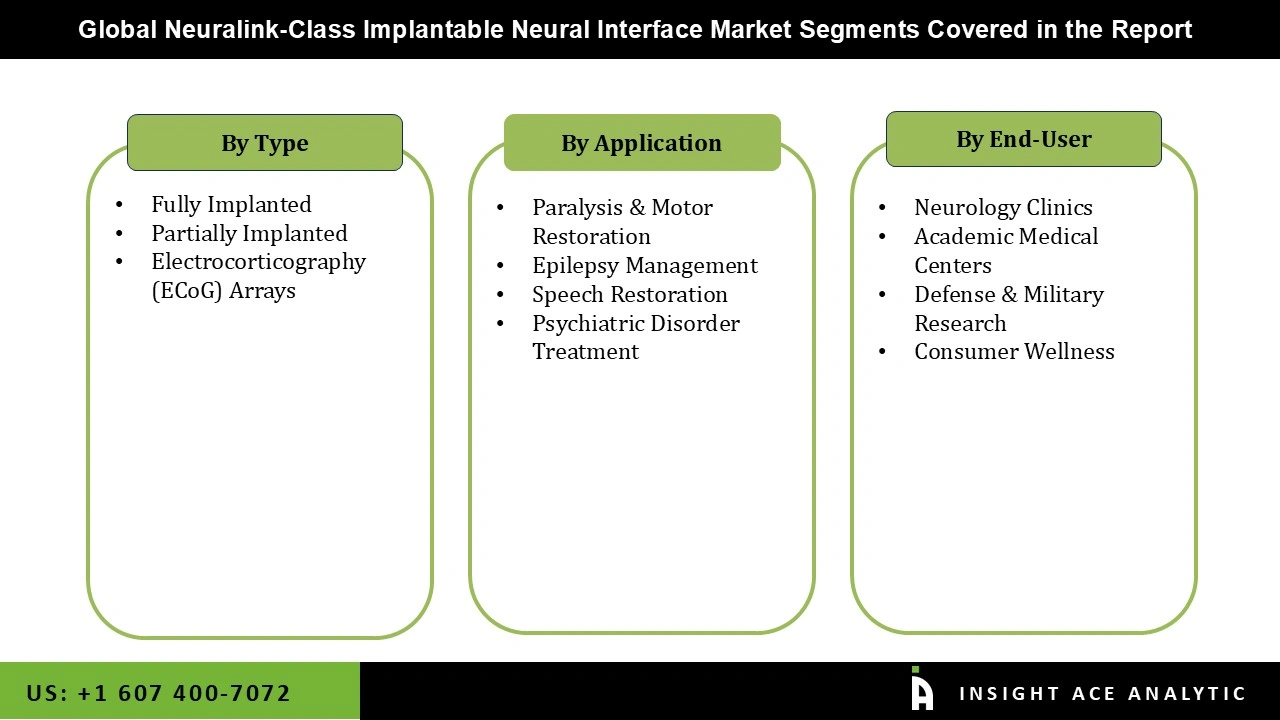
Neuralink-Class Implantable Neural Interface Market, by Application-
- Epilepsy Management
- Paralysis & Motor Restoration
- Psychiatric Disorder Treatment
- Speech Restoration
Neuralink-Class Implantable Neural Interface Market, by End-user-
- Neurology Clinics
- Defense & Military Research
- Academic Medical Centers
- Consumer Wellness
Neuralink-Class Implantable Neural Interface Market, by Region-
- North America-
- The US
- Canada
- Europe-
- Germany
- The UK
- France
- Italy
- Spain
- Rest of Europe
- Asia-Pacific-
- China
- Japan
- India
- South Korea
- South East Asia
- Rest of Asia Pacific
- Latin America-
- Brazil
- Argentina
- Mexico
- Rest of Latin America
- Middle East and Africa-
- GCC Countries
- South Africa
- Rest of Middle East and Africa
Research Design and Approach
This study employed a multi-step, mixed-method research approach that integrates:
- Secondary research
- Primary research
- Data triangulation
- Hybrid top-down and bottom-up modelling
- Forecasting and scenario analysis
This approach ensures a balanced and validated understanding of both macro- and micro-level market factors influencing the market.
Secondary Research
Secondary research for this study involved the collection, review, and analysis of publicly available and paid data sources to build the initial fact base, understand historical market behaviour, identify data gaps, and refine the hypotheses for primary research.
Sources Consulted
Secondary data for the market study was gathered from multiple credible sources, including:
- Government databases, regulatory bodies, and public institutions
- International organizations (WHO, OECD, IMF, World Bank, etc.)
- Commercial and paid databases
- Industry associations, trade publications, and technical journals
- Company annual reports, investor presentations, press releases, and SEC filings
- Academic research papers, patents, and scientific literature
- Previous market research publications and syndicated reports
These sources were used to compile historical data, market volumes/prices, industry trends, technological developments, and competitive insights.

Primary Research
Primary research was conducted to validate secondary data, understand real-time market dynamics, capture price points and adoption trends, and verify the assumptions used in the market modelling.
Stakeholders Interviewed
Primary interviews for this study involved:
- Manufacturers and suppliers in the market value chain
- Distributors, channel partners, and integrators
- End-users / customers (e.g., hospitals, labs, enterprises, consumers, etc., depending on the market)
- Industry experts, technology specialists, consultants, and regulatory professionals
- Senior executives (CEOs, CTOs, VPs, Directors) and product managers
Interview Process
Interviews were conducted via:
- Structured and semi-structured questionnaires
- Telephonic and video interactions
- Email correspondences
- Expert consultation sessions
Primary insights were incorporated into demand modelling, pricing analysis, technology evaluation, and market share estimation.
Data Processing, Normalization, and Validation
All collected data were processed and normalized to ensure consistency and comparability across regions and time frames.
The data validation process included:
- Standardization of units (currency conversions, volume units, inflation adjustments)
- Cross-verification of data points across multiple secondary sources
- Normalization of inconsistent datasets
- Identification and resolution of data gaps
- Outlier detection and removal through algorithmic and manual checks
- Plausibility and coherence checks across segments and geographies
This ensured that the dataset used for modelling was clean, robust, and reliable.
Market Size Estimation and Data Triangulation
Bottom-Up Approach
The bottom-up approach involved aggregating segment-level data, such as:
- Company revenues
- Product-level sales
- Installed base/usage volumes
- Adoption and penetration rates
- Pricing analysis
This method was primarily used when detailed micro-level market data were available.

Top-Down Approach
The top-down approach used macro-level indicators:
- Parent market benchmarks
- Global/regional industry trends
- Economic indicators (GDP, demographics, spending patterns)
- Penetration and usage ratios
This approach was used for segments where granular data were limited or inconsistent.
Hybrid Triangulation Approach
To ensure accuracy, a triangulated hybrid model was used. This included:
- Reconciling top-down and bottom-up estimates
- Cross-checking revenues, volumes, and pricing assumptions
- Incorporating expert insights to validate segment splits and adoption rates
This multi-angle validation yielded the final market size.
Forecasting Framework and Scenario Modelling
Market forecasts were developed using a combination of time-series modelling, adoption curve analysis, and driver-based forecasting tools.
Forecasting Methods
- Time-series modelling
- S-curve and diffusion models (for emerging technologies)
- Driver-based forecasting (GDP, disposable income, adoption rates, regulatory changes)
- Price elasticity models
- Market maturity and lifecycle-based projections
Scenario Analysis
Given inherent uncertainties, three scenarios were constructed:
- Base-Case Scenario: Expected trajectory under current conditions
- Optimistic Scenario: High adoption, favourable regulation, strong economic tailwinds
- Conservative Scenario: Slow adoption, regulatory delays, economic constraints
Sensitivity testing was conducted on key variables, including pricing, demand elasticity, and regional adoption.
Request Customization
Add countries, segments, company profiles, or extend forecast — free 10% customization with purchase.
Customize This Report →Enquire Before Buying
Speak with our analyst team about scope, methodology, pricing, or deliverable formats.
Enquire Now →Frequently Asked Questions
Neuralink-Class Implantable Neural Interface Market Size is valued at USD 1.51 Bn in 2025 and is predicted to reach USD 7.46 Bn by the year 2035
Neuralink-Class Implantable Neural Interface Market is expected to grow at a 17.5% CAGR during the forecast period for 2026 to 2035
Neuralink, Precision Neuroscience, Synchron, Blackrock Neurotech, Science Corporation, and Paradromics. and Others.
Neuralink-Class Implantable Neural Interface Market is segmented into Type, Application, End-user, and other
North America region is leading the Neuralink-Class Implantable Neural Interface Market.