AI Virtual Companions Market Size, Share, Revenue Report 2026 to 2035
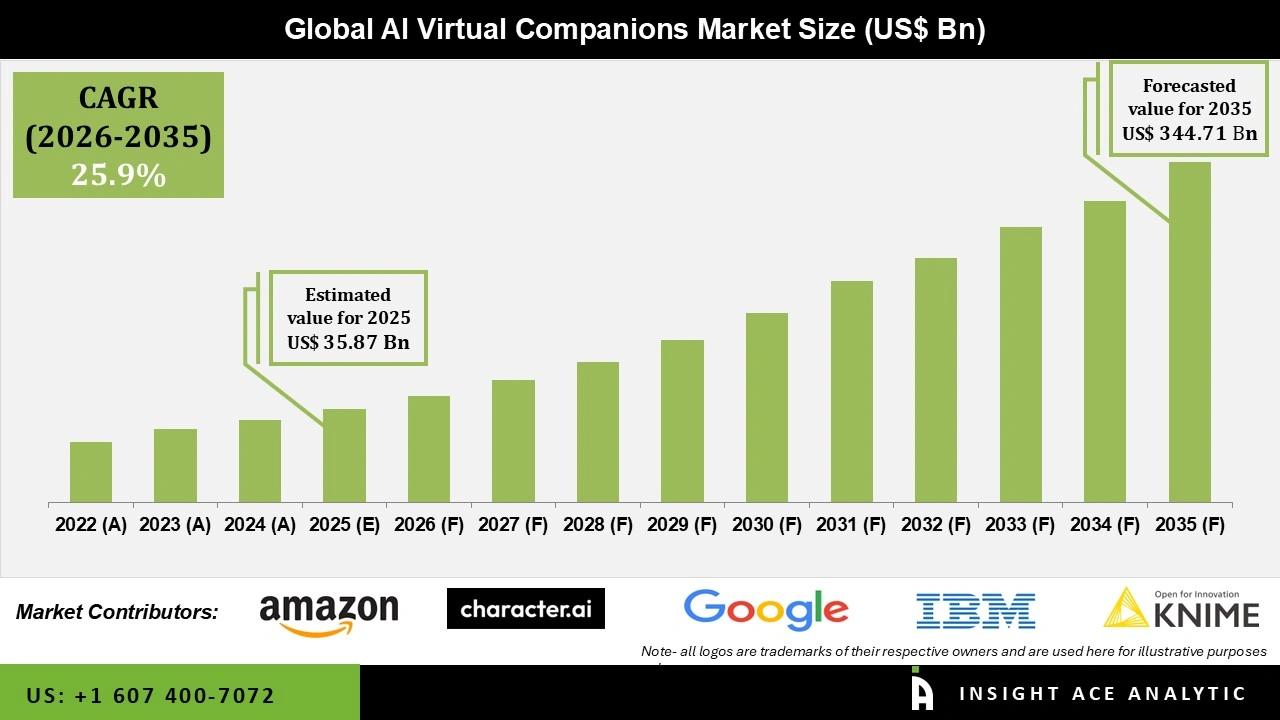
Global AI Virtual Companions Market Size is valued at USD 35.87 Bn in 2025 and is predicted to reach USD 344.71 Bn by the year 2035 at a 25.9% CAGR during the forecast period for 2026 to 2035.
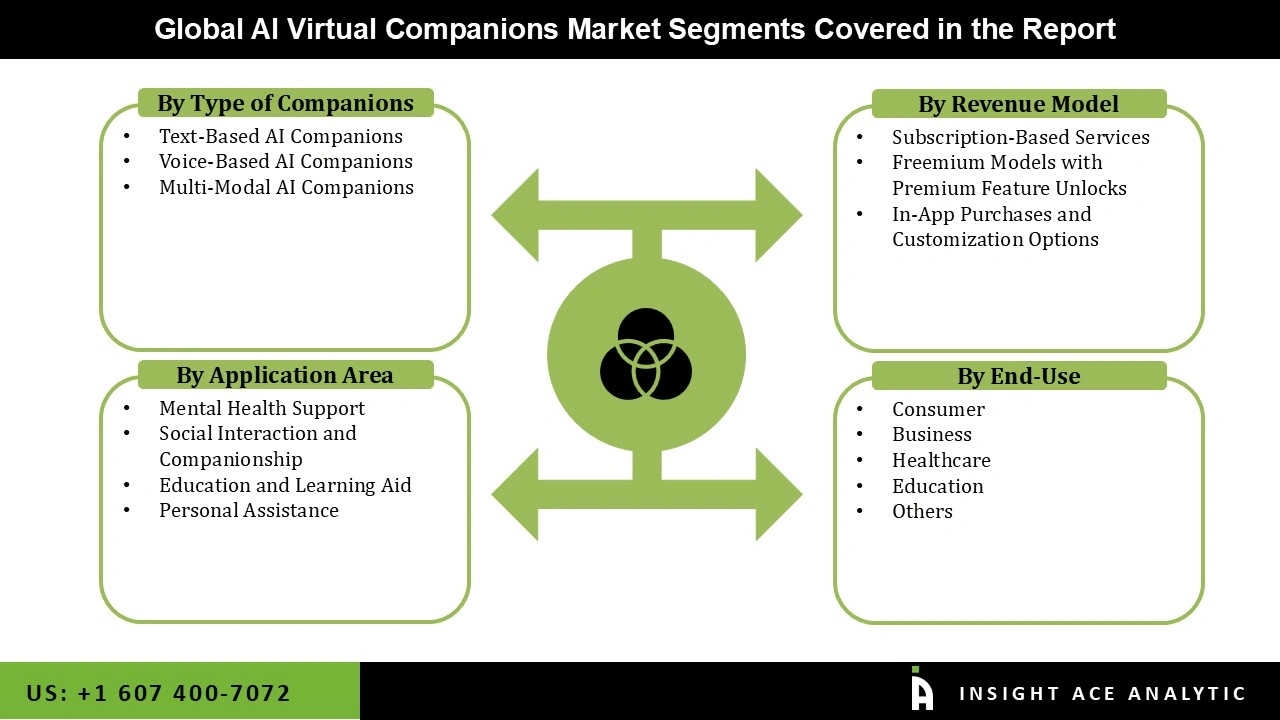
AI Virtual Companions Market Size, Share & Trends Analysis Distribution by Companion Type (Text-Based AI Companions, Multi-Modal AI Companions, and Voice-Based AI Companions), Revenue Model (Subscription-Based Services, In-App Purchases and Customization Options, and Freemium Models with Premium Feature Unlocks), Application (Education and Learning Aid, Mental Health Support, Social Interaction and Companionship, Personal Assistance), End-user (Education, Consumer, Healthcare, Business, and Others), and Segment Forecasts, 2026 to 2035
A software-based assistant driven by artificial intelligence that communicates with people by text, speech, or chat to offer companionship, support, and emotional support is known as an AI virtual companion. Natural language processing, machine learning, and data analytics are some of the technologies these companions utilize to comprehend user input and provide tailored, human-like responses. AI virtual companions are frequently included in digital platforms, smart devices, and mobile apps to assist users in managing everyday duties, providing entertainment, reminders, and meaningful interactions. Since AI technologies, including AI companions, can help with mental health concerns and loneliness, the virtual companions market is becoming a prominent area of AI technology.
The AI virtual companion market is being greatly influenced by the growing acceptability of AI companions in both the consumer and business sectors. This trend is mostly caused by organizations looking to improve customer engagement and operational efficiency, as well as changing consumer tastes for individualized and effective solutions in everyday chores. Additionally, a key factor propelling the AI virtual companion market's growth is the company's entry into vital industries, including productivity, healthcare, and education. AI virtual companions are being used in the healthcare industry for patient monitoring and individualized care. Similarly, educational establishments are using AI partners to offer customized learning experiences that improve student performance and engagement.
The increasing need for personalized digital experiences, the rapid advancement of AI technology, and the widespread use of digital platforms and smart devices are driving the demand for AI virtual companions market. The market is expanding quickly due to the demand for scalable customer support solutions, continuous user interaction, and rising awareness of mental wellness. Additionally, advancements in machine learning, natural language processing, and emotional identification improve the quality of interactions, boosting consumer acceptability and trust. Furthermore, the technological developments in artificial intelligence, which enable these apps to become more responsive, emotionally sophisticated, and capable of managing more complex tasks, are driving the market. However, the risks to data privacy, ethical conundrums, ambiguous laws, costly development, and low customer confidence are all impeding the virtual companions market expansion.
Competitive Landscape
Which are the Leading Players in AI Virtual Companions Market?
- OpenAI
- Amazon
- Luka
- Nomi AI
- Character AI
- Soul Machines
- International Business Machines
- KNIME
- Zoom Video Communications
Market Dynamics
Driver
Growing Prevalence of Mental Health Issues
The AI virtual companions are anticipated to expand in the future due to the rising incidence of mental health issues. Growing social isolation exacerbates stress and loneliness, compromising emotional well-being and perhaps causing or exacerbating mental health diseases, which is why mental health conditions are on the rise. By providing real-time conversations, emotional recognition, and customized coping mechanisms, artificial intelligence (AI) virtual companions support mental health by assisting users in managing stress, anxiety, and mood swings through ongoing, nonjudgmental support, improving emotional well-being, and early intervention. For instance, in May 2024, approximately 43% of individuals reported feeling more nervous, up from 37% in 2023 and 32% in 2022, according to the American Psychiatric Association, a US-based professional organization of psychologists. This indicates a consistent increase in anxiety levels. Therefore, the expansion of the AI virtual companions market is being driven by the rising prevalence of mental health issues.
Restrain/Challenge
Growing Concerns About Data Privacy
The AI virtual companions market is severely constrained by growing consumer and governmental worries about data protection. The potential consumers are reluctant to embrace AI virtual companions that demand a lot of personal data due to growing knowledge of data breaches and abuse. Companies must make significant investments in data protection measures due to the General Data Protection Regulation (GDPR) of the European Union, which is an example of strict compliance requirements. According to a survey conducted by the International Association of Privacy Professionals (IAPP), for instance, 75% of consumers are reluctant to provide personal information to AI services unless they are guaranteed strong privacy protections. In addition to slowing adoption rates, this reluctance diverts resources from innovation and market expansion by requiring both new and incumbent businesses to negotiate complicated legal environments.
Text-Based AI Companions Segment is Expected to Drive the AI Virtual Companions Market
The text-based AI companions category held the largest share in the AI Virtual Companions market in 2025. Increased smartphone use and mobile internet usage have broadened the reach of these AI companions, enabling round-the-clock interaction. The use of text-based AI virtual companions has also been aided by governments and groups that promote mental health awareness because they provide instantaneous, anonymous support to anyone experiencing emotional discomfort. The text-based AI virtual companion market is anticipated to see ongoing acceptance across a variety of applications, including education, entertainment, and workplace productivity tools, as AI models continue to advance with deeper learning, contextual understanding, and multilingual capabilities. Additionally, text-based AI assistants are becoming indispensable for companies and individuals looking to increase productivity through task management and summaries. They also assist by providing answers to inquiries and optimizing processes.
Consumer Segment is Growing at the Highest Rate in the AI Virtual Companions Market
In 2025, the consumer category dominated the AI Virtual Companions market. AI virtual companions that can smoothly handle interactions in both digital and real places are necessary due to the growth of remote and hybrid work environments. By simplifying job management and communication in a variety of work environments, these partners increase adaptability and productivity. Additionally, businesses are increasingly integrating AI companions into their current workflows in an effort to increase productivity. These companions use data from emails, meetings, and papers to provide individualized support. For instance, Zoom Communications, Inc. introduced the AI-powered Zoom Workplace platform in March 2024, incorporating AI companions to improve productivity and collaboration by collecting, combining, and sharing data from team conversations, papers, and meetings.
Why North America Led the AI Virtual Companions Market?
The AI Virtual Companions market was dominated by North America region in 2025. The region's leadership in AI innovation and high rates of consumer acceptance, which have created a strong ecosystem for AI technology, are the main drivers of this dominance. The growing use of AI virtual companions in daily life is a reflection of consumers' aspirations for more individualized and effective solutions, which are bolstered by technological and operational developments.
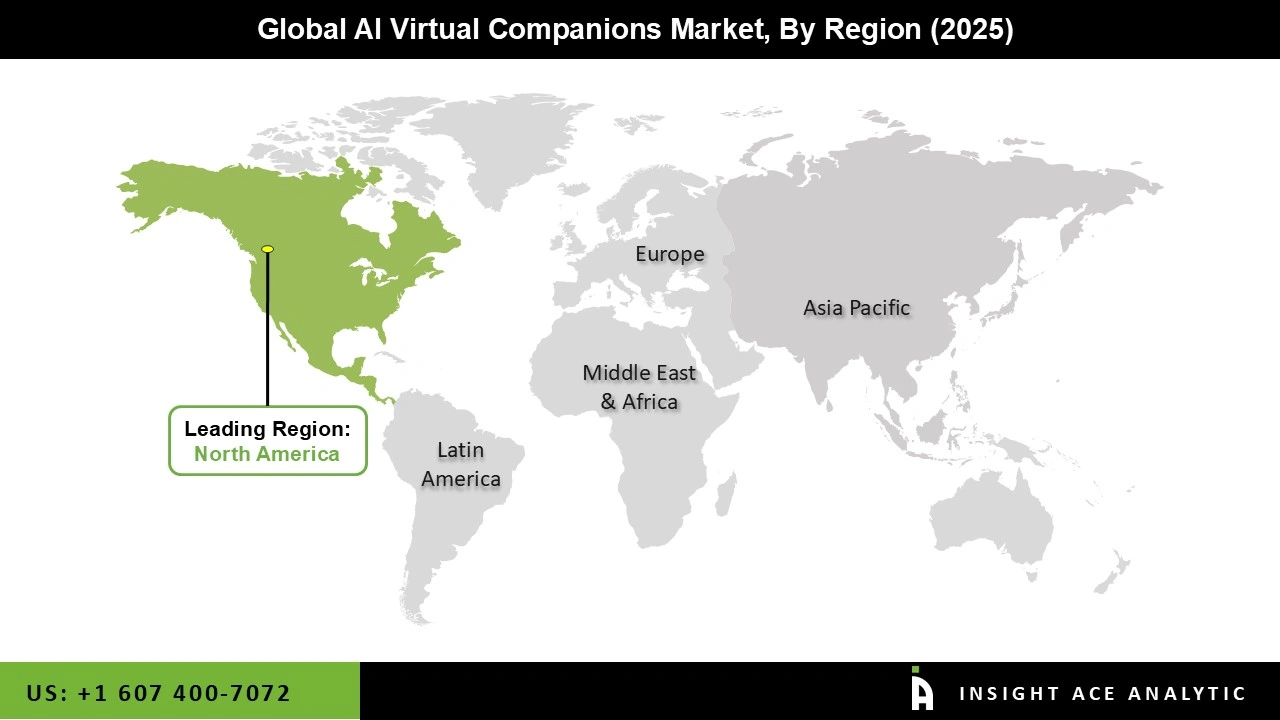
Notably, groups like the Consumer Technology Association have emphasized how AI-driven solutions are becoming more and more popular, highlighting the region's crucial role in determining the AI virtual companions market's future. Additionally, for investors and strategists hoping to profit from the changing landscape of AI companions, North America offers substantial prospects as digital transformation picks up speed.
Key developments
• November 2024: Google LLC introduced Learn About, an experimental AI learning companion that offers interactive, graphically rich content, quizzes, and more contextual information to support educational study. It seeks to provide a more thorough, individualized learning experience by sourcing data from reliable academic sites.
AI Virtual Companions Market Report Scope :
| Report Attribute | Specifications |
| Market size value in 2025 | USD 38.87 Bn |
| Revenue forecast in 2035 | USD 344.71 Bn |
| Growth Rate CAGR | CAGR of 25.9% from 2026 to 2035 |
| Quantitative Units | Representation of revenue in US$ Bn and CAGR from 2026 to 2035 |
| Historic Year | 2022 to 2025 |
| Forecast Year | 2026 to 2035 |
| Report Coverage | The forecast of revenue, the position of the company, the competitive market structure, growth prospects, and trends |
| Segments Covered | Companion Type, Revenue Model, Application, End-user, and By Region |
| Regional Scope | North America; Europe; Asia Pacific; Latin America; Middle East & Africa |
| Country Scope | U.S.; Canada; U.K.; Germany; China; India; Japan; Brazil; Mexico; The UK; France; Italy; Spain; China; Japan; India; South Korea; Southeast Asia; South Korea; Southeast Asia |
| Competitive Landscape | OpenAI, Amazon, Luka, Nomi AI, Character AI, Google, Soul Machines, International Business Machines, KNIME, and Zoom Video Communications |
| Customization Scope | Free customization report with the procurement of the report, Modifications to the regional and segment scope. Geographic competitive landscape. |
| Pricing and Available Payment Methods | Explore pricing alternatives that are customized to your particular study requirements. |
Segmentations of AI Virtual Companions Market:
AI Virtual Companions Market, by Companion Type-
- Text-Based AI Companions
- Multi-Modal AI Companions
- Voice-Based AI Companions
AI Virtual Companions Market, by Revenue Model-
- Subscription-Based Services
- In-App Purchases and Customization Options
- Freemium Models with Premium Feature Unlocks
AI Virtual Companions Market, by Application-
- Education and Learning Aid
- Mental Health Support
- Social Interaction and Companionship
- Personal Assistance
AI Virtual Companions Market, by End-user-
- Education
- Consumer
- Healthcare
- Business
- Others
AI Virtual Companions Market, By Region-
- North America-
- The US
- Canada
- Europe-
- Germany
- The UK
- France
- Italy
- Spain
- Rest of Europe
- Asia-Pacific-
- China
- Japan
- India
- South Korea
- South East Asia
- Rest of Asia Pacific
- Latin America-
- Brazil
- Argentina
- Mexico
- Rest of Latin America
- Middle East & Africa-
- GCC Countries
- South Africa
- Rest of Middle East and Africa
Research Design and Approach
This study employed a multi-step, mixed-method research approach that integrates:
- Secondary research
- Primary research
- Data triangulation
- Hybrid top-down and bottom-up modelling
- Forecasting and scenario analysis
This approach ensures a balanced and validated understanding of both macro- and micro-level market factors influencing the market.
Secondary Research
Secondary research for this study involved the collection, review, and analysis of publicly available and paid data sources to build the initial fact base, understand historical market behaviour, identify data gaps, and refine the hypotheses for primary research.
Sources Consulted
Secondary data for the market study was gathered from multiple credible sources, including:
- Government databases, regulatory bodies, and public institutions
- International organizations (WHO, OECD, IMF, World Bank, etc.)
- Commercial and paid databases
- Industry associations, trade publications, and technical journals
- Company annual reports, investor presentations, press releases, and SEC filings
- Academic research papers, patents, and scientific literature
- Previous market research publications and syndicated reports
These sources were used to compile historical data, market volumes/prices, industry trends, technological developments, and competitive insights.

Primary Research
Primary research was conducted to validate secondary data, understand real-time market dynamics, capture price points and adoption trends, and verify the assumptions used in the market modelling.
Stakeholders Interviewed
Primary interviews for this study involved:
- Manufacturers and suppliers in the market value chain
- Distributors, channel partners, and integrators
- End-users / customers (e.g., hospitals, labs, enterprises, consumers, etc., depending on the market)
- Industry experts, technology specialists, consultants, and regulatory professionals
- Senior executives (CEOs, CTOs, VPs, Directors) and product managers
Interview Process
Interviews were conducted via:
- Structured and semi-structured questionnaires
- Telephonic and video interactions
- Email correspondences
- Expert consultation sessions
Primary insights were incorporated into demand modelling, pricing analysis, technology evaluation, and market share estimation.
Data Processing, Normalization, and Validation
All collected data were processed and normalized to ensure consistency and comparability across regions and time frames.
The data validation process included:
- Standardization of units (currency conversions, volume units, inflation adjustments)
- Cross-verification of data points across multiple secondary sources
- Normalization of inconsistent datasets
- Identification and resolution of data gaps
- Outlier detection and removal through algorithmic and manual checks
- Plausibility and coherence checks across segments and geographies
This ensured that the dataset used for modelling was clean, robust, and reliable.
Market Size Estimation and Data Triangulation
Bottom-Up Approach
The bottom-up approach involved aggregating segment-level data, such as:
- Company revenues
- Product-level sales
- Installed base/usage volumes
- Adoption and penetration rates
- Pricing analysis
This method was primarily used when detailed micro-level market data were available.

Top-Down Approach
The top-down approach used macro-level indicators:
- Parent market benchmarks
- Global/regional industry trends
- Economic indicators (GDP, demographics, spending patterns)
- Penetration and usage ratios
This approach was used for segments where granular data were limited or inconsistent.
Hybrid Triangulation Approach
To ensure accuracy, a triangulated hybrid model was used. This included:
- Reconciling top-down and bottom-up estimates
- Cross-checking revenues, volumes, and pricing assumptions
- Incorporating expert insights to validate segment splits and adoption rates
This multi-angle validation yielded the final market size.
Forecasting Framework and Scenario Modelling
Market forecasts were developed using a combination of time-series modelling, adoption curve analysis, and driver-based forecasting tools.
Forecasting Methods
- Time-series modelling
- S-curve and diffusion models (for emerging technologies)
- Driver-based forecasting (GDP, disposable income, adoption rates, regulatory changes)
- Price elasticity models
- Market maturity and lifecycle-based projections
Scenario Analysis
Given inherent uncertainties, three scenarios were constructed:
- Base-Case Scenario: Expected trajectory under current conditions
- Optimistic Scenario: High adoption, favourable regulation, strong economic tailwinds
- Conservative Scenario: Slow adoption, regulatory delays, economic constraints
Sensitivity testing was conducted on key variables, including pricing, demand elasticity, and regional adoption.
Request Customization
Add countries, segments, company profiles, or extend forecast — free 10% customization with purchase.
Customize This Report →Enquire Before Buying
Speak with our analyst team about scope, methodology, pricing, or deliverable formats.
Enquire Now →Frequently Asked Questions
AI Virtual Companions Market Size is valued at USD 35.87 Bn in 2025 and is predicted to reach USD 344.71 Bn by the year 2035
The AI Virtual Companions Market is expected to grow at a 25.9% CAGR during the forecast period for 2026 to 2035
OpenAI, Amazon, Luka, Nomi AI, Character AI, Google, Soul Machines, International Business Machines, KNIME, Zoom Video Communications and Others.
AI Virtual Companions Market is segmented into Companion Type, Revenue Model, Application, End-user, and Other.
North America region is leading the AI Virtual Companions Market.