AI in Drones Market Size Expected to Reach USD 10,950.64 Million to 2035
What is AI in Drones Market Size?
Global AI in Drones Market Size is valued at USD 845.58 Mn in 2025 and is predicted to reach USD 10,950.64 Mn by the year 2035 at a 29.8% CAGR during the forecast period for 2026 to 2035.
AI in Drones Market Size, Share & Trends Analysis Distribution by Solution (Infrastructure, Services, and Software), Function (Ground Control & Fleet Management, Flight & Mission Operations, R&D & Model Optimization, Customer Experience & Service Interface, Maintenance, Diagnostics, and Asset Health, Revenue Optimization & Asset Utilization; Training, Simulation, and Human-machine Teaming), Technology (Computer Vision, Machine Learning, Sensor Fusion AI, Generative AI, and Natural Language Processing), End-user (Commercial, Military, and Government & Law Enforcement), and Segment Forecasts, 2026 to 2035
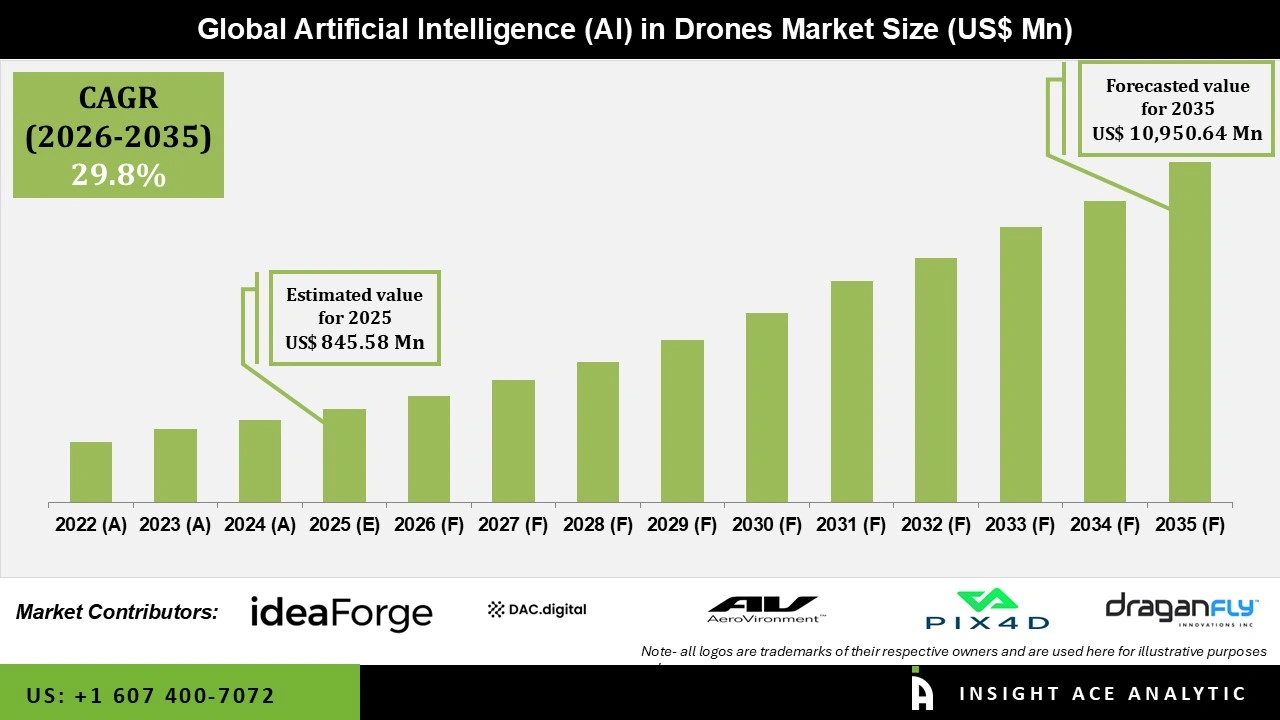
The "artificial intelligence" (AI) in drones refers to the incorporation of sophisticated algorithms and machine learning methods that allow drones to carry out tasks independently without continual human supervision. It can carry out increasingly difficult tasks on its own due to this integration, which greatly improves its skills and functionalities. It denotes the use of machine learning models, artificial intelligence algorithms, and associated technologies with drones. This makes it possible for drones to process data in real-time, make judgments on their own, adjust to changing circumstances, and carry out missions with little assistance from humans. The growing need for autonomous drone operations across a variety of industries, together with large investments in AI-driven analytics and data processing capabilities, are the main drivers of the AI in drones market's growth trajectory.
The growing use of drones in the international logistics and e-commerce industry is another important factor driving the expansion of AI in drone market. AI-powered drones have the potential to improve delivery process efficiency in the logistics and e-commerce industry. For instance, in October 2023, drone delivery options were introduced by Amazon, a global leader in the e-commerce industry, in several nations, including Italy and the UK. Additionally, the ongoing advancements in drone hardware and AI software are what propel the AI in drones market's expansion. Drone cargo capacity, flight time, and dependability have all increased because of advancements in lightweight materials, battery technology, and sensor integration. Furthermore, the spread of cloud computing and IoT devices has made it easier to process and transmit data, which has increased the use of AI in drone technology.
In addition, AI in drones contributes to the improvement of military capabilities and the efficiency of surveillance systems in the defense industry. Thus, the demand for AI in drone market is anticipated to rise dramatically due to the increasing worldwide military and defense spending. The construction sector is also driving up demand for progress tracking and site monitoring in the AI in drones market. However, obstacles including strict legal frameworks, worries about data security and privacy, and the high initial cost of advanced AI drone systems could limit the AI in drones market growth. Despite these obstacles, the AI in drones market is anticipated to have substantial potential, especially in developing nations that are using cutting-edge technologies to boost production and efficiency across industries.
Competitive Landscape
Which are the Leading Players in AI in Drones Market?
- DJI
- Skydio, Inc.
- Ideaforge Technology Ltd.
- Aerovironment, Inc.
- Shield Al
- Dac.Digital
- Draganfly Innovations Inc.
- PIX4D SA
- Dronedeploy
- Teledyne Flir Llc
- Asteria.Co.In.
- Volarious
- Precision AI Inc.
- Flypix Ai Gmbh
- Saiwa
- Brinc Drones Inc.
- Skyfire AI, Inc.
- Autel Robotics
- Hylio
- 3DSurvey
- Qualcomm Technologies, Inc.
- Percepto Ltd.
- ESRI
- Dedrone Holdings Inc.
- Honeywell International Inc.
Market Dynamics
Driver
Increase in Demand for Drones with Real-time Data Analytics and Autonomous Capabilities
The growing need for drones with autonomous capabilities and real-time data analytics is the main driver of the AI in drones market. AI-powered drones are being used in a variety of industries, including agriculture, defense, logistics, and energy, for everything from infrastructure surveillance and inspection to crop monitoring and precision agriculture. Additionally, drone systems have better object detection, obstacle avoidance, and data interpretation capabilities due to the use of machine learning, computer vision, and deep learning algorithms. Furthermore, AI-enabled drones are essential for complicated, large-scale operations since they have increased operational efficiency and decreased human interference and danger. The widespread use of IoT devices and cloud computing has also made it easier to transmit and process data, which has increased the uptake of AI in drone technology.
Restrain/Challenge
Stringent Regulatory and Legal Frameworks Imposed by Governments
The presence of stringent legal and regulatory frameworks enforced by governments worldwide is a significant barrier to AI in drone market. Authorities frequently impose limits on the use of drones, such as those pertaining to flight altitude, operational zones, and operator license requirements. Widespread adoption is further complicated by privacy, data security, and public safety concerns because drone misuse or unauthorized monitoring may have legal repercussions. Furthermore, manufacturers and service providers experience uncertainty due to frequent regulatory changes, which hinders investment and innovation. The entire development and scalability of AI-powered drone technologies are hampered by these legal obstacles, which raise compliance costs and postpone implementation, particularly in commercial areas such as delivery and urban mobility.
Software Segment is Expected to Drive the AI in Drones Market
The software category held the largest share in the AI in Drones market in 2025 fueled by advanced analytics features, automated data processing, increased productivity and accuracy, and improved data analysis and interpretation. The efficient processing of the vast amounts of data that drones gather, including images, videos, and sensor readings, depends on this AI-connected software. The amount of time and effort needed to handle data is greatly decreased by this integration. Additionally, it makes it possible to spot possible trends, unusual behaviors, and patterns in drone data, which helps people make better decisions. The drone industry's rapid adoption of AI is primarily responsible for this segment's growth. Furthermore, AI-powered drone software is also opening up new uses, such as delivery services, infrastructure inspection, and precision agriculture.
Flight & Mission Operations Segment is Growing at the Highest Rate in the AI in Drones Market
In 2025, the flight & mission operations category dominated the AI in Drones market. The core of AI-driven drone capabilities is flight and mission operations, which include swarm coordination, autonomous navigation, route optimization, and obstacle avoidance. AI makes it possible for drones to dynamically adapt in real time to changing settings, weather, or impediments, enabling safe and reliable mission completion. Additionally, the capacity to automate and optimize drone flight paths is essential for timely and cost-effective operations in sectors including e-commerce, defense, and disaster relief. While emergency response operators utilize drones for search and rescue or reconnaissance in hostile settings, delivery services use AI to reduce route times and improve logistical efficiency.
Why North America Led the AI in Drones Market?
The AI in Drones market was dominated by North America region in 2025 driven by the presence of top drone businesses, significant R&D spending, and a robust defense infrastructure. Furthermore, the growing use of drones creates a strong need for advanced propulsion systems, such as gas turbines, internal combustion engines, and electric and hybrid-electric propulsion units.
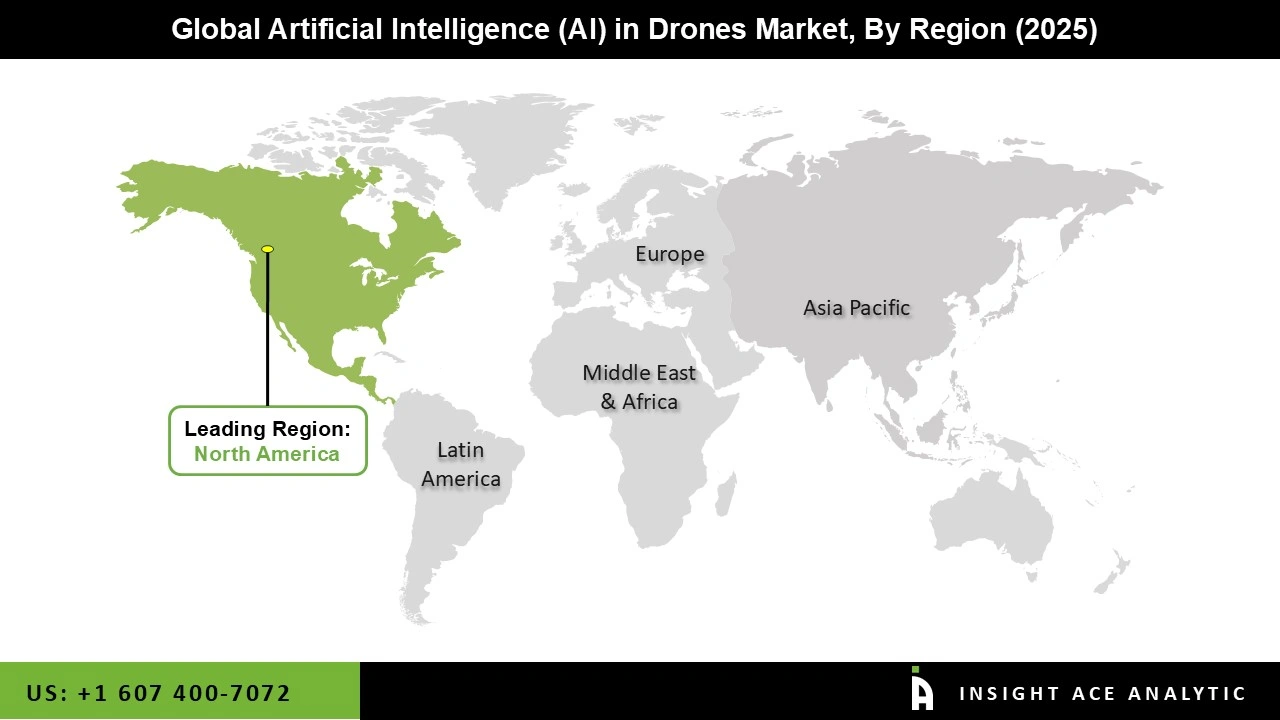
AI in drones is increasingly being used in the area for delivery services, agricultural, infrastructure inspection, and emergency services—all of which require dependable and effective propulsion systems. The FAA's supportive regulations and US and Canadian innovation clusters have created a robust ecosystem of drone startups and AI solution providers. Additionally, the region's focus on cybersecurity, R&D, and the production of AI chips speeds up drone adoption.
Key Development
June 2025: DroneDeploy, Inc. and Point One Navigation, a software business, collaborated to provide drone data with centimeter accuracy using Polaris RTK corrections. With more than 70,000 RTK-enabled flights, our partnership improves aerial mapping and 3D modeling accuracy, providing seamless, AI-powered reality capture and high-quality spatial data to sectors such as energy and construction.
AI in Drones Market Report Scope :
| Report Attribute | Specifications |
| Market size value in 2025 | USD 845.58 Mn |
| Revenue forecast in 2035 | USD 10,950.64 Mn |
| Growth Rate CAGR | CAGR of 29.8% from 2026 to 2035 |
| Quantitative Units | Representation of revenue in US$ Bn and CAGR from 2026 to 2035 |
| Historic Year | 2022 to 2025 |
| Forecast Year | 2026 to 2035 |
| Report Coverage | The forecast of revenue, the position of the company, the competitive market structure, growth prospects, and trends |
| Segments Covered | Solution, Function, Technology, End-user, and By Region |
| Regional Scope | North America; Europe; Asia Pacific; Latin America; Middle East & Africa |
| Country Scope | U.S.; Canada; U.K.; Germany; China; India; Japan; Brazil; Mexico; The UK; France; Italy; Spain; China; Japan; India; South Korea; Southeast Asia; South Korea; Southeast Asia |
| Competitive Landscape | DJI, Skydio, Inc., ideaForge Technology Ltd., AeroVironment, Inc., Shield AI, DAC.digital, Draganfly Innovations Inc., PIX4D SA, DroneDeploy, Teledyne FLIR LLC, Asteria Aerospace Co. Ltd., Volarious, Precision AI Inc., FlyPix AI GmbH, Saiwa, BRINC Drones Inc., Skyfire AI, Inc., Autel Robotics, Hylio, 3Dsurvey, Qualcomm Technologies, Inc., Percepto Ltd., Esri, Dedrone Holdings Inc., and Honeywell International Inc. |
| Customization Scope | Free customization report with the procurement of the report, Modifications to the regional and segment scope. Geographic competitive landscape. |
| Pricing and Available Payment Methods | Explore pricing alternatives that are customized to your particular study requirements. |
Segmentations of AI in Drones Market :
AI in Drones Market, By Solution-
- Infrastructure
- Services
- Core data services
- Integrated services
- Software
- AI development tools
- Software development kits (SDKs) and machine learning (ML) frameworks
- Vision-specific AI toolkits
- AI application platforms
- Onboard autonomy stacks
- Fleet/Cloud platforms
- AI development tools
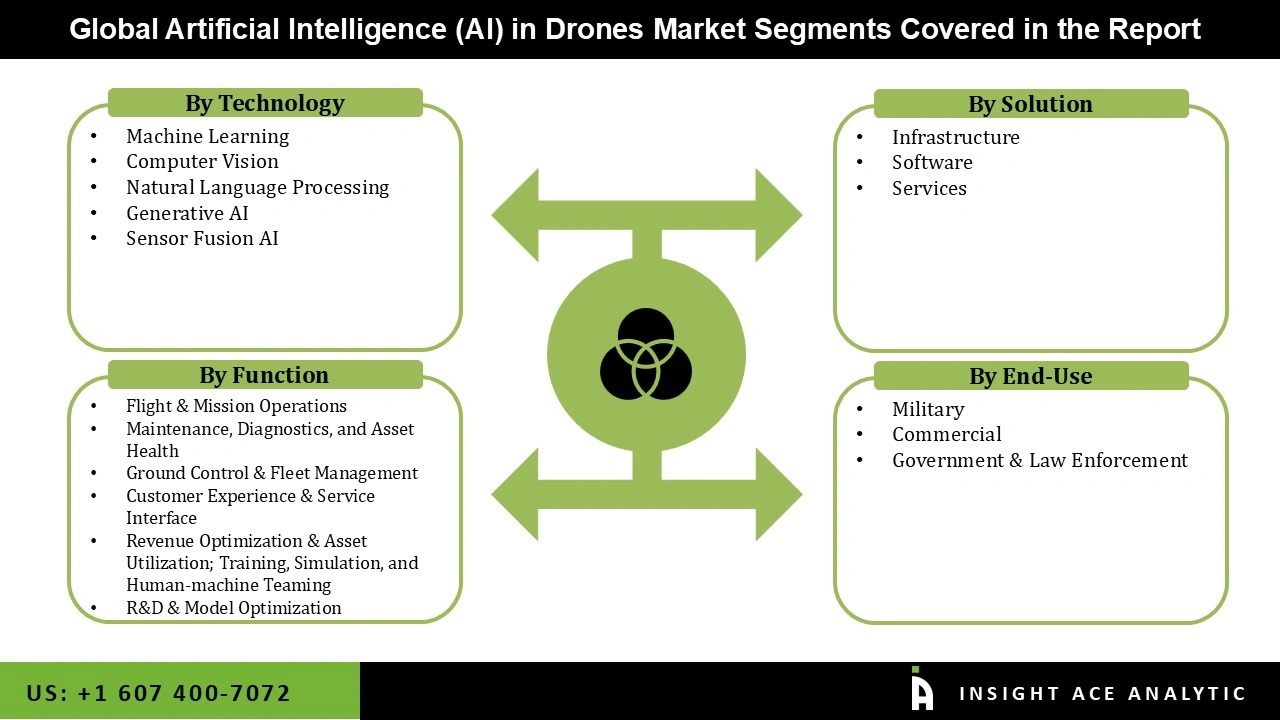
AI in Drones Market by Function-
- Ground Control & Fleet Management
- Flight & Mission Operations
- R&D & Model Optimization
- Customer Experience & Service Interface
- Maintenance, Diagnostics, and Asset Health
- Revenue Optimization & Asset Utilization; Training, Simulation, and Human-machine Teaming
AI in Drones Market, by Technology-
- Computer Vision
- Machine Learning
- Sensor Fusion AI
- Generative AI
- Natural Language Processing
AI in Drones Market, by End-user-
- Commercial
- Military
- Government & Law Enforcement
AI in Drones Market, by Region-
- North America-
- The US
- Canada
- Europe-
- Germany
- The UK
- France
- Italy
- Spain
- Rest of Europe
- Asia-Pacific-
- China
- Japan
- India
- South Korea
- South East Asia
- Rest of Asia Pacific
- Latin America-
- Brazil
- Argentina
- Mexico
- Rest of Latin America
- Middle East & Africa-
- GCC Countries
- South Africa
- Rest of Middle East and Africa
Research Design and Approach
This study employed a multi-step, mixed-method research approach that integrates:
- Secondary research
- Primary research
- Data triangulation
- Hybrid top-down and bottom-up modelling
- Forecasting and scenario analysis
This approach ensures a balanced and validated understanding of both macro- and micro-level market factors influencing the market.
Secondary Research
Secondary research for this study involved the collection, review, and analysis of publicly available and paid data sources to build the initial fact base, understand historical market behaviour, identify data gaps, and refine the hypotheses for primary research.
Sources Consulted
Secondary data for the market study was gathered from multiple credible sources, including:
- Government databases, regulatory bodies, and public institutions
- International organizations (WHO, OECD, IMF, World Bank, etc.)
- Commercial and paid databases
- Industry associations, trade publications, and technical journals
- Company annual reports, investor presentations, press releases, and SEC filings
- Academic research papers, patents, and scientific literature
- Previous market research publications and syndicated reports
These sources were used to compile historical data, market volumes/prices, industry trends, technological developments, and competitive insights.

Primary Research
Primary research was conducted to validate secondary data, understand real-time market dynamics, capture price points and adoption trends, and verify the assumptions used in the market modelling.
Stakeholders Interviewed
Primary interviews for this study involved:
- Manufacturers and suppliers in the market value chain
- Distributors, channel partners, and integrators
- End-users / customers (e.g., hospitals, labs, enterprises, consumers, etc., depending on the market)
- Industry experts, technology specialists, consultants, and regulatory professionals
- Senior executives (CEOs, CTOs, VPs, Directors) and product managers
Interview Process
Interviews were conducted via:
- Structured and semi-structured questionnaires
- Telephonic and video interactions
- Email correspondences
- Expert consultation sessions
Primary insights were incorporated into demand modelling, pricing analysis, technology evaluation, and market share estimation.
Data Processing, Normalization, and Validation
All collected data were processed and normalized to ensure consistency and comparability across regions and time frames.
The data validation process included:
- Standardization of units (currency conversions, volume units, inflation adjustments)
- Cross-verification of data points across multiple secondary sources
- Normalization of inconsistent datasets
- Identification and resolution of data gaps
- Outlier detection and removal through algorithmic and manual checks
- Plausibility and coherence checks across segments and geographies
This ensured that the dataset used for modelling was clean, robust, and reliable.
Market Size Estimation and Data Triangulation
Bottom-Up Approach
The bottom-up approach involved aggregating segment-level data, such as:
- Company revenues
- Product-level sales
- Installed base/usage volumes
- Adoption and penetration rates
- Pricing analysis
This method was primarily used when detailed micro-level market data were available.

Top-Down Approach
The top-down approach used macro-level indicators:
- Parent market benchmarks
- Global/regional industry trends
- Economic indicators (GDP, demographics, spending patterns)
- Penetration and usage ratios
This approach was used for segments where granular data were limited or inconsistent.
Hybrid Triangulation Approach
To ensure accuracy, a triangulated hybrid model was used. This included:
- Reconciling top-down and bottom-up estimates
- Cross-checking revenues, volumes, and pricing assumptions
- Incorporating expert insights to validate segment splits and adoption rates
This multi-angle validation yielded the final market size.
Forecasting Framework and Scenario Modelling
Market forecasts were developed using a combination of time-series modelling, adoption curve analysis, and driver-based forecasting tools.
Forecasting Methods
- Time-series modelling
- S-curve and diffusion models (for emerging technologies)
- Driver-based forecasting (GDP, disposable income, adoption rates, regulatory changes)
- Price elasticity models
- Market maturity and lifecycle-based projections
Scenario Analysis
Given inherent uncertainties, three scenarios were constructed:
- Base-Case Scenario: Expected trajectory under current conditions
- Optimistic Scenario: High adoption, favourable regulation, strong economic tailwinds
- Conservative Scenario: Slow adoption, regulatory delays, economic constraints
Sensitivity testing was conducted on key variables, including pricing, demand elasticity, and regional adoption.
Request Customization
Add countries, segments, company profiles, or extend forecast — free 10% customization with purchase.
Customize This Report →Enquire Before Buying
Speak with our analyst team about scope, methodology, pricing, or deliverable formats.
Enquire Now →Frequently Asked Questions
AI in Drones Market Size is valued at USD 845.58 Mn in 2025 and is predicted to reach USD 10,950.64 Mn by the year 2035
The AI in Drones Market is expected to grow at a 29.8% CAGR during the forecast period for 2026 to 2035
DJI, Skydio, Inc., ideaForge Technology Ltd., AeroVironment, Inc., Shield AI, DAC.digital, Draganfly Innovations Inc., PIX4D SA, DroneDeploy, Teledyne FLIR LLC, Asteria Aerospace Co. Ltd., Volarious, Precision AI Inc., FlyPix AI GmbH, Saiwa, BRINC Drones Inc., Skyfire AI, Inc., Autel Robotics, Hylio, 3Dsurvey, Qualcomm Technologies, Inc., Percepto Ltd., Esri, Dedrone Holdings Inc., Honeywell International Inc. and Other.
AI in Drones Market is segmeneted into Solution, Function, Technology, End-user, and Other
North America region is leading the AI in Drones Market