Mycelium-based Building Materials Market Size, Share, Scope Report 2026 to 2035
What is Mycelium-based Building Materials Market Size?
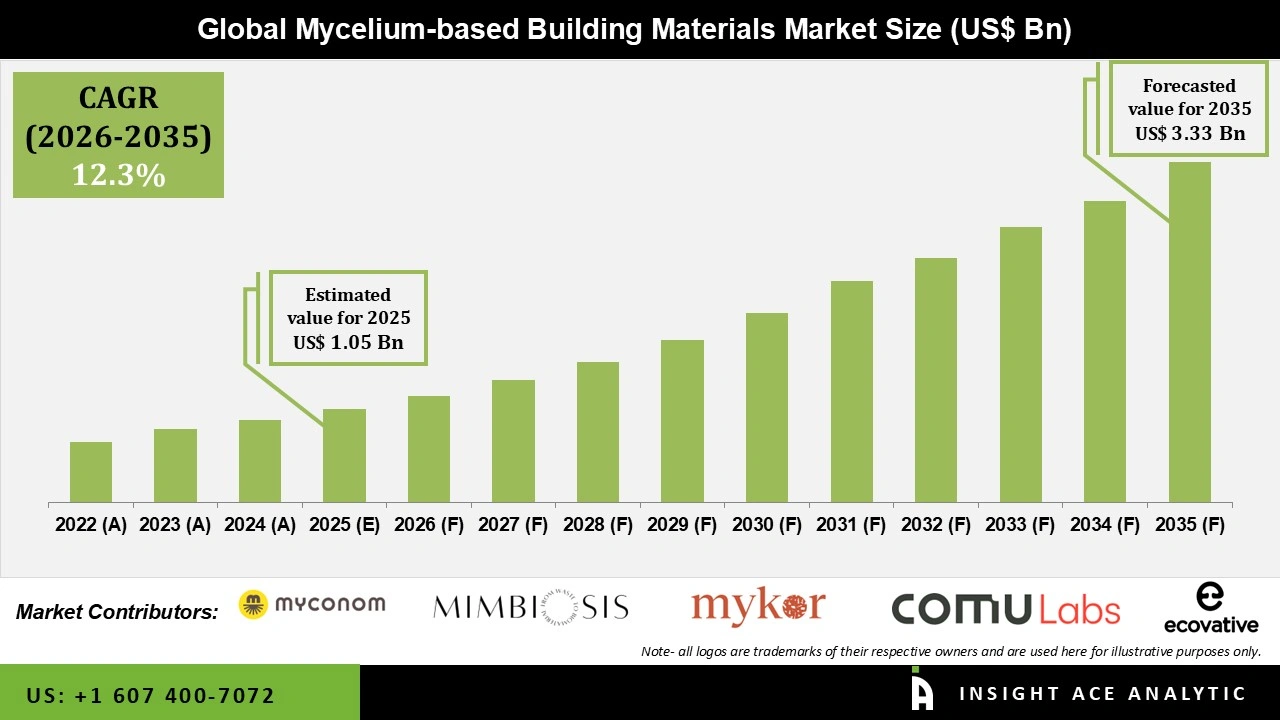
Global Mycelium-based Building Materials Market Size is valued at US$ 1.05 Bn in 2025 and is predicted to reach US$ 3.33 Bn by the year 2035 at an 12.3% CAGR during the forecast period for 2026 to 2035.
Mycelium-based Building Materials Market Size, Share & Trends Analysis Distribution by Product (Mycelium Insulation Panels, Mycelium Bricks & Blocks, Mycelium Acoustic Panels, Mycelium Composites, and Others), by Application (Walls & Partitions, Roofing & Insulation, Flooring & Underlayment, Acoustic & Aesthetic Applications, and Others), and Segment Forecasts, 2026 to 2035.
Mycelium-based building materials are becoming more and more popular, because they provide a combination of strength, light weight, and sustainability that traditional materials find difficult to match. They are used by builders for lightweight bricks, acoustic boards, insulation panels, and even interior design. Mycelium naturally resists fire, controls moisture, and offers exceptional thermal comfort since it develops into dense, foam-like structures. Because it can be molded into nearly any shape, designers find it handy for creating unique architectural items. Because they are produced from agricultural byproducts and safely degrade at the end of their lives, these materials not only improve performance but also lower waste and carbon emissions. The global market for Mycelium-based Building Materials is expanding due to the developers and builders are actively looking for low-carbon, biodegradable substitutes for conventional building material.
The advances in biology and material science is another element propelling the Mycelium-based Building Materials market. The Mycelium-based Building Materials market is expanding because of ongoing advancements in culture methods, composite composition, and fabrication techniques. Journal of Materials Chemistry A indicates the mycelium-coir composites have the lowest energy consumption of only 7.7 MJ/kg and using polystyrene nominal insulation, energy consumption is 83.5 MJ/kg. However, need of regulated conditions and constant feedstock quality to produce consistent results are some of the obstacles impeding the growth of the Mycelium-based Building Materials sector. Over the course of the forecast period, opportunities for the Mycelium-based Building Materials market will be created by innovation and strong research-driven development.
Competitive Landscape
Some of the Key Players in Mycelium-based Building Materials Market:
- Myconom Bio Materials
- MIMBIOSIS
- Mykor
- Mogu Srl
- Ecovative LLC
- MycoFoundry (Canada)
- COMU Labs Inc.
- MycoWorks Inc.
- Ecovative LLC
- MycoTile
- Mycela
- Mycelia NV
- Bolt Threads Inc.
- Biomyc
- MycoTechnology
- Nature’s Fynd
Market Segmentation:
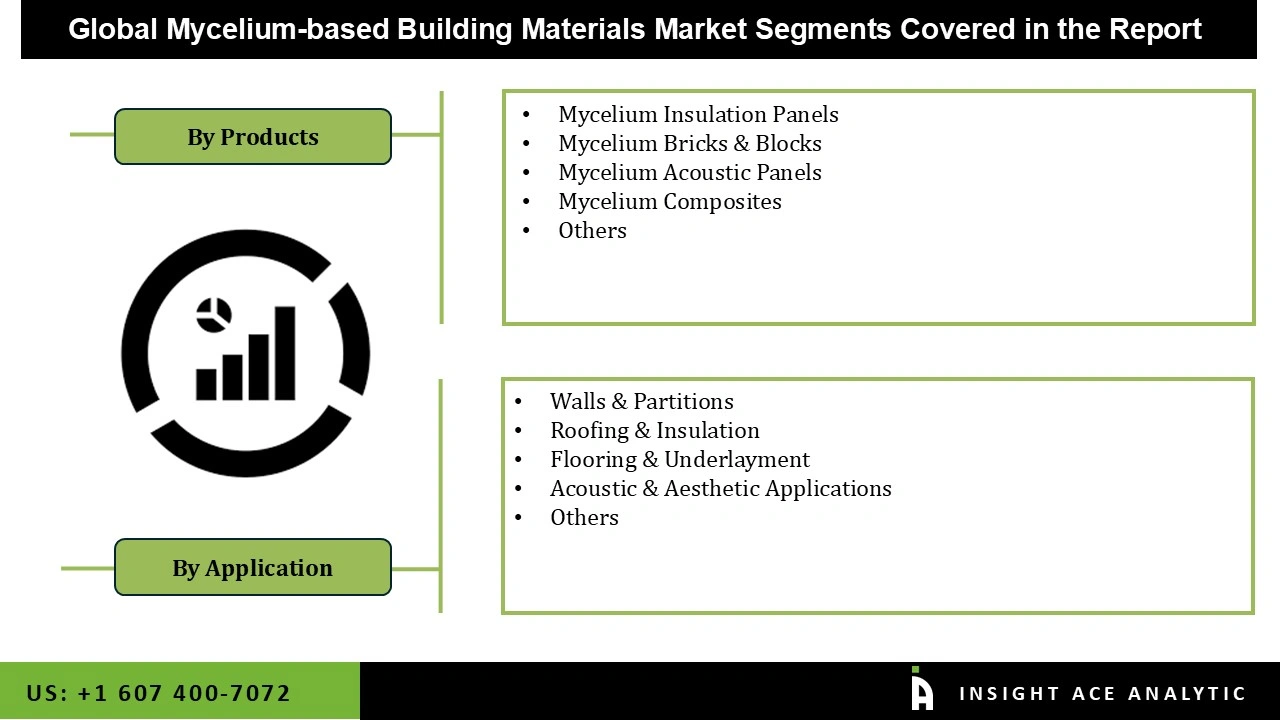
The mycelium-based building materials market is segmented by product and application. By product, the market is segmented into mycelium insulation panels, mycelium bricks & blocks, mycelium acoustic panels, mycelium composites, and others. By application, the market is segmented into walls & partitions, roofing & insulation, flooring & underlayment, acoustic & aesthetic applications, and others.
By Product, the Mycelium Insulation Panels Segment is Expected to Drive the Mycelium-based Building Materials Market
The mycelium insulation panels segment led the mycelium-based building materials market in 2025. This convergence is because these panels provide a useful, in-demand application where mycelium's inherent capabilities stand out. These requirements are satisfied by mycelium panels, which are lightweight, compostable, and reasonably priced when production expands. Projects aiming for low-carbon construction are also drawn to their capacity to be grown utilizing agricultural waste. Insulation is one of the first areas where sustainable materials are being used as green construction regulations tighten globally.
Roofing & Insulation Segment is Growing at the Highest Rate in the Mycelium-based Building Materials Market
Roofing and insulation represent the largest and fastest-growing application segment in the Mycelium-based Building Materials Market. Growth is primarily driven by increasing pressure on builders and developers to reduce building energy consumption and comply with stricter green-building standards. Mycelium offers natural thermal insulation, effective moisture regulation, and inherent fire-resistant properties, making it a promising alternative to conventional synthetic insulation materials. Its lightweight structure and ability to be molded into panels and customized forms also support easier handling and integration into existing construction practices, which can accelerate adoption. Demand is further strengthened by the construction industry’s growing preference for low-carbon and circular materials. As mycelium can be cultivated using agricultural waste with relatively low energy requirements, it has a substantially lower environmental impact than many petroleum-based insulation products. These performance and sustainability advantages are expected to position roofing and insulation as the leading application area throughout the forecast period.
Regionally, Asia Pacific Led the Mycelium-based Building Materials Market
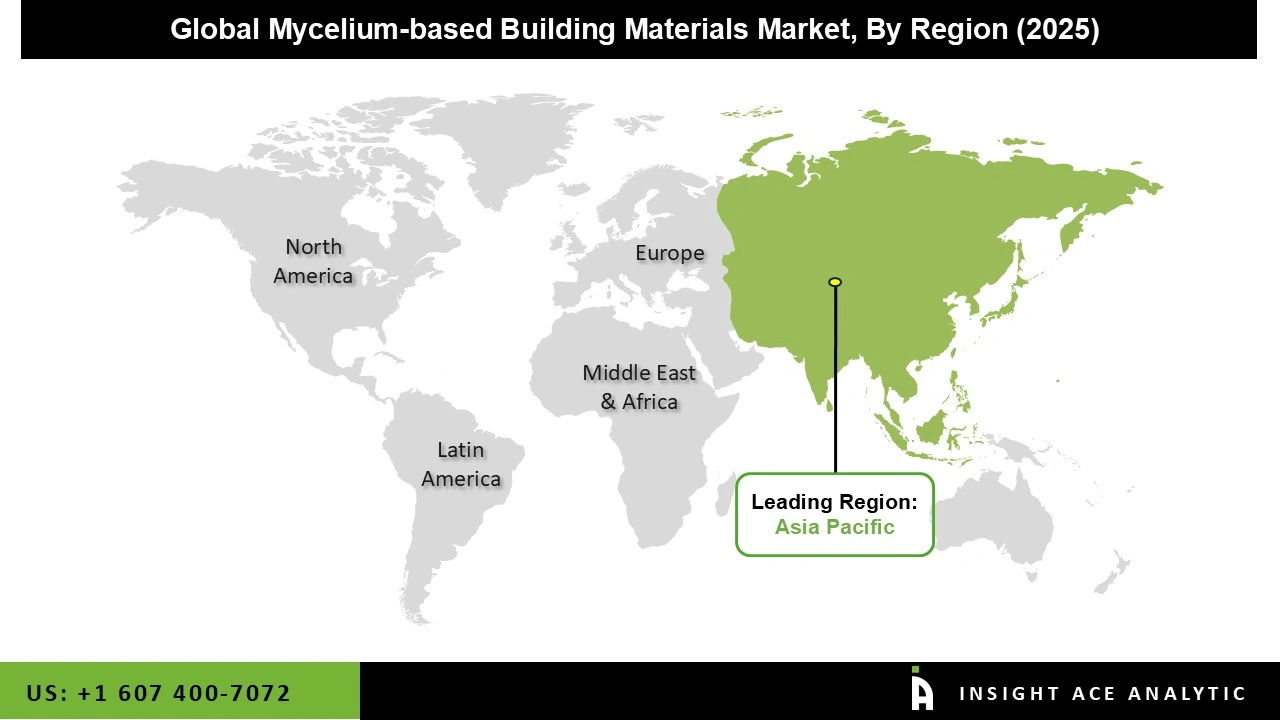
Asia Pacific dominated the mycelium-based building materials market in 2025. The United States is at the forefront of this expansion. This is due to the Fast urbanization and growing environmental concerns about traditional building materials infrastructure. In areas that prioritize low-energy and climate-resilient building, mycelium-based materials are becoming more popular as reasonably priced, renewable substitutes for plastics and concrete. Local production capacities are being improved by ongoing developments in biotechnology and material science throughout Asia. n countries in the region such as Australia, South Korea, and Japan, government-led green building initiatives are spurring increased investments in sustainable housing and infrastructure.
With European Union's goal of reaching net-zero emissions by 2050 and progressive environmental laws becoming more and more common in the Europe, the Mycelium-based Building Materials market is expanding at the strongest and fastest rate in this region. Additionally, With large R&D expenditures on mycelium-based materials, nations like the Netherlands, Denmark, and the UK are at the forefront of bio-based construction innovation. Large-scale applications and commercialization are being accelerated by supportive financing initiatives under Horizon Europe and the European Green Deal. Adoption is also supported by the robust presence of eco-conscious consumers and sustainable architecture movements .
Mycelium-based Building Materials Market Report Scope:
| Report Attribute | Specifications |
| Market Size Value In 2025 | USD 1.05 Bn |
| Revenue Forecast In 2035 | USD 3.33 Bn |
| Growth Rate CAGR | CAGR of 12.3% from 2026 to 2035 |
| Quantitative Units | Representation of revenue in US$ Bn and CAGR from 2026 to 2035 |
| Historic Year | 2022 to 2025 |
| Forecast Year | 2026-2035 |
| Report Coverage | The forecast of revenue, the position of the company, the competitive market structure, growth prospects, and trends |
| Segments Covered | By Product, By Application, and By Region |
| Regional Scope | North America; Europe; Asia Pacific; Latin America; Middle East & Africa |
| Country Scope | U.S.; Canada; Germany; The UK; France; Italy; Spain; Rest of Europe; China; Japan; India; South Korea; Southeast Asia; Rest of Asia Pacific; Brazil; Argentina; Mexico; Rest of Latin America; GCC Countries; South Africa; Rest of the Middle East and Africa |
| Competitive Landscape | Myconom Bio Materials, MIMBIOSIS, Mykor, Mogu Srl, Ecovative LLC, MycoFoundry (Canada), COMU Labs Inc., MycoWorks Inc., Ecovative LLC, MycoTile, Mycela, Mycelia NV, Bolt Threads Inc., Biomyc, MycoTechnology, and Nature’s Fynd |
| Customization Scope | Free customization report with the procurement of the report, Modifications to the regional and segment scope. Geographic competitive landscape. |
| Pricing and Available Payment Methods | Explore pricing alternatives that are customized to your particular study requirements. |
Segmentation of Mycelium-based Building Materials Market -
Mycelium-based Building Materials Market by Product-
- Mycelium Insulation Panels
- Mycelium Bricks & Blocks
- Mycelium Acoustic Panels
- Mycelium Composites
- Others
Mycelium-based Building Materials Market by Application-
- Walls & Partitions
- Roofing & Insulation
- Flooring & Underlayment
- Acoustic & Aesthetic Applications
- Others
Mycelium-based Building Materials Market by Region-
- North America-
- The US
- Canada
- Europe-
- Germany
- The UK
- France
- Italy
- Spain
- Rest of Europe
- Asia-Pacific-
- China
- Japan
- India
- South Korea
- South East Asia
- Rest of Asia Pacific
- Latin America-
- Brazil
- Argentina
- Mexico
- Rest of Latin America
- Middle East and Africa-
- GCC Countries
- South Africa
- Rest of Middle East and Africa
Research Design and Approach
This study employed a multi-step, mixed-method research approach that integrates:
- Secondary research
- Primary research
- Data triangulation
- Hybrid top-down and bottom-up modelling
- Forecasting and scenario analysis
This approach ensures a balanced and validated understanding of both macro- and micro-level market factors influencing the market.
Secondary Research
Secondary research for this study involved the collection, review, and analysis of publicly available and paid data sources to build the initial fact base, understand historical market behaviour, identify data gaps, and refine the hypotheses for primary research.
Sources Consulted
Secondary data for the market study was gathered from multiple credible sources, including:
- Government databases, regulatory bodies, and public institutions
- International organizations (WHO, OECD, IMF, World Bank, etc.)
- Commercial and paid databases
- Industry associations, trade publications, and technical journals
- Company annual reports, investor presentations, press releases, and SEC filings
- Academic research papers, patents, and scientific literature
- Previous market research publications and syndicated reports
These sources were used to compile historical data, market volumes/prices, industry trends, technological developments, and competitive insights.

Primary Research
Primary research was conducted to validate secondary data, understand real-time market dynamics, capture price points and adoption trends, and verify the assumptions used in the market modelling.
Stakeholders Interviewed
Primary interviews for this study involved:
- Manufacturers and suppliers in the market value chain
- Distributors, channel partners, and integrators
- End-users / customers (e.g., hospitals, labs, enterprises, consumers, etc., depending on the market)
- Industry experts, technology specialists, consultants, and regulatory professionals
- Senior executives (CEOs, CTOs, VPs, Directors) and product managers
Interview Process
Interviews were conducted via:
- Structured and semi-structured questionnaires
- Telephonic and video interactions
- Email correspondences
- Expert consultation sessions
Primary insights were incorporated into demand modelling, pricing analysis, technology evaluation, and market share estimation.
Data Processing, Normalization, and Validation
All collected data were processed and normalized to ensure consistency and comparability across regions and time frames.
The data validation process included:
- Standardization of units (currency conversions, volume units, inflation adjustments)
- Cross-verification of data points across multiple secondary sources
- Normalization of inconsistent datasets
- Identification and resolution of data gaps
- Outlier detection and removal through algorithmic and manual checks
- Plausibility and coherence checks across segments and geographies
This ensured that the dataset used for modelling was clean, robust, and reliable.
Market Size Estimation and Data Triangulation
Bottom-Up Approach
The bottom-up approach involved aggregating segment-level data, such as:
- Company revenues
- Product-level sales
- Installed base/usage volumes
- Adoption and penetration rates
- Pricing analysis
This method was primarily used when detailed micro-level market data were available.

Top-Down Approach
The top-down approach used macro-level indicators:
- Parent market benchmarks
- Global/regional industry trends
- Economic indicators (GDP, demographics, spending patterns)
- Penetration and usage ratios
This approach was used for segments where granular data were limited or inconsistent.
Hybrid Triangulation Approach
To ensure accuracy, a triangulated hybrid model was used. This included:
- Reconciling top-down and bottom-up estimates
- Cross-checking revenues, volumes, and pricing assumptions
- Incorporating expert insights to validate segment splits and adoption rates
This multi-angle validation yielded the final market size.
Forecasting Framework and Scenario Modelling
Market forecasts were developed using a combination of time-series modelling, adoption curve analysis, and driver-based forecasting tools.
Forecasting Methods
- Time-series modelling
- S-curve and diffusion models (for emerging technologies)
- Driver-based forecasting (GDP, disposable income, adoption rates, regulatory changes)
- Price elasticity models
- Market maturity and lifecycle-based projections
Scenario Analysis
Given inherent uncertainties, three scenarios were constructed:
- Base-Case Scenario: Expected trajectory under current conditions
- Optimistic Scenario: High adoption, favourable regulation, strong economic tailwinds
- Conservative Scenario: Slow adoption, regulatory delays, economic constraints
Sensitivity testing was conducted on key variables, including pricing, demand elasticity, and regional adoption.
Request Customization
Add countries, segments, company profiles, or extend forecast — free 10% customization with purchase.
Customize This Report →Enquire Before Buying
Speak with our analyst team about scope, methodology, pricing, or deliverable formats.
Enquire Now →Frequently Asked Questions
Mycelium-based Building Materials Market Size is valued at US$ 1.05 Bn in 2025 and is predicted to reach US$ 3.33 Bn by the year 2035
The Mycelium-based Building Materials Market is expected to grow at a 12.3% CAGR during the forecast period for 2026 to 2035
Myconom Bio Materials, MIMBIOSIS, Mykor, Mogu Srl, Ecovative LLC, MycoFoundry (Canada), COMU Labs Inc., MycoWorks Inc., Ecovative LLC, MycoTile, Mycela, Mycelia NV, Bolt Threads Inc., Biomyc, MycoTechnology, Nature’s Fynd and Others.
Mycelium-based Building Materials Market is segmented into Product, Application, and Others.
Asia Pacific region is leading the Mycelium-based Building Materials Market.