Micronutrients Fertilizers Market Report with Forecast 2026 to 2035
What is Micronutrients Fertilizers Market Size?
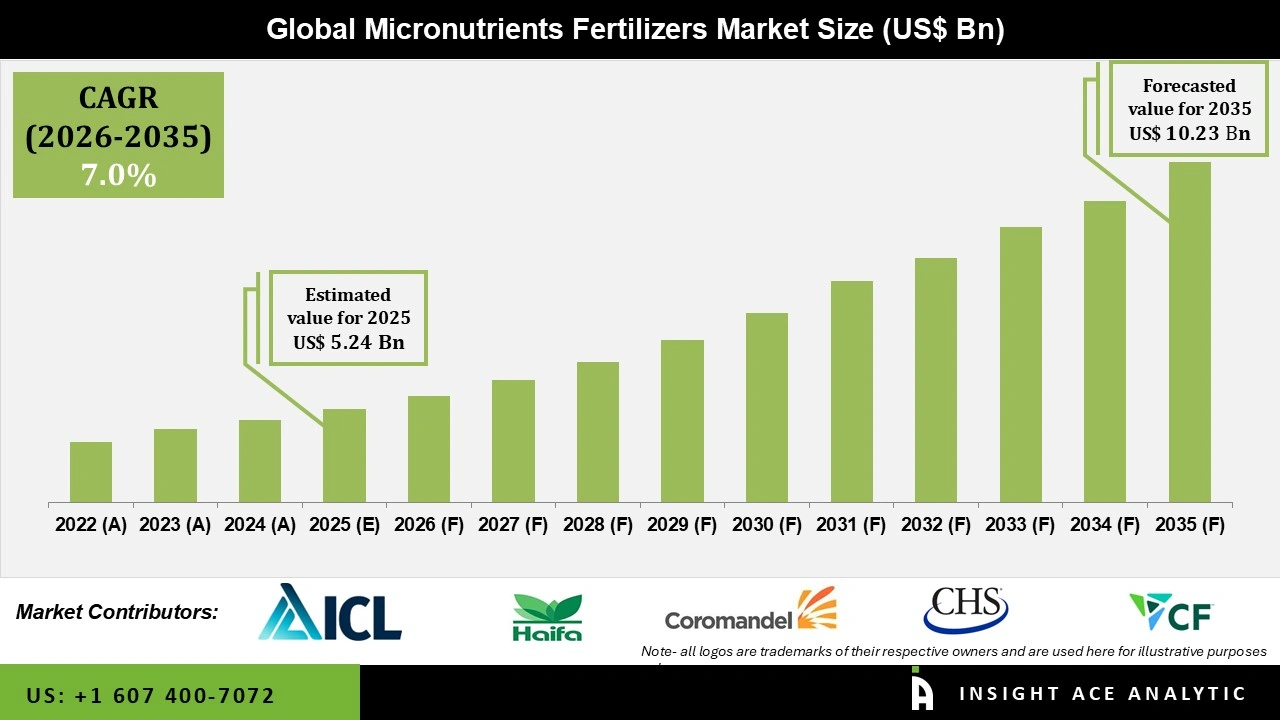
Global Micronutrients Fertilizers Market Size is valued at USD 5.24 Bn in 2025 and is predicted to reach USD 10.23 Bn by the year 2035 at a 7.0% CAGR during the forecast period for 2026 to 2035.
Micronutrients Fertilizers Market Size, Share & Trends Analysis Distribution by Form (Anode, Chelated, and Non-Chelated), Nutrient (Copper, Zinc, Molybdenum, Boron, Manganese, Iron, and Others), Crop Type (Grains & Cereals, Fruits & Vegetables, Commercial Crops, Pulses & Oilseeds, Others), and Segment Forecasts, 2026 to 2035
Micronutrients Fertilizers Market Key Takeaways:
|
The micronutrient fertilizers play a crucial role in agriculture by providing plants with trace elements that are needed to their growth and development. These elements are essential for many physiological and biochemical processes in plants, even though their requirements are lower than those of macronutrients such as potassium, phosphorus, and nitrogen. The significance of micronutrient fertilizers is in their ability to address certain deficiencies in plants or soil, hence improving crop quality, yields, and general health. The growing awareness of soil nutrient inadequacies, the expanding use of precision agriculture techniques, and the growing demand for nutrient-efficient farming practices are the main factors driving the micronutrients fertilizers market.
The growing demand for agricultural output is a key factor for the micronutrients fertilizers market growth. Improving crop yields and food quality is crucial as the world's population grows. The importance of micronutrients in fostering plant health and improving the caliber of agricultural products is becoming more widely acknowledged by farmers. Because of this understanding, micronutrient-enriched fertilizers are receiving more attention, which is increasing demand in the cutthroat agricultural sector. Additionally, the expansion of the micronutrients fertilizers market is significantly influenced by technical breakthroughs. The farmers can apply micronutrient fertilizers more effectively due to the integration of precision agriculture, a strategy that uses technology to ensure optimal field variability in crop management.
Over the forecast period, the micronutrients fertilizers market expansion is being shaped by the expanding regulatory trends. To encourage sustainable farming methods, governments are enforcing more stringent environmental laws. Since micronutrient fertilizers are thought to cause less environmental damage than conventional fertilizers, these policies promote their use. The shift to sustainable techniques is in line with international initiatives to improve food security in the face of climate change. Furthermore, in terms of the economy, growing disposable incomes and consumer knowledge of nutrition and health also act as the growth drivers for the micronutrients fertilizers market expansion. However, obstacles like shifting raw material costs and strict regulations could prevent the micronutrients fertilizers market from expanding.
Competitive Landscape
Which are the Leading Players in Micronutrients Fertilizers Market?
- CF Industries Holdings, Inc.
- ICL GROUP LTD
- CHS Inc.
- Nouryon
- Haifa Group
- Indian Farmers Fertiliser Cooperative Limited
- SABIC Agri-Nutrients
- Rashtriya Chemicals and Fertilizers Limited
- Coromandel International Ltd
- Sociedad Quimica Y Minera De Chile SA
Market Dynamics
Driver
Increase in the Use of Micronutrients to Promote Immunity and Root Growth
The manufacture of growth hormones that regulate root initiation and development is disrupted when micronutrients like zinc are lacking, which significantly affects these activities. Applying balanced micronutrient mixtures gives roots the necessary micronutrients to compensate for these shortages. It promotes lateral root growth, root hair elongation, and the development of root primordia. This increases rooting volume and improves soil nutrient extraction. Furthermore, robust roots are crucial for enhancing plant immunity. Micronutrients such as manganese and zinc fortify plant cell walls, reducing their susceptibility to disease and toxic attacks. Micronutrient-supported, well-developed roots can help plants resist abiotic stresses like flooding, drought, and temperature changes by controlling their hormone responses. Moreover, the increased root growth provides resistance to lodging and other problems brought on by stress. Thus, the micronutrients fertilizers market is expanding due in large part to the various ways that micronutrients improve root function and crop immunity.
Restrain/Challenge
Lack of Awareness Among Farmers in Developing Regions
A major obstacle facing the micronutrients fertilizers market is farmers' lack of information, particularly in developing nations. The need and advantages of adding balanced micronutrients to soils are not well understood by many smallholder and resource-poor farmers in these areas, who also tend to have low educational attainment. Additionally, these farmers' fertilization strategies tend to concentrate solely on important nutrients like potassium, phosphorus, and nitrogen due to their budgetary limitations and poverty. They frequently don't know how heavy cereal cropping affects long-term soil health and crop yield, as well as how it gradually depletes secondary and micronutrients. To close this awareness gap, more funding must be allocated to rural outreach initiatives, technical concepts must be made easier to grasp, and local organizations and communities must be enlisted to spread awareness locally in the languages spoken by the general public.
Chelated Segment is Growing at the Highest Rate in the Micronutrients Fertilizers Market
In 2025, the Chelated category dominated the micronutrients fertilizers market because they are more efficient in delivering and making nutrients available. Essential micronutrient ions, such as zinc, iron, and manganese, are bound to organic compounds by chelation, which keeps them from becoming insoluble in soil and enhances plant absorption, particularly in calcareous and alkaline soils where non-chelated versions would otherwise precipitate and become inaccessible. Farmers looking to consistently repair micronutrient deficits and enhance crop performance find chelated formulations especially appealing due to their chemical stability and increased bioavailability. Additionally, chelated products are recommended for soils with low nutrient availability by government extension services in key producing nations, which encourages their use. The commercial dominance of chelated forms in micronutrient fertilizers is supported by these agronomic and environmental benefits.
Zinc Segment is Expected to Drive the Micronutrients Fertilizers Market
The zinc category held the largest share in the micronutrients fertilizers market in 2025 because it is essential to the growth and immunity of plants. Zinc is necessary for many metabolic processes in crops, such as cell division, DNA synthesis, and protein synthesis. As farmers around the world recognize the value of zinc in achieving greater yields, the demand for zinc fertilizers is growing. Every season, the harvesting of cereals like wheat and rice removes significant amounts of zinc from the soil. Therefore, to replenish low levels, fertilizers must be used on a regular basis to supplement zinc. Furthermore, the development of precision farming makes it possible to apply zinc fertilizers precisely and precisely to areas or portions of fields that lack zinc. The sales of zinc-based micronutrient fertilizers and, eventually, the expansion of the micronutrient fertilizer market are being further stimulated by this economical strategy.
Why North America Led the Micronutrients Fertilizers Market?
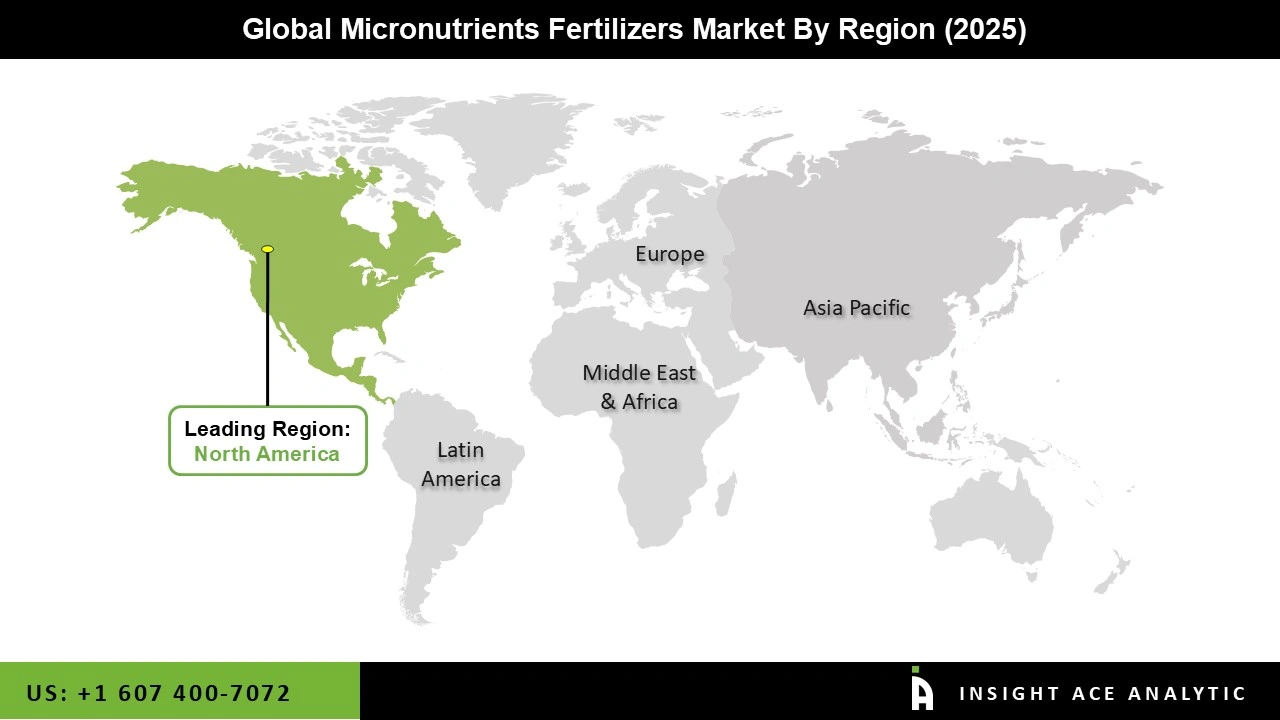
The Micronutrients Fertilizers market was dominated by North America region in 2025 driven by a strong integration of technology in farming, widespread adoption of enhanced crop feeding techniques, and increased awareness of soil health. The area gains from its leadership in digital farming platforms, variable-rate application technology, and precision agriculture, all of which are fueling the market for customized micronutrient blends. Government-backed initiatives promoting effective nitrogen usage, a well-established fertilizer supply chain, and continuous investments in sustainable agriculture all contribute to market expansion.
Furthermore, North America's growing emphasis on climate-smart and carbon-efficient farming methods makes it a major growth factor for the global market for nutrients and micronutrient fertilizers. Moreover, the market is further supported by a strong distribution network for agri-inputs, farmer education initiatives on micronutrient inadequacies, and new product developments such as chelated and controlled-release formulations.
Micronutrients Fertilizers Market Report Scope:
| Report Attribute | Specifications |
| Market size value in 2025 | USD 5.24 Bn |
| Revenue forecast in 2035 | USD 10.23 Bn |
| Growth Rate CAGR | CAGR of 7.0% from 2026 to 2035 |
| Quantitative Units | Representation of revenue in US$ Bn and CAGR from 2026 to 2035 |
| Historic Year | 2022 to 2025 |
| Forecast Year | 2026-2035 |
| Report Coverage | The forecast of revenue, the position of the company, the competitive market structure, growth prospects, and trends |
| Segments Covered | Form, Nutrient, Crop Type, and By Region |
| Regional Scope | North America; Europe; Asia Pacific; Latin America; Middle East & Africa |
| Country Scope | U.S.; Canada; U.K.; Germany; China; India; Japan; Brazil; Mexico; The UK; France; Italy; Spain; China; Japan; India; South Korea; Southeast Asia; South Korea; Southeast Asia |
| Competitive Landscape | CF Industries Holdings, Inc., ICL GROUP LTD, CHS Inc., Nouryon, Haifa Group, Indian Farmers Fertiliser Cooperative Limited, SABIC Agri-Nutrients, Rashtriya Chemicals and Fertilizers Limited, Coromandel International Ltd, and Sociedad Quimica Y Minera De Chile SA |
| Customization Scope | Free customization report with the procurement of the report, Modifications to the regional and segment scope. Geographic competitive landscape. |
| Pricing and Available Payment Methods | Explore pricing alternatives that are customized to your particular study requirements. |
Segmentation of Micronutrients Fertilizers Market :
Micronutrients Fertilizers Market by Form-
- Anode
- Chelated
- Non-Chelated
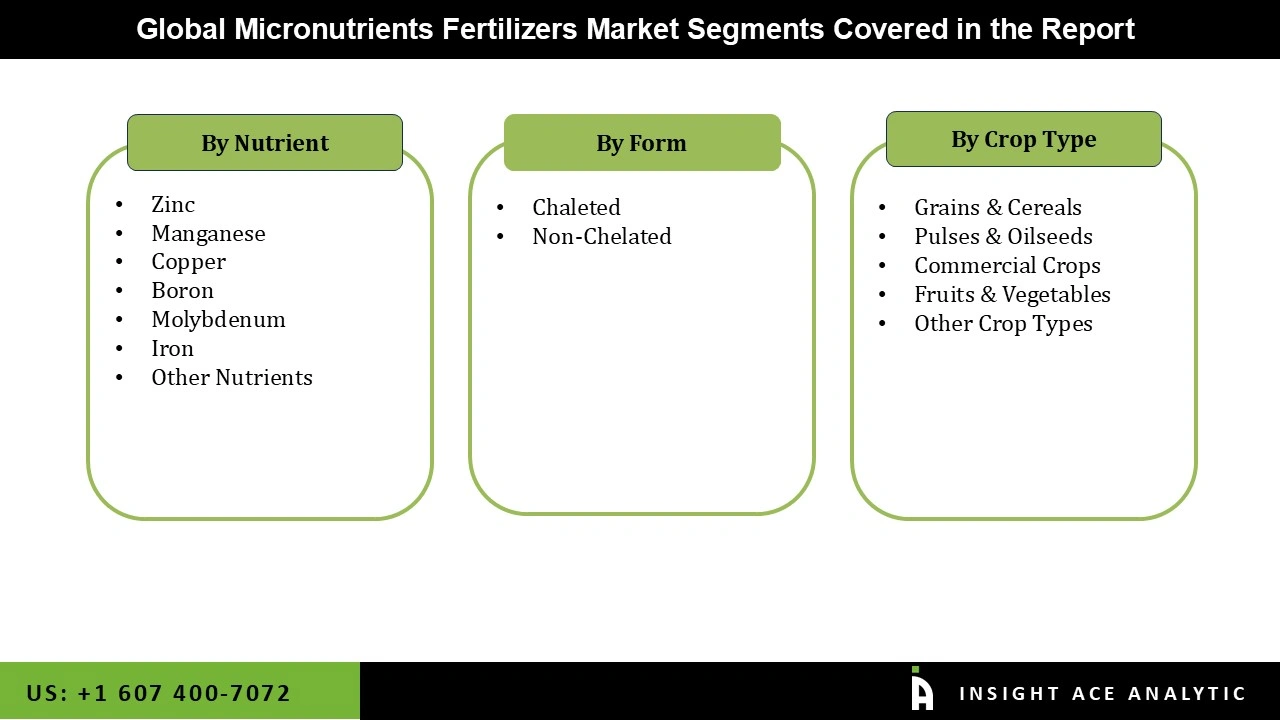
Micronutrients Fertilizers Market by Nutrient-
- Copper
- Zinc
- Molybdenum
- Boron
- Manganese
- Iron
- Others
Micronutrients Fertilizers Market by Crop Type-
- Grains & Cereals
- Fruits & Vegetables
- Commercial Crops
- Pulses & Oilseeds
- Others
Micronutrients Fertilizers Market By Region-
- North America-
- The US
- Canada
- Europe-
- Germany
- The UK
- France
- Italy
- Spain
- Rest of Europe
- Asia-Pacific-
- China
- Japan
- India
- South Korea
- South East Asia
- Rest of Asia Pacific
- Latin America-
- Brazil
- Argentina
- Mexico
- Rest of Latin America
- Middle East & Africa-
- GCC Countries
- South Africa
- Rest of Middle East and Africa
Research Design and Approach
This study employed a multi-step, mixed-method research approach that integrates:
- Secondary research
- Primary research
- Data triangulation
- Hybrid top-down and bottom-up modelling
- Forecasting and scenario analysis
This approach ensures a balanced and validated understanding of both macro- and micro-level market factors influencing the market.
Secondary Research
Secondary research for this study involved the collection, review, and analysis of publicly available and paid data sources to build the initial fact base, understand historical market behaviour, identify data gaps, and refine the hypotheses for primary research.
Sources Consulted
Secondary data for the market study was gathered from multiple credible sources, including:
- Government databases, regulatory bodies, and public institutions
- International organizations (WHO, OECD, IMF, World Bank, etc.)
- Commercial and paid databases
- Industry associations, trade publications, and technical journals
- Company annual reports, investor presentations, press releases, and SEC filings
- Academic research papers, patents, and scientific literature
- Previous market research publications and syndicated reports
These sources were used to compile historical data, market volumes/prices, industry trends, technological developments, and competitive insights.

Primary Research
Primary research was conducted to validate secondary data, understand real-time market dynamics, capture price points and adoption trends, and verify the assumptions used in the market modelling.
Stakeholders Interviewed
Primary interviews for this study involved:
- Manufacturers and suppliers in the market value chain
- Distributors, channel partners, and integrators
- End-users / customers (e.g., hospitals, labs, enterprises, consumers, etc., depending on the market)
- Industry experts, technology specialists, consultants, and regulatory professionals
- Senior executives (CEOs, CTOs, VPs, Directors) and product managers
Interview Process
Interviews were conducted via:
- Structured and semi-structured questionnaires
- Telephonic and video interactions
- Email correspondences
- Expert consultation sessions
Primary insights were incorporated into demand modelling, pricing analysis, technology evaluation, and market share estimation.
Data Processing, Normalization, and Validation
All collected data were processed and normalized to ensure consistency and comparability across regions and time frames.
The data validation process included:
- Standardization of units (currency conversions, volume units, inflation adjustments)
- Cross-verification of data points across multiple secondary sources
- Normalization of inconsistent datasets
- Identification and resolution of data gaps
- Outlier detection and removal through algorithmic and manual checks
- Plausibility and coherence checks across segments and geographies
This ensured that the dataset used for modelling was clean, robust, and reliable.
Market Size Estimation and Data Triangulation
Bottom-Up Approach
The bottom-up approach involved aggregating segment-level data, such as:
- Company revenues
- Product-level sales
- Installed base/usage volumes
- Adoption and penetration rates
- Pricing analysis
This method was primarily used when detailed micro-level market data were available.

Top-Down Approach
The top-down approach used macro-level indicators:
- Parent market benchmarks
- Global/regional industry trends
- Economic indicators (GDP, demographics, spending patterns)
- Penetration and usage ratios
This approach was used for segments where granular data were limited or inconsistent.
Hybrid Triangulation Approach
To ensure accuracy, a triangulated hybrid model was used. This included:
- Reconciling top-down and bottom-up estimates
- Cross-checking revenues, volumes, and pricing assumptions
- Incorporating expert insights to validate segment splits and adoption rates
This multi-angle validation yielded the final market size.
Forecasting Framework and Scenario Modelling
Market forecasts were developed using a combination of time-series modelling, adoption curve analysis, and driver-based forecasting tools.
Forecasting Methods
- Time-series modelling
- S-curve and diffusion models (for emerging technologies)
- Driver-based forecasting (GDP, disposable income, adoption rates, regulatory changes)
- Price elasticity models
- Market maturity and lifecycle-based projections
Scenario Analysis
Given inherent uncertainties, three scenarios were constructed:
- Base-Case Scenario: Expected trajectory under current conditions
- Optimistic Scenario: High adoption, favourable regulation, strong economic tailwinds
- Conservative Scenario: Slow adoption, regulatory delays, economic constraints
Sensitivity testing was conducted on key variables, including pricing, demand elasticity, and regional adoption.
Request Customization
Add countries, segments, company profiles, or extend forecast — free 10% customization with purchase.
Customize This Report →Enquire Before Buying
Speak with our analyst team about scope, methodology, pricing, or deliverable formats.
Enquire Now →Frequently Asked Questions
Micronutrients Fertilizers Market Size is valued at USD 5.24 Bn in 2025 and is predicted to reach USD 10.23 Bn by the year 2035
Micronutrients Fertilizers Market is expected to grow at a 7.0% CAGR during the forecast period for 2026 to 2035
CF Industries Holdings, Inc., ICL GROUP LTD, CHS Inc., Nouryon, Haifa Group, Indian Farmers Fertiliser Cooperative Limited, SABIC Agri-Nutrients, Rashtriya Chemicals and Fertilizers Limited, Coromandel International Ltd, Sociedad Quimica Y Minera De Chile SA and Others
Micronutrients Fertilizers Market is segmented into Form, Nutrient, Crop Type, and By Region
North America region is leading the Micronutrients Fertilizers Market.