Carbon-Negative Cementing Market Size, Share, Trend, Forecast Report 2026 to 2035
What is Carbon-Negative Cementing Market Size?
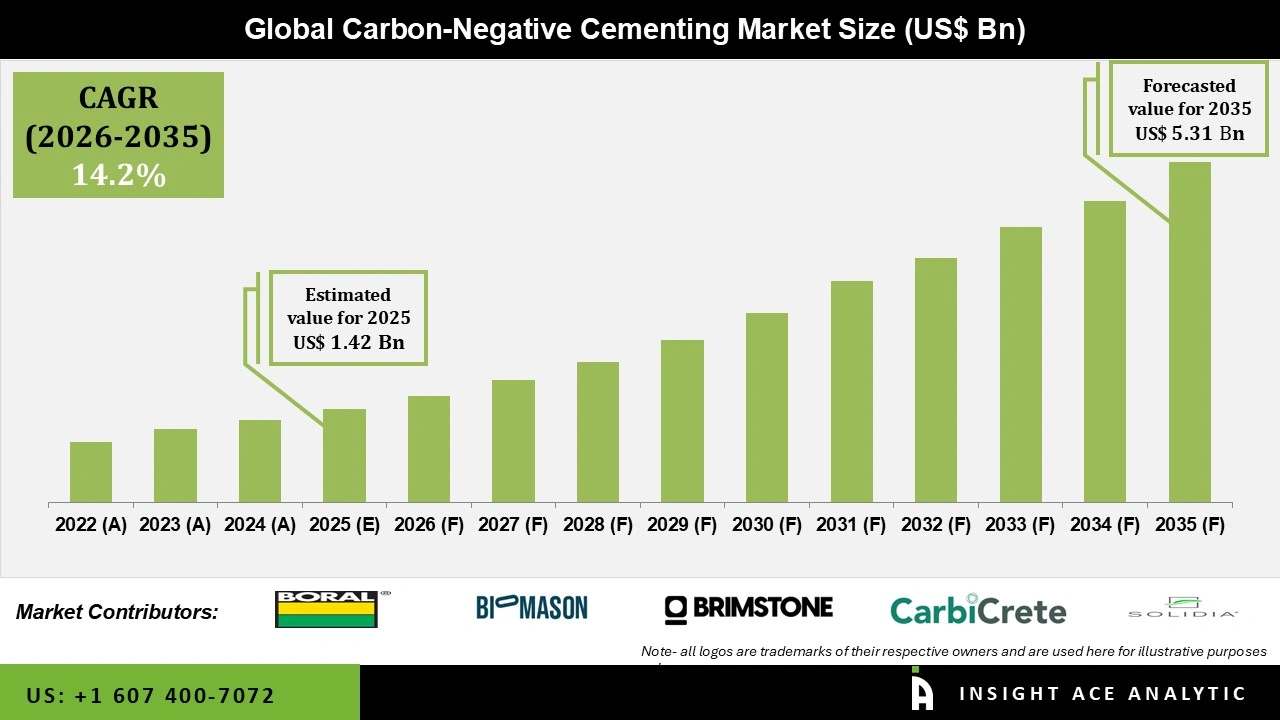
Global Carbon-Negative Cementing Market Size is valued at USD 1.42 Bn in 2025 and is predicted to reach USD 5.31 Bn by the year 2035 at a 14.2% CAGR during the forecast period for 2026 to 2035.
Carbon-Negative Cementing Market Size, Share & Trends Analysis Distribution By Type of Raw Material (Natural Raw Materials, Industrial Waste Raw Materials), By Type of Product (Bio-Based Cements, CO2-Mineralized Concrete, Calcium Sulfoaluminate (CSA) Cement, Carbon Capture Utilisation and Storage (CCUS) Enhanced Cement, Geopolymers, Magnesium Oxide Cement, Zero-Clinker / Electrochemical Cement), By Type of Technology (Bio-Mineralisation Systems, Carbon Capture Platforms, Hybrid Carbon Sequestration Systems), By Application (Construction, Commercial, Residential, Infrastructure, Bridges & Tunnels, Roads & Highways), By Distribution Channel (Direct Sales, Distributors, Online Channels), By End User (Construction Firms, Cement Producers, Government Agencies, Precast Manufacturers, Real Estate Developers) and Segment Forecasts, 2026 to 2035.
Carbon-negative cement is an emerging class of construction materials designed to go beyond reducing emissions by actively removing carbon dioxide from the atmosphere. Unlike conventional cement, which is one of the largest industrial sources of greenhouse gas emissions, carbon-negative alternatives incorporate innovative chemistries and processes that capture, store, or mineralise CO₂ during production or curing. These materials often rely on industrial by-products, alternative binders, or novel electrochemical and biological processes to achieve a lower or even net-negative carbon footprint. As the construction sector faces increasing pressure to decarbonise, carbon-negative cement represents a significant shift toward more sustainable building practices. By turning a traditionally carbon-intensive material into a potential carbon sink, these solutions are redefining how infrastructure and buildings can contribute to climate goals.
In recent years, innovation has significantly accelerated the development of the Carbon-Negative Cementing Market. Advanced technologies such as carbon mineralisation, bio-based binding systems, and carbon capture integration are enabling manufacturers to produce cement with substantially reduced environmental impact. These solutions are being applied across a wide range of construction activities, from large-scale infrastructure projects to residential and commercial developments. Additionally, integrating carbon capture, utilisation, and storage (CCUS) technologies into cement production helps convert captured emissions into stable mineral forms in concrete, further enhancing sustainability. There is also a growing emphasis on utilising industrial waste materials such as fly ash, slag, and recycled aggregates, which not only reduces emissions but also supports circular economy principles. The market is also benefiting from increasing collaboration among construction companies, material innovators, technology providers, and research institutions. These partnerships are driving the commercialisation of new products and improving their scalability and performance.
Governments and regulatory bodies are playing a supportive role by introducing stricter emission standards, green building certifications, and incentives for low-carbon construction materials. As a result, demand for carbon-negative cement solutions is rising, particularly in regions focused on achieving net-zero targets and sustainable infrastructure development. Despite its strong potential, the market faces several challenges that need to be addressed. High initial production costs and limited large-scale manufacturing capacity can restrict widespread adoption. Additionally, the need for standardisation and regulatory approval for new materials can slow down market entry. Integrating these advanced materials into existing construction practices may also require changes in design, supply chains, and workforce training. Concerns around long-term durability, performance validation, and consistency of raw material supply can further influence adoption decisions.
However, ongoing technological advancements, increased investment in sustainable construction, and a global push toward decarbonization are expected to support steady market growth. As awareness grows and production processes become more efficient, carbon-negative cement is likely to play a crucial role in reducing the construction industry's environmental impact. Overall, it represents a forward-looking solution that not only addresses emissions reduction but also contributes to climate-positive development by integrating buildings and infrastructure into the carbon removal ecosystem.
Competitive Landscape
Which are the Leading Players in the Carbon-Negative Cementing Market?
- Boral
- BioMason
- Blue Planet
- Brimstone Energy
- Calera
- CarbiCrete
- CarbonBuilt
- CarbonCure Technologies
- Cemex
- Ecocem
- Fortera
- Green Cement
- Heidelberg Materials
- LafargeHolcim (Holcim Group)
- Mineral Carbonation International (MCi)
- Novacem
- Seratech
- Solid Carbon
- Solidia Technologies
- Sublime Systems
- Siam Cement Group
Market Dynamics
Driver
Growing Focus on Decarbonization and Sustainable Construction Practices
The primary driver of the carbon-negative cementing market is the increasing global focus on reducing carbon emissions from the construction sector. Traditional cement production is a major contributor to greenhouse gas emissions, prompting governments, industries, and developers to seek more sustainable alternatives. Carbon-negative cement technologies address this challenge by not only reducing emissions but also actively capturing and storing carbon dioxide during production or curing. As countries move toward net-zero targets and stricter environmental regulations, there is a strong push to adopt low-carbon and carbon-negative building materials. In addition, growing awareness among construction firms and real estate developers about sustainable building practices is accelerating demand. These materials also support green building certifications and ESG (Environmental, Social, and Governance) goals, making them increasingly attractive for modern infrastructure and commercial projects.
Restrain/Challenge
High Production Costs, Standardization Issues, and Adoption Barriers
The major challenges in this market is the relatively high cost associated with producing carbon-negative cement compared to conventional alternatives. Many of these technologies are still in the early stages of commercialisation, requiring significant investment in research, infrastructure, and scaling capabilities. Additionally, the lack of standardised regulations and performance benchmarks for new cement types can create uncertainty for manufacturers and end users. Construction companies may also be hesitant to adopt these materials due to concerns about long-term durability, compatibility with existing systems, and limited awareness or technical expertise. Supply chain constraints, particularly in sourcing consistent raw materials such as industrial waste, can further impact production. These factors collectively slow down widespread adoption, especially in price-sensitive markets.
CO2-Mineralized Concrete Segment is Expected to Drive the Carbon-Negative Cementing Market
CO2-mineralized concrete is expected to be a key growth driver within the market. This segment involves injecting captured carbon dioxide into concrete during the curing process, where it is permanently converted into stable minerals. This not only reduces the carbon footprint of the material but can also enhance its strength and durability. The growing adoption of carbon capture technologies and increasing demand for sustainable construction materials are supporting the expansion of this segment. As infrastructure and commercial construction projects seek low-carbon solutions without compromising performance, CO2-mineralized concrete is gaining strong traction. Its ability to integrate with existing concrete production processes also makes it a practical and scalable solution.
Carbon Capture Platforms Segment is Expected to Drive the Carbon-Negative Cementing Market
Carbon capture platforms represent another significant growth segment in this market. These technologies capture carbon emissions generated during cement production and either store them or convert them into usable materials. By integrating carbon capture, utilization, and storage (CCUS) systems into cement manufacturing, companies can significantly reduce their environmental impact. The increasing investment in carbon capture technologies, along with supportive government policies and funding, is accelerating the adoption of this segment. Additionally, these platforms enable manufacturers to transition toward more sustainable operations without completely overhauling existing production infrastructure, making them an attractive option for large-scale cement producers.
Why Asia- Pacific Led the Carbon-Negative Cementing Market?
Asia-Pacific is expected to lead the carbon-negative cementing market due to rapid urbanisation, large-scale infrastructure development, and increasing environmental regulations across key economies such as China, India, and Japan. The region accounts for a significant share of global cement production and consumption, making it a critical area for adopting sustainable alternatives. Governments in this region are actively promoting low-carbon construction practices through policies, incentives, and green building initiatives.
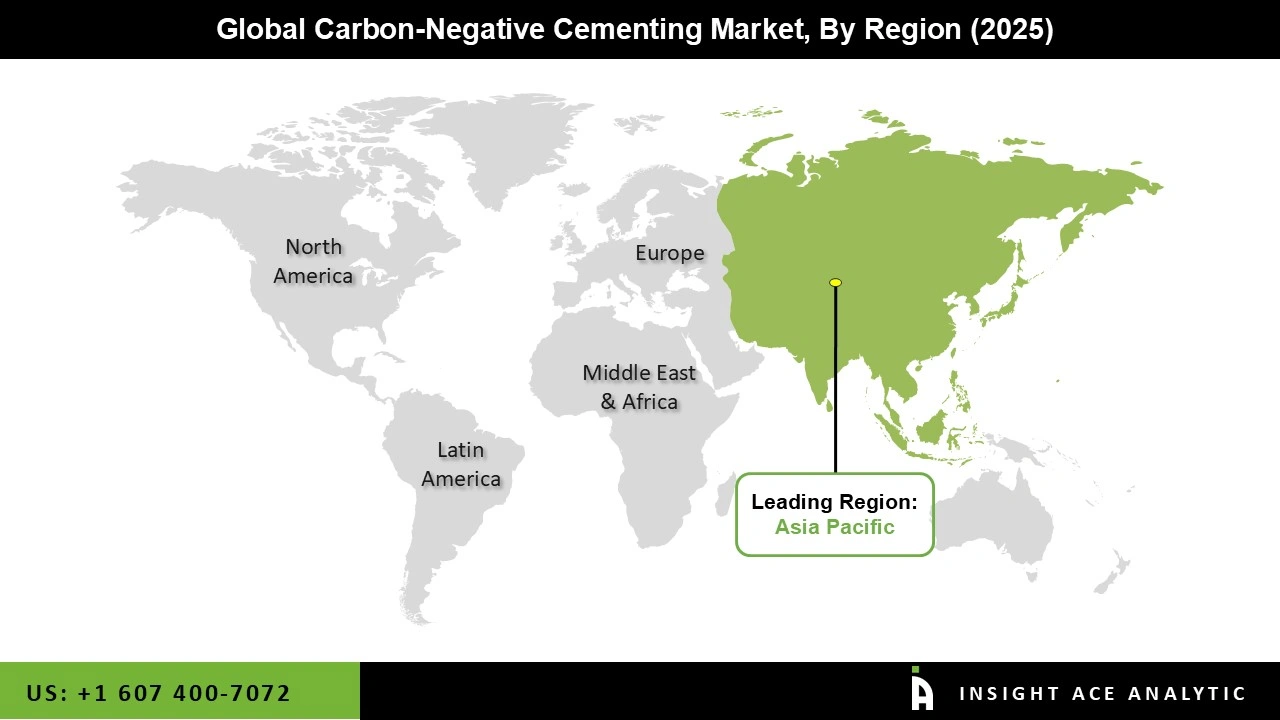
Additionally, the availability of industrial waste materials such as fly ash and slag supports the production of carbon-negative cement. Growing investments in sustainable infrastructure, coupled with rising awareness of climate change and carbon reduction goals, are further driving market growth. Overall, Asia-Pacific’s dominance is supported by strong construction demand, policy support, and increasing focus on environmentally responsible development.
Key Developments:
• In February 2026, CarbonCure Technologies expanded its carbon mineralisation technology deployment through new partnerships with ready-mix concrete producers across North America and Asia, enabling wider adoption of CO₂-injected concrete for low-carbon construction projects
• In December 2025, Sublime Systems secured additional funding to expand its electrochemical cement production technology, which eliminates the need for traditional limestone calcination and reduces CO₂ emissions in the manufacturing process.
Carbon-Negative Cementing Market Report Scope:
| Report Attribute | Specifications |
| Market size value in 2025 | USD 1.42 Bn |
| Revenue forecast in 2035 | USD 5.31 Bn |
| Growth Rate CAGR | CAGR of 14.2% from 2026 to 2035 |
| Quantitative Units | Representation of revenue in US$ Bn and CAGR from 2026 to 2035 |
| Historic Year | 2021 to 2025 |
| Forecast Year | 2026-2035 |
| Report Coverage | The forecast of revenue, the position of the company, the competitive market structure, growth prospects, and trends |
| Segments Covered | Raw Material Type, Product Type, Application, Technology Type, Distribution Channel, End User, and By Region |
| Regional Scope | North America; Europe; Asia Pacific; Latin America; Middle East & Africa |
| Country Scope | US, Canada, Mexico, Rest of North America, Austria, Belgium, Denmark, France, Germany, Ireland, Italy, Netherlands, Norway, Russia, Spain, Sweden, Switzerland, UK, Rest of Europe, Australia, China, India, Japan, New Zealand, Singapore, South Korea, Rest of Asia-Pacific, Brazil, Chile, Colombia, Venezuela, Rest of Latin America, Egypt, Iran, Iraq, Israel, Kuwait, Saudi Arabia, UAE, Rest of MEA |
| Competitive Landscape | Boral, BioMason, Blue Planet, Brimstone Energy, Calera, CarbiCrete, CarbonBuilt, CarbonCure Technologies, Cemex, Ecocem, Fortera, Green Cement, Heidelberg Materials, LafargeHolcim (Holcim Group), Mineral Carbonation International (MCi), Novacem, Seratech, Solid Carbon, Solidia Technologies, Sublime Systems, and Siam Cement Group. |
| Customization Scope | Free customization report with the procurement of the report, Modifications to the regional and segment scope. Geographic competitive landscape. |
| Pricing and Available Payment Methods | Explore pricing alternatives that are customized to your particular study requirements. |
Segmentations of Carbon-Negative Cementing Market:
Carbon-Negative Cementing Market, by Type of Raw Material-
- Natural Raw Materials
- Industrial Waste Raw Materials
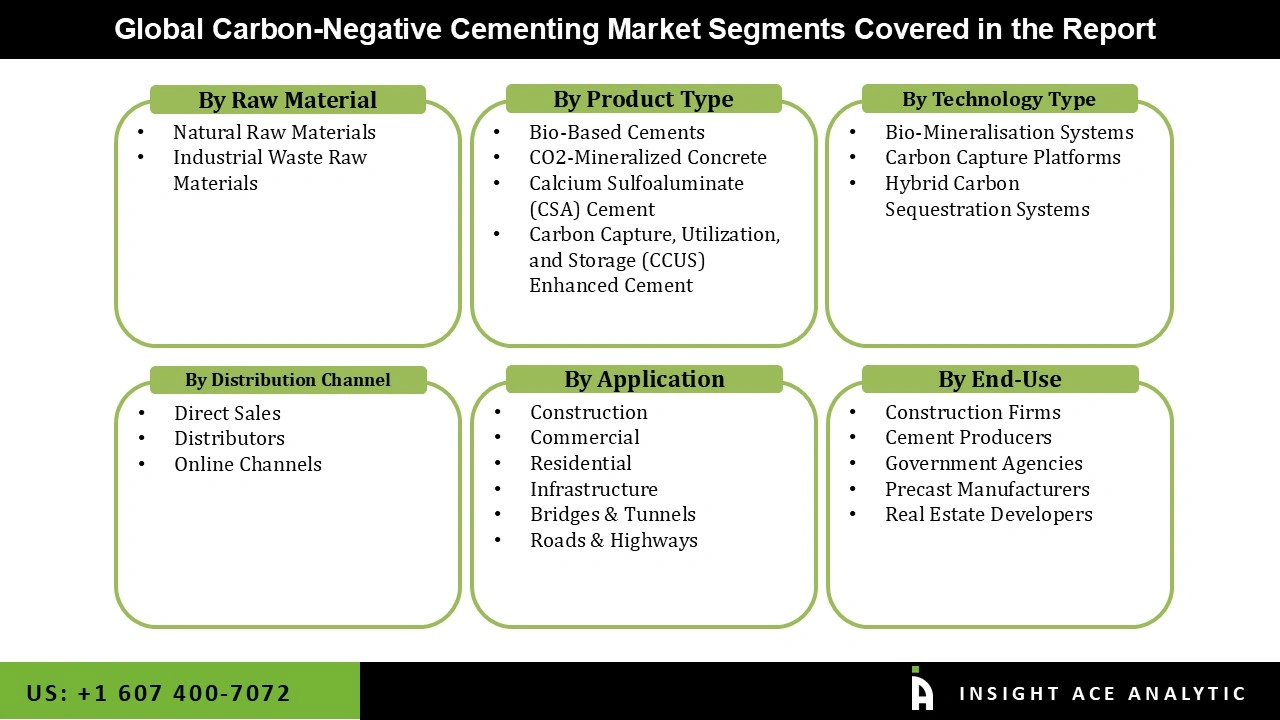
Carbon-Negative Cementing Market, by Type of Product-
- Bio-Based Cements
- CO2-Mineralized Concrete
- Calcium Sulfoaluminate (CSA) Cement
- Carbon Capture, Utilization, and Storage (CCUS) Enhanced Cement
- Geopolymers
- Magnesium Oxide Cement
- Zero-Clinker / Electrochemical Cement
Carbon-Negative Cementing Market, by Type of Technology-
- Bio-Mineralization Systems
- Carbon Capture Platforms
- Hybrid Carbon Sequestration Systems
Carbon-Negative Cementing Market, by Application-
- Construction
- Commercial
- Residential
- Infrastructure
- Bridges & Tunnels
- Roads & Highways
Carbon-Negative Cementing Market, by Distribution Channel-
- Direct Sales
- Distributors
- Online Channels
Carbon-Negative Cementing Market, by End User-
- Construction Firms
- Cement Producers
- Government Agencies
- Precast Manufacturers
- Real Estate Developers
Carbon-Negative Cementing Market, by Region-
- North America-
- The US
- Canada
- Europe-
- Germany
- The UK
- France
- Italy
- Spain
- Rest of Europe
- Asia-Pacific-
- China
- Japan
- India
- South Korea
- South East Asia
- Rest of Asia Pacific
- Latin America-
- Brazil
- Argentina
- Mexico
- Rest of Latin America
- Middle East and Africa-
- GCC Countries
- South Africa
- Rest of Middle East and Africa
Research Design and Approach
This study employed a multi-step, mixed-method research approach that integrates:
- Secondary research
- Primary research
- Data triangulation
- Hybrid top-down and bottom-up modelling
- Forecasting and scenario analysis
This approach ensures a balanced and validated understanding of both macro- and micro-level market factors influencing the market.
Secondary Research
Secondary research for this study involved the collection, review, and analysis of publicly available and paid data sources to build the initial fact base, understand historical market behaviour, identify data gaps, and refine the hypotheses for primary research.
Sources Consulted
Secondary data for the market study was gathered from multiple credible sources, including:
- Government databases, regulatory bodies, and public institutions
- International organizations (WHO, OECD, IMF, World Bank, etc.)
- Commercial and paid databases
- Industry associations, trade publications, and technical journals
- Company annual reports, investor presentations, press releases, and SEC filings
- Academic research papers, patents, and scientific literature
- Previous market research publications and syndicated reports
These sources were used to compile historical data, market volumes/prices, industry trends, technological developments, and competitive insights.

Primary Research
Primary research was conducted to validate secondary data, understand real-time market dynamics, capture price points and adoption trends, and verify the assumptions used in the market modelling.
Stakeholders Interviewed
Primary interviews for this study involved:
- Manufacturers and suppliers in the market value chain
- Distributors, channel partners, and integrators
- End-users / customers (e.g., hospitals, labs, enterprises, consumers, etc., depending on the market)
- Industry experts, technology specialists, consultants, and regulatory professionals
- Senior executives (CEOs, CTOs, VPs, Directors) and product managers
Interview Process
Interviews were conducted via:
- Structured and semi-structured questionnaires
- Telephonic and video interactions
- Email correspondences
- Expert consultation sessions
Primary insights were incorporated into demand modelling, pricing analysis, technology evaluation, and market share estimation.
Data Processing, Normalization, and Validation
All collected data were processed and normalized to ensure consistency and comparability across regions and time frames.
The data validation process included:
- Standardization of units (currency conversions, volume units, inflation adjustments)
- Cross-verification of data points across multiple secondary sources
- Normalization of inconsistent datasets
- Identification and resolution of data gaps
- Outlier detection and removal through algorithmic and manual checks
- Plausibility and coherence checks across segments and geographies
This ensured that the dataset used for modelling was clean, robust, and reliable.
Market Size Estimation and Data Triangulation
Bottom-Up Approach
The bottom-up approach involved aggregating segment-level data, such as:
- Company revenues
- Product-level sales
- Installed base/usage volumes
- Adoption and penetration rates
- Pricing analysis
This method was primarily used when detailed micro-level market data were available.

Top-Down Approach
The top-down approach used macro-level indicators:
- Parent market benchmarks
- Global/regional industry trends
- Economic indicators (GDP, demographics, spending patterns)
- Penetration and usage ratios
This approach was used for segments where granular data were limited or inconsistent.
Hybrid Triangulation Approach
To ensure accuracy, a triangulated hybrid model was used. This included:
- Reconciling top-down and bottom-up estimates
- Cross-checking revenues, volumes, and pricing assumptions
- Incorporating expert insights to validate segment splits and adoption rates
This multi-angle validation yielded the final market size.
Forecasting Framework and Scenario Modelling
Market forecasts were developed using a combination of time-series modelling, adoption curve analysis, and driver-based forecasting tools.
Forecasting Methods
- Time-series modelling
- S-curve and diffusion models (for emerging technologies)
- Driver-based forecasting (GDP, disposable income, adoption rates, regulatory changes)
- Price elasticity models
- Market maturity and lifecycle-based projections
Scenario Analysis
Given inherent uncertainties, three scenarios were constructed:
- Base-Case Scenario: Expected trajectory under current conditions
- Optimistic Scenario: High adoption, favourable regulation, strong economic tailwinds
- Conservative Scenario: Slow adoption, regulatory delays, economic constraints
Sensitivity testing was conducted on key variables, including pricing, demand elasticity, and regional adoption.
Request Customization
Add countries, segments, company profiles, or extend forecast — free 10% customization with purchase.
Customize This Report →Enquire Before Buying
Speak with our analyst team about scope, methodology, pricing, or deliverable formats.
Enquire Now →Frequently Asked Questions
Carbon-Negative Cementing Market Size is valued at USD 1.42 Bn in 2025 and is predicted to reach USD 5.31 Bn by the year 2035
The Carbon-Negative Cementing Market is expected to grow at a 14.2% CAGR during the forecast period for 2026 to 2035
Boral, BioMason, Blue Planet, Brimstone Energy, Calera, CarbiCrete, CarbonBuilt, CarbonCure Technologies, Cemex, Ecocem, Fortera, Green Cement, Heidelberg Materials, LafargeHolcim (Holcim Group), Mineral Carbonation International (MCi), Novacem, Seratech, Solid Carbon, Solidia Technologies, Sublime Systems, Siam Cement Group. and Others.
Carbon-Negative Cementing Market is segmented into Raw Material Type, Product Type, Application, Technology Type, Distribution Channel, End User, and other.
Asia Pacific region is leading the Carbon-Negative Cementing Market.