Micronized PTFE Market Forecast with Size and Share Analysis 2026 to 2035
What is Micronized PTFE Market Size?
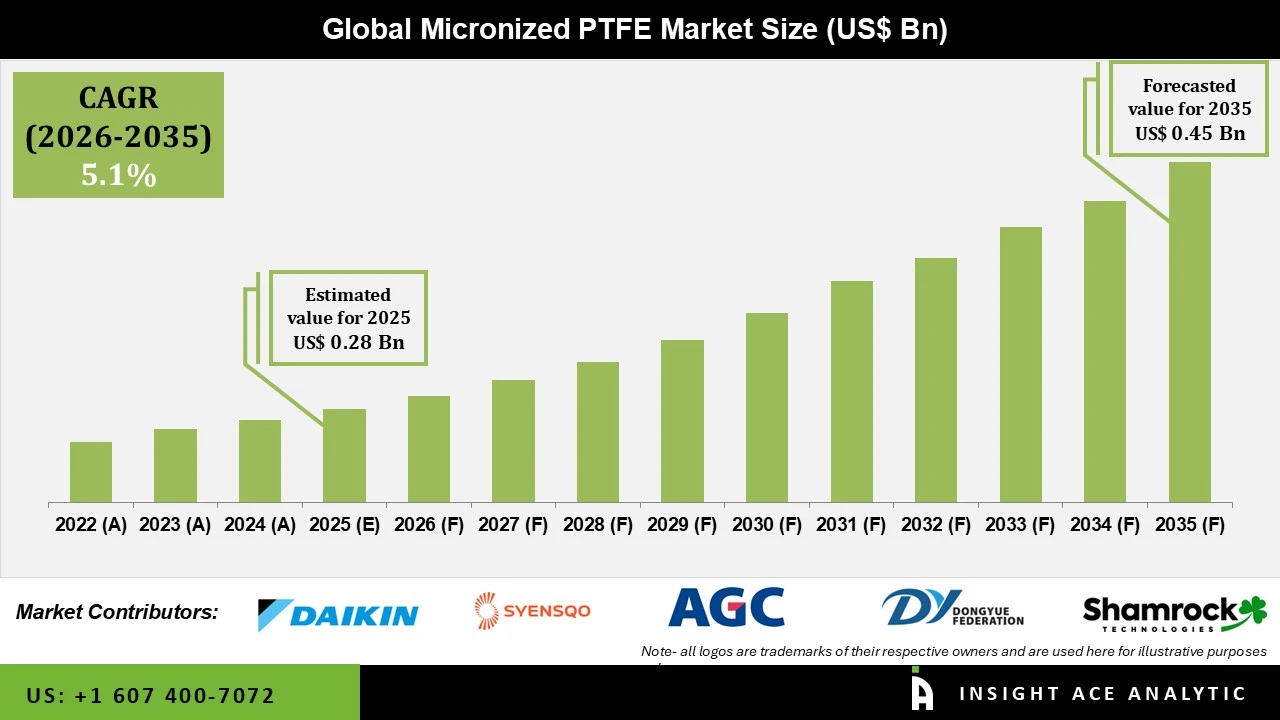
Micronized PTFE Market Size is valued at USD 0.28 Bn in 2025 and is predicted to reach USD 0.45 Bn by the year 2035 at a 5.1% CAGR during the forecast period for 2026 to 2035.
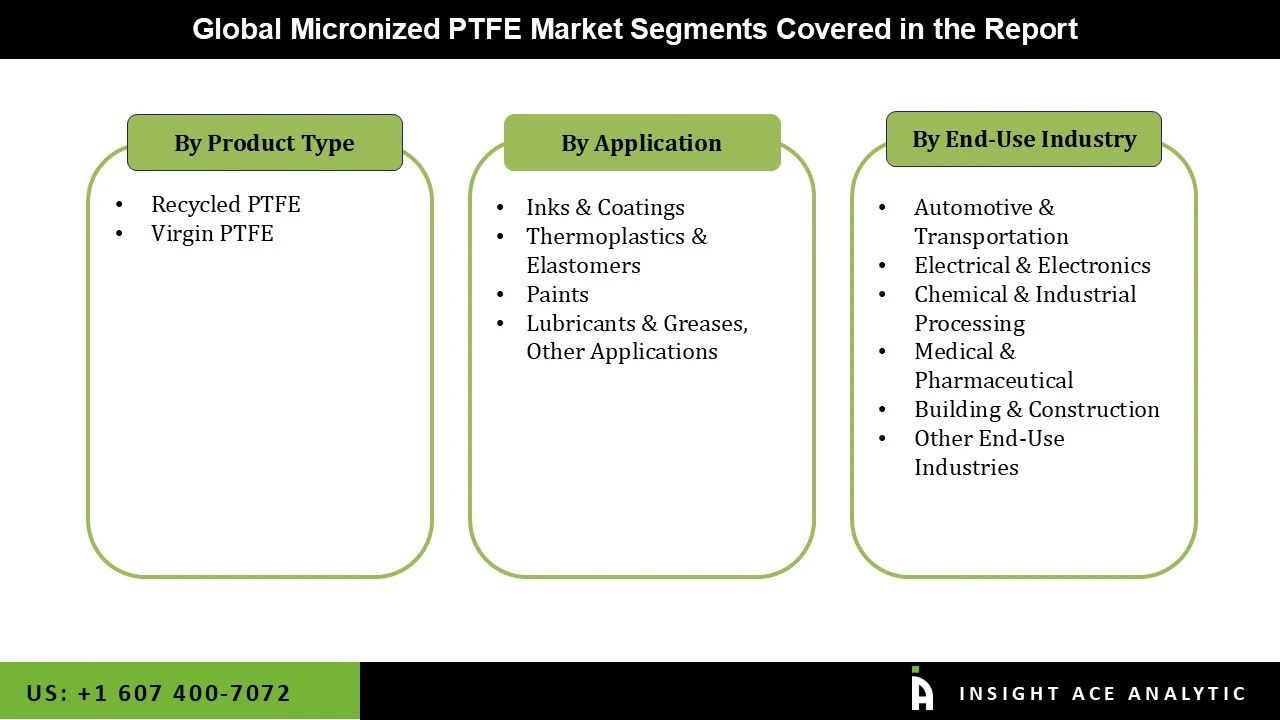
Micronized PTFE Market Size, Share & Trends Analysis Distribution by Type (Virgin PTFE and Recycled PTFE), Application (Paints, Inks & Coatings, Lubricants & Greases, Thermoplastics & Elastomers, and Others), End-user (Automotive & Transportation, Medical & Pharmaceutical, Chemical & Industrial Processing, Electrical & Electronics, Building & Construction, and Others), and Segment Forecasts, 2026 to 2035
Micronized PTFE Market Key Takeaways:
|
Micronized polytetrafluoroethylene (PTFE), sometimes referred to as PTFE micro powder, is a tiny white powder with particle sizes ranging from 1 to 20 microns (μm) with a molecular weight between 30,000 and 200,000. In coatings, inks, plastics, elastomers, and industrial lubricants, these particles are employed to improve surface qualities like lubricity, scratch resistance, wear reduction, chemical inertness, and anti-blocking behavior. Rather than macroeconomic volume trends, the demand for micronized PTFE powders is intrinsically linked to performance improvement in downstream formulations. Apart from maintaining the remarkable qualities of PTFE, the micronized version has a number of special qualities, such as high crystallinity, superior dispersibility, and the capacity to blend uniformly with other substances. The paints and coatings industry is expected to grow as a result of the growing global infrastructure, which would help the micronized PTFE market.
Additionally, the micronized PTFE market is expanding significantly at the moment due to its numerous uses in a variety of sectors. This material is being used more and more in industries including electronics, automotive, and aerospace because of its remarkable chemical resistance and low-friction qualities. Another main factor affecting the micronized PTFE market dynamics seems to be the need for high-performance materials that improve the longevity and effectiveness of products. In addition, the trend in manufacturing processes toward energy-efficient and lightweight solutions points to a bright future for micronized polytetrafluoroethylene. The quality of the final product is being enhanced by ongoing technological developments in PTFE processing methods. Furthermore, the use of micronized PTFE in advanced composite materials, lubrication additives, and specialty coating applications is growing.
Moreover, the use of micronized PTFE is anticipated to increase due to growing awareness of environmental sustainability. There may be a trend in this industry toward more environmentally friendly options as firms look for alternatives to conventional materials that could be hazardous to the environment. The applications may grow as a result of continuous advancements in formulations and processing methods, improving the market environment as a whole. However, compared to other materials with comparable properties, the micronized PTFE is more expensive due to its labor-intensive manufacture. It could be pricey and unappealing to some end users, especially those in areas where costs are crucial. Its adoption in some applications may also be limited by the availability of less expensive materials with equivalent or even better attributes, notwithstanding its special advantages. Thus, this will limit the micronized PTFE market growth over the forecast period.
Competitive Landscape
Which are the Leading Players in Micronized PTFE Market?
• The Chemours Company
• Daikin Industries, Ltd.
• 3M
• Syensqo
• AGC INC.
• Dongyue Group
• Shamrock Technologies
• Gujarat Fluorochemicals Limited
• Halopolymer
• Nanjing Tianshi New Material Technologies Co., Ltd.
• Maflon S.P.A.
• Fuzhou Topda New Material Co., Ltd.
• Peflon
• Suzhou Norshine Performance Material co. Ltd.
• Reprolon
• Zhejiang Quzhou Wannengda Technology Co., Ltd.
• Zhonghao Chenguang Research Institute Of Chemical Industry Co., Ltd.
• Kitamura Limited
• Polymer Add (Thailand) Co., Ltd.
• Hangzhou Jufu New Material Technology Co., Ltd.
• Shanghai Tongs Science & Technology Co., Ltd.
• Hangzhou Fine Fluorotech Co., Ltd.
• Itaflon
• Xeon PTFE
• Shanghai Kayson Chemical
Market Dynamics
Driver
Rapid Development of the Construction and Building Industry
A synthetic polymer known as micronized polytetrafluoroethylene, or micronized PTFE, is being used more and more in the building and construction industry for a variety of purposes, including inks, paints and coatings, additives, and more. A surge in housing schemes, government infrastructure development projects, and thriving residential housing development activities are some of the major elements driving the building and construction industry's rapid expansion. The National Investment Promotion & Facilitation Agency projects that by 2025, the construction sector in India will be worth US$1.4 trillion. The United States Census Bureau reports that during the first three months of 2022, construction investment was US$376.6 billion, up 12% from the same period in 2021. The use of micronized PTFE in the commercial, industrial, and residential sectors is growing due to the building and construction industry's explosive growth, which is propelling the market.
Restrain/Challenge
Strict Safety and Environmental Regulations
The micronized PTFE market is confronted with significant obstacles because of stricter safety and environmental standards. Regulations are keeping a careful eye on PTFE's environmental impact and the possible health hazards linked to certain chemical compounds used in its manufacture because it is a member of the larger family of fluoropolymers. The stringent regulations on the use of perfluorinated compounds (PFCs) have been put in place by nations in Europe, North America, and Asia, raising concerns about environmental persistence and bioaccumulation. In addition to raising the cost of compliance, these requirements make manufacturing more difficult by necessitating more stringent testing, certification, and monitoring. These legislative constraints significantly limit the market's potential for rapid expansion, forcing producers to either innovate within legal parameters or risk losing market share.
Virgin PTFE Segment is Expected to Drive the Micronized PTFE Market
The Virgin PTFE category held the largest share in the Micronized PTFE market in 2025. In industries including chemical processing, electrical and electronics, medicine, and high-end industrial applications that need extremely high levels of product purity, performance consistency, and regulatory compliance, natural PTFE has become increasingly prevalent. The superior thermal stability, chemical resistance, and reduced friction of virgin micronized PTFE make it more versatile than recycled grades. The applications include lubricants, coatings, elastomers, thermoplastics, and inks. Additionally, producers and end users are increasingly looking for virgin PTFE in order to meet stricter tolerances, higher product quality, and compliance with stricter environmental and food-contact requirements.
Automotive & Transportation Segment is Growing at the Highest Rate in the Micronized PTFE Market
In 2025, the automotive & transportation category dominated the Micronized PTFE market driven by the material's potential to greatly improve the efficiency, dependability, and performance of vehicles. With ultra-fine particles that are usually less than 35 microns, micronized PTFE is commonly used in automotive parts such as paints, anti-corrosion coatings, gaskets, seals, bearings, and high-performance lubricants. Additionally, as manufacturers strive for lightweight, long-lasting solutions in both conventional and electric vehicles (EVs), Apso's extraordinarily low friction coefficient reduces wear on moving parts, improving fuel economy and extending component life. Moreover, it is perfect for challenging automotive settings, such as high-temperature zones in engines and brake systems, due to its chemical inertness and thermal stability.
Why North America Led the Micronized PTFE Market?
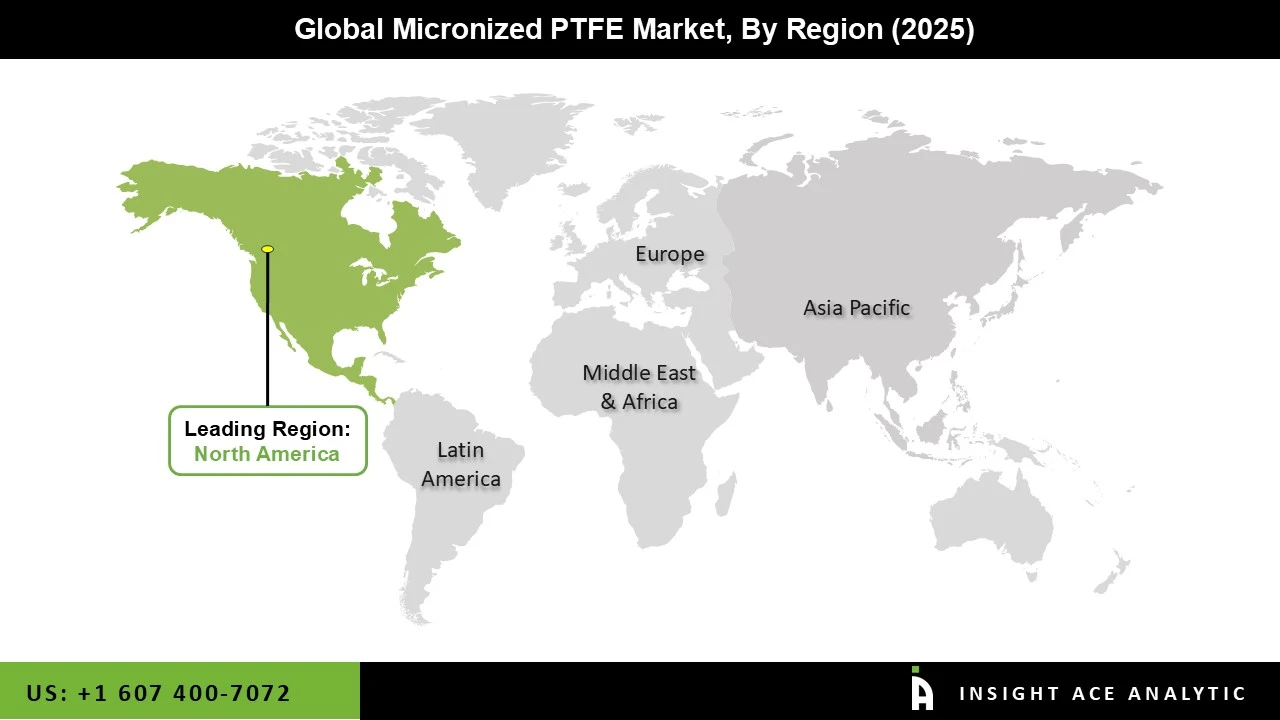
The Micronized PTFE market was dominated by North America region in 2025 driven primarily by the need for thermoplastic, lubricant, and industrial coating applications, especially in the automotive and aerospace industries. The harsh environment of the high-performance lubricants and low-VOC coatings has a major role in the micronized PTFE market's expansion. Furthermore, the market is driven by technological improvements and the growing use of quartz metal technology. Although North America won't be at the top, it will have compound yearly growth, and valuations will rise as a result of its use in industrial applications. Additionally, the adoption of novel particle-size improvements is encouraged by the robust R&D capabilities. PTFE additives are used by manufacturers to meet the high-end finish specifications for both consumer and commercial goods.
Key Development
August 2025: Chemours has established key alliances with SRF Limited to guarantee that fluoropolymer production capacity is available in India. With the addition of micronized PTFE powders (Zonyl Micropowders), this agreement significantly expands Chemour's supply of PTFE raw materials from the upstream to the downstream additive use, increasing accessibility for coatings, lubricants, inks, and plastic modification applications.
March 2024: The 3M Company introduced its new surface-modified micronized PTFE powders for use in low-VOC and water-based coating systems. As evidenced by the growing regulatory and consumer demand, the introduction is meant to meet the ongoing need for more ecologically friendly formulations while preserving high durability and exceptional low-friction performance qualities.
Micronized PTFE Market Report Scope:
| Report Attribute | Specifications |
| Market size value in 2025 | USD 0.28 Bn |
| Revenue forecast in 2035 | USD 0.45 Bn |
| Growth Rate CAGR | CAGR of 5.1% from 2026 to 2035 |
| Quantitative Units | Representation of revenue in US$ Bn and CAGR from 2026 to 2035 |
| Historic Year | 2022 to 2025 |
| Forecast Year | 2026-2035 |
| Report Coverage | The forecast of revenue, the position of the company, the competitive market structure, growth prospects, and trends |
| Segments Covered | Type, Application, End-user, and By Region |
| Regional Scope | North America; Europe; Asia Pacific; Latin America; Middle East & Africa |
| Country Scope | U.S.; Canada; U.K.; Germany; China; India; Japan; Brazil; Mexico; The UK; France; Italy; Spain; China; Japan; India; South Korea; Southeast Asia; South Korea; Southeast Asia |
| Competitive Landscape | The Chemours Company, Daikin Industries, Ltd., 3M, Syensqo, AGC INC., Dongyue Group, Shamrock Technologies, Gujarat Fluorochemicals Limited, Halopolymer, Nanjing Tianshi New Material Technologies Co., Ltd., Maflon S.P.A., Fuzhou Topda New Material Co., Ltd., Peflon, Suzhou Norshine Performance Material co. Ltd., Reprolon, Zhejiang Quzhou Wannengda Technology Co., Ltd., Zhonghao Chenguang Research Institute Of Chemical Industry Co., Ltd., Kitamura Limited, Polymer Add (Thailand) Co., Ltd., Hangzhou Jufu New Material Technology Co., Ltd., Shanghai Tongs Science & Technology Co., Ltd., Hangzhou Fine Fluorotech Co., Ltd., Itaflon, Xeon PTFE, and Shanghai Kayson Chemical. |
| Customization Scope | Free customization report with the procurement of the report, Modifications to the regional and segment scope. Geographic competitive landscape. |
| Pricing and Available Payment Methods | Explore pricing alternatives that are customized to your particular study requirements. |
Market Segmentation:
Micronized PTFE Market by Type-
• Virgin PTFE
• Recycled PTFE
Micronized PTFE Market by Application-
• Paints
• Inks & Coatings
• Lubricants & Greases
• Thermoplastics & Elastomers
• Others
Micronized PTFE Market by End-user-
• Automotive & Transportation
• Medical & Pharmaceutical
• Chemical & Industrial Processing
• Electrical & Electronics
• Building & Construction
• Others
By Region-
North America-
• The US
• Canada
Europe-
• Germany
• The UK
• France
• Italy
• Spain
• Rest of Europe
Asia-Pacific-
• China
• Japan
• India
• South Korea
• South East Asia
• Rest of Asia Pacific
Latin America-
• Brazil
• Argentina
• Mexico
• Rest of Latin America
Middle East & Africa-
• GCC Countries
• South Africa
• Rest of Middle East and Africa
Research Design and Approach
This study employed a multi-step, mixed-method research approach that integrates:
- Secondary research
- Primary research
- Data triangulation
- Hybrid top-down and bottom-up modelling
- Forecasting and scenario analysis
This approach ensures a balanced and validated understanding of both macro- and micro-level market factors influencing the market.
Secondary Research
Secondary research for this study involved the collection, review, and analysis of publicly available and paid data sources to build the initial fact base, understand historical market behaviour, identify data gaps, and refine the hypotheses for primary research.
Sources Consulted
Secondary data for the market study was gathered from multiple credible sources, including:
- Government databases, regulatory bodies, and public institutions
- International organizations (WHO, OECD, IMF, World Bank, etc.)
- Commercial and paid databases
- Industry associations, trade publications, and technical journals
- Company annual reports, investor presentations, press releases, and SEC filings
- Academic research papers, patents, and scientific literature
- Previous market research publications and syndicated reports
These sources were used to compile historical data, market volumes/prices, industry trends, technological developments, and competitive insights.

Primary Research
Primary research was conducted to validate secondary data, understand real-time market dynamics, capture price points and adoption trends, and verify the assumptions used in the market modelling.
Stakeholders Interviewed
Primary interviews for this study involved:
- Manufacturers and suppliers in the market value chain
- Distributors, channel partners, and integrators
- End-users / customers (e.g., hospitals, labs, enterprises, consumers, etc., depending on the market)
- Industry experts, technology specialists, consultants, and regulatory professionals
- Senior executives (CEOs, CTOs, VPs, Directors) and product managers
Interview Process
Interviews were conducted via:
- Structured and semi-structured questionnaires
- Telephonic and video interactions
- Email correspondences
- Expert consultation sessions
Primary insights were incorporated into demand modelling, pricing analysis, technology evaluation, and market share estimation.
Data Processing, Normalization, and Validation
All collected data were processed and normalized to ensure consistency and comparability across regions and time frames.
The data validation process included:
- Standardization of units (currency conversions, volume units, inflation adjustments)
- Cross-verification of data points across multiple secondary sources
- Normalization of inconsistent datasets
- Identification and resolution of data gaps
- Outlier detection and removal through algorithmic and manual checks
- Plausibility and coherence checks across segments and geographies
This ensured that the dataset used for modelling was clean, robust, and reliable.
Market Size Estimation and Data Triangulation
Bottom-Up Approach
The bottom-up approach involved aggregating segment-level data, such as:
- Company revenues
- Product-level sales
- Installed base/usage volumes
- Adoption and penetration rates
- Pricing analysis
This method was primarily used when detailed micro-level market data were available.

Top-Down Approach
The top-down approach used macro-level indicators:
- Parent market benchmarks
- Global/regional industry trends
- Economic indicators (GDP, demographics, spending patterns)
- Penetration and usage ratios
This approach was used for segments where granular data were limited or inconsistent.
Hybrid Triangulation Approach
To ensure accuracy, a triangulated hybrid model was used. This included:
- Reconciling top-down and bottom-up estimates
- Cross-checking revenues, volumes, and pricing assumptions
- Incorporating expert insights to validate segment splits and adoption rates
This multi-angle validation yielded the final market size.
Forecasting Framework and Scenario Modelling
Market forecasts were developed using a combination of time-series modelling, adoption curve analysis, and driver-based forecasting tools.
Forecasting Methods
- Time-series modelling
- S-curve and diffusion models (for emerging technologies)
- Driver-based forecasting (GDP, disposable income, adoption rates, regulatory changes)
- Price elasticity models
- Market maturity and lifecycle-based projections
Scenario Analysis
Given inherent uncertainties, three scenarios were constructed:
- Base-Case Scenario: Expected trajectory under current conditions
- Optimistic Scenario: High adoption, favourable regulation, strong economic tailwinds
- Conservative Scenario: Slow adoption, regulatory delays, economic constraints
Sensitivity testing was conducted on key variables, including pricing, demand elasticity, and regional adoption.
Request Customization
Add countries, segments, company profiles, or extend forecast — free 10% customization with purchase.
Customize This Report →Enquire Before Buying
Speak with our analyst team about scope, methodology, pricing, or deliverable formats.
Enquire Now →Frequently Asked Questions
Micronized PTFE Market Size is valued at USD 0.28 Bn in 2025 and is predicted to reach USD 0.45 Bn by the year 2035
Micronized PTFE Market is expected to grow at a 5.1% CAGR during the forecast period for 2026 to 2035.
The Chemours Company, Daikin Industries, Ltd., 3M, Syensqo, AGC INC., Dongyue Group, Shamrock Technologies, Gujarat Fluorochemicals Limited, Halopolymer, Nanjing Tianshi New Material Technologies Co., Ltd., Maflon S.P.A., Fuzhou Topda New Material Co., Ltd., Peflon, Suzhou Norshine Performance Material co. Ltd., Reprolon, Zhejiang Quzhou Wannengda Technology Co., Ltd., Zhonghao Chenguang Research Institute Of Chemical Industry Co., Ltd., Kitamura Limited, Polymer Add (Thailand) Co., Ltd., Hangzhou Jufu New Material Technology Co., Ltd., Shanghai Tongs Science & Technology Co., Ltd., Hangzhou Fine Fluorotech Co., Ltd., Itaflon, Xeon PTFE, and Shanghai Kayson Chemical.
Micronized PTFE Market is segmented into Type, Application, End-user, and By Region
North America region is leading the Micronized PTFE Market