Medical Anti Decubitus Air Mattress Market Size, Share, Scope Report 2026 to 2035
What is Medical Anti Decubitus Air Mattress Market Size?
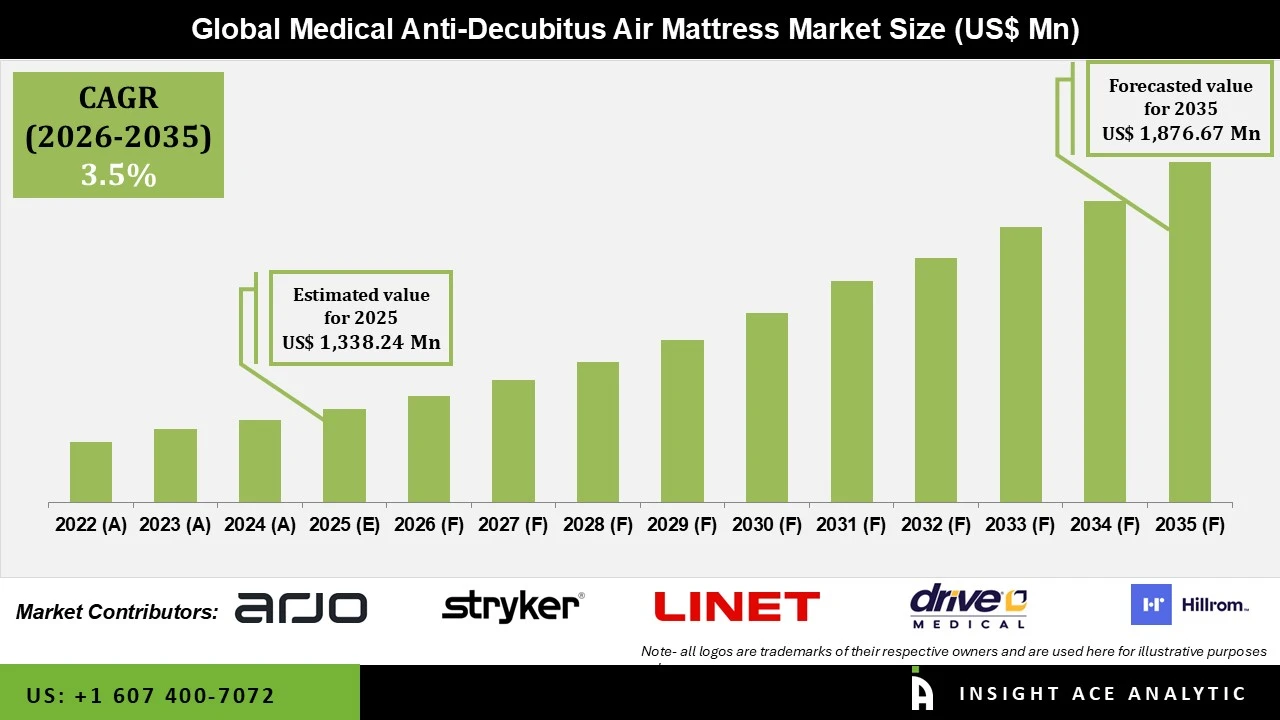
Medical Anti Decubitus Air Mattress Market Size is valued at USD 1,338.24 Mn in 2025 and is predicted to reach USD 1,876.67 Mn by the year 2035 at a 4.5% CAGR during the forecast period for 2026 to 2035.
Medical Anti Decubitus Air Mattress Market Size, Share & Trends Analysis Distribution by Mattress Type (Static Air Mattress, Alternating Pressure Air Mattress, Hybrid Air Mattress, Low Air Loss Mattress, and Others), Application (Hospitals, Homecare, Nursing Homes, Rehabilitation Centers, and Others), and Segment Forecasts, 2026 to 2035
A medical anti-decubitus air mattress is a specialized therapeutic support surface intended to help patients who are bedridden or have restricted mobility avoid and treat pressure ulcers, sometimes referred to as bedsores or decubitus ulcers. These mattresses feature air-filled cells that are linked to an electric pump system that periodically inflates and deflates various mattress parts. This dynamic pressure redistribution enhances blood circulation, lessens tissue damage, and lessens extended strain on any one area of the body. The medical anti-decubitus air mattress market is driven by the growing number of hospital admissions, the rising incidence of pressure ulcers among elderly and immobile patients, and the increasing need for sophisticated pressure-relieving products in long-term and home healthcare settings.
One of the main drivers of the medical anti-decubitus air mattress market is the increasing prevalence of pressure ulcers, particularly in the elderly, bedridden, and people with limited mobility. The demand for therapeutic support surfaces is being driven by the need to prevent these costly and crippling conditions. Another major factor driving the demand for pressure ulcer prevention solutions is the world's aging population, which is more vulnerable to chronic illnesses and mobility impairments. Moreover, the medical anti-decubitus air mattress market is rising due to several significant healthcare developments that are developing swiftly. Hospitals and long-term care institutions urgently need to invest in better preventive pressure relief solutions due to the increase in pressure ulcers among the elderly, disabled, and chronically ill patient populations.
In addition, there is an increasing emphasis on preventative healthcare initiatives to lessen the burden on healthcare systems. This tendency is supported by the usage of particular mattresses to prevent pressure ulcers, which will drive the medical anti-decubitus air mattress market expansion as people and healthcare organizations seek out preventive measures. The effectiveness and appeal of air mattresses are enhanced by ongoing technological advancements, such as enhanced pressure distribution algorithms, sensor fusion, and user interface controls, which aid in their market uptake. Additionally, laws and policies aimed at preventing hospital-acquired diseases, such as pressure ulcers, frequently encourage or even require the use of anti-decubitus support surfaces, which propel the medical anti-decubitus air mattress market expansion.
Competitive Landscape
Which are the Leading Players in Medical Anti-Decubitus Air Mattress Market?
• Arjo AB
• Stryker Corporation
• Talley Group Ltd
• Besco Medical
• Drive DeVilbiss Healthcare
• Invacare Corporation
• Medline Industries Inc.
• Joerns Healthcare
• Betten Malsch GmbH
• LINET Group SE
• Hill-Rom
• Apex Medical Corp
• Paramount Bed Holdings Co., Ltd.
• Wellell Inc.
• OSD Medical GmbH
• Others
Market Dynamics
Driver
Rapidly Increasing Elderly Population and the Rising Number of Patients with Chronic Diseases
The rapidly increasing elderly population and the rising number of patients with restricted mobility as a result of chronic illnesses, spinal cord injuries, or extended hospital stays are some of the main factors propelling the medical anti-decubitus air mattress market. Due to their weaker skin, decreased mobility, and poor blood circulation, older people are more prone to pressure ulcers. Bedsore risk is further increased by the growing prevalence of lifestyle-related illnesses like diabetes, obesity, and cardiovascular diseases. Additionally, the need for preventive healthcare products, such as air mattresses, has greatly expanded as a result. Furthermore, the use of enhanced support surfaces is expanding worldwide due to increased awareness among caregivers and healthcare professionals about patient comfort and pressure ulcer prevention.
Restrain/Challenge
High Cost of Technologically Advanced Air Mattresses
The high cost of technologically advanced air mattresses, especially those with sensors, alternating air flow systems, and automatic pressure adjustment, is a major barrier to the medical anti-decubitus air mattress market. Particularly in undeveloped and impoverished areas, insurance coverage may not fully reimburse these products, which are frequently costly for individual patients. Affordability consequently becomes a significant issue, which restricts their use in home healthcare settings. Additionally, the medical anti-decubitus air mattress market penetration is hampered by a lack of knowledge regarding pressure ulcer prevention and inadequate healthcare infrastructure in rural areas. Other issues that discourage widespread adoption and hinder market growth include maintenance requirements, reliance on energy, and the necessity for expert help.
Alternating Pressure Air Mattress Segment is Expected to Drive the Medical Anti-Decubitus Air Mattress Market
The alternating pressure air mattress category held the largest share in the Medical Anti-Decubitus Air Mattress market in 2025. Systems with advanced pressure cycling capabilities and automated control technologies, such as programmable pressure systems and intelligent monitoring technologies, are included in this category of advanced technology. These technologies allow for better blood circulation and pressure relief under all patient care conditions. The excellent therapeutic capabilities of the alternating pressure air mattress sector, which can handle a wide range of patient applications while maintaining constant pressure relief standards and clinical effectiveness across all healthcare facilities, provide for the segment's market leadership. Additionally, technological developments have increased demand for alternating pressure mattresses, resulting in improved features such as integrated monitoring systems and customizable pressure settings.
Hospitals Segment is Growing at the Highest Rate in the Medical Anti-Decubitus Air Mattress Market
In 2025, the hospitals category dominated the Medical Anti-Decubitus Air Mattress market, as a result of longer hospital stays, an increase in the number of critically ill and immobile patients, and an increase in the incidence of chronic diseases. In order to improve patient comfort, lower treatment costs, and improve clinical outcomes, hospitals are putting pressure ulcer prevention first and investing in cutting-edge anti-decubitus air mattresses, which is creating a sizable market demand. Additionally, the demand in hospital settings is further fueled by the rising number of operations, trauma cases, and extended stays in the intensive care unit. The medical anti-decubitus air mattress market expansion is also aided by government programs and hospital accreditation requirements that place a strong emphasis on preventing hospital-acquired illnesses, such as bedsores.
Why North America Led the Medical Anti-Decubitus Air Mattress Market?
The Medical Anti-Decubitus Air Mattress market was dominated by North America region in 2025 propelled by high healthcare costs and a well-established healthcare system. Government programs that encourage the prevention of pressure ulcers, such as the CMS guidelines, are contributing to the medical anti-decubitus air mattress market's expansion. Additionally, the demand for medical anti-decubitus mattresses in North America is being driven by the rising incidence of chronic illnesses and an aging population. The United States boasts advanced healthcare systems, comprehensive reimbursement programs, and a high level of awareness regarding pressure ulcer prevention requirements. Furthermore, the North American region has made significant investments in patient care technology, and government regulatory agencies are emphasizing the use of quality criteria to assess medical device performance.

Medical Anti-Decubitus Air Mattress Market Report Scope:
| Report Attribute | Specifications |
| Market size value in 2025 | USD 1,338.24 Mn |
| Revenue forecast in 2035 | USD 1,876.67 Mn |
| Growth Rate CAGR | CAGR of 4.5% from 2026 to 2035 |
| Quantitative Units | Representation of revenue in US$ Mn and CAGR from 2026 to 2035 |
| Historic Year | 2022 to 2025 |
| Forecast Year | 2026-2035 |
| Report Coverage | The forecast of revenue, the position of the company, the competitive market structure, growth prospects, and trends |
| Segments Covered | Mattress Type, Application, and By Region |
| Regional Scope | North America; Europe; Asia Pacific; Latin America; Middle East & Africa |
| Country Scope | U.S.; Canada; U.K.; Germany; China; India; Japan; Brazil; Mexico; The UK; France; Italy; Spain; China; Japan; India; South Korea; Southeast Asia; South Korea; Southeast Asia |
| Competitive Landscape | Arjo AB, Stryker Corporation, Talley Group Ltd, Besco Medical, Drive DeVilbiss Healthcare, Invacare Corporation, Medline Industries Inc., Joerns Healthcare, Betten Malsch GmbH, LINET Group SE, Hill-Rom, Apex Medical Corp, Paramount Bed Holdings Co., Ltd., Wellell Inc., OSD Medical GmbH, and Others. |
| Customization Scope | Free customization report with the procurement of the report, Modifications to the regional and segment scope. Geographic competitive landscape. |
| Pricing and Available Payment Methods | Explore pricing alternatives that are customized to your particular study requirements. |
Market Segmentation:
Medical Anti-Decubitus Air Mattress Market by Mattress Type-
• Static Air Mattress
• Alternating Pressure Air Mattress
• Hybrid Air Mattress
• Low Air Loss Mattress
• Others
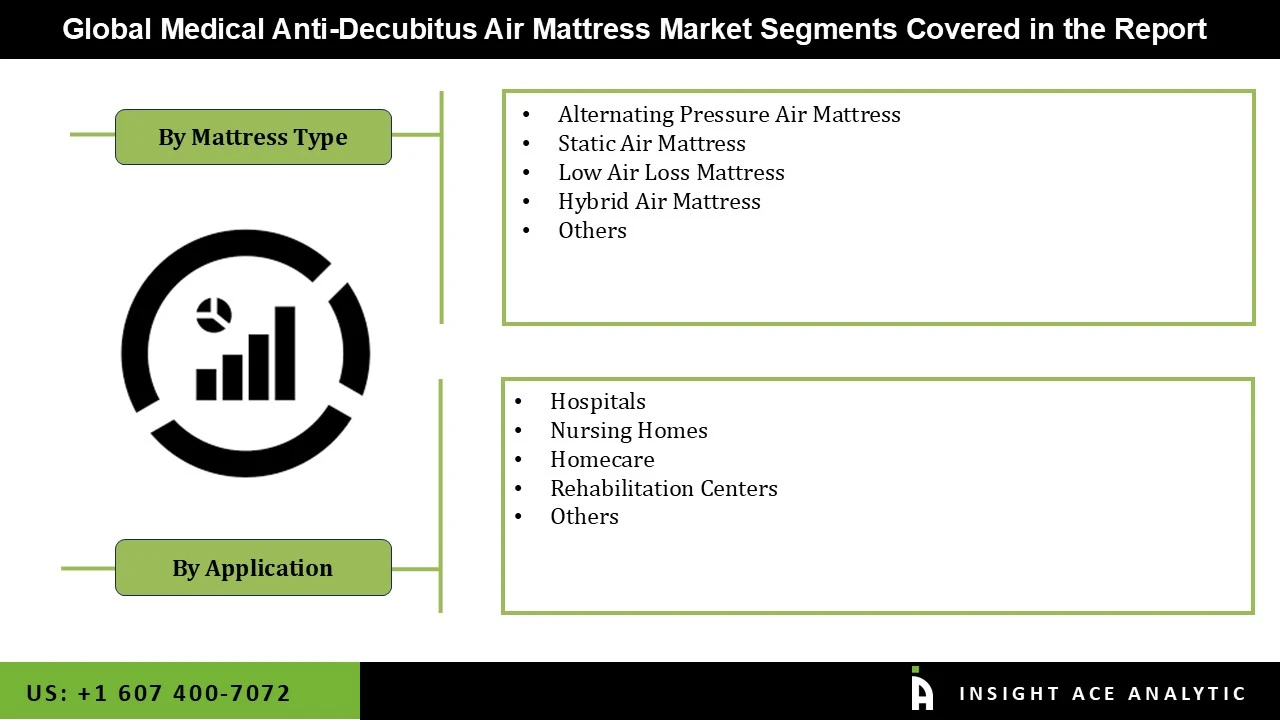
Medical Anti-Decubitus Air Mattress Market by Application-
• Hospitals
• Homecare
• Nursing Homes
• Rehabilitation Centers
• Others
Medical Anti-Decubitus Air Mattress Market By Region-
North America-
• The US
• Canada
Europe-
• Germany
• The UK
• France
• Italy
• Spain
• Rest of Europe
Asia-Pacific-
• China
• Japan
• India
• South Korea
• South East Asia
• Rest of Asia Pacific
Latin America-
• Brazil
• Argentina
• Mexico
• Rest of Latin America
Middle East & Africa-
• GCC Countries
• South Africa
• Rest of Middle East and Africa
Research Design and Approach
This study employed a multi-step, mixed-method research approach that integrates:
- Secondary research
- Primary research
- Data triangulation
- Hybrid top-down and bottom-up modelling
- Forecasting and scenario analysis
This approach ensures a balanced and validated understanding of both macro- and micro-level market factors influencing the market.
Secondary Research
Secondary research for this study involved the collection, review, and analysis of publicly available and paid data sources to build the initial fact base, understand historical market behaviour, identify data gaps, and refine the hypotheses for primary research.
Sources Consulted
Secondary data for the market study was gathered from multiple credible sources, including:
- Government databases, regulatory bodies, and public institutions
- International organizations (WHO, OECD, IMF, World Bank, etc.)
- Commercial and paid databases
- Industry associations, trade publications, and technical journals
- Company annual reports, investor presentations, press releases, and SEC filings
- Academic research papers, patents, and scientific literature
- Previous market research publications and syndicated reports
These sources were used to compile historical data, market volumes/prices, industry trends, technological developments, and competitive insights.

Primary Research
Primary research was conducted to validate secondary data, understand real-time market dynamics, capture price points and adoption trends, and verify the assumptions used in the market modelling.
Stakeholders Interviewed
Primary interviews for this study involved:
- Manufacturers and suppliers in the market value chain
- Distributors, channel partners, and integrators
- End-users / customers (e.g., hospitals, labs, enterprises, consumers, etc., depending on the market)
- Industry experts, technology specialists, consultants, and regulatory professionals
- Senior executives (CEOs, CTOs, VPs, Directors) and product managers
Interview Process
Interviews were conducted via:
- Structured and semi-structured questionnaires
- Telephonic and video interactions
- Email correspondences
- Expert consultation sessions
Primary insights were incorporated into demand modelling, pricing analysis, technology evaluation, and market share estimation.
Data Processing, Normalization, and Validation
All collected data were processed and normalized to ensure consistency and comparability across regions and time frames.
The data validation process included:
- Standardization of units (currency conversions, volume units, inflation adjustments)
- Cross-verification of data points across multiple secondary sources
- Normalization of inconsistent datasets
- Identification and resolution of data gaps
- Outlier detection and removal through algorithmic and manual checks
- Plausibility and coherence checks across segments and geographies
This ensured that the dataset used for modelling was clean, robust, and reliable.
Market Size Estimation and Data Triangulation
Bottom-Up Approach
The bottom-up approach involved aggregating segment-level data, such as:
- Company revenues
- Product-level sales
- Installed base/usage volumes
- Adoption and penetration rates
- Pricing analysis
This method was primarily used when detailed micro-level market data were available.

Top-Down Approach
The top-down approach used macro-level indicators:
- Parent market benchmarks
- Global/regional industry trends
- Economic indicators (GDP, demographics, spending patterns)
- Penetration and usage ratios
This approach was used for segments where granular data were limited or inconsistent.
Hybrid Triangulation Approach
To ensure accuracy, a triangulated hybrid model was used. This included:
- Reconciling top-down and bottom-up estimates
- Cross-checking revenues, volumes, and pricing assumptions
- Incorporating expert insights to validate segment splits and adoption rates
This multi-angle validation yielded the final market size.
Forecasting Framework and Scenario Modelling
Market forecasts were developed using a combination of time-series modelling, adoption curve analysis, and driver-based forecasting tools.
Forecasting Methods
- Time-series modelling
- S-curve and diffusion models (for emerging technologies)
- Driver-based forecasting (GDP, disposable income, adoption rates, regulatory changes)
- Price elasticity models
- Market maturity and lifecycle-based projections
Scenario Analysis
Given inherent uncertainties, three scenarios were constructed:
- Base-Case Scenario: Expected trajectory under current conditions
- Optimistic Scenario: High adoption, favourable regulation, strong economic tailwinds
- Conservative Scenario: Slow adoption, regulatory delays, economic constraints
Sensitivity testing was conducted on key variables, including pricing, demand elasticity, and regional adoption.
Request Customization
Add countries, segments, company profiles, or extend forecast — free 10% customization with purchase.
Customize This Report →Enquire Before Buying
Speak with our analyst team about scope, methodology, pricing, or deliverable formats.
Enquire Now →Frequently Asked Questions
Medical Anti Decubitus Air Mattress Market Size is valued at USD 1,338.24 Mn in 2025 and is predicted to reach USD 1,876.67 Mn by the year 2035
Medical Anti Decubitus Air Mattress Market is predicted to grow at a 4.5% CAGR during the forecast period for 2026 to 2035.
Arjo AB, Stryker Corporation, Talley Group Ltd, Besco Medical, Drive DeVilbiss Healthcare, Invacare Corporation, Medline Industries Inc., Joerns Healthcare, Betten Malsch GmbH, LINET Group SE, Hill-Rom, Apex Medical Corp, Paramount Bed Holdings Co., Ltd., Wellell Inc., OSD Medical GmbH, and Others.
Medical Anti Decubitus Air Mattress Market is segmented into Mattress Type, Application, and By Region
North America region is leading the Medical Anti Decubitus Air Mattress Market.