Molecular Tumor Board Solutions Market Size, Share, Trend, Scope Report 2026 to 2035
What is Molecular Tumor Board Solutions Market Size?
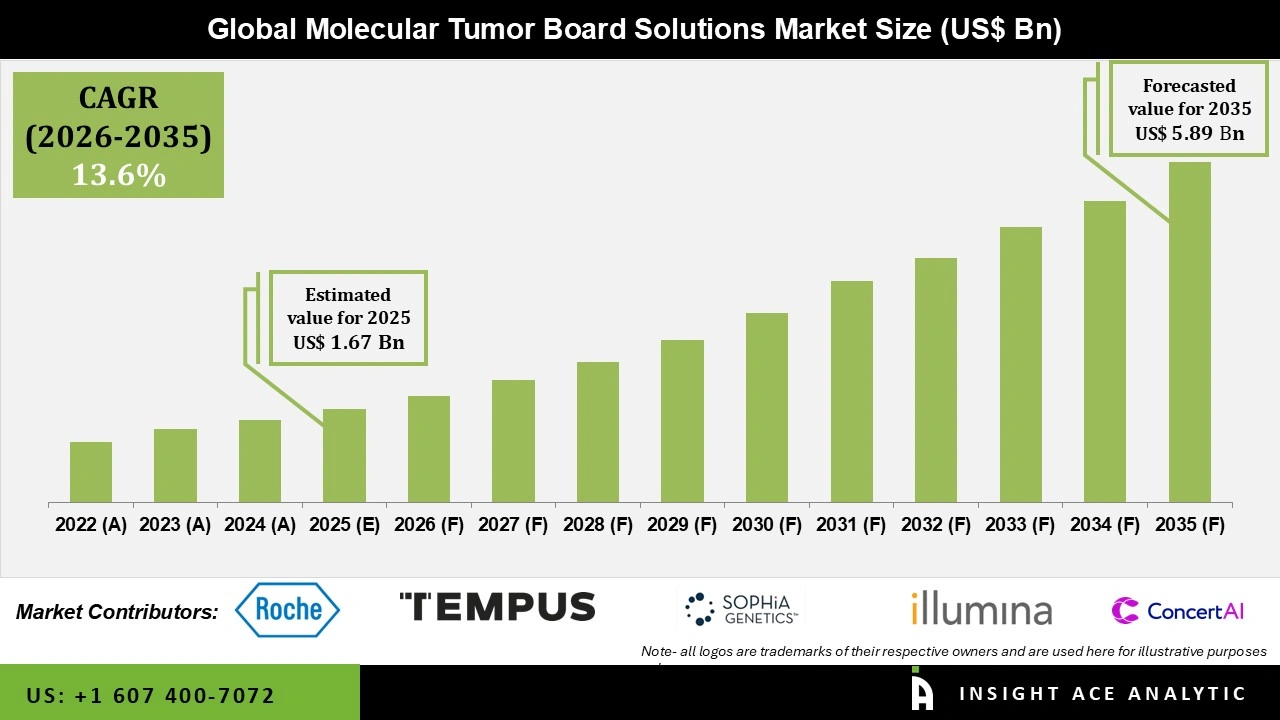
Global Molecular Tumor Board Solutions Market Size is valued at USD 1.67 Bn in 2025 and is predicted to reach USD 5.89 Bn by the year 2035 at a 13.6% CAGR during the forecast period for 2026 to 2035.
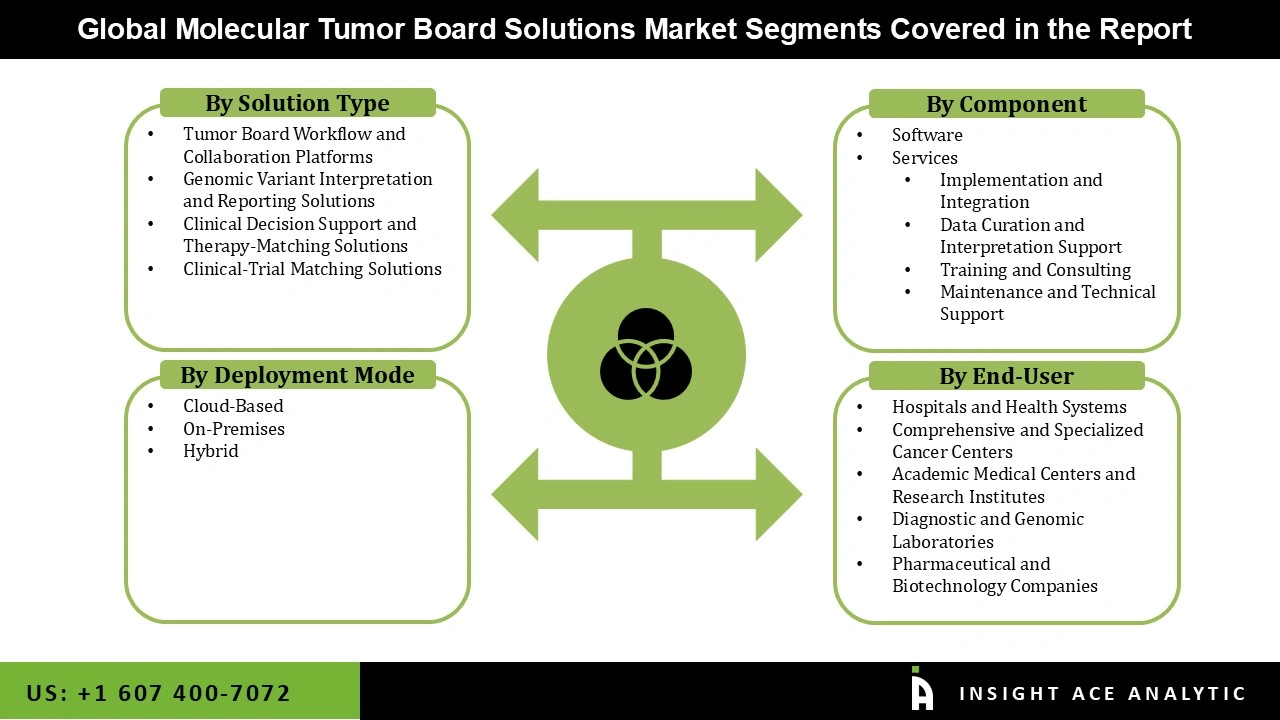
Molecular Tumor Board Solutions Market Size, Share & Trends Analysis By Solution Type (Tumor Board Workflow and Collaboration Platforms, Genomic Variant Interpretation and Reporting Solutions, Clinical Decision Support and Therapy-Matching Solutions, and Clinical-Trial Matching Solutions), Component (Software and Services), Deployment Mode (Cloud-Based, On-Premises, and Hybrid), End User (Hospitals and Integrated Health Systems, Comprehensive and Specialized Cancer Centers, Academic Medical Centers and Research Institutes, Diagnostic and Genomic Laboratories, and Pharmaceutical and Biotechnology Companies), and Segment Forecasts, 2026 to 2035.
Molecular tumor board (MTB) solutions are sophisticated technology platforms that enable multidisciplinary teams involved in the treatment of cancer patients to analyze genomic information about tumors and provide an optimal individual therapy strategy. Molecular tumor board solutions integrate patient clinical data, NGS results, biomarkers, treatment guidelines, scientific literature, and clinical trials databases into one platform. Collaboration of oncologists, pathologists, geneticists, radiologists, bioinformatics specialists, and pharmacists in the context of molecular tumor board platforms allows making better decisions in the field of personalized treatment.
Precision medicine is one of the key trends in the healthcare industry today. The rapid development of technologies used in genomics sequencing has provided healthcare specialists with vast amounts of genomic information, which can be used for finding genetic alterations connected with specific forms of cancer. However, the interpretation of such information is quite complicated. Thus, the use of MTB solutions becomes extremely relevant since they allow simplifying the process by means of integrating clinical information into a workflow.
Moreover, there is an escalating burden of cancer worldwide, which is also driving market growth. The growing numbers of lung cancer, breast cancer, colorectal cancer, prostate cancer, melanoma, and rare cancers are increasing the need for individualized treatment approaches. The use of MTB solution by healthcare providers for the assessment of biomarker-based treatments and identification of potential targeted treatments and patient matching to clinical trials is gaining traction.
Competitive Landscape
Which are the Leading Players in Molecular Tumor Board Solutions Market?
- F. Hoffmann-La Roche Ltd.
- Koninklijke Philips N.V.
- QIAGEN N.V.
- SOPHiA GENETICS SA
- Illumina, Inc.
- Molecular Health GmbH
- GenomOncology, LLC
- Velsera Inc.
- Tempus AI, Inc.
- ConcertAI, LLC
Market Dynamics
Driver
Growing Adoption of Precision Oncology and Genomic Testing
Increasing acceptance of precision oncology is one of the main factors responsible for driving the growth of the Molecular Tumor Board Solutions Market. Hospitals and clinics have shifted their focus from traditional treatments for cancers through genome sequencing of the patients' samples. This has increased the need for sophisticated software platforms that are able to interpret the genome sequences and help healthcare professionals in making decisions regarding treatment options for their patients. Molecular tumor board solutions incorporate sequencing data, guidelines, publications, biomarker database, and therapy information in a single integrated solution. These systems help oncologists in identifying the right therapy for patients without the complexity involved in interpretation of genomic reports. The process has been made simpler through use of artificial intelligence (AI)-based clinical decision support systems, which help in prioritization of clinically important variants and treatment options for patients. An increase in number of next-generation sequencing tests available in the market, increasing popularity of personalized medicines, and rising approvals for target cancer therapies are some of the other major factors driving the molecular tumor board solutions market.
Restrain/Challenge
High Implementation Costs and Limited Standardization of Genomic Data
Despite all positive factors and the presence of robust growth in the market, there are some challenges that prevent the wider acceptance of solutions offered by the molecular tumor boards. One of such major challenges is the expensive nature of developing an advanced platform for genomic data analysis, integration with various hospital information systems and cloud computing. The other challenge is the nonstandardization issue that exists in relation to various genomic testing laboratories. Sequencing platforms produce data according to different formats, reporting criteria, and methods for the interpretation of variants. Another problem that needs to be taken into account is the need for highly specialized staff to analyze rare genetic variants. Currently, a shortage of qualified staff is still a serious problem for many healthcare facilities. Apart from that, there are also some regulatory and reimbursement-related challenges that influence the market adoption process.
Software Segment Is Expected to Hold the Largest Share of the Molecular Tumor Board Solutions Market
The software segment is expected to account for the largest share of the Molecular Tumor Board Solutions Market during the forecast period. Software represents the central technology layer used to collect patient information, analyze genomic variants, match biomarkers with therapies, identify clinical trials, prepare tumor-board presentations, and document treatment recommendations.
Cloud-based Deployment Segment is Projected to Register the Fastest Growth
Cloud deployment is anticipated to register the highest growth rate during the prediction period owing to its scalability, accessibility, and capacity to enable collaboration among healthcare professionals across geographically dispersed locations. With the help of cloud-based molecular tumor board platform, medical experts can access genomic reports, pathology results, radiological images, biomarkers data, and treatment plans of different healthcare facilities in real-time. Healthcare providers are relying on cloud infrastructure in order to save on IT maintenance expenditures and increase flexibility and accessibility of the system. Moreover, cloud platforms facilitate updating of software, integration with EHRs, LIS, and genomic sequencing platforms, and centralization of data at multiple hospitals. Virtual tumor boards are becoming more popular, which is another driving factor of the market. The use of cloud-based platforms helps healthcare professionals located at different hospitals and research institutions collaborate remotely and share their experiences related to treatment of difficult oncologic patients. These benefits are predicted to boost the demand for cloud-based molecular tumor boards.
Why North America Led the Molecular Tumor Board Solutions Market?
North America held a leading position in the Molecular Tumor Board Solutions Market in 2025 due to its advanced precision-oncology infrastructure, extensive use of genomic testing, large concentration of comprehensive cancer centers, and strong presence of healthcare technology and molecular-diagnostics companies.
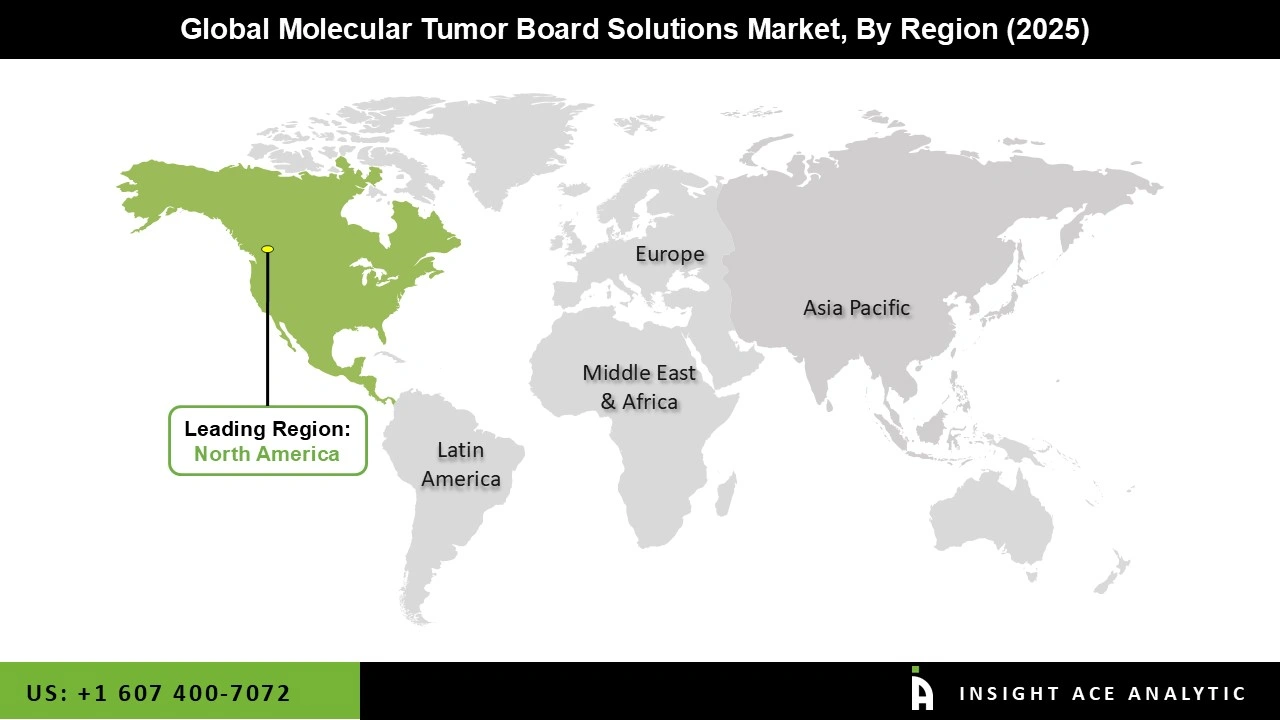
Asia Pacific is expected to register a high growth rate during the forecast period. China, Japan, South Korea, India, Australia, and Singapore are expanding genomic-testing capacity, precision-oncology programs, digital-health infrastructure, and cloud-based clinical collaboration. However, adoption will vary according to healthcare spending, genomic-testing reimbursement, data-protection regulations, and the availability of molecular specialists.
Key Development
• In August 2025, Illumina introduced Connected Insights version 5.2. The updated oncology interpretation platform added capabilities intended to improve interpretation accuracy, data visualization, and compatibility with downstream assays and non-Illumina datasets. The development supports broader adoption of genomic interpretation and reporting across oncology laboratories and precision-medicine programs.
Molecular Tumor Board Solutions Market Report Scope:
| Report Attribute | Specifications |
| Market size value in 2025 | USD 1.67 Bn |
| Revenue forecast in 2035 | USD 5.89 Bn |
| Growth Rate CAGR | CAGR of 13.6% from 2026 to 2035 |
| Quantitative Units | Representation of revenue in US$ Bn and CAGR from 2026 to 2035 |
| Historic Year | 2022 to 2025 |
| Forecast Year | 2026-2035 |
| Report Coverage | The forecast of revenue, the position of the company, the competitive market structure, growth prospects, and trends |
| Segments Covered | Type, Component, Deployment Mode, End-user, and By Region |
| Regional Scope | North America; Europe; Asia Pacific; Latin America; Middle East & Africa |
| Country Scope | U.S.; Canada; U.K.; Germany; China; India; Japan; Brazil; Mexico; The UK; France; Italy; Spain; China; Japan; India; South Korea; Southeast Asia; South Korea; Southeast Asia |
| Competitive Landscape | F. Hoffmann-La Roche Ltd.; Koninklijke Philips N.V.; QIAGEN N.V.; SOPHiA GENETICS SA; Illumina, Inc.; Molecular Health GmbH; GenomOncology, LLC; Velsera, Inc.; Tempus AI, Inc.; ConcertAI, LLC |
| Customization Scope | Free customization report with the procurement of the report, Modifications to the regional and segment scope. Geographic competitive landscape. |
| Pricing and Available Payment Methods | Explore pricing alternatives that are customized to your particular study requirements. |
Segmentations of Molecular Tumor Board Solutions Market:
Molecular Tumor Board Solutions Market By Solution Type-
- Tumor Board Workflow and Collaboration Platforms
- Genomic Variant Interpretation and Reporting Solutions
- Clinical Decision Support and Therapy-Matching Solutions
- Clinical-Trial Matching Solutions
Molecular Tumor Board Solutions Market By Component-
- Software
- Services
- Implementation and Integration
- Data Curation and Interpretation Support
- Training and Consulting
- Maintenance and Technical Support
Molecular Tumor Board Solutions Market By Deployment Mode-
- Cloud-Based
- On-Premises
- Hybrid
Molecular Tumor Board Solutions Market By End User-
- Hospitals and Health Systems
- Comprehensive and Specialized Cancer Centers
- Academic Medical Centers and Research Institutes
- Diagnostic and Genomic Laboratories
- Pharmaceutical and Biotechnology Companies
Molecular Tumor Board Solutions Market By Region-
- North America-
- The US
- Canada
- Europe-
- Germany
- The UK
- France
- Italy
- Spain
- Rest of Europe
- Asia-Pacific-
- China
- Japan
- India
- South Korea
- South East Asia
- Rest of Asia Pacific
- Latin America-
- Brazil
- Argentina
- Mexico
- Rest of Latin America
- Middle East and Africa-
- GCC Countries
- South Africa
- Rest of Middle East and Africa
Research Design and Approach
This study employed a multi-step, mixed-method research approach that integrates:
- Secondary research
- Primary research
- Data triangulation
- Hybrid top-down and bottom-up modelling
- Forecasting and scenario analysis
This approach ensures a balanced and validated understanding of both macro- and micro-level market factors influencing the market.
Secondary Research
Secondary research for this study involved the collection, review, and analysis of publicly available and paid data sources to build the initial fact base, understand historical market behaviour, identify data gaps, and refine the hypotheses for primary research.
Sources Consulted
Secondary data for the market study was gathered from multiple credible sources, including:
- Government databases, regulatory bodies, and public institutions
- International organizations (WHO, OECD, IMF, World Bank, etc.)
- Commercial and paid databases
- Industry associations, trade publications, and technical journals
- Company annual reports, investor presentations, press releases, and SEC filings
- Academic research papers, patents, and scientific literature
- Previous market research publications and syndicated reports
These sources were used to compile historical data, market volumes/prices, industry trends, technological developments, and competitive insights.

Primary Research
Primary research was conducted to validate secondary data, understand real-time market dynamics, capture price points and adoption trends, and verify the assumptions used in the market modelling.
Stakeholders Interviewed
Primary interviews for this study involved:
- Manufacturers and suppliers in the market value chain
- Distributors, channel partners, and integrators
- End-users / customers (e.g., hospitals, labs, enterprises, consumers, etc., depending on the market)
- Industry experts, technology specialists, consultants, and regulatory professionals
- Senior executives (CEOs, CTOs, VPs, Directors) and product managers
Interview Process
Interviews were conducted via:
- Structured and semi-structured questionnaires
- Telephonic and video interactions
- Email correspondences
- Expert consultation sessions
Primary insights were incorporated into demand modelling, pricing analysis, technology evaluation, and market share estimation.
Data Processing, Normalization, and Validation
All collected data were processed and normalized to ensure consistency and comparability across regions and time frames.
The data validation process included:
- Standardization of units (currency conversions, volume units, inflation adjustments)
- Cross-verification of data points across multiple secondary sources
- Normalization of inconsistent datasets
- Identification and resolution of data gaps
- Outlier detection and removal through algorithmic and manual checks
- Plausibility and coherence checks across segments and geographies
This ensured that the dataset used for modelling was clean, robust, and reliable.
Market Size Estimation and Data Triangulation
Bottom-Up Approach
The bottom-up approach involved aggregating segment-level data, such as:
- Company revenues
- Product-level sales
- Installed base/usage volumes
- Adoption and penetration rates
- Pricing analysis
This method was primarily used when detailed micro-level market data were available.

Top-Down Approach
The top-down approach used macro-level indicators:
- Parent market benchmarks
- Global/regional industry trends
- Economic indicators (GDP, demographics, spending patterns)
- Penetration and usage ratios
This approach was used for segments where granular data were limited or inconsistent.
Hybrid Triangulation Approach
To ensure accuracy, a triangulated hybrid model was used. This included:
- Reconciling top-down and bottom-up estimates
- Cross-checking revenues, volumes, and pricing assumptions
- Incorporating expert insights to validate segment splits and adoption rates
This multi-angle validation yielded the final market size.
Forecasting Framework and Scenario Modelling
Market forecasts were developed using a combination of time-series modelling, adoption curve analysis, and driver-based forecasting tools.
Forecasting Methods
- Time-series modelling
- S-curve and diffusion models (for emerging technologies)
- Driver-based forecasting (GDP, disposable income, adoption rates, regulatory changes)
- Price elasticity models
- Market maturity and lifecycle-based projections
Scenario Analysis
Given inherent uncertainties, three scenarios were constructed:
- Base-Case Scenario: Expected trajectory under current conditions
- Optimistic Scenario: High adoption, favourable regulation, strong economic tailwinds
- Conservative Scenario: Slow adoption, regulatory delays, economic constraints
Sensitivity testing was conducted on key variables, including pricing, demand elasticity, and regional adoption.
Request Customization
Add countries, segments, company profiles, or extend forecast — free 10% customization with purchase.
Customize This Report →Enquire Before Buying
Speak with our analyst team about scope, methodology, pricing, or deliverable formats.
Enquire Now →Frequently Asked Questions
Molecular Tumor Board Solutions Market Size is valued at USD 1.67 Bn in 2025 and is predicted to reach USD 5.89 Bn by the year 2035
The Molecular Tumor Board Solutions Market is expected to grow at a 13.6% CAGR during the forecast period for 2026 to 2035
F. Hoffmann-La Roche Ltd.; Koninklijke Philips N.V.; QIAGEN N.V.; SOPHiA GENETICS SA; Illumina, Inc.; Molecular Health GmbH; GenomOncology, LLC; Velsera, Inc.; Tempus AI, Inc.; ConcertAI, LLC
Molecular Tumor Board Solutions Market is segmented into Type, Component, Deployment Mode, End-user, and Other.
North America region is leading the Molecular Tumor Board Solutions Market.