Landfill Gas Capture and Utilization Market Key Players Analysis 2026 to 2035
What is Landfill Gas Capture and Utilization Market Size?
Global Landfill Gas Capture and Utilization Market Size is valued at USD 3.55 Bn in 2025 and is predicted to reach USD 7.49 Bn by the year 2035 at a 7.7% CAGR during the forecast period for 2026 to 2035.
Landfill Gas Capture and Utilization Market Size, Share & Trends Analysis Distribution by Product Type (Renewable Natural Gas, Landfill Gas (Direct), and Medium-Btu), Application (Thermal/Heat Generation, Electricity Generation, and Fuels), By Region and Segment Forecasts, 2026 to 2035.
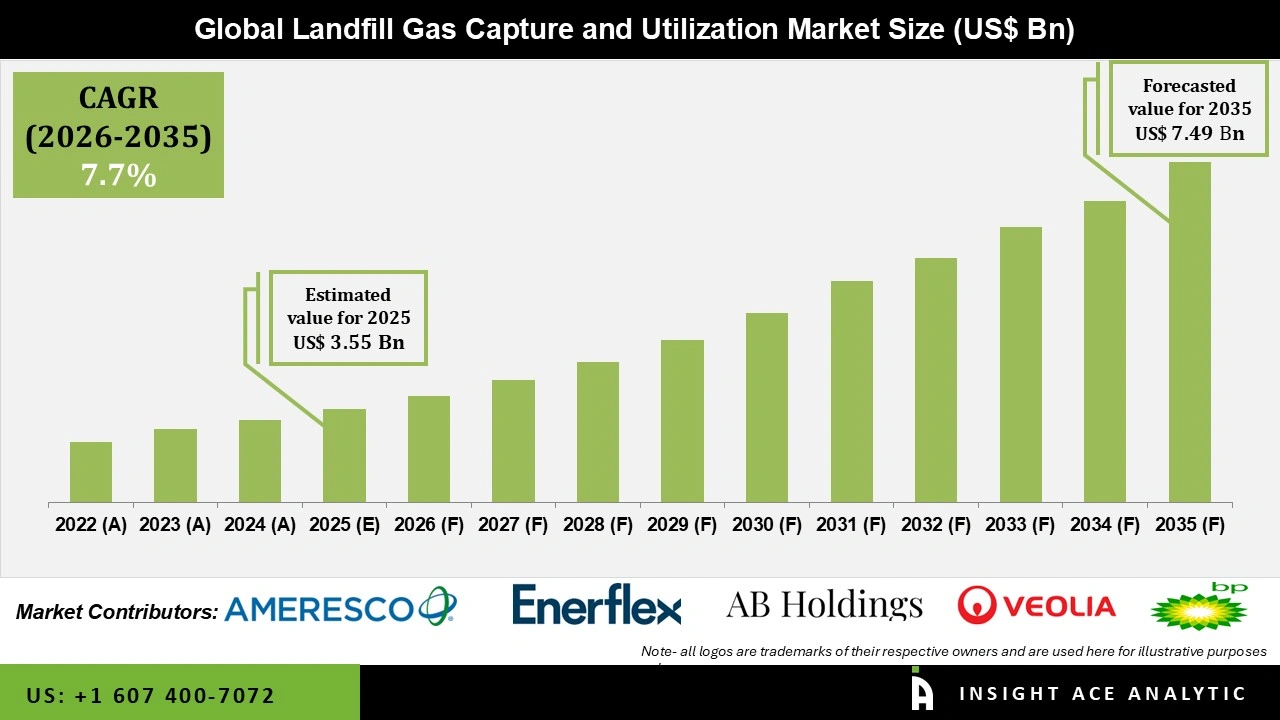
Landfill Gas Capture and Utilization Market Key Takeaways:
|
Landfill gas capture and utilization is the process of extracting and processing gas from landfills to create a variety of goods. It lowers carbon (CO2) and methane (CH4) emissions from landfills. Landfill gas-to-energy operations use a variety of components, including pipelines, turbines, sensors, generators, and other components. It is creative and environmentally beneficial to use the naturally existing gases produced during the decomposition of organic waste in landfills. The environmental restrictions on methane emissions, urban landfill expansion, early waste-to-energy programs, government subsidies for renewable energy, and public pressure to lower greenhouse gas emissions are all attributed to the landfill gas capture and utilization market growth.
The landfill gas capture and utilization market is presently undergoing a significant transition due to growing environmental consciousness and regulatory demands. The potential of landfill gas as a renewable energy source is becoming more widely recognized by stakeholders, which has increased investment and advanced gas capture system technology. In addition to being a reaction to environmental concerns, this change is part of a larger movement toward sustainable waste management techniques. The use of landfill gas capture systems seems to be accelerating as public and private organizations work to lower greenhouse gas emissions, indicating a bright future for landfill gas capture and utilization market.
Furthermore, the landfill gas capture and utilization market is probably going to gain from the increased focus on the concepts of the circular economy, which see trash as a resource rather than a burden. This paradigm change promotes creative waste management strategies, such as turning landfill gas into useful electricity. Additionally, the efficiency of gas collection procedures may be further improved by using cutting-edge technologies like anaerobic digestion and gas-to-energy systems. The landfill gas capture and utilization market appears to be well-positioned to contribute significantly to the shift to a more sustainable energy landscape as it develops, supporting international initiatives to reduce climate change and advance renewable energy sources.
Competitive Landscape
Which are the Leading Players in Landfill Gas Capture and Utilization Market?
- Ameresco
- Walker Industries
- Enerflex Ltd.
- BP p.l.c.
- ENBRIDGE INC.
- Centerpoint Energy
- Nextera Energy, Inc.
- AB HOLDING SPA
- Veolia
- EDL
- Infinis
- Biffa
- Suez
- Landfill Systems Ltd.
- CHENGTOU HOLDING CO., LTD.
- Other Prominent Players
Market Dynamics
Driver
Growing Need for Renewable Energy
The landfill gas capture and utilization market is anticipated to develop in the future due to the growing need for renewable energy. Corporate sustainability objectives, regulatory support, and environmental awareness are driving growing demand for renewable energy. By utilizing the potential of methane gas released from organic waste that is decaying in landfills, landfill gas capture and use helps meet the demand for renewable energy.
Restrain/Challenge
High Initial Investment and Ongoing Costs of Landfill Gas Capture Equipment
One of the biggest barriers in the growth of the landfill gas capture and utilization market is the high initial investment and ongoing costs of landfill gas capture equipment. Implementing these systems requires a large upfront investment in infrastructure, equipment, and upkeep, which can be prohibitive, especially for landfills or smaller towns with little funding. In poor regions or small-scale dumps, the cost of updating biogas equipment and setting up landfill gas capture systems may be prohibitive. In addition, the ongoing operational costs, which include supervision, maintenance, and energy consumption for gas extraction and purification, could reduce the projects' economic feasibility. Because of this, many landfills continue to flare gas instead of using it to generate energy.
The Landfill Gas (Direct) Segment is Expected to Drive the Landfill Gas Capture and Utilization Market
The Landfill Gas (Direct) category held the largest share in the Landfill Gas Capture and Utilization market in 2025 because it requires less capital and simpler infrastructure than either full upgrading to renewable natural gas or electricity generation. Because it involves less gas processing, takes less time to establish a project, and allows for immediate energy savings by replacing traditional fuels like coal, furnace oil, or LPG, direct use is preferred by many municipalities and industrial institutions. Furthermore, landfill operators are being encouraged to embrace direct utilization options as a workable and affordable compliance solution due to mounting regulatory pressure to limit methane emissions and minimize flaring, which is bolstering the category's ongoing market expansion.
The Electricity Generation Segment is Growing at the Highest Rate in the Landfill Gas Capture and Utilization Market
In 2025, the Electricity Generation category dominated the Landfill Gas Capture and Utilization market. The most sustainable method of managing the breakdown of organic waste is to use landfill gas for direct energy generation. The efficiency of power-producing systems may be impacted by this technique, despite its widespread use and effectiveness. Nevertheless, substituting it for traditional fossil fuels in industrial boilers or furnaces greatly increases the decrease of greenhouse gas emissions. In addition to supporting regional, renewable energy sources, the effective use of landfill gas directly encourages a boom in environmentally friendly waste management techniques. Additionally, the landfill gas capture and utilization market is being strengthened by the growing use of landfill gas for power generation as a result of the tightening regulations on methane emissions and the growing demand for clean, renewable energy.
Why North America Led the Landfill Gas Capture and Utilization Market?
The Landfill Gas Capture and Utilisation market was dominated by the North America region in 2025. The region's technological accomplishments, the quantity of operational landfills, and the existence of significant industrial centers. Due to the region's emphasis on reducing greenhouse gas emissions and achieving carbon neutrality targets, the market is expected to expand. Additionally, proactive government initiatives, industrial infrastructure, and current technological breakthroughs enable new landfill gas-to-energy projects.
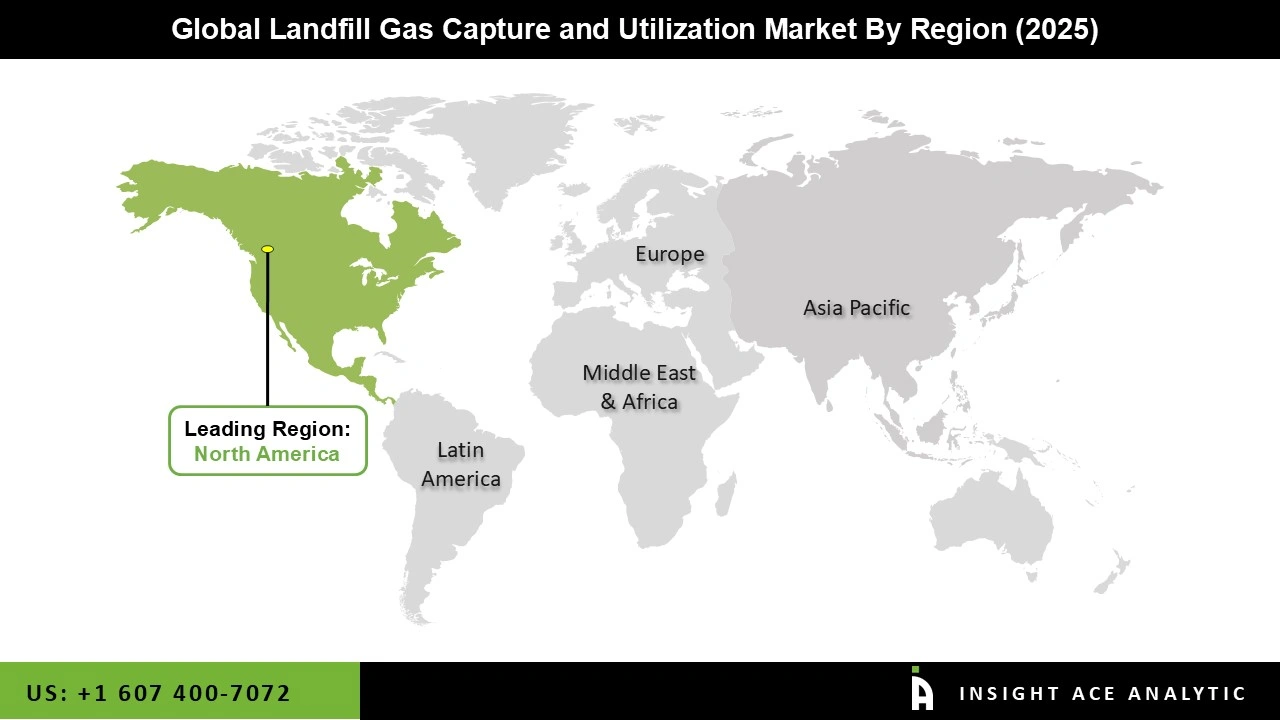
Collaborations between the landfill gas capture and utilisation market and North American suppliers spur technological advancements that lead to better landfill gas extraction techniques and capabilities. Furthermore, as governments in North America push for cleaner energy and stricter emissions controls, landfill gas capture and utilization technology is being used more and more, making it an essential part of the region's renewable energy infrastructure.
Landfill Gas Capture and Utilization Market Report Scope:
| Report Attribute | Specifications |
| Market size value in 2025 | USD 3.55 Bn |
| Revenue forecast in 2035 | USD 7.49 Bn |
| Growth Rate CAGR | CAGR of 7.7% from 2026 to 2035 |
| Quantitative Units | Representation of revenue in US$ Bn and CAGR from 2026 to 2035 |
| Historic Year | 2022 to 2025 |
| Forecast Year | 2026-2035 |
| Report Coverage | The forecast of revenue, the position of the company, the competitive market structure, growth prospects, and trends |
| Segments Covered | Product Type, Application, and By Region |
| Regional Scope | North America; Europe; Asia Pacific; Latin America; Middle East & Africa |
| Country Scope | U.S.; Canada; U.K.; Germany; China; India; Japan; Brazil; Mexico; The UK; France; Italy; Spain; China; Japan; India; South Korea; Southeast Asia; South Korea; Southeast Asia |
| Competitive Landscape | Ameresco, Walker Industries, Enerflex Ltd., BP p.l.c., ENBRIDGE INC., CenterPoint Energy, NextEra Energy, Inc., AB HOLDING SPA, Veolia, EDL, Infinis, Biffa, Suez, Landfill Systems Ltd., and CHENGTOU HOLDING CO., LTD. |
| Customization Scope | Free customization report with the procurement of the report, Modifications to the regional and segment scope. Geographic competitive landscape. |
| Pricing and Available Payment Methods | Explore pricing alternatives that are customized to your particular study requirements. |
Segmentation of Landfill Gas Capture and Utilization Market :
Landfill Gas Capture and Utilization Market, by Product Type-
- Renewable Natural Gas
- Landfill Gas (Direct)
- Medium-Btu
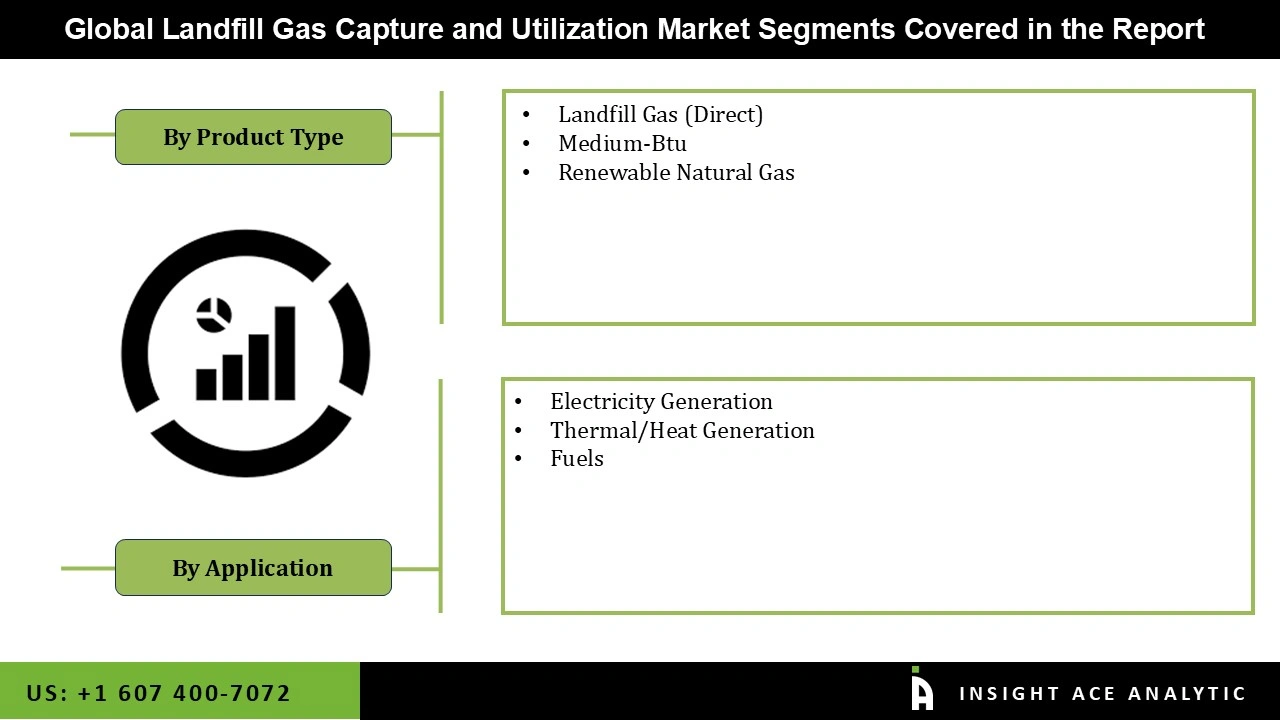
Landfill Gas Capture and Utilization Market, by Application-
- Thermal/Heat Generation
- Electricity Generation
- Fuels
Landfill Gas Capture and Utilization Market, by Region-
- North America-
- The US
- Canada
- Europe-
- Germany
- The UK
- France
- Italy
- Spain
- Rest of Europe
- Asia-Pacific-
- China
- Japan
- India
- South Korea
- South East Asia
- Rest of Asia Pacific
- Latin America-
- Brazil
- Argentina
- Mexico
- Rest of Latin America
- Middle East & Africa-
- GCC Countries
- South Africa
- Rest of Middle East and Africa
Research Design and Approach
This study employed a multi-step, mixed-method research approach that integrates:
- Secondary research
- Primary research
- Data triangulation
- Hybrid top-down and bottom-up modelling
- Forecasting and scenario analysis
This approach ensures a balanced and validated understanding of both macro- and micro-level market factors influencing the market.
Secondary Research
Secondary research for this study involved the collection, review, and analysis of publicly available and paid data sources to build the initial fact base, understand historical market behaviour, identify data gaps, and refine the hypotheses for primary research.
Sources Consulted
Secondary data for the market study was gathered from multiple credible sources, including:
- Government databases, regulatory bodies, and public institutions
- International organizations (WHO, OECD, IMF, World Bank, etc.)
- Commercial and paid databases
- Industry associations, trade publications, and technical journals
- Company annual reports, investor presentations, press releases, and SEC filings
- Academic research papers, patents, and scientific literature
- Previous market research publications and syndicated reports
These sources were used to compile historical data, market volumes/prices, industry trends, technological developments, and competitive insights.
Primary Research
Primary research was conducted to validate secondary data, understand real-time market dynamics, capture price points and adoption trends, and verify the assumptions used in the market modelling.
Stakeholders Interviewed
Primary interviews for this study involved:
- Manufacturers and suppliers in the market value chain
- Distributors, channel partners, and integrators
- End-users / customers (e.g., hospitals, labs, enterprises, consumers, etc., depending on the market)
- Industry experts, technology specialists, consultants, and regulatory professionals
- Senior executives (CEOs, CTOs, VPs, Directors) and product managers
Interview Process
Interviews were conducted via:
- Structured and semi-structured questionnaires
- Telephonic and video interactions
- Email correspondences
- Expert consultation sessions
Primary insights were incorporated into demand modelling, pricing analysis, technology evaluation, and market share estimation.
Data Processing, Normalization, and Validation
All collected data were processed and normalized to ensure consistency and comparability across regions and time frames.
The data validation process included:
- Standardization of units (currency conversions, volume units, inflation adjustments)
- Cross-verification of data points across multiple secondary sources
- Normalization of inconsistent datasets
- Identification and resolution of data gaps
- Outlier detection and removal through algorithmic and manual checks
- Plausibility and coherence checks across segments and geographies
This ensured that the dataset used for modelling was clean, robust, and reliable.
Market Size Estimation and Data Triangulation
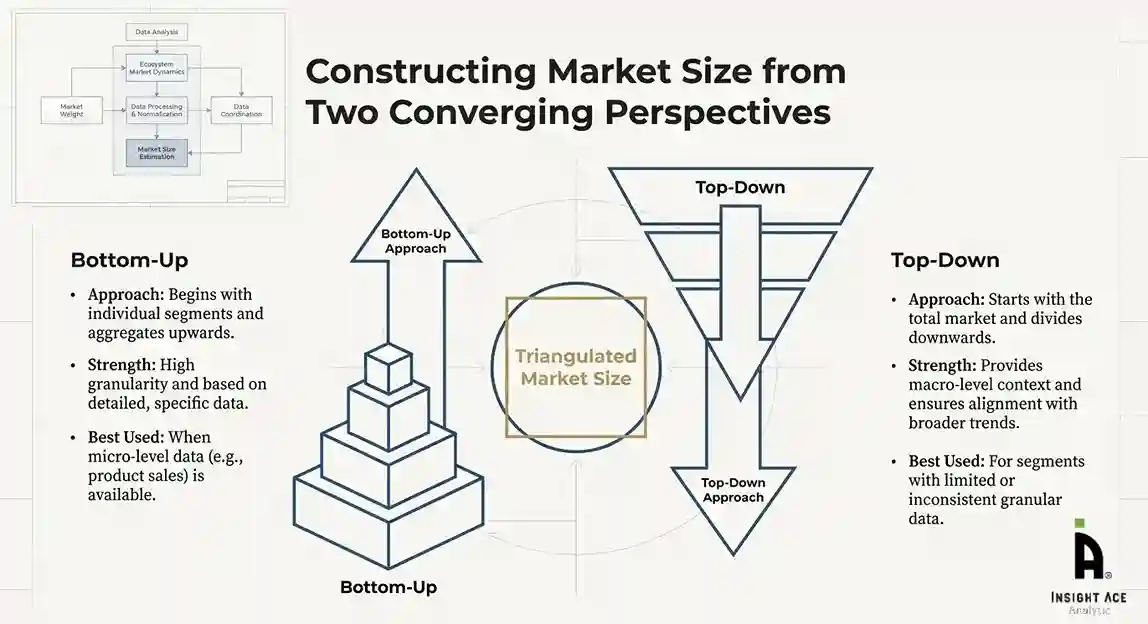
Bottom-Up Approach
The bottom-up approach involved aggregating segment-level data, such as:
- Company revenues
- Product-level sales
- Installed base/usage volumes
- Adoption and penetration rates
- Pricing analysis
This method was primarily used when detailed micro-level market data were available.
Top-Down Approach
The top-down approach used macro-level indicators:
- Parent market benchmarks
- Global/regional industry trends
- Economic indicators (GDP, demographics, spending patterns)
- Penetration and usage ratios
This approach was used for segments where granular data were limited or inconsistent.
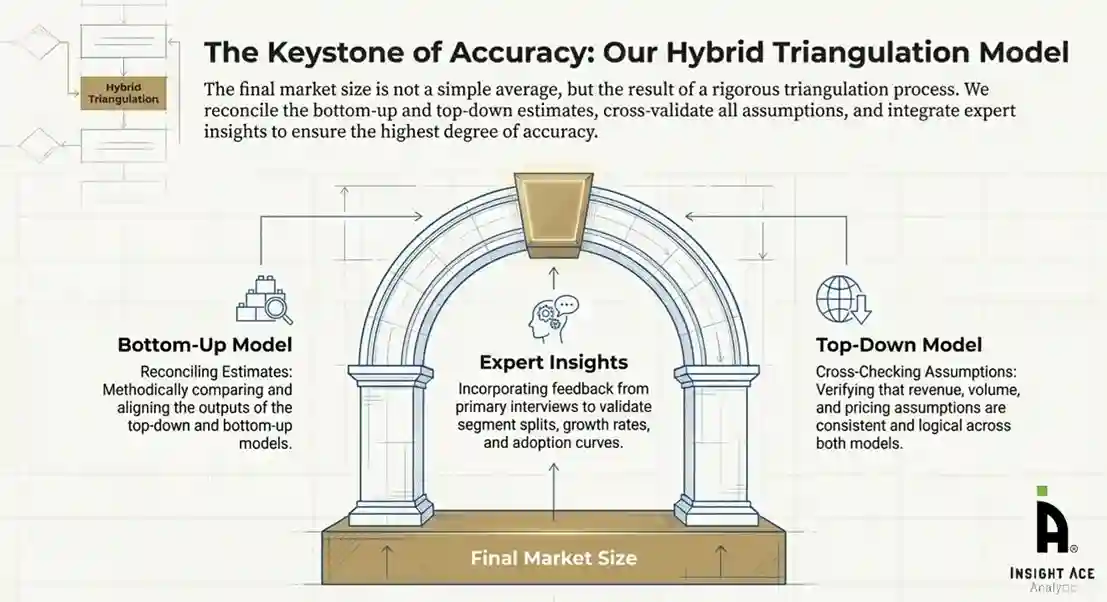
Hybrid Triangulation Approach
To ensure accuracy, a triangulated hybrid model was used. This included:
- Reconciling top-down and bottom-up estimates
- Cross-checking revenues, volumes, and pricing assumptions
- Incorporating expert insights to validate segment splits and adoption rates
This multi-angle validation yielded the final market size.
Forecasting Framework and Scenario Modelling
Market forecasts were developed using a combination of time-series modelling, adoption curve analysis, and driver-based forecasting tools.
Forecasting Methods
- Time-series modelling
- S-curve and diffusion models (for emerging technologies)
- Driver-based forecasting (GDP, disposable income, adoption rates, regulatory changes)
- Price elasticity models
- Market maturity and lifecycle-based projections
Scenario Analysis
Given inherent uncertainties, three scenarios were constructed:
- Base-Case Scenario: Expected trajectory under current conditions
- Optimistic Scenario: High adoption, favourable regulation, strong economic tailwinds
- Conservative Scenario: Slow adoption, regulatory delays, economic constraints
Sensitivity testing was conducted on key variables, including pricing, demand elasticity, and regional adoption.
Request Customization
Add countries, segments, company profiles, or extend forecast — free 10% customization with purchase.
Customize This Report →Enquire Before Buying
Speak with our analyst team about scope, methodology, pricing, or deliverable formats.
Enquire Now →Frequently Asked Questions
Landfill Gas Capture and Utilization Market Size is valued at USD 3.55 Bn in 2025 and is predicted to reach USD 7.49 Bn by the year 2035
Landfill Gas Capture and Utilization Market is expected to grow at a 7.7% CAGR during the forecast period for 2026 to 2035
Ameresco, Walker Industries, Enerflex Ltd., BP p.l.c., ENBRIDGE INC., CenterPoint Energy, NextEra Energy, Inc., AB HOLDING SPA, Veolia, EDL, Infinis, Biffa, Suez, Landfill Systems Ltd., CHENGTOU HOLDING CO., LTD. and Others.
Landfill Gas Capture and Utilization Marketis segmented into by Product Type (Renewable Natural Gas, Landfill Gas (Direct), and Medium-Btu), Application (Thermal/Heat Generation, Electricity Generation, and Fuels), and Other.
North America region is leading the Landfill Gas Capture and Utilization Market.