Heart lung Machine Market Size, Share and Trends Report 2026 to 2035
Heart lung Machine Market Size is valued at USD 2.09 Bn in 2025 and is predicted to reach USD 3.89 Bn by the year 2035 at a 6.5% CAGR during the forecast period for 2026 to 2035.
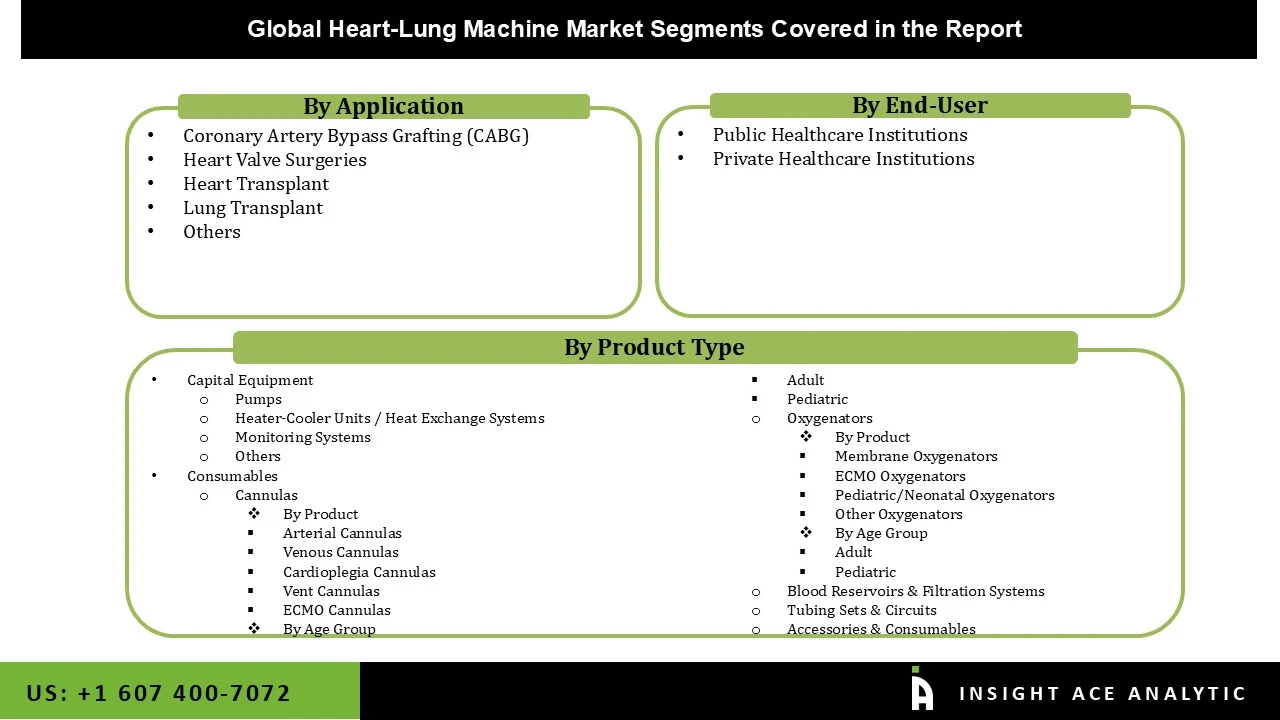
Heart-lung Machine Market Size, Share & Trends Analysis Distribution by Product Type (Capital Equipment [Heater-Cooler Units / Heat Exchange Systems, Monitoring Systems, Pumps, Others] and Consumables [Oxygenators {By Product (Membrane Oxygenators, Pediatric/Neonatal Oxygenators, ECMO Oxygenators, Other Oxygenators), By Age Group (Adult, Pediatric)}, Cannulas {By Product (Venous Cannulas, Arterial Cannulas, ECMO Cannulas, Cardioplegia Cannulas, Vent Cannulas), By Age Group (Adult, Pediatric)}, Blood Reservoirs & Filtration Systems, Accessories & Consumables, Tubing Sets & Circuits]), Application (Heart Valve Surgeries, Coronary Artery Bypass Grafting (CABG), Lung Transplant, Heart Transplant, and Others), End-user (Private Healthcare Institutions and Public Healthcare Institutions), and Segment Forecasts, 2026 to 2035
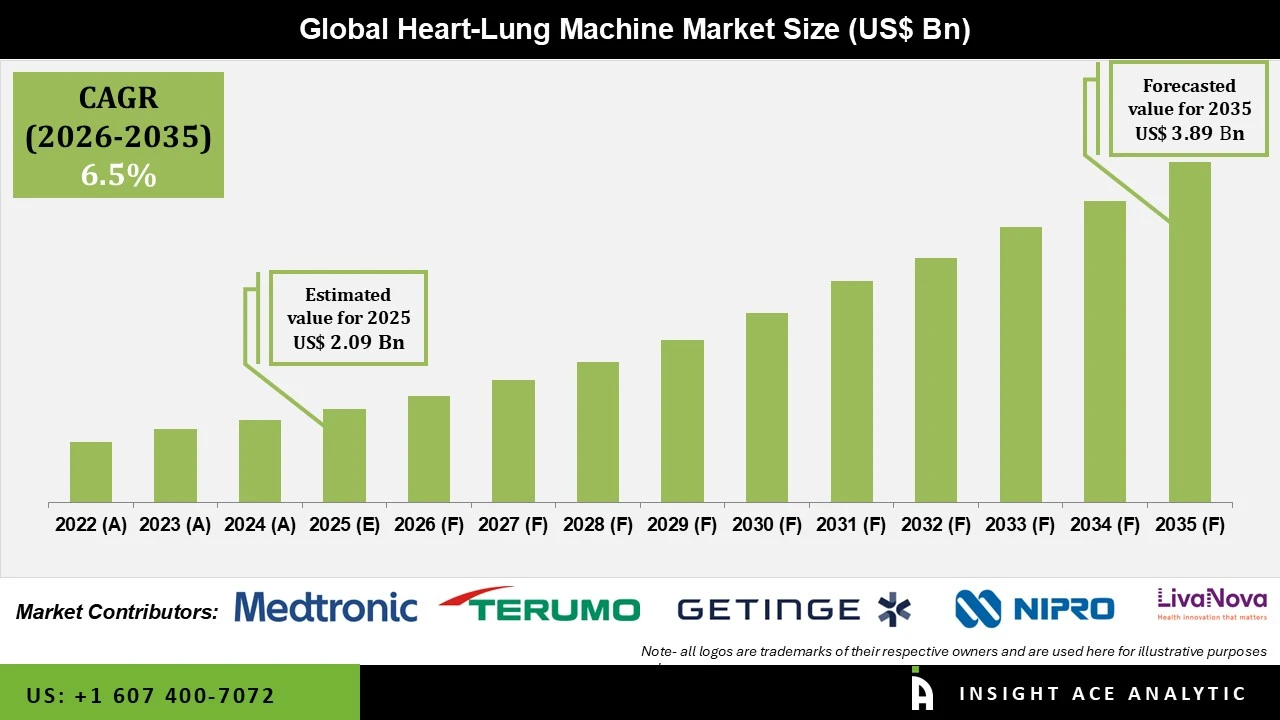
During cardiac surgery, the heart-lung machine, sometimes referred to as the cardiopulmonary bypass (CPB) machine, is an essential medical tool that temporarily replaces the heart and lungs. In patients undergoing operations like open heart surgery, it keeps their blood flowing and their oxygen levels stable. The device allows surgeons to operate on a still, bloodless field by diverting blood from the heart, oxygenating it, and removing carbon dioxide before returning it to the body. Numerous cardiac procedures require this technology, which greatly enhances surgical results and patient safety. The rising number of organ transplant procedures and the rising incidence of cardiovascular disease are major factors in the heart-lung machine market's expansion.
Globally, the number of lung procedures, heart transplants, and open heart surgeries has significantly increased in recent years. The main cause of this is a number of environmental and lifestyle changes that have increased the incidence of organ failures and cardiovascular illnesses. This has resulted into significant growth in the heart-lung machine market. Additionally, governments in a number of developing countries are working to give patients better healthcare facilities, which is fueling the heart-lung machine market. In order to update the current oxygenator pump models, industry participants are also spending money on research and development projects. These efforts have resulted in the creation of modular heart-lung devices that are safe, affordable, and easy to use.
In addition, the growing number of minimally invasive procedures, in which heart-lung machines are essential to achieving safer, more successful surgical results, is another factor driving the market's expansion. Additionally, it is anticipated that growing healthcare spending and the introduction of automated technologies that guarantee improved accuracy and decreased human error would drive market growth in the upcoming years. However, the high cost of equipment, the hazards associated with cardiopulmonary bypass, and the scarcity of medical professionals are likely to impede the growth of the heart-lung machine market. Apart from this, technical advancements and large-scale funding of research projects by significant players are some of the key elements that would provide better growth opportunities in the heart-lung machine market.
Competitive Landscape
Which are the Leading Players in Heart-lung Machine Market?
• Medtronic
• Getinge AB
• Technowood America Corporation
• Surge Cardiovascular
• EUROSETS
• Braille Biomedical
• Nipro Corporation do Brasil (NIPRO)
• Terumo Corporation
• LivaNova PLC
• Fresenius Medical Care
• MERA (Senko Medical Instrument Mfg. Co., Ltd.)
Market Dynamics
Driver
Rise in Respiratory and Cardiovascular Disorders Worldwide
The heart-lung machine market is mostly driven by the rise in respiratory and cardiovascular disorders worldwide. According to the World Health Organization, heart failure and coronary artery disease are the two main causes of cardiovascular diseases, which account for around 17.9 million deaths each year. The need for cardiopulmonary bypass treatments is driven by the increasing prevalence of cardiac disorders, especially among older populations. Modern heart-lung machines are required for the increasing number of CABG procedures that have been carried out in the United States in recent years. Additionally, rising investment for surgical infrastructure and government healthcare efforts propel market expansion. The demand for heart-lung machines has increased in India due to the expansion of access to cardiac procedures through national health systems. In North America, reimbursement policies for CABG and valve procedures motivate hospitals to invest in sophisticated equipment.
Restrain/Challenge
High Expense of Heart-lung Machine
The high expense of heart-lung machines continues to prevent their widespread use, particularly in developing nations. These devices are expensive up front because they frequently have sophisticated features like better oxygenation and biocompatibility. The total cost of ownership is increased by continuing maintenance, consumables like oxygenators, and training needs in addition to the original purchase price. Even with the rising demand for cardiopulmonary procedures, these financial constraints are hard to explain for hospitals in resource-constrained areas like rural India and parts of Latin America. Additionally, because of this, access to life-saving treatments is still restricted, highlighting the need for scalable and reasonably priced alternatives. Moreover, the necessity for experienced individuals to run and maintain these complicated machinery further inhibits the heart-lung machine market expansion.
Coronary Artery Bypass Grafting (CABG) Segment is Growing at the Highest Rate in the Heart-lung Machine Market
In 2025, the Coronary Artery Bypass Grafting (CABG) category dominated the Heart-lung Machine market driven by coronary artery disease's (CAD) high prevalence. For patients with severe CAD, where coronary artery obstructions necessitate bypass treatments to restore heart blood flow, CABG surgeries are crucial. Over 200,000 CABG procedures are carried out each year in the US alone, according to the American Heart Association (AHA). The significance of heart-lung machines is reinforced by their vital role in assisting these surgeries, which involves temporarily replacing the heart and lungs. The CABG category is still essential to maintaining the expansion of the heart-lung machine industry as the number of individuals diagnosed with CAD rises worldwide.
Public Healthcare Institutions Segment is Expected to Drive the Heart-lung Machine Market
The Public Healthcare Institutions category held the largest share in the Heart-lung Machine market in 2025 driven by rising government spending on improving hospital facilities and increasing access to cutting-edge heart care treatments. Reliable and affordable cardiopulmonary bypass systems are in high demand because to the rising incidence of cardiovascular disorders and an increase in the number of heart surgeries carried out in public hospitals. Additionally, the adoption is being aided by public sector attempts to modernize operating rooms, create cardiac centers, and enhance critical care skills. Large-volume purchases are also made possible by advantageous reimbursement rules, public health insurance programs, and procurement initiatives, all of which support the segment's consistent heart-lung machine market expansion.
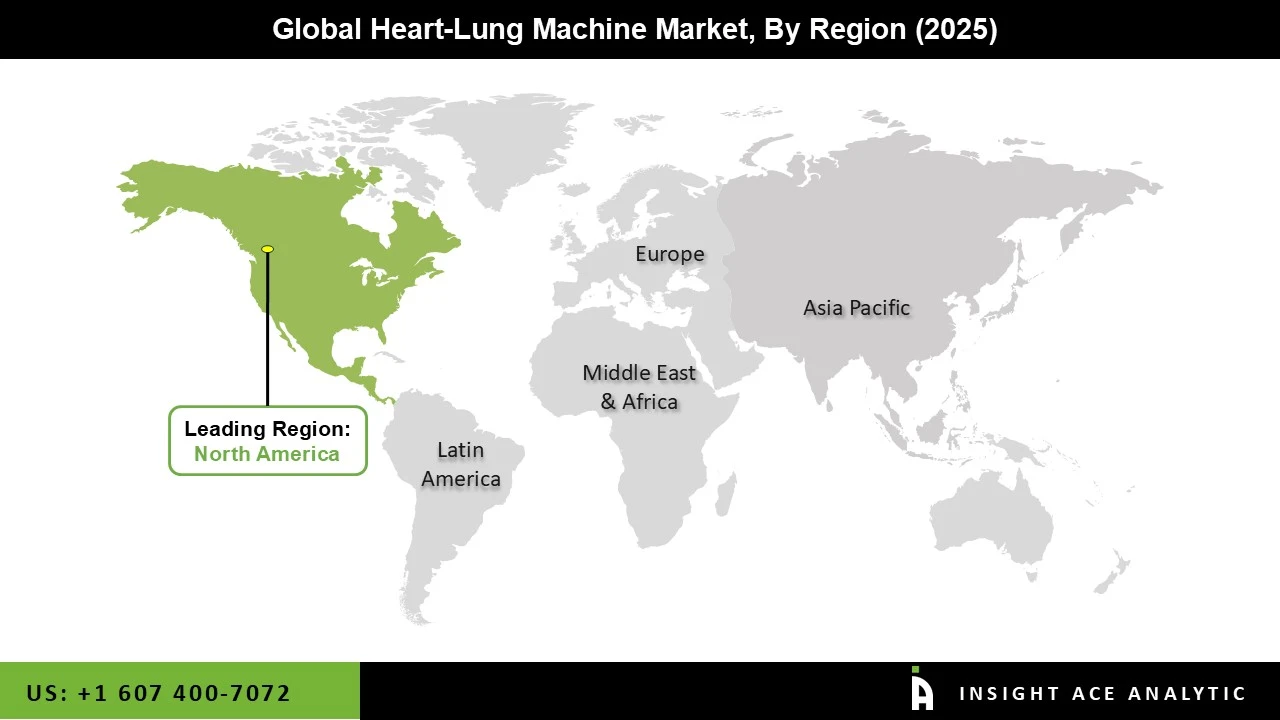
Why North America Led the Heart-lung Machine Market?
The Heart-lung Machine market was dominated by North America region in 2025 due to numerous factors, the region has a high frequency of cardiovascular disorders, adding to a substantial demand for cardiac surgery and procedures where heart-lung machines are needed. Furthermore, North America is renowned for its cutting-edge healthcare infrastructure, which includes hospitals and well-known cardiac clinics with cutting-edge equipment and technology. Moreover, the region benefits from considerable research and development activity in the field of cardiac care, leading to continual advances in heart-lung machine systems. In addition, North America's high healthcare costs and advantageous reimbursement systems encourage the use of pricey medical technologies like heart-lung machines.
Heart-lung Machine Market Report Scope:
| Report Attribute | Specifications |
| Market size value in 2025 | USD 2.09 Bn |
| Revenue forecast in 2035 | USD 3.89 Bn |
| Growth Rate CAGR | CAGR of 6.5% from 2026 to 2035 |
| Quantitative Units | Representation of revenue in US$ Bn and CAGR from 2026 to 2035 |
| Historic Year | 2022 to 2025 |
| Forecast Year | 2026-2035 |
| Report Coverage | The forecast of revenue, the position of the company, the competitive market structure, growth prospects, and trends |
| Segments Covered | Product Type, Application, End-user, and By Region |
| Regional Scope | North America; Europe; Asia Pacific; Latin America; Middle East & Africa |
| Country Scope | U.S.; Canada; U.K.; Germany; China; India; Japan; Brazil; Mexico; The UK; France; Italy; Spain; China; Japan; India; South Korea; Southeast Asia; South Korea; Southeast Asia |
| Competitive Landscape | Medtronic, Getinge AB, Technowood America Corporation, Surge Cardiovascular, EUROSETS, Braille Biomedical, Nipro Corporation do Brasil (NIPRO), Terumo Corporation, LivaNova PLC, Fresenius Medical Care, and MERA (Senko Medical Instrument Mfg. Co., Ltd.). |
| Customization Scope | Free customization report with the procurement of the report, Modifications to the regional and segment scope. Geographic competitive landscape. |
| Pricing and Available Payment Methods | Explore pricing alternatives that are customized to your particular study requirements. |
Market Segmentation:
Heart-lung Machine Market by Product Type-
- Capital Equipment
-
- Heater-Cooler Units / Heat Exchange Systems
- Monitoring Systems
- Pumps
- Others
- Consumables
-
- Oxygenators
- By Product
-
- Membrane Oxygenators
- Pediatric/Neonatal Oxygenators
- ECMO Oxygenators
- Other Oxygenators
- By Age Group
-
- Adult
- Pediatri
- Cannulas
- By Product
-
- Venous Cannulas
- Arterial Cannulas
- ECMO Cannulas
- Cardioplegia Cannulas
- Vent Cannulas
- By Age Group
-
- Adult
- Pediatric
-
- Blood Reservoirs & Filtration Systems
- Accessories & Consumables
- Tubing Sets & Circuits
Heart-lung Machine Market by Application-
- Heart Valve Surgeries
- Coronary Artery Bypass Grafting (CABG)
- Lung Transplant
- Heart Transplant
- Others
Heart-lung Machine Market by End-user-
- Private Healthcare Institutions
- Public Healthcare Institutions
Research Design and Approach
This study employed a multi-step, mixed-method research approach that integrates:
- Secondary research
- Primary research
- Data triangulation
- Hybrid top-down and bottom-up modelling
- Forecasting and scenario analysis
This approach ensures a balanced and validated understanding of both macro- and micro-level market factors influencing the market.
Secondary Research
Secondary research for this study involved the collection, review, and analysis of publicly available and paid data sources to build the initial fact base, understand historical market behaviour, identify data gaps, and refine the hypotheses for primary research.
Sources Consulted
Secondary data for the market study was gathered from multiple credible sources, including:
- Government databases, regulatory bodies, and public institutions
- International organizations (WHO, OECD, IMF, World Bank, etc.)
- Commercial and paid databases
- Industry associations, trade publications, and technical journals
- Company annual reports, investor presentations, press releases, and SEC filings
- Academic research papers, patents, and scientific literature
- Previous market research publications and syndicated reports
These sources were used to compile historical data, market volumes/prices, industry trends, technological developments, and competitive insights.
Primary Research
Primary research was conducted to validate secondary data, understand real-time market dynamics, capture price points and adoption trends, and verify the assumptions used in the market modelling.
Stakeholders Interviewed
Primary interviews for this study involved:
- Manufacturers and suppliers in the market value chain
- Distributors, channel partners, and integrators
- End-users / customers (e.g., hospitals, labs, enterprises, consumers, etc., depending on the market)
- Industry experts, technology specialists, consultants, and regulatory professionals
- Senior executives (CEOs, CTOs, VPs, Directors) and product managers
Interview Process
Interviews were conducted via:
- Structured and semi-structured questionnaires
- Telephonic and video interactions
- Email correspondences
- Expert consultation sessions
Primary insights were incorporated into demand modelling, pricing analysis, technology evaluation, and market share estimation.
Data Processing, Normalization, and Validation
All collected data were processed and normalized to ensure consistency and comparability across regions and time frames.
The data validation process included:
- Standardization of units (currency conversions, volume units, inflation adjustments)
- Cross-verification of data points across multiple secondary sources
- Normalization of inconsistent datasets
- Identification and resolution of data gaps
- Outlier detection and removal through algorithmic and manual checks
- Plausibility and coherence checks across segments and geographies
This ensured that the dataset used for modelling was clean, robust, and reliable.
Market Size Estimation and Data Triangulation
Bottom-Up Approach
The bottom-up approach involved aggregating segment-level data, such as:
- Company revenues
- Product-level sales
- Installed base/usage volumes
- Adoption and penetration rates
- Pricing analysis
This method was primarily used when detailed micro-level market data were available.
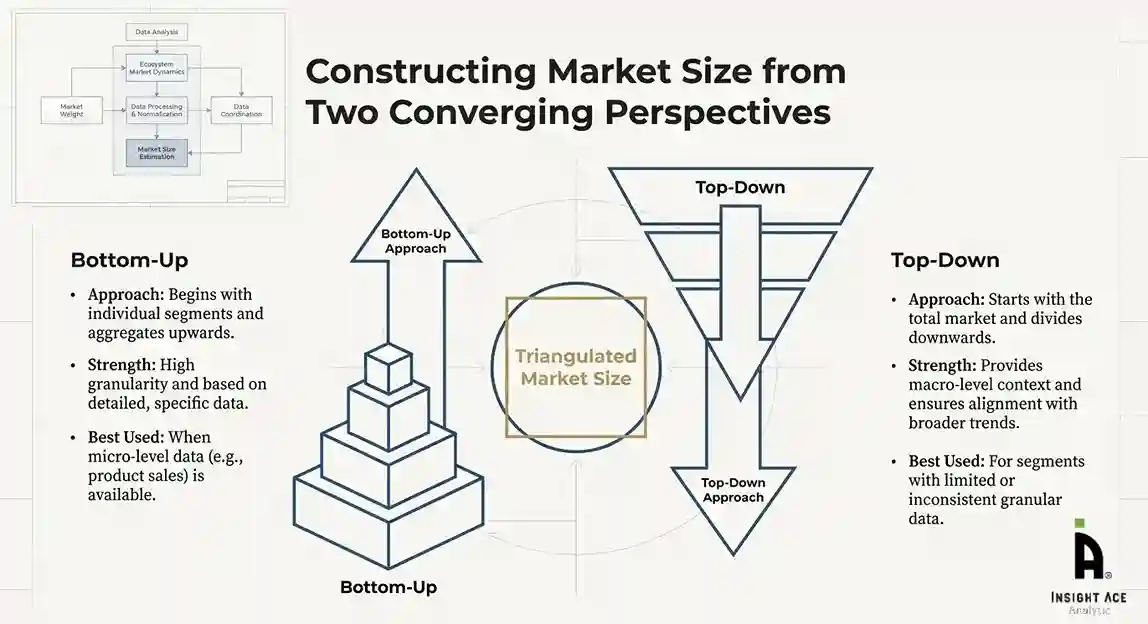
Top-Down Approach
The top-down approach used macro-level indicators:
- Parent market benchmarks
- Global/regional industry trends
- Economic indicators (GDP, demographics, spending patterns)
- Penetration and usage ratios
This approach was used for segments where granular data were limited or inconsistent.
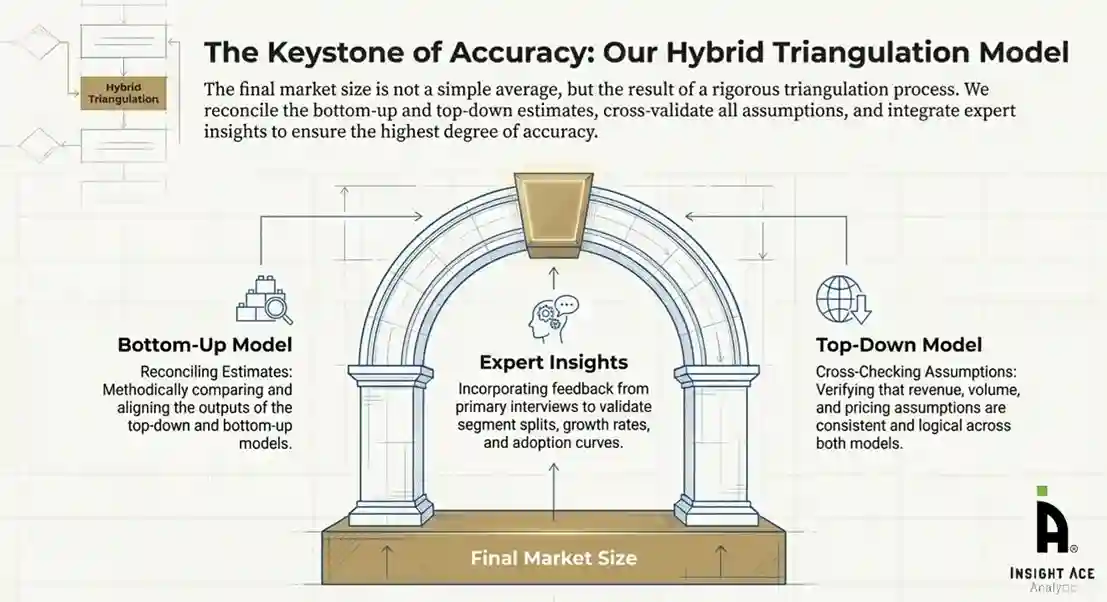
Hybrid Triangulation Approach
To ensure accuracy, a triangulated hybrid model was used. This included:
- Reconciling top-down and bottom-up estimates
- Cross-checking revenues, volumes, and pricing assumptions
- Incorporating expert insights to validate segment splits and adoption rates
This multi-angle validation yielded the final market size.
Forecasting Framework and Scenario Modelling
Market forecasts were developed using a combination of time-series modelling, adoption curve analysis, and driver-based forecasting tools.
Forecasting Methods
- Time-series modelling
- S-curve and diffusion models (for emerging technologies)
- Driver-based forecasting (GDP, disposable income, adoption rates, regulatory changes)
- Price elasticity models
- Market maturity and lifecycle-based projections
Scenario Analysis
Given inherent uncertainties, three scenarios were constructed:
- Base-Case Scenario: Expected trajectory under current conditions
- Optimistic Scenario: High adoption, favourable regulation, strong economic tailwinds
- Conservative Scenario: Slow adoption, regulatory delays, economic constraints
Sensitivity testing was conducted on key variables, including pricing, demand elasticity, and regional adoption.
Request Customization
Add countries, segments, company profiles, or extend forecast — free 10% customization with purchase.
Customize This Report →Enquire Before Buying
Speak with our analyst team about scope, methodology, pricing, or deliverable formats.
Enquire Now →Frequently Asked Questions
Heart lung Machine Market Size is valued at USD 2.09 Bn in 2025 and is predicted to reach USD 3.89 Bn by the year 2035
Heart lung Machine Market Size is predicted to develop at a 6.5% CAGR during the forecast period for 2026 to 2035.
Medtronic, Getinge AB, Technowood America Corporation, Surge Cardiovascular, EUROSETS, Braille Biomedical, Nipro Corporation do Brasil (NIPRO), Terumo Corporation, LivaNova PLC, Fresenius Medical Care, and MERA (Senko Medical Instrument Mfg. Co., Ltd.).
Heart lung Machine Market is segmented into Product Type, Application, End-user, and By Region
North America region is leading the Heart lung Machine Market.