Neurovascular Mechanical Thrombectomy Devices Market Size, Revenue, Forecast Report 2026 to 2035
What is Neurovascular Mechanical Thrombectomy Devices Market Size?
Neurovascular Mechanical Thrombectomy Devices Market is estimated to grow at a 8.5% CAGR during the forecast period for 2026 to 2035.
Neurovascular Mechanical Thrombectomy Devices Market Size, Share & Trends Analysis Distribution by Product (Stent Retrievers, Aspiration Catheters, Superbore (≥0.085"), Large-Bore (0.068"–0.084"), Small-Bore / Distal (<0.068"), Aspiration Pumps & Consumables, Aspiration Pumps, Tubing & Canisters, Balloon Guide Catheters, Emerging Clot-Capture Devices), by Occlusion Location (Anterior Circulation Large Vessel Occlusion, Posterior Circulation Occlusion, Medium & Distal Vessel Occlusion), by End User (Comprehensive / Tertiary Stroke Centers, Thrombectomy-Capable & Secondary Stroke Centers) and Segment Forecasts, 2026 to 2035
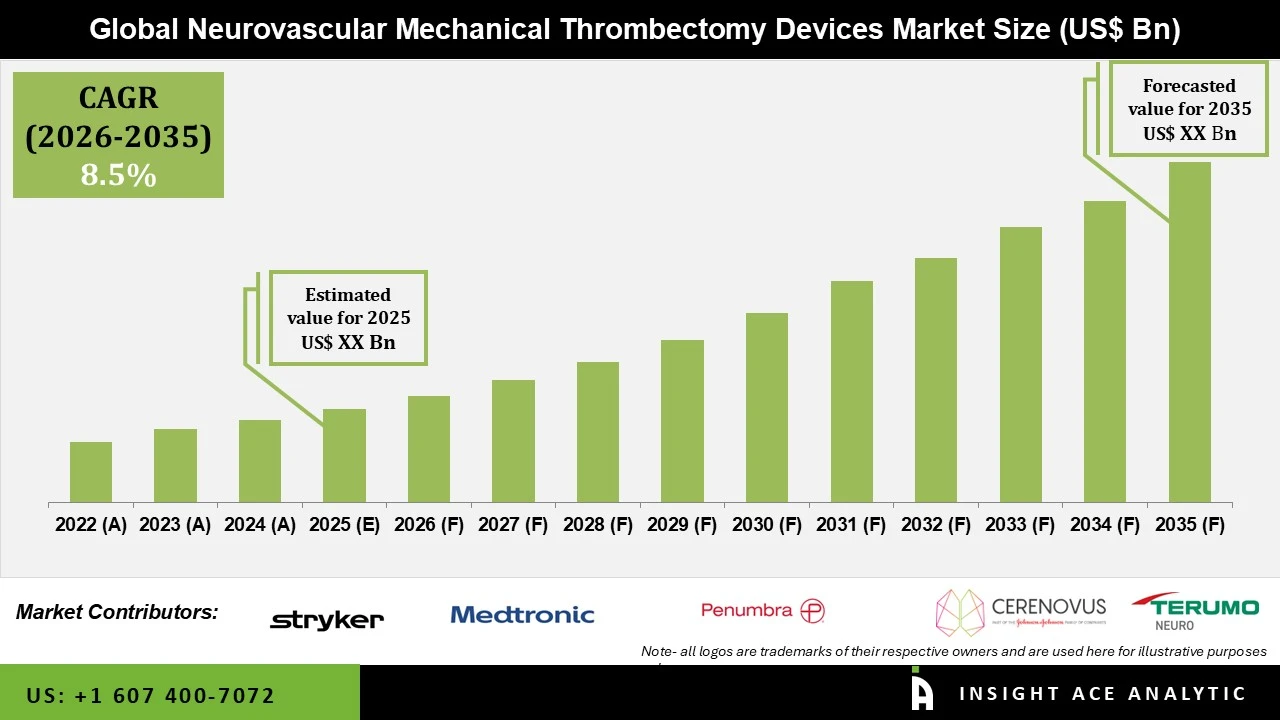
Neurovascular mechanical thrombectomy devices are specialised tools used to remove blood clots from blocked brain vessels, mainly in patients with acute ischemic stroke. These devices help restore blood flow by capturing, retrieving, or aspirating clots from cerebral arteries, which lowers the risk of serious neurological damage. The main technologies include stent retrievers, aspiration catheters, aspiration pumps and related consumables, balloon guide catheters, and new clot-capture devices. Recent product developments aim to make clot removal more efficient, improve access to blood vessels, increase safety during procedures, and achieve better treatment results for different types and locations of vessel blockages.
The market for neurovascular mechanical thrombectomy devices includes the development, manufacturing, distribution, and sale of these devices and their consumables for treating strokes with endovascular procedures. These devices are mainly used for large vessel occlusions in the front and back parts of the brain, as well as for medium and smaller vessel blockages. The market involves medical device makers, technology developers, and healthcare providers who work in comprehensive, tertiary, thrombectomy-capable, and secondary stroke centres. It covers both existing thrombectomy systems and new technologies aimed at making procedures more efficient, increasing access to treatment, and meeting the changing needs of stroke care.
Competitive Landscape
Which are the Leading Players in the Neurovascular Mechanical Thrombectomy Devices Market?
• Stryker Corporation
• Medtronic plc
• Penumbra, Inc.
• Johnson & Johnson MedTech (Cerenovus)
• Terumo Neuro (Terumo Corporation)
• Wallaby Medical (WallabyPhenox)
• Rapid Medical Ltd.
• Imperative Care, Inc.
• Route 92 Medical, Inc.
• Acandis GmbH
• Vesalio
• Perfuze Ltd.
• Anaconda Biomed, S.L.
• MicroPort NeuroScientific Corporation
• Zylox-Tonbridge Medical Technology Co., Ltd.
• Peijia Medical Limited
• Shanghai HeartCare Medical Technology Co., Ltd.
• HeMo Bioengineering Co., Ltd.
Market Dynamics
Driver
Rising Prevalence of Ischemic Stroke and Growing Demand for Minimally Invasive Treatment As ischemic stroke becomes more common and the need for quick, effective clot removal grows, demand for neurovascular mechanical thrombectomy devices is rising. Mechanical thrombectomy has become an important treatment approach for patients with acute ischemic stroke caused by large vessel blockages, helping doctors restore blood flow by removing clots from blocked brain arteries. Better stroke diagnosis, increased awareness of early symptoms, and wider access to specialised endovascular care are also boosting the market. Ongoing improvements in stent retrievers, aspiration catheters, and clot-capture tools are leading more healthcare providers to use advanced thrombectomy solutions, making procedures more efficient and improving patient outcomes.
Restrain/Challenge
High Procedural Complexity and Limited Access to Specialised Stroke Treatment Centres One major challenge for the neurovascular mechanical thrombectomy devices market is that endovascular procedures are complex and there aren’t enough specialized stroke treatment centers in many areas. Mechanical thrombectomy needs skilled neurointerventional specialists, advanced imaging, catheter labs, and well-coordinated emergency stroke teams. These needs can raise treatment costs and make access harder, especially in developing or underserved regions. Differences in patient anatomy, clot type, and where the blockage is can also affect which device is used and how well the procedure works. This means there is a constant need to improve device design, train doctors, and update treatment protocols.
Stent Retrievers Segment is Expected to Drive the Neurovascular Mechanical Thrombectomy Devices Market
Stent retrievers are expected to make up a large part of the neurovascular mechanical thrombectomy devices market because they play a key role in treating acute ischemic stroke. These devices grab and remove blood clots from blocked brain arteries, helping doctors restore blood flow. Their wide use in clinics, strong product lineups, and ongoing improvements in design, flexibility, and performance are helping this segment grow. Also, more doctors are using stent retrievers together with aspiration catheters, which makes these devices even more important in thrombectomy procedures.
Aspiration Catheters Segment is Expected to Drive the Neurovascular Mechanical Thrombectomy Devices Market
The aspiration catheters segment is expected to grow quickly as more doctors use direct aspiration techniques and as catheter designs improve. These devices let doctors remove blood clots by suction, giving an alternative or extra option to stent retriever procedures. Better catheter size, flexibility, and ability to reach difficult areas are making it easier to remove clots. The creation of large-bore and superbore catheters also means more types of clots and blood vessels can be treated, which is leading more neurointerventional specialists to use them.
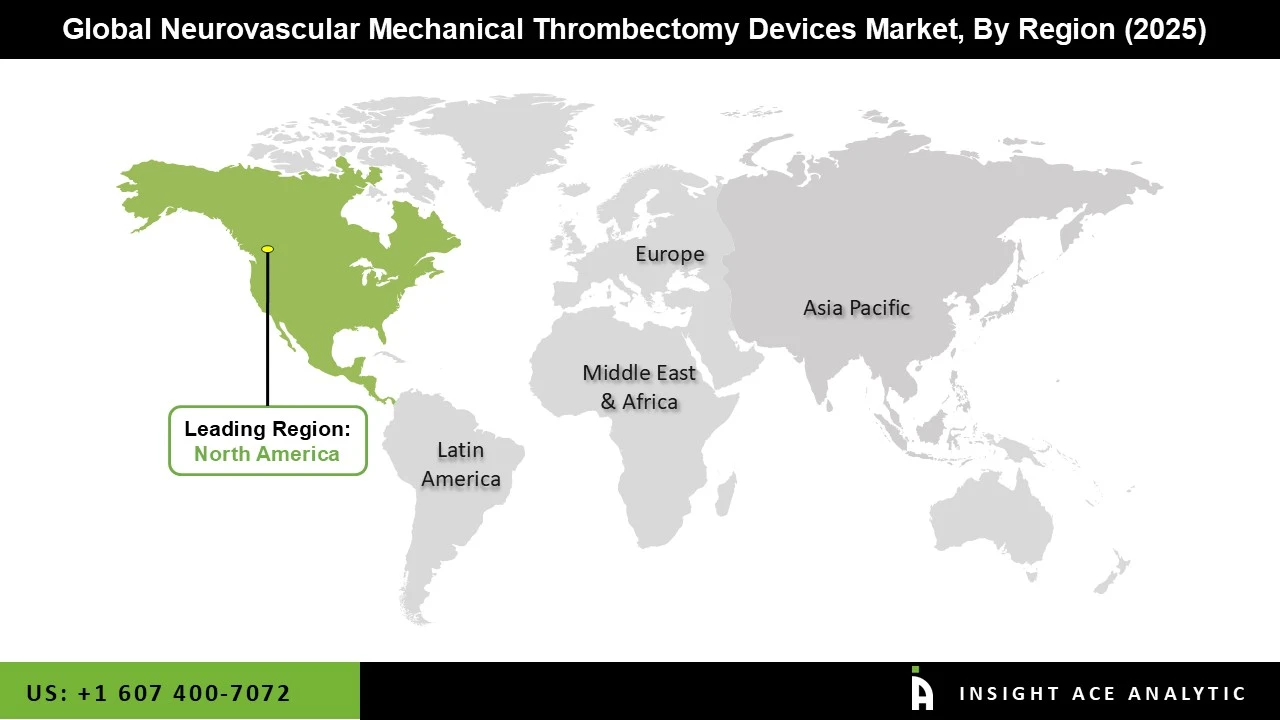
Why North America Led the Neurovascular Mechanical Thrombectomy Devices Market?
North America is expected to stay ahead in the neurovascular mechanical thrombectomy devices market thanks to its advanced healthcare system, high use of minimally invasive procedures, and many established medical device companies. The U.S. has a strong network of stroke centers, skilled specialists, and access to advanced imaging and treatment technologies. Ongoing product innovation and investments from companies like Stryker, Medtronic, Penumbra, and Johnson & Johnson MedTech are helping develop and bring new thrombectomy systems to market. More awareness of early stroke treatment, better emergency care, and a focus on making mechanical thrombectomy more available are also driving growth in the region.
Key Development
• In February 2026, Johnson & Johnson launched its CEREGLIDE™ 42 and CEREGLIDE™ 57 aspiration catheters and INNERGLIDE™ 7 delivery aid in the U.S. The additions complete the CEREGLIDE catheter family and are designed to support aspiration-based stroke treatment, improve access to distal clots, and simplify procedural workflows.
• In January 2026, phenox received FDA 510(k) clearance for its Esperance® pHLO Aspiration System. The system combines an aspiration catheter, tubing set, and introducer sheath, strengthening the company's portfolio of neurovascular clot-removal technologies for acute ischemic stroke treatment.
Neurovascular Mechanical Thrombectomy Devices Market Report Scope:
| Report Attribute | Specifications |
| Market size value in 2025 | USD XX Bn |
| Revenue forecast in 2035 | USD XX Bn |
| Growth Rate CAGR | CAGR of 8.5% from 2026 to 2035 |
| Quantitative Units | Representation of revenue in US$ Bn and CAGR from 2026 to 2035 |
| Historic Year | 2022 to 2025 |
| Forecast Year | 2026-2035 |
| Report Coverage | The forecast of revenue, the position of the company, the competitive market structure, growth prospects, and trends |
| Segments Covered | Product, Occulsion Location, End User and By Region |
| Regional Scope | North America; Europe; Asia Pacific; Latin America; Middle East & Africa |
| Country Scope | U.S.; Canada; U.K.; Germany; China; India; Japan; Brazil; Mexico; France; Italy; Spain; South Korea; Southeast Asia |
| Competitive Landscape | Stryker Corporation, Medtronic plc, Penumbra, Inc., Johnson & Johnson MedTech (Cerenovus), Terumo Neuro (Terumo Corporation), Wallaby Medical (WallabyPhenox), Rapid Medical Ltd., Imperative Care, Inc., Route 92 Medical, Inc., Acandis GmbH, Vesalio, Perfuze Ltd., Anaconda Biomed, S.L., MicroPort NeuroScientific Corporation, Zylox-Tonbridge Medical Technology Co., Ltd., Peijia Medical Limited, Shanghai HeartCare Medical Technology Co., Ltd., HeMo Bioengineering Co., Ltd. |
| Customization Scope | Free customization report with the procurement of the report, Modifications to the regional and segment scope. Geographic competitive landscape. |
| Pricing and Available Payment Methods | Explore pricing alternatives that are customized to your particular study requirements. |
Market Segmentation:
Neurovascular Mechanical Thrombectomy Devices Market by Product -
• Stent Retrievers
• Aspiration Catheters
o Superbore (≥0.085")
o Large-Bore (0.068"-0.084")
o Small-Bore / Distal (<0.068")
• Aspiration Pumps & Consumables
o Aspiration Pumps
o Tubing & Canisters
• Balloon Guide Catheters
• Emerging Clot-Capture Devices
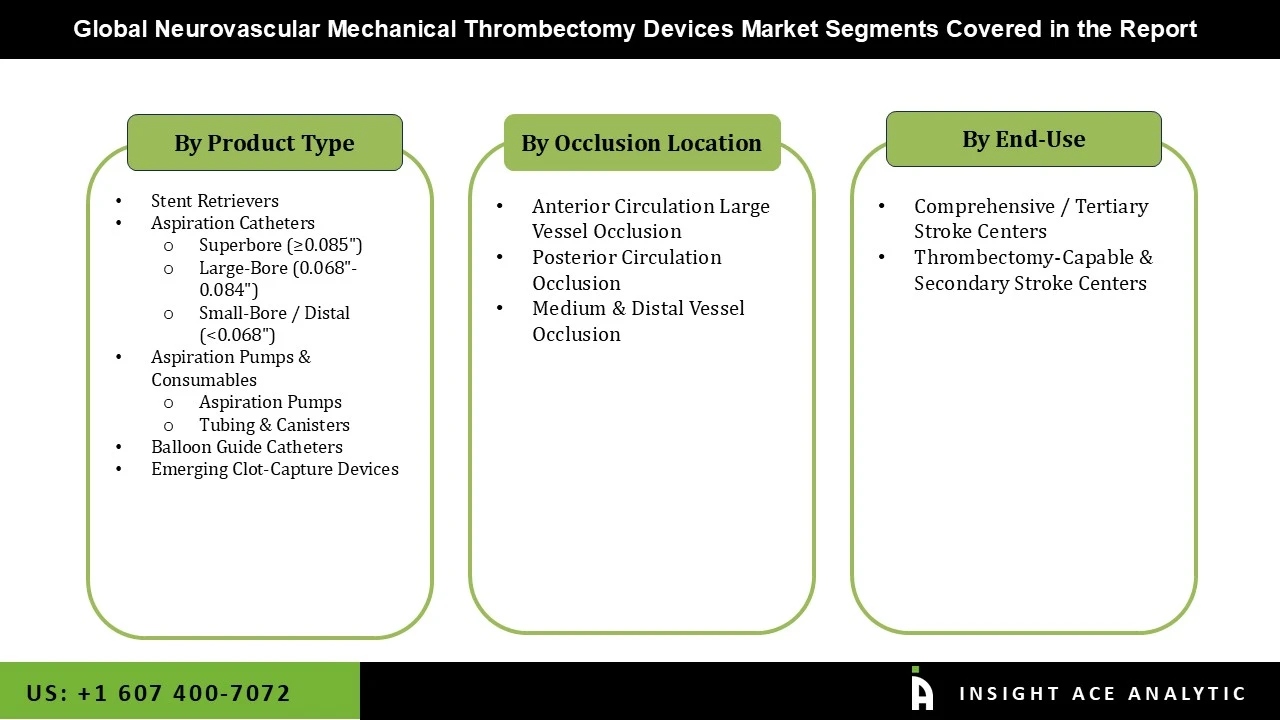
Neurovascular Mechanical Thrombectomy Devices Market by Occlusion Location-
• Anterior Circulation Large Vessel Occlusion
• Posterior Circulation Occlusion
• Medium & Distal Vessel Occlusion
Neurovascular Mechanical Thrombectomy Devices Market by End User -
• Comprehensive / Tertiary Stroke Centers
• Thrombectomy-Capable & Secondary Stroke Centers
Neurovascular Mechanical Thrombectomy Devices Market by Region-
North America-
• The US
• Canada
• Mexico
Europe-
• Germany
• The UK
• France
• Italy
• Spain
• Rest of Europe
Asia-Pacific-
• China
• Japan
• India
• South Korea
• South East Asia
• Rest of Asia Pacific
Latin America-
• Brazil
• Argentina
• Rest of Latin America
Middle East & Africa-
• GCC Countries
• South Africa
• Rest of Middle East and Africa
Research Design and Approach
This study employed a multi-step, mixed-method research approach that integrates:
- Secondary research
- Primary research
- Data triangulation
- Hybrid top-down and bottom-up modelling
- Forecasting and scenario analysis
This approach ensures a balanced and validated understanding of both macro- and micro-level market factors influencing the market.
Secondary Research
Secondary research for this study involved the collection, review, and analysis of publicly available and paid data sources to build the initial fact base, understand historical market behaviour, identify data gaps, and refine the hypotheses for primary research.
Sources Consulted
Secondary data for the market study was gathered from multiple credible sources, including:
- Government databases, regulatory bodies, and public institutions
- International organizations (WHO, OECD, IMF, World Bank, etc.)
- Commercial and paid databases
- Industry associations, trade publications, and technical journals
- Company annual reports, investor presentations, press releases, and SEC filings
- Academic research papers, patents, and scientific literature
- Previous market research publications and syndicated reports
These sources were used to compile historical data, market volumes/prices, industry trends, technological developments, and competitive insights.

Primary Research
Primary research was conducted to validate secondary data, understand real-time market dynamics, capture price points and adoption trends, and verify the assumptions used in the market modelling.
Stakeholders Interviewed
Primary interviews for this study involved:
- Manufacturers and suppliers in the market value chain
- Distributors, channel partners, and integrators
- End-users / customers (e.g., hospitals, labs, enterprises, consumers, etc., depending on the market)
- Industry experts, technology specialists, consultants, and regulatory professionals
- Senior executives (CEOs, CTOs, VPs, Directors) and product managers
Interview Process
Interviews were conducted via:
- Structured and semi-structured questionnaires
- Telephonic and video interactions
- Email correspondences
- Expert consultation sessions
Primary insights were incorporated into demand modelling, pricing analysis, technology evaluation, and market share estimation.
Data Processing, Normalization, and Validation
All collected data were processed and normalized to ensure consistency and comparability across regions and time frames.
The data validation process included:
- Standardization of units (currency conversions, volume units, inflation adjustments)
- Cross-verification of data points across multiple secondary sources
- Normalization of inconsistent datasets
- Identification and resolution of data gaps
- Outlier detection and removal through algorithmic and manual checks
- Plausibility and coherence checks across segments and geographies
This ensured that the dataset used for modelling was clean, robust, and reliable.
Market Size Estimation and Data Triangulation
Bottom-Up Approach
The bottom-up approach involved aggregating segment-level data, such as:
- Company revenues
- Product-level sales
- Installed base/usage volumes
- Adoption and penetration rates
- Pricing analysis
This method was primarily used when detailed micro-level market data were available.

Top-Down Approach
The top-down approach used macro-level indicators:
- Parent market benchmarks
- Global/regional industry trends
- Economic indicators (GDP, demographics, spending patterns)
- Penetration and usage ratios
This approach was used for segments where granular data were limited or inconsistent.
Hybrid Triangulation Approach
To ensure accuracy, a triangulated hybrid model was used. This included:
- Reconciling top-down and bottom-up estimates
- Cross-checking revenues, volumes, and pricing assumptions
- Incorporating expert insights to validate segment splits and adoption rates
This multi-angle validation yielded the final market size.
Forecasting Framework and Scenario Modelling
Market forecasts were developed using a combination of time-series modelling, adoption curve analysis, and driver-based forecasting tools.
Forecasting Methods
- Time-series modelling
- S-curve and diffusion models (for emerging technologies)
- Driver-based forecasting (GDP, disposable income, adoption rates, regulatory changes)
- Price elasticity models
- Market maturity and lifecycle-based projections
Scenario Analysis
Given inherent uncertainties, three scenarios were constructed:
- Base-Case Scenario: Expected trajectory under current conditions
- Optimistic Scenario: High adoption, favourable regulation, strong economic tailwinds
- Conservative Scenario: Slow adoption, regulatory delays, economic constraints
Sensitivity testing was conducted on key variables, including pricing, demand elasticity, and regional adoption.
Request Customization
Add countries, segments, company profiles, or extend forecast — free 10% customization with purchase.
Customize This Report →Enquire Before Buying
Speak with our analyst team about scope, methodology, pricing, or deliverable formats.
Enquire Now →Frequently Asked Questions
Neurovascular Mechanical Thrombectomy Devices Market is estimated to grow at a 8.5% CAGR during the forecast period for 2026 to 2035.
Stryker Corporation, Medtronic plc, Penumbra, Inc., Johnson & Johnson MedTech (Cerenovus), Terumo Neuro (Terumo Corporation), Wallaby Medical (WallabyPhenox), Rapid Medical Ltd., Imperative Care, Inc., Route 92 Medical, Inc., Acandis GmbH, Vesalio, Perfuze Ltd., Anaconda Biomed, S.L., MicroPort NeuroScientific Corporation, Zylox-Tonbridge Medical Technology Co., Ltd., Peijia Medical Limited, Shanghai HeartCare Medical Technology Co., Ltd., HeMo Bioengineering Co., Ltd.
Neurovascular Mechanical Thrombectomy Devices Market is segmented into Product, Occulsion Location, End User and By Region
North America region is leading the Neurovascular Mechanical Thrombectomy Devices Market.