



Educational Tourism Market Size is valued at 363.41 billion in 2022 and is predicted to reach 1141.05 billion by the year 2031 at a 13.7% CAGR during the forecast period for 2023-2031.
Educational Tourism Market Size, Share & Trends Analysis Report by age group (less than 15 years, 16-25 years, 26-40 years and 41-55 years), Education Type (Students, Teachers, Government Officials, Corporation Managers, Enterprise Owners, Workers) And Occupation (Students, Teachers, Government Officials, Corporation Managers, Enterprise Owners, Workers), Region And Segment Forecasts, 2023-2031 .
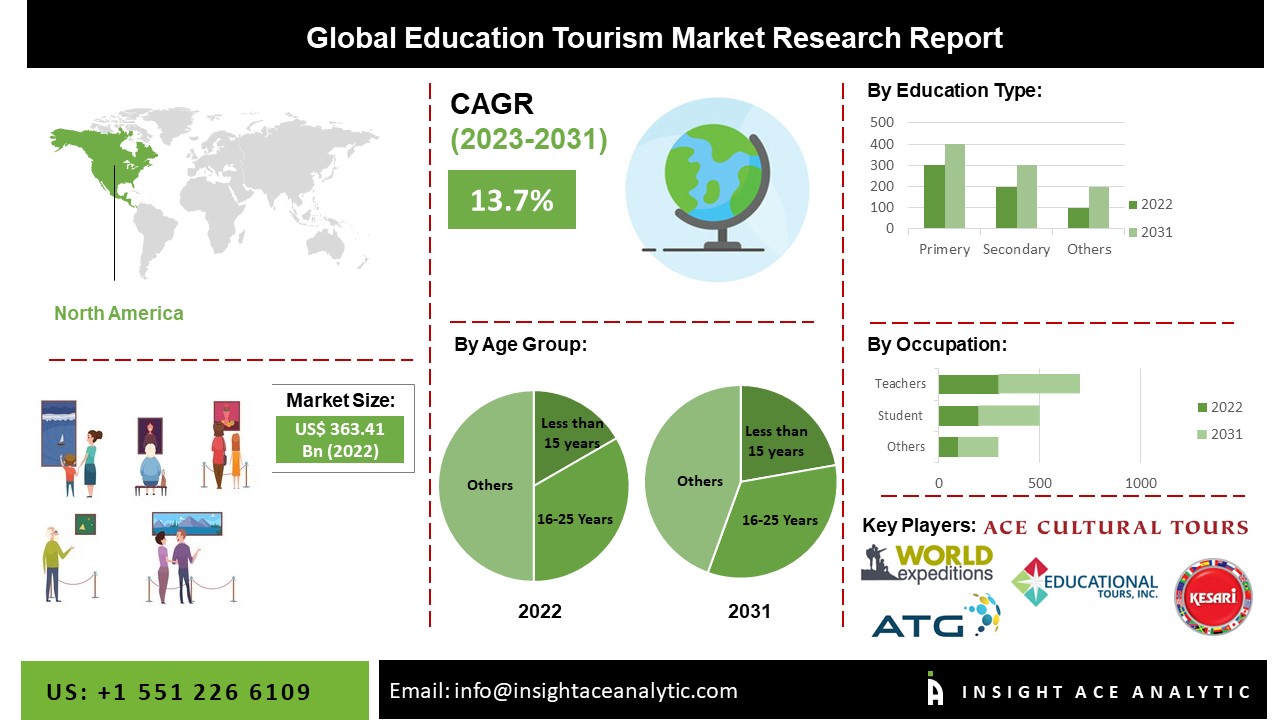
Educational tourism, also known as educational travel or tourism, is a form of travel that combines educational experiences and recreational activities. It involves individuals or groups traveling to different locations to gain knowledge, learn new skills, and explore educational opportunities. The market growth is anticipated to accelerate due to the growing emphasis on international experiences and cross-cultural learning due to the increased globalization of education. Hands-on experiences, interactive learning environments, and knowledge application in the real world are all part of educational tourism. Students and educational institutions participate in educational tourism programs due to the desire for experiential learning.
Furthermore, another element driving educational tourism is a rise in people's disposable income worldwide. There is an increasing need for genuine travel experiences as people's standards of living rise. Educational travel is now more readily available and easy thanks to technological improvements, notably transportation and communication. Additionally, the ease with which students and educational institutions may plan and participate in educational excursions accelerates market expansion. This is due to advancements in transportation infrastructure, low-cost air travel, online booking services, and electronic communication tools.
The educational tourism market is segmented based on age group, education type and occupation. Based on age group, the market is segmented as less than 15 years, 16-25 years, 26-40 years and 41-55 years. By application, the market is segmented into students, teachers, government officials, corporation managers, enterprise owners, workers, etc. The market is segmented by occupation as students, teachers, government officials, corporation managers, enterprise owners, workers and others.
The college category will hold a major share of the global Educational Tourism market in 2022. The high transparency regarding specialized degrees, lenient immigration restrictions, and reasonably priced college options are key drivers of this market. Because few options are nearby, many consumers choose to move away for college. A prestigious college degree boosts the likelihood of finding a decent job or even a good post-graduate program. Due to the accessibility of high-quality education and the countries' lax immigration regulations, the U.S., Canada, and the U.K. remain among the top destinations for college migration.
The government officials segment is projected to grow rapidly in the global educational tourism market. Federal officials can travel to other locations for assignments, training, conferences, and seminars. Together, these government representatives work to promote locations, speed up visa procedures, enforce safety and quality standards, create a conducive atmosphere for educational tourism, and support educational institutions and tourism groups. Their participation plays a crucial role in promoting the expansion and sustainability of the educational tourism business.
The North America Educational Tourism market is expected to register a tremendous market share in revenue shortly. North America attracts many international and domestic travelers seeking educational experiences across various fields. North America has numerous renowned academic institutions, including universities, colleges, and language schools. These institutions attract students and researchers from around the world who seek educational opportunities, cultural exchange, and academic collaborations. In addition, Asia Pacific is projected to grow rapidly in the global educational tourism market. Asia Pacific region boasts diverse natural landscapes and national parks that attract nature enthusiasts and those interested in environmental education. Educational tourism involves wildlife exploration, environmental conservation projects, eco-tours, and outdoor experiential learning.
| Report Attribute | Specifications |
| Market Size Value In 2022 | USD 363.41 Bn |
| Revenue Forecast In 2031 | USD 1141.05 Bn |
| Growth Rate CAGR | CAGR of 13.7 % from 2023 to 2031 |
| Quantitative Units | Representation of revenue in US$ Bn and CAGR from 2023 to 2031 |
| Historic Year | 2019 to 2022 |
| Forecast Year | 2023-2031 |
| Report Coverage | The forecast of revenue, the position of the company, the competitive market structure, growth prospects, and trends |
| Segments Covered | Age Group, Education Type And Occupation. |
| Regional Scope | North America; Europe; Asia Pacific; Latin America; Middle East & Africa |
| Country Scope | U.S.; Canada; U.K.; Germany; China; India; Japan; Brazil; Mexico; The UK; France; Italy; Spain; China; Japan; India; South Korea; Southeast Asia; South Korea; South East Asia |
| Competitive Landscape | World Expeditions Travel Group Pty Ltd; ACE CULTURAL TOURS; Atlantis Erudition &Travel Services; Kesari Tours Pvt. Ltd.; ATG Travel; Global Educational Travel; Educational Tours, Inc.; AAI EDUTOURZ; EF Education First; Capital Tours, Inc |
| Customization Scope | Free customization report with the procurement of the report, Modifications to the regional and segment scope. Particular Geographic competitive landscape. |
| Pricing and Available Payment Methods | Explore pricing alternatives that are customized to your particular study requirements. |
Educational Tourism Market By age Group

Educational Tourism Market By Education Type
Educational Tourism Market By Occupation
Educational Tourism Market By Region-
North America-
Europe-
Asia-Pacific-
Latin America-
Middle East & Africa-
This study employed a multi-step, mixed-method research approach that integrates:
This approach ensures a balanced and validated understanding of both macro- and micro-level market factors influencing the market.
Secondary research for this study involved the collection, review, and analysis of publicly available and paid data sources to build the initial fact base, understand historical market behaviour, identify data gaps, and refine the hypotheses for primary research.
Secondary data for the market study was gathered from multiple credible sources, including:
These sources were used to compile historical data, market volumes/prices, industry trends, technological developments, and competitive insights.

Primary research was conducted to validate secondary data, understand real-time market dynamics, capture price points and adoption trends, and verify the assumptions used in the market modelling.
Primary interviews for this study involved:
Interviews were conducted via:
Primary insights were incorporated into demand modelling, pricing analysis, technology evaluation, and market share estimation.
All collected data were processed and normalized to ensure consistency and comparability across regions and time frames.
The data validation process included:
This ensured that the dataset used for modelling was clean, robust, and reliable.
The bottom-up approach involved aggregating segment-level data, such as:
This method was primarily used when detailed micro-level market data were available.

The top-down approach used macro-level indicators:
This approach was used for segments where granular data were limited or inconsistent.
To ensure accuracy, a triangulated hybrid model was used. This included:
This multi-angle validation yielded the final market size.
Market forecasts were developed using a combination of time-series modelling, adoption curve analysis, and driver-based forecasting tools.
Given inherent uncertainties, three scenarios were constructed:
Sensitivity testing was conducted on key variables, including pricing, demand elasticity, and regional adoption.