SCBA Facepiece Market Size, Share & Trends Analysis Distribution by Material (Silicone, Rubber, and Polycarbonate (Lens)), Facepiece Type (Full-Face Mask and Half-Face Mask), End-use (Industrial, Firefighting, Law Enforcement & Hazmat Teams, and Military & Defense), and Segment Forecasts, 2025-2034
SCBA Facepiece Market expected to grow at a 5.0% CAGR during the forecast period for 2025-2034.
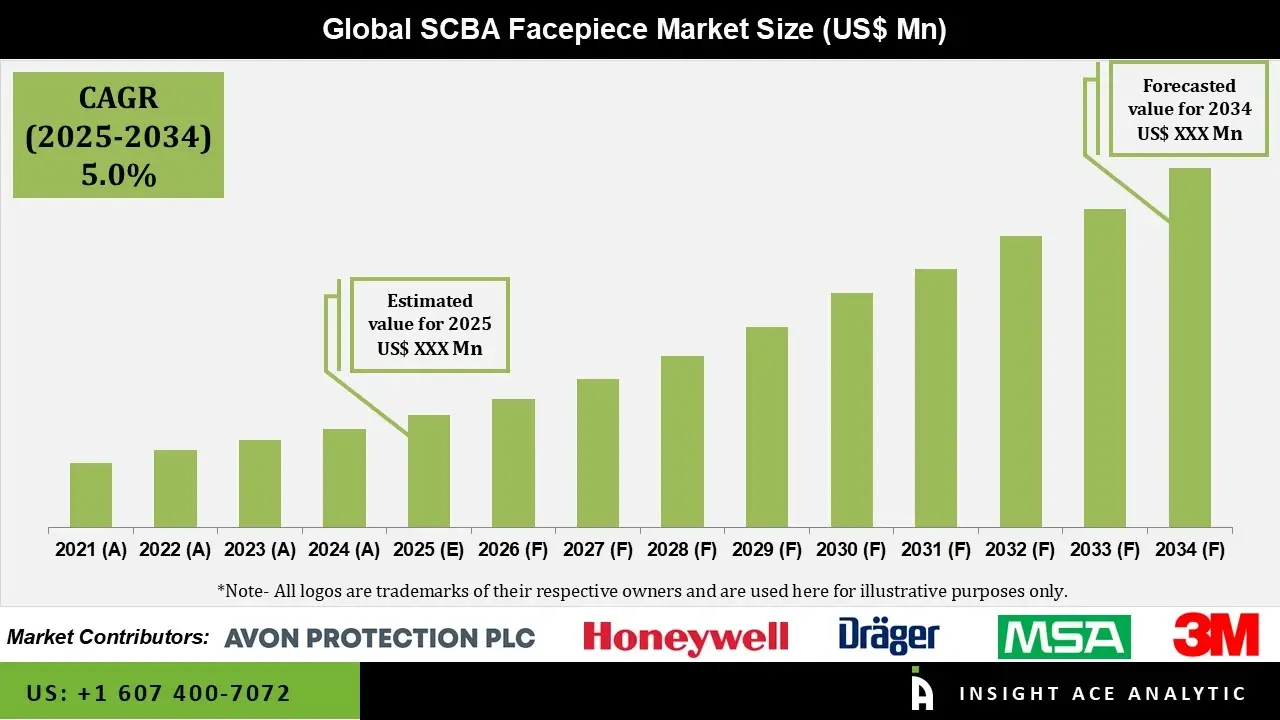
The SCBA (Self-Contained Breathing Apparatus) facepiece is an essential part of respiratory protective gear intended for usage in dangerous situations, including emergency response situations, industrial settings, or firefighting. It serves as the interface between the user and the breathing apparatus, guaranteeing a tight seal that filters out dangerous impurities and delivers clean, breathable air.
The facepiece usually has a clear visor for visibility, adjustable straps for a snug fit, and is constructed from sturdy, heat-resistant materials like rubber or silicone. Comfort, dependability, and compatibility with other PPE (Personal Protective Equipment), including helmets or communication equipment, are prioritized in its design.
The SCBA facepieces market is expanding significantly due to the rising need for respiratory protection in a number of industries. The growing awareness of occupational health and safety standards worldwide and an increase in safety laws boost the market growth. Additionally, the use of upgraded SCBA facepieces is being driven by technological breakthroughs such as improved comfort, durability, and fit designs. Furthermore, growing applications in the mining, industrial, chemical processing, and defense sectors support the SCBA facepiece market growth.
Moreover, the increased investments in safety equipment by governments and commercial organizations around the world also contribute to the industry's growth, and improving economic conditions in developing nations further encourage the SCBA facepiece market expansion.
In addition, the SCBA facepiece market is influenced by shifting labor demographics and growing acceptance of personal safety equipment in non-traditional sectors like electronics and pharmaceuticals. Furthermore, there is an urgent need for workers to have adequate respiratory protection due to growing industrialization, especially in the building, manufacturing, and chemical processing industries. This trend is further accelerated by investments in infrastructure development in emerging economies.
However, SCBA facepieces are costly to manufacture and acquire, particularly full-face variants with sophisticated features. Costs are increased by high-quality materials like silicone and polycarbonate, as well as safety certificates. This may restrict adoption among smaller emergency services or in cost-sensitive markets. Therefore, it is expected that this will restrict the SCBA facepiece market growth.
Competitive Landscape
Which are the Leading Players in SCBA Facepiece Market?
• 3M Company
• MSA Safety Incorporated
• Avon Protection plc
• Sundström Safety AB
• Honeywell International, Inc.
• Interspiro AB
• Shigematsu Works Co., Ltd.
• Drägerwerk AG & Co. KGaA
• Scott Safety
• Duram Mask
Market Dynamics
Driver
Increasing Occupational Safety and Regulatory Requirements
The SCBA facepiece market is expanding rapidly as a result of increasing occupational safety and regulatory requirements. More strict respiratory protection laws are being implemented by government agencies and authorities for workplace safety in a variety of industries, comprising construction, mining, chemicals, and firefighting. SCBA facepieces are essential for adhering to regulations like OSHA requirements and NFPA 1981, which promote worker safety in environments with dangerous gases or low oxygen levels.
The need for certified facepieces is growing quickly in both developed and developing markets as adherence becomes crucial. Additionally, industries like heavy manufacturing, oil and gas extraction, and firefighting that often expose workers to smoke, dangerous vapors, or cramped spaces are investing more in high-quality respiratory gear. This is anticipated to boost the adoption of SCBA facepieces.
Restrain/Challenge
High Initial Investment and Continuing Maintenance Costs
Over the course of the projected period, the SCBA facepiece market expansion is expected to be constrained by high initial investment and continuing maintenance costs. Superior SCBA systems, especially those with advanced features, require a high upfront cost. The total cost is influenced by the purchase price as well as ongoing expenses for maintenance, fit evaluations, hygiene, and eventual replacement of obsolete parts.
These financial commitments may impede procurement or limit thorough implementation for smaller organizations, volunteer firefighting teams, or companies in undeveloped areas. Moreover, the SCBA facepiece market's growth is being constrained by the intricacy of usage and training requirements. SCBA facepieces require proper fit assessments, regular inspections, and user experience; they are not simple to use straight out of the box. Safety is at risk due to improper fitting or adjustment.
Full-Face Mask Segment is Expected to Drive the SCBA Facepiece Market
The full-face mask category held the largest share in the SCBA Facepiece market in 2024 because of its extensive use in industrial activities and firefighting, as well as its exceptional protection. Agencies and employers are being encouraged to switch from half-mask solutions to full-face units that integrate respiratory and eye protection into a single authorized device due to growing regulatory pressure and proposed emergency-response regulations. Additionally, full-face masks are the preferred option for firefighting, HAZMAT, and many industrial applications because they provide measurably better face seals and integrated eye protection, lowering contamination risk in chemical, confined-space, and hazardous materials scenarios.
Firefighting Segment is Growing at the Highest Rate in the SCBA Facepiece Market
In 2024, the firefighting category dominated the SCBA Facepiece market because of the growing focus on workplace and firefighter safety, which is driven by more stringent government laws and occupational health standards that require the use of improved respiratory protection in dangerous situations, particularly fire events. The development of fire service infrastructure and the increasing number of firemen worldwide, especially as regional urbanization and industrial growth pick up speed, are other important factors.
The need for better-equipped firefighting units—supported by contemporary SCBA facepieces that provide improved comfort, clear vision, and dependable performance in smoke-filled environments—increases in tandem with the growth of cities and the diversification of industrial operations.
Why North America Led the SCBA Facepiece Market?
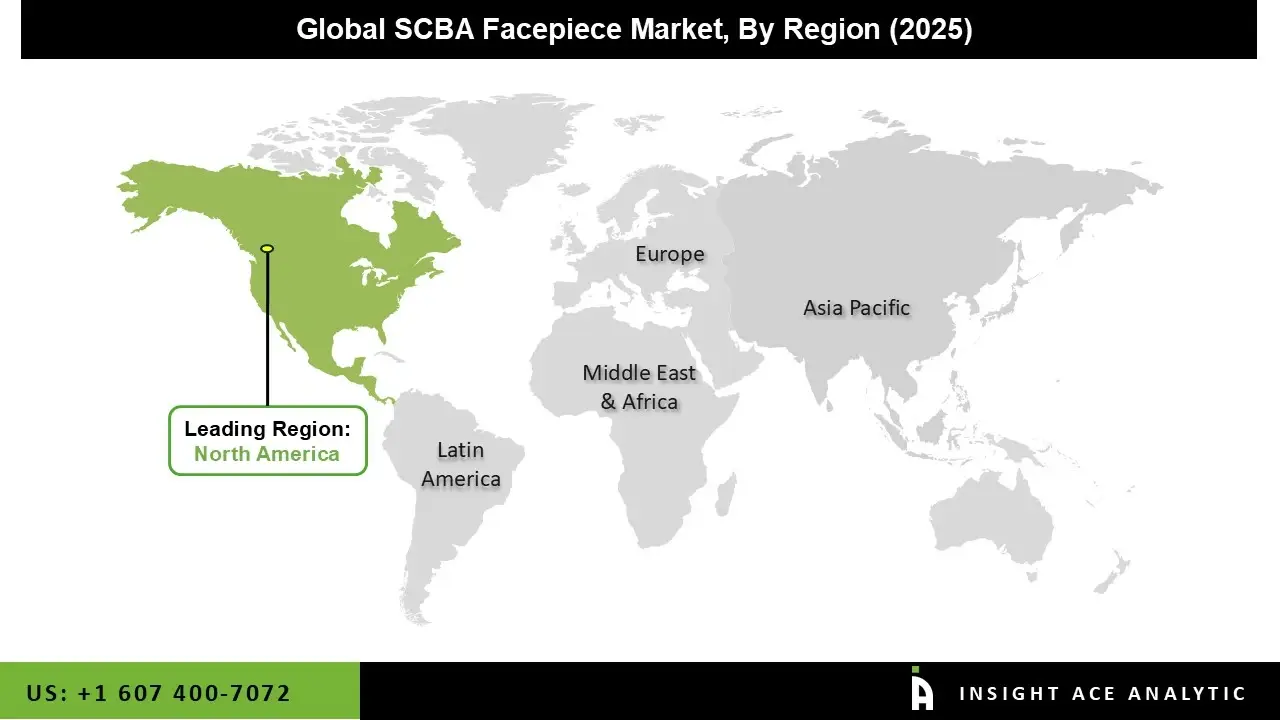
The SCBA Facepieces market was dominated by the North America region in 2024. The demand for SCBA facepieces for usage in hazardous work situations is rising as a result of this region's notable expansion in infrastructure development and construction. Additionally, this region is funding research and development projects to create a lighter, more sophisticated SCBA facepiece that provides wearer protection. This is anticipated to fuel the market's expansion in the area.
Furthermore, in the SCBA facepiece market, there are a number of well-established companies that are well-known in the area. These companies contribute to the market's expansion by providing a variety of SCBA products and having a robust distribution network. Moreover, the market for SCBA facepieces is rising as a result of the expansion of the firefighting sector in North America.
Key Development
In March 2025, Honeywell International established a strategic alliance with Interspiro to jointly develop improved connectivity features and next-generation SCBA facepieces.
SCBA Facepiece Market Report Scope:
| Report Attribute | Specifications | |
| Growth Rate CAGR | CAGR of 5.0% from 2025 to 2034 | |
| Quantitative Units | Representation of revenue in US$ Bn and CAGR from 2024 to 2034 | |
| Historic Year | 2021 to 2024 | |
| Forecast Year | 2025-2034 | |
| Report Coverage | The forecast of revenue, the position of the company, the competitive market structure, growth prospects, and trends | |
| Segments Covered | Material, Facepiece Type, End-use, and By Region | |
| Regional Scope | North America; Europe; Asia Pacific; Latin America; Middle East & Africa | |
| Country Scope | U.S.; Canada; U.K.; Germany; China; India; Japan; Brazil; Mexico; The UK; France; Italy; Spain; China; Japan; India; South Korea; Southeast Asia; South Korea; Southeast Asia | |
| Competitive Landscape | 3M Company, MSA Safety Incorporated, Avon Protection plc, Sundström Safety AB, Honeywell International, Inc., Interspiro AB, Shigematsu Works Co., Ltd., Drägerwerk AG & Co. KGaA, Scott Safety, and Duram Mask. | |
| Customization Scope | Free customization report with the procurement of the report, Modifications to the regional and segment scope. Geographic competitive landscape. | |
| Pricing and Available Payment Methods | Explore pricing alternatives that are customized to your particular study requirements. |
Market Segmentation:
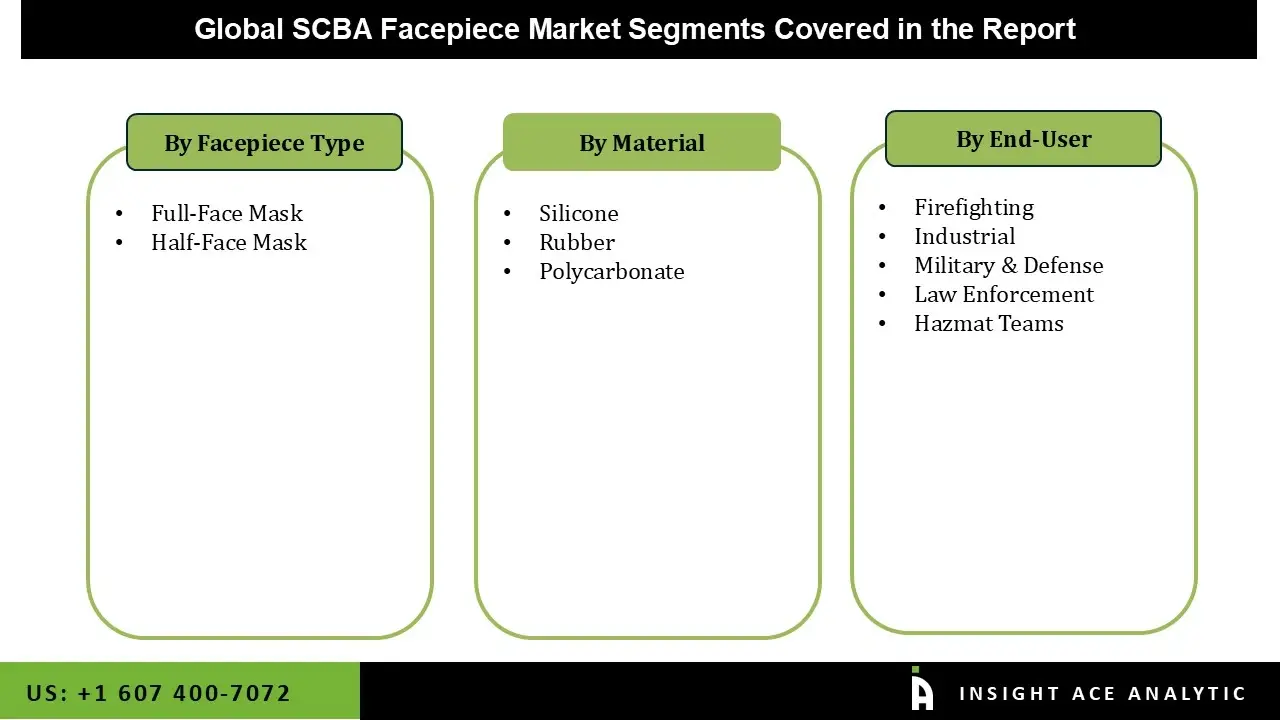
SCBA Facepiece Market by Material-
• Silicone
• Rubber
• Polycarbonate (Lens)
SCBA Facepiece Market by Facepiece Type-
• Full-Face Mask
• Half-Face Mask
SCBA Facepiece Market by End-use-
• Industrial
• Firefighting
• Law Enforcement & Hazmat Teams
• Military & Defense
By Region-
North America-
• The US
• Canada
Europe-
• Germany
• The UK
• France
• Italy
• Spain
• Rest of Europe
Asia-Pacific-
• China
• Japan
• India
• South Korea
• South East Asia
• Rest of Asia Pacific
Latin America-
• Brazil
• Argentina
• Mexico
• Rest of Latin America
Middle East & Africa-
• GCC Countries
• South Africa
• Rest of Middle East and Africa
Research Design and Approach
This study employed a multi-step, mixed-method research approach that integrates:
- Secondary research
- Primary research
- Data triangulation
- Hybrid top-down and bottom-up modelling
- Forecasting and scenario analysis
This approach ensures a balanced and validated understanding of both macro- and micro-level market factors influencing the market.
Secondary Research
Secondary research for this study involved the collection, review, and analysis of publicly available and paid data sources to build the initial fact base, understand historical market behaviour, identify data gaps, and refine the hypotheses for primary research.
Sources Consulted
Secondary data for the market study was gathered from multiple credible sources, including:
- Government databases, regulatory bodies, and public institutions
- International organizations (WHO, OECD, IMF, World Bank, etc.)
- Commercial and paid databases
- Industry associations, trade publications, and technical journals
- Company annual reports, investor presentations, press releases, and SEC filings
- Academic research papers, patents, and scientific literature
- Previous market research publications and syndicated reports
These sources were used to compile historical data, market volumes/prices, industry trends, technological developments, and competitive insights.

Primary Research
Primary research was conducted to validate secondary data, understand real-time market dynamics, capture price points and adoption trends, and verify the assumptions used in the market modelling.
Stakeholders Interviewed
Primary interviews for this study involved:
- Manufacturers and suppliers in the market value chain
- Distributors, channel partners, and integrators
- End-users / customers (e.g., hospitals, labs, enterprises, consumers, etc., depending on the market)
- Industry experts, technology specialists, consultants, and regulatory professionals
- Senior executives (CEOs, CTOs, VPs, Directors) and product managers
Interview Process
Interviews were conducted via:
- Structured and semi-structured questionnaires
- Telephonic and video interactions
- Email correspondences
- Expert consultation sessions
Primary insights were incorporated into demand modelling, pricing analysis, technology evaluation, and market share estimation.
Data Processing, Normalization, and Validation
All collected data were processed and normalized to ensure consistency and comparability across regions and time frames.
The data validation process included:
- Standardization of units (currency conversions, volume units, inflation adjustments)
- Cross-verification of data points across multiple secondary sources
- Normalization of inconsistent datasets
- Identification and resolution of data gaps
- Outlier detection and removal through algorithmic and manual checks
- Plausibility and coherence checks across segments and geographies
This ensured that the dataset used for modelling was clean, robust, and reliable.
Market Size Estimation and Data Triangulation
Bottom-Up Approach
The bottom-up approach involved aggregating segment-level data, such as:
- Company revenues
- Product-level sales
- Installed base/usage volumes
- Adoption and penetration rates
- Pricing analysis
This method was primarily used when detailed micro-level market data were available.

Top-Down Approach
The top-down approach used macro-level indicators:
- Parent market benchmarks
- Global/regional industry trends
- Economic indicators (GDP, demographics, spending patterns)
- Penetration and usage ratios
This approach was used for segments where granular data were limited or inconsistent.
Hybrid Triangulation Approach
To ensure accuracy, a triangulated hybrid model was used. This included:
- Reconciling top-down and bottom-up estimates
- Cross-checking revenues, volumes, and pricing assumptions
- Incorporating expert insights to validate segment splits and adoption rates
This multi-angle validation yielded the final market size.
Forecasting Framework and Scenario Modelling
Market forecasts were developed using a combination of time-series modelling, adoption curve analysis, and driver-based forecasting tools.
Forecasting Methods
- Time-series modelling
- S-curve and diffusion models (for emerging technologies)
- Driver-based forecasting (GDP, disposable income, adoption rates, regulatory changes)
- Price elasticity models
- Market maturity and lifecycle-based projections
Scenario Analysis
Given inherent uncertainties, three scenarios were constructed:
- Base-Case Scenario: Expected trajectory under current conditions
- Optimistic Scenario: High adoption, favourable regulation, strong economic tailwinds
- Conservative Scenario: Slow adoption, regulatory delays, economic constraints
Sensitivity testing was conducted on key variables, including pricing, demand elasticity, and regional adoption.
Request Customization
Add countries, segments, company profiles, or extend forecast — free 10% customization with purchase.
Customize This Report →Enquire Before Buying
Speak with our analyst team about scope, methodology, pricing, or deliverable formats.
Enquire Now →Frequently Asked Questions
SCBA Facepiece Market expected to grow at a 5.0% CAGR during the forecast period for 2025-2034.
SCBA Facepiece Market Players is 3M Company, MSA Safety Incorporated, Avon Protection plc, Sundström Safety AB, Honeywell International, Inc., Interspiro AB, Shigematsu Works Co., Ltd., Drägerwerk AG & Co. KGaA, Scott Safety, and Duram Mask.
The primary SCBA Facepieces market segments are By Material, By Facepiece Type and End-use.
SCBA Facepieces market was dominated by the North America region