E-Waste Management Market Size, Revenue, Trend Report 2026 to 2035
What is E-Waste Management Market Size?
Global E-Waste Management Market Size is valued at USD 22.01 Billion in 2025 and is predicted to reach USD 85.05 Billion by the year 2035 at a 14.6% CAGR during the forecast period for 2026 to 2035.
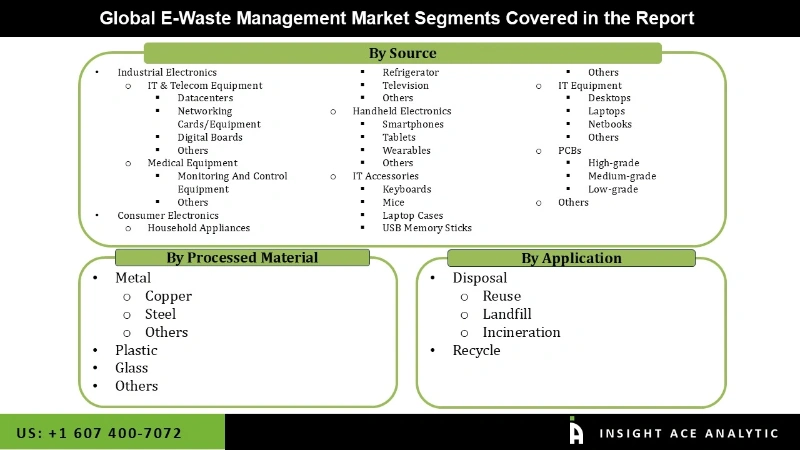
E-Waste Management Market Size, Share & Trends Analysis Report By Processed Material (Metal, Plastic, Glass, Others), By Source (Industrial Electronics (IT & Telecom Equipment [Datacenters, Networking Cards/Equipment, Digital Boards, Others], Medical Equipment [Monitoring and Control Equipment, Others]); Consumer Electronics (Household Appliances [Refrigerator, Television, Others], Handheld Electronics [Smartphones, Tablets, Wearables, Others], IT Accessories [Keyboards, Mice, Laptop Cases, USB Memory Sticks, Others], IT Equipment [Desktops, Laptops, Netbooks, Others], PCBs [High-grade, Medium-grade, Low-grade]), Others), By Application (Disposal (Reuse, Landfill, Incineration), Recycle), By Region, And Segment Forecasts, 2026 to 2035.
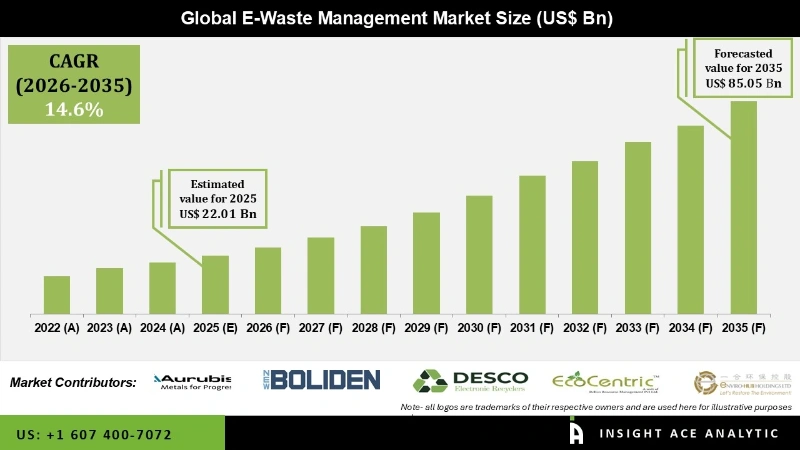
E-Waste Management Market Key Takeaways:
|
Key Industry Insights & Findings from the Report:
- E-waste management market is being driven by shorter life spans of electronics and a lack of sources for precious metals.
- The market is mainly driven by strict rules put in place by states.
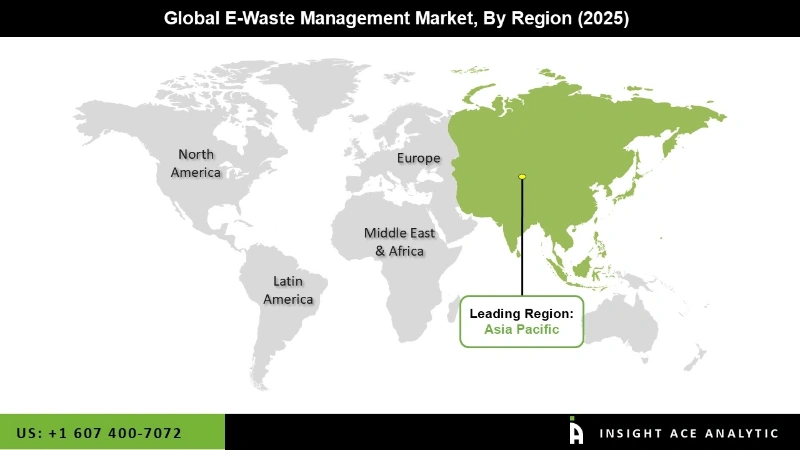
- Asia-Pacific led the market and brought in a lot of money around the world in 2024.
- The challenges for the e-waste management market include inadequate infrastructure, lack of specialized recycling plants, poor technical skills, and limited public awareness about the environmental impacts of e-waste.
E-waste is discarded electrical or electronic equipment. This includes both working and damaged items tossed in the waste or contributed to a charity merchant such as Goodwill. Increasing health risks, such as pneumonia, renal damage, and Wilson's disease, exacerbate the need for effective scrap management techniques. Additionally, the availability of precious metals such as gold, silver, platinum, and gallium makes electronic scrap recycling an appealing and realistic choice. These elements are expected to have a beneficial impact on market growth. Furthermore, the growing middle-income population in developing nations, combined with altering consumer preferences, is causing the quick replacement of older versions of electronic products with newer versions.
However, the COVID-19 pandemic had a wide-ranging impact on social lives, highlighting the interdependence of the world's environmental and community systems. The COVID-19 pandemic had a wide-ranging impact on social dynamism, emphasizing the interdependence of the world's ecological and assembly systems. Lockdowns and halts in industry and trade movements were implemented to prevent the spread of the virus across society, resulting in a fall in economic growth, mobility restrictions, and increased demand for digitization and quarantine in homes.
Competitive Landscape:
Some of the E-waste management market players are:
- Aurubis AG
- Boliden Group (Boliden AB)
- Desco Electronic Recyclers (Desco Electronic Recyclers Pty Ltd)
- EcoCentric Management Pvt. Ltd.
- ENVIRO-HUB HOLDINGS LTD.
- ERI (Electronic Recyclers International, Inc.)
- Greentec (Greentec International Inc.)
- Kuusakoski Oy
- MRI Technologies, LLC
- Namo eWaste Management Ltd.
- Sims Limited
- Stena Metall AB
- Tetronics Environmental Technology Ltd.
- Umicore SA/NV
- WM Intellectual Property Holdings, L.L.C.
- Other Market Players
Market Segmentation:
The E-waste management market is segmented on the processed material, source, and application. Based on Processed Material, the market is segmented as metal, plastic, glass, others. Based on source, the market is segmented into Industrial Electronics (IT & Telecom Equipment, Datacenters, Networking Cards/Equipment, Digital Boards, Others, Medical Equipment, Monitoring and Control Equipment, Others), Consumer Electronics (Household Appliances – Refrigerator, Television, Others; Handheld Electronics – Smartphones, Tablets, Wearables, Others; IT Accessories – Keyboards, Mice, Laptop Cases, USB Memory Sticks, Others; IT Equipment – Desktops, Laptops, Netbooks, Others; PCBs – High-grade, Medium-grade, Low-grade), Others. The application segment includes disposal (Reuse, Landfill, Incineration) and recycle.
Based On Processed Material, The Plastic Segment Is Accounted As A Major Contributor In The E-Waste Management Market.
Based on type, the market is segmented into metal, plastic, glass, others. Among these, the plastic segment dominates the MRD detection market due to its extensive use in consumables such as assay plates, tubes, pipette tips, and cartridge systems. Its affordability, disposability, and versatility make it the material of choice for both manual and automated MRD workflows. In contrast, metals like steel and copper are mainly used in durable parts of diagnostic instruments and account for a smaller market share due to infrequent replacement.
Industrial Electronics Segment Witnessed Growth At A Rapid Rate.
Based on source, the market is segmented into industrial electronics, consumer electronics and other, among these, industrial electronics segment witnessed growth at a rapid rate. The Industrial Electronics segment dominates the MRD detection market, as it encompasses the specialized and high-precision equipment used in clinical laboratories, hospitals, and research institutions. Instruments such as flow cytometers, PCR analyzers, and next-generation sequencing systems fall under this category and are essential for accurate and reliable MRD detection. In contrast, consumer electronics have little to no role in this field, as MRD testing requires advanced, regulated equipment that is not suited for personal or home use.
In The Region, Asia Pacific E-Waste Management Market Holds A Significant Revenue Share
Asia Pacific E-waste management market is expected to register the highest market share in terms of revenue in the near future. Increasing disposable income in developed and developing nations, combined with an increased preference for electronic gadgets, is one of the primary development drivers for the region's industry. Furthermore, developed countries such as the United States and the United Kingdom export a considerable amount of e-waste to Asian countries, which is expected to bode well for the regional market throughout the projection period. Furthermore, due to the illegal dumping of e-waste from developed countries, as well as increased government legislation for systematic collection and recycling of electronic junk in the region, the Middle East and Africa region is predicted to register the highest CAGR throughout the forecast period.
Recent Developments:
-
In Sept 2023, ERI constructed three ITAD and electronics recycling facilities in order to adapt to the changing demand. According to a news release, as part of the plan, the facility in Aurora, Colorado was shut down and its operations were relocated to a newly constructed, larger recycling facility that ERI had established earlier this year near Phoenix, Arizona.
E-Waste Management Market Report Scope:
| Report Attribute | Specifications |
| Market size value in 2025 | USD 22.01 Billion |
| Revenue forecast in 2035 | USD 85.05 Billion |
| Growth rate CAGR | CAGR of 14.6% from 2026 to 2035 |
| Quantitative units | Representation of revenue in US$ Mn, and CAGR from 2026 to 2035 |
| Historic Year | 2022 to 2025 |
| Forecast Year | 2026-2035 |
| Report coverage | The forecast of revenue, the position of the company, the competitive market statistics, growth prospects, and trends |
| Segments covered | Recycler Type, Material Recovery, And Source Type |
| Regional scope | North America; Europe; Asia Pacific; Latin America; Middle East & Africa |
| Country scope | U.S.; Canada; U.K.; Germany; China; India; Japan; Brazil; Mexico; France; Italy; Spain; South Korea; Southeast Asia |
| Competitive Landscape | Aurubis AG, Electronic Recyclers International, Inc., SIMS Metal Management, Ltd., Umicore S.A., Boliden AB, MBA Polymers, Inc., Stena Metall AB, Enviro-Hub Holdings Ltd., Global Electric Electronic Processing Inc., and Tetronics International Ltd. |
| Customization scope | Free customization report with the procurement of the report, Modifications to the regional and segment scope. Particular Geographic competitive landscape. |
| Pricing and available payment methods | Explore pricing alternatives that are customized to your particular study requirements. |
Segmentation of E-Waste Management Market-
E-Waste Management Market By Processed Material
- Metal
- Copper
- Steel
- Others
- Plastic
- Glass
- Others
E-Waste Management Market- By Source
- Industrial Electronics
- IT & Telecom Equipment
- Datacenters
- Networking Cards/Equipment
- Digital Boards
- Others
- Medical Equipment
- Monitoring And Control Equipment
- Others
- IT & Telecom Equipment
- Consumer Electronics
- Household Appliances
- Refrigerator
- Television
- Others
- Handheld Electronics
- Smartphones
- Tablets
- Wearables
- Others
- IT Accessories
- Keyboards
- Mice
- Laptop Cases
- USB Memory Sticks
- Others
- IT Equipment
- Desktops
- Laptops
- Netbooks
- Others
- PCBs
- High-grade
- Medium-grade
- Low-grade
- Household Appliances
- Others
E-Waste Management Market By Application –
- Disposal
- Reuse
- Landfill
- Incineration
- Recycle
E-Waste Management Market By Region-
North America-
- The US
- Canada
Europe-
- Germany
- The UK
- France
- Italy
- Spain
- Rest of Europe
Asia-Pacific-
- China
- Japan
- India
- South Korea
- Southeast Asia
- Rest of Asia Pacific
Latin America-
- Brazil
- Mexico
- Argentina
- Rest of Latin America
Middle East & Africa-
- GCC Countries
- South Africa
- Rest of the Middle East and Africa
Research Design and Approach
This study employed a multi-step, mixed-method research approach that integrates:
- Secondary research
- Primary research
- Data triangulation
- Hybrid top-down and bottom-up modelling
- Forecasting and scenario analysis
This approach ensures a balanced and validated understanding of both macro- and micro-level market factors influencing the market.
Secondary Research
Secondary research for this study involved the collection, review, and analysis of publicly available and paid data sources to build the initial fact base, understand historical market behaviour, identify data gaps, and refine the hypotheses for primary research.
Sources Consulted
Secondary data for the market study was gathered from multiple credible sources, including:
- Government databases, regulatory bodies, and public institutions
- International organizations (WHO, OECD, IMF, World Bank, etc.)
- Commercial and paid databases
- Industry associations, trade publications, and technical journals
- Company annual reports, investor presentations, press releases, and SEC filings
- Academic research papers, patents, and scientific literature
- Previous market research publications and syndicated reports
These sources were used to compile historical data, market volumes/prices, industry trends, technological developments, and competitive insights.

Primary Research
Primary research was conducted to validate secondary data, understand real-time market dynamics, capture price points and adoption trends, and verify the assumptions used in the market modelling.
Stakeholders Interviewed
Primary interviews for this study involved:
- Manufacturers and suppliers in the market value chain
- Distributors, channel partners, and integrators
- End-users / customers (e.g., hospitals, labs, enterprises, consumers, etc., depending on the market)
- Industry experts, technology specialists, consultants, and regulatory professionals
- Senior executives (CEOs, CTOs, VPs, Directors) and product managers
Interview Process
Interviews were conducted via:
- Structured and semi-structured questionnaires
- Telephonic and video interactions
- Email correspondences
- Expert consultation sessions
Primary insights were incorporated into demand modelling, pricing analysis, technology evaluation, and market share estimation.
Data Processing, Normalization, and Validation
All collected data were processed and normalized to ensure consistency and comparability across regions and time frames.
The data validation process included:
- Standardization of units (currency conversions, volume units, inflation adjustments)
- Cross-verification of data points across multiple secondary sources
- Normalization of inconsistent datasets
- Identification and resolution of data gaps
- Outlier detection and removal through algorithmic and manual checks
- Plausibility and coherence checks across segments and geographies
This ensured that the dataset used for modelling was clean, robust, and reliable.
Market Size Estimation and Data Triangulation
Bottom-Up Approach
The bottom-up approach involved aggregating segment-level data, such as:
- Company revenues
- Product-level sales
- Installed base/usage volumes
- Adoption and penetration rates
- Pricing analysis
This method was primarily used when detailed micro-level market data were available.

Top-Down Approach
The top-down approach used macro-level indicators:
- Parent market benchmarks
- Global/regional industry trends
- Economic indicators (GDP, demographics, spending patterns)
- Penetration and usage ratios
This approach was used for segments where granular data were limited or inconsistent.
Hybrid Triangulation Approach
To ensure accuracy, a triangulated hybrid model was used. This included:
- Reconciling top-down and bottom-up estimates
- Cross-checking revenues, volumes, and pricing assumptions
- Incorporating expert insights to validate segment splits and adoption rates
This multi-angle validation yielded the final market size.
Forecasting Framework and Scenario Modelling
Market forecasts were developed using a combination of time-series modelling, adoption curve analysis, and driver-based forecasting tools.
Forecasting Methods
- Time-series modelling
- S-curve and diffusion models (for emerging technologies)
- Driver-based forecasting (GDP, disposable income, adoption rates, regulatory changes)
- Price elasticity models
- Market maturity and lifecycle-based projections
Scenario Analysis
Given inherent uncertainties, three scenarios were constructed:
- Base-Case Scenario: Expected trajectory under current conditions
- Optimistic Scenario: High adoption, favourable regulation, strong economic tailwinds
- Conservative Scenario: Slow adoption, regulatory delays, economic constraints
Sensitivity testing was conducted on key variables, including pricing, demand elasticity, and regional adoption.
Request Customization
Add countries, segments, company profiles, or extend forecast — free 10% customization with purchase.
Customize This Report →Enquire Before Buying
Speak with our analyst team about scope, methodology, pricing, or deliverable formats.
Enquire Now →Frequently Asked Questions
E-Waste Management Market Size is valued at USD 22.01 Billion in 2025 and is predicted to reach USD 85.05 Billion by the year 2035
E-Waste Management Market expected to grow at a 14.6% CAGR during the forecast period for 2026-2035.
Aurubis AG, Electronic Recyclers International, Inc., SIMS Metal Management, Ltd., Umicore S.A., Boliden AB, MBA Polymers, Inc., Stena Metall AB, Envi
E-waste management market is segmented on the processed material, source, and application, Equipment, Datacenters, Networking Cards/Equipment, Digital Boards, Others, Medical Equipment.
North America region is leading the E-Waste Management Market