Dark Genome Therapeutics Market Size, Share, Forecast Report 2026 to 2035
What is Dark Genome Therapeutics Market Size?
Global Dark Genome Therapeutics Market Size is valued at USD 3.07 Bn in 2025 and is predicted to reach USD 19.59 Bn by the year 2035 at a 20.5% CAGR during the forecast period for 2026 to 2035.
Dark Genome Therapeutics Market, Share & Trends Analysis Report, By Indication (Cancer, Autoimmune diseases, Fibrotic diseases, Neurodegenerative Disorders), By Phases (Preclinical, Phase 1, Phase 2, Phase 3), By Region, and Segment Forecasts, 2026 to 2035.
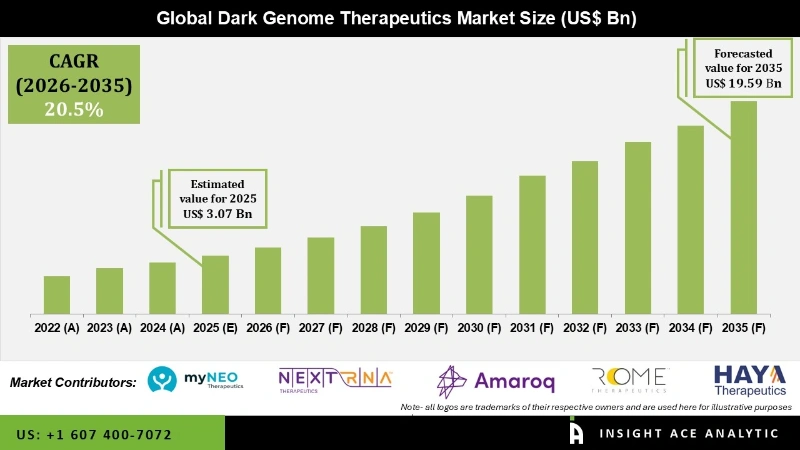
Dark Genome Therapeutics Market Key Takeaways:
|
The dark genome comprises long stretches of DNA, including genes that encode conventional proteins as well as a vast array of genomic repeats, repeating elements that dominate this non-coding portion of the genome. Many of these repeats originated from ancient viruses and retrotransposons that have integrated into the DNA over evolutionary time. Among them are human endogenous retroviruses (HERVs), remnants of ancient viral infections that are typically inactive in healthy cells. However, under certain pathological conditions, such as cancer and neurodegenerative diseases, these HERVs can become reactivated. This reactivation has positioned HERVs as promising targets for developing innovative immunotherapies.
Dark genome elements such as human endogenous retroviruses (HERVs) and long non-coding RNAs (lncRNAs) are gaining attention as cancer-specific antigens and gene regulators, opening new pathways for the development of targeted therapies and immunotherapies. RNA-based therapeutics are also being explored to suppress fibrogenic gene expression influenced by dark genome components in conditions like pulmonary and cardiac fibrosis. In neurodegenerative diseases such as Alzheimer's and Parkinson's, non-coding RNAs linked to brain function and neuroinflammation present promising therapeutic targets. Driving these advancements are cutting-edge technologies like next-generation sequencing (NGS), CRISPR gene editing, and transcriptomics, which are allowing scientists to delve deeply into previously unexplored non-coding regions of the genome.
Competitive Landscape
Some of the Major Key Players in the Dark Genome Therapeutics Market are:
- myNEO Therapeutics
- NextRNA Therapeutics
- Haya Therapeutics
- Rome Therapeutics
- Amaroq Therapeutics
- Transposon Therapeutics
- Evaxion Therapeutics
- Hervolution Therapeutics
- Flamingo Therapeutics
- GeNeuro
Market Segmentation
The Dark Genome Therapeutics Market is segmented based on indication, phase. Based on indication, the market is segmented into cancer, autoimmune diseases, fibrotic diseases, and neurodegenerative disorders. Based on the phases, the market is divided into preclinical, phase 1, phase 2, and phase 3.
The Cancer Segment is Expected to Have the Highest Growth Rate During the Forecast Period
Based on indication, the market is segmented into cancer, autoimmune diseases, fibrotic diseases, and neurodegenerative disorders. Among these, the cancer segment is expected to have the highest growth rate during the forecast period. The cancer segment is currently experiencing the highest growth within the dark genome therapeutics market. This surge is primarily driven by the increasing prevalence of various cancers worldwide and the growing adoption of gene therapy as a targeted treatment approach.
Gene therapy's ability to specifically target cancer cells while minimizing damage to healthy cells has made it an increasingly attractive treatment option. The segment's growth is further supported by extensive research and development activities focused on developing new gene therapy solutions for different types of cancers. the successful commercialization of several cancer gene therapy products and increasing regulatory approvals have strengthened this segment's market position.
The Preclinical Segment Dominates the Market
Based on the phases, the market is divided into preclinical, phase 1, phase 2, and phase 3. Among these, the preclinical segment dominates the market. The preclinical stage currently represents the highest growth segment in the dark genome therapeutics market. This phase is experiencing significant expansion due to increased research and development activities focused on non-coding genomic elements, such as long non-coding RNAs (lncRNAs) and human endogenous retroviruses (HERVs), which are being explored for their potential roles in various diseases. Dark genome elements have implications across a wide range of diseases, from cancer and autoimmune diseases to neurodegenerative and fibrotic disorders. This broad potential encourages extensive target discovery and therapeutic exploration, keeping much of the market activity within the preclinical stage.
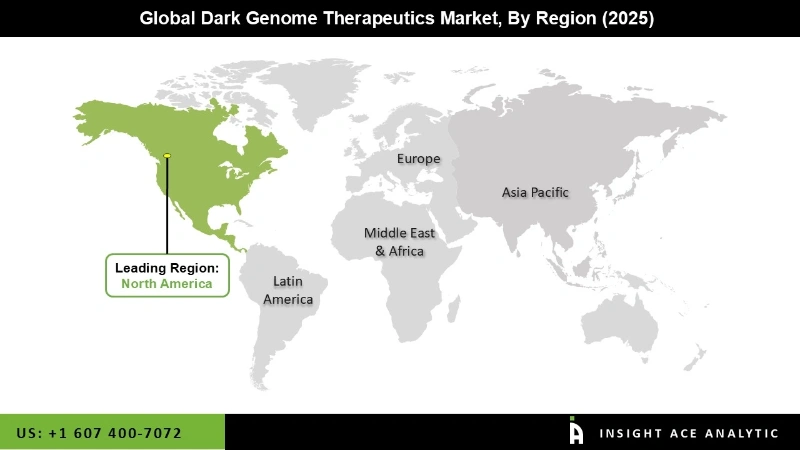
North America Has the Largest Market Share During the Forecast Period.
The North American region holds the largest market share in the dark genome therapeutics sector and is projected to maintain its dominance throughout the forecast period. The United States and Canada boast a robust network of research institutions, biotechnology firms, and pharmaceutical companies actively engaged in genomic and gene therapy research. This infrastructure facilitates rapid advancements in dark genome therapeutics. Regulatory agencies such as the U.S. Food and Drug Administration (FDA) provide clear guidelines and support for the development and approval of genomic-based therapies, encouraging innovation in the field.
Recent Developments:
- In Dec 2024, HERVolution Therapeutics ApS announced a $11.7 million Series A financing to advance its lead assets toward clinical evaluation. The funds from this financing round supported several key initiatives, including the validation of their HERV-targeting approach, cGMP manufacturing in collaboration with SII, initiation of Phase 1 clinical trials for their lead asset IPT-001, exploration of additional disease indications, and expansion of company infrastructure to support clinical development.
- In Sept 2024, HAYA Therapeutics, SA, announced a multi-year contract with Eli Lilly and Company to support preclinical drug discovery activities in obesity and related metabolic diseases using HAYA's cutting-edge RNA-guided regulatory genome technology. To treat these chronic illnesses, the partners will find several RNA-based therapeutic targets generated from the regulatory genome. In addition to an upfront payment that includes an equity investment, HAYA is eligible to collect pre-clinical, clinical, and commercial milestone payments totaling up to $1 billion, as well as royalties on product sales, under the terms of the partnership.
Dark Genome Therapeutics Market Report Scope:
| Report Attribute | Specifications |
| Market Size Value In 2025 | USD 3.07 Billion |
| Revenue Forecast In 2035 | USD 19.59 Billion |
| Growth Rate CAGR | CAGR of 20.5% from 2026 to 2035 |
| Quantitative Units | Representation of revenue in US$ Bn and CAGR from 2026 to 2035 |
| Historic Year | 2022 to 2025 |
| Forecast Year | 2026-2035 |
| Report Coverage | The forecast of revenue, the position of the company, the competitive market structure, growth prospects, and trends |
| Segments Covered | By Indication, Phases |
| Regional Scope | North America; Europe; Asia Pacific; Latin America; Middle East & Africa |
| Country Scope | U.S.; Canada; U.K.; Germany; China; India; Japan; Brazil; Mexico; The UK; France; Italy; Spain; China; Japan; India; South Korea; Southeast Asia; South Korea; South East Asia |
| Competitive Landscape | myNEO Therapeutics, NextRNA Therapeutics, Haya Therapeutics, Rome Therapeutics, Amaroq Therapeutics, Transposon Therapeutics, Evaxion Therapeutics, Hervolution Therapeutics, Flamingo Therapeutics, GeNeuro |
| Customization Scope | Free customization report with the procurement of the report and modifications to the regional and segment scope. Particular Geographic competitive landscape. |
| Pricing and Available Payment Methods | Explore pricing alternatives that are customized to your particular study requirements. |
Segmentation of Dark Genome Therapeutics Market
Global Dark Genome Therapeutics Market - By Indication
- Cancer
- Autoimmune diseases
- Fibrotic diseases
- Neurodegenerative Disorders
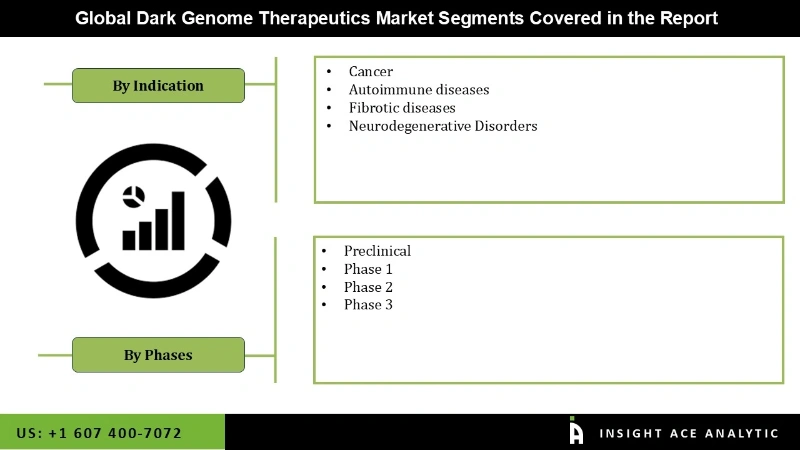
Global Dark Genome Therapeutics Market – By Phases
- Preclinical
- Phase 1
- Phase 2
- Phase 3
Global Dark Genome Therapeutics Market – By Region
North America-
- The US
- Canada
Europe-
- Germany
- The UK
- France
- Italy
- Spain
- Rest of Europe
Asia-Pacific-
- China
- Japan
- India
- South Korea
- Southeast Asia
- Rest of Asia Pacific
Latin America-
- Brazil
- Argentina
- Mexico
- Rest of Latin America
Middle East & Africa-
- GCC Countries
- South Africa
- Rest of the Middle East and Africa
Research Design and Approach
This study employed a multi-step, mixed-method research approach that integrates:
- Secondary research
- Primary research
- Data triangulation
- Hybrid top-down and bottom-up modelling
- Forecasting and scenario analysis
This approach ensures a balanced and validated understanding of both macro- and micro-level market factors influencing the market.
Secondary Research
Secondary research for this study involved the collection, review, and analysis of publicly available and paid data sources to build the initial fact base, understand historical market behaviour, identify data gaps, and refine the hypotheses for primary research.
Sources Consulted
Secondary data for the market study was gathered from multiple credible sources, including:
- Government databases, regulatory bodies, and public institutions
- International organizations (WHO, OECD, IMF, World Bank, etc.)
- Commercial and paid databases
- Industry associations, trade publications, and technical journals
- Company annual reports, investor presentations, press releases, and SEC filings
- Academic research papers, patents, and scientific literature
- Previous market research publications and syndicated reports
These sources were used to compile historical data, market volumes/prices, industry trends, technological developments, and competitive insights.

Primary Research
Primary research was conducted to validate secondary data, understand real-time market dynamics, capture price points and adoption trends, and verify the assumptions used in the market modelling.
Stakeholders Interviewed
Primary interviews for this study involved:
- Manufacturers and suppliers in the market value chain
- Distributors, channel partners, and integrators
- End-users / customers (e.g., hospitals, labs, enterprises, consumers, etc., depending on the market)
- Industry experts, technology specialists, consultants, and regulatory professionals
- Senior executives (CEOs, CTOs, VPs, Directors) and product managers
Interview Process
Interviews were conducted via:
- Structured and semi-structured questionnaires
- Telephonic and video interactions
- Email correspondences
- Expert consultation sessions
Primary insights were incorporated into demand modelling, pricing analysis, technology evaluation, and market share estimation.
Data Processing, Normalization, and Validation
All collected data were processed and normalized to ensure consistency and comparability across regions and time frames.
The data validation process included:
- Standardization of units (currency conversions, volume units, inflation adjustments)
- Cross-verification of data points across multiple secondary sources
- Normalization of inconsistent datasets
- Identification and resolution of data gaps
- Outlier detection and removal through algorithmic and manual checks
- Plausibility and coherence checks across segments and geographies
This ensured that the dataset used for modelling was clean, robust, and reliable.
Market Size Estimation and Data Triangulation
Bottom-Up Approach
The bottom-up approach involved aggregating segment-level data, such as:
- Company revenues
- Product-level sales
- Installed base/usage volumes
- Adoption and penetration rates
- Pricing analysis
This method was primarily used when detailed micro-level market data were available.

Top-Down Approach
The top-down approach used macro-level indicators:
- Parent market benchmarks
- Global/regional industry trends
- Economic indicators (GDP, demographics, spending patterns)
- Penetration and usage ratios
This approach was used for segments where granular data were limited or inconsistent.
Hybrid Triangulation Approach
To ensure accuracy, a triangulated hybrid model was used. This included:
- Reconciling top-down and bottom-up estimates
- Cross-checking revenues, volumes, and pricing assumptions
- Incorporating expert insights to validate segment splits and adoption rates
This multi-angle validation yielded the final market size.
Forecasting Framework and Scenario Modelling
Market forecasts were developed using a combination of time-series modelling, adoption curve analysis, and driver-based forecasting tools.
Forecasting Methods
- Time-series modelling
- S-curve and diffusion models (for emerging technologies)
- Driver-based forecasting (GDP, disposable income, adoption rates, regulatory changes)
- Price elasticity models
- Market maturity and lifecycle-based projections
Scenario Analysis
Given inherent uncertainties, three scenarios were constructed:
- Base-Case Scenario: Expected trajectory under current conditions
- Optimistic Scenario: High adoption, favourable regulation, strong economic tailwinds
- Conservative Scenario: Slow adoption, regulatory delays, economic constraints
Sensitivity testing was conducted on key variables, including pricing, demand elasticity, and regional adoption.
Request Customization
Add countries, segments, company profiles, or extend forecast — free 10% customization with purchase.
Customize This Report →Enquire Before Buying
Speak with our analyst team about scope, methodology, pricing, or deliverable formats.
Enquire Now →Frequently Asked Questions
Dark Genome Therapeutics Market Size is valued at USD 3.07 Bn in 2025 and is predicted to reach USD 19.59 Bn by the year 2035.
Dark Genome Therapeutics Market is expected to grow at a 20.5% CAGR during the forecast period for 2026-2035.
myNEO Therapeutics, NextRNA Therapeutics, Haya Therapeutics, Rome Therapeutics, Amaroq Therapeutics, Transposon Therapeutics, Evaxion Therapeutics.
Dark Genome Therapeutics Market is segmented based on indication, phase.
North America region is leading the Dark Genome Therapeutics Market.