Premenstrual Syndrome Treatment Market Current Trends Analysis 2026 to 2035
What is Premenstrual Syndrome Treatment Market Size?
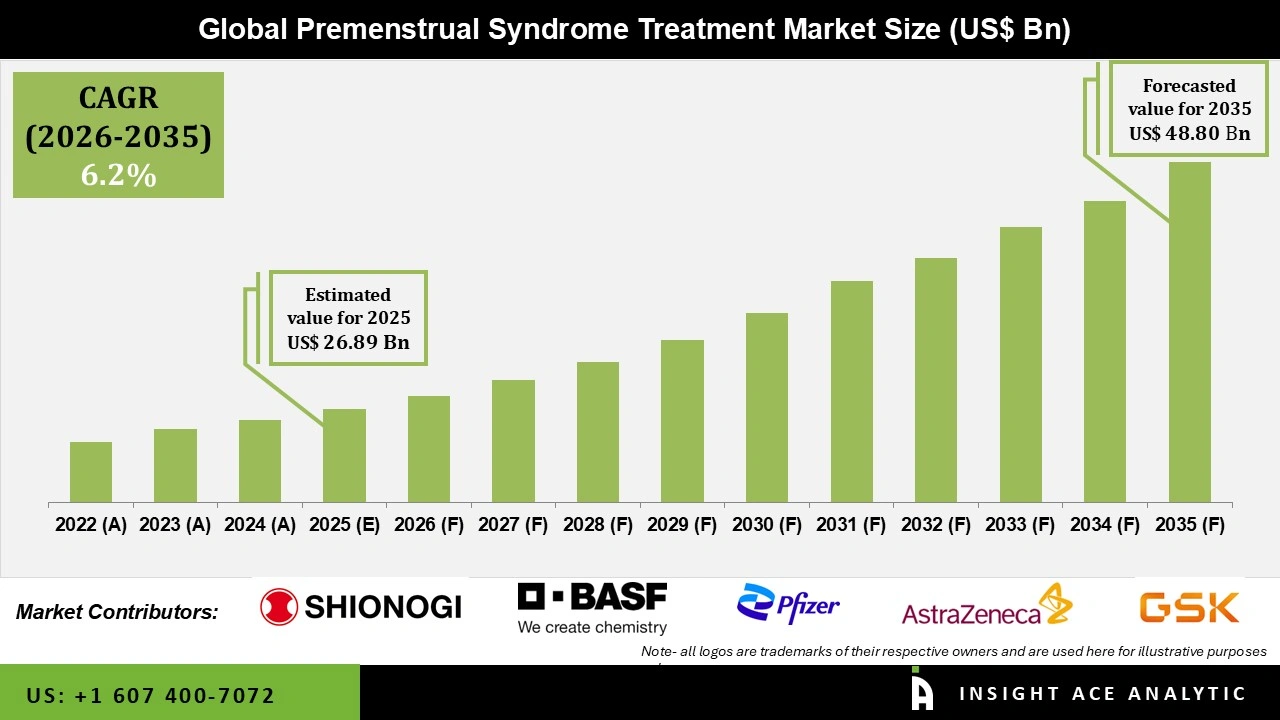
Global Premenstrual Syndrome Treatment Market Size is valued at USD 26.89 Bn in 2025 and is predicted to reach USD 48.80 Bn by the year 2035 at a 6.2% CAGR during the forecast period for 2026 to 2035.
Premenstrual Syndrome Treatment Market Size, Share & Trends Analysis Distribution by Type (Prescription and OTC), Drug Type (Antidepressants, Analgesics, Oral Contraceptives & Ovarian Suppression Agents, and Others), Distribution Channel (Hospital Pharmacies, Online Pharmacies, and Drug Stores & Retail Pharmacies), and Segment Forecasts, 2026 to 2035.
Premenstrual Syndrome Treatment Market Key Takeaways:
|
Treatment options for premenstrual syndrome (PMS) include over-the-counter medications, pharmacological interventions, and holistic methods intended to lessen the psychological and physical symptoms that women encounter before their periods. These choices include antidepressants, painkillers, nutritional supplements, and hormonal drugs. The personalized regimens that incorporate conventional medications with lifestyle modifications, stress-reduction strategies, and alternative therapies according to patient preferences and symptom intensity are the mainstay of modern PMS care. The growing emphasis on precision medicine, which improves patient outcomes and treatment effectiveness, expanding healthcare spending, which increases access to care and broadens treatment options, and increased female employment participation are the factors driving the premenstrual syndrome treatment market.
The premenstrual syndrome treatment market is mostly driven by the rising rates of premenstrual dysphoric disorder (PMDD) and PMS among working women, which are caused by their busy schedules and sedentary lifestyles. Another significant growth-inducing component is people's growing understanding of the various treatment options for PMS issues. In addition, many are using dietary supplements derived from plants to alleviate PMS. Nutrients, including calcium, potassium, magnesium, and proteins found in these supplements, help to lessen anxiety and sadness as well as exhaustion. This is having a favourable impact on the premenstrual syndrome treatment market growth, as is the emergence of smartphone applications that track emotional and physiological changes in the body and provide medication reminder notifications.
In addition, the new developments in medication formulations & delivery systems, such as long-acting injectables and transdermal patches, increase accessibility and encourage patient compliance. More women seek therapy as a result of these developments, which promotes the premenstrual syndrome treatment market growth. Additional factors driving the premenstrual syndrome treatment market's expansion are the improved convenience, diversity, and efficacy of therapies. Furthermore, the premenstrual syndrome treatment market is seeing a growing trend toward personalized medicine, which focuses on customizing treatments based on specific patient profiles that include lifestyle, hormonal, and genetic factors.
Competitive Landscape
Which are the Leading Players in the Premenstrual Syndrome Treatment Market?
- GlaxoSmithKline Plc.
- ABBVIE INC.
- Bayer AG.
- BASF Corporation
- AstraZeneca plc
1. Reddy’s Laboratories Ltd
- Eli Lilly And Company.
1. Lundbeck A/S
- Pfizer Inc.
- Shionogi Inc.
Market Dynamics
Driver
Increased Knowledge and Instruction on Women's Health
The premenstrual syndrome treatment market is being driven in large part by the increased awareness of women's health around the world. Government programs, social media efforts, and increased health education all aid in women's understanding of PMS symptoms and accessible therapies. Additionally, the adoption rate of both pharmaceutical and non-pharmaceutical treatments rises as a result of early medical consultation brought about by educational initiatives. For moderate to severe PMS symptoms, women are increasingly turning to doctors, which is driving demand for effective treatments worldwide. The National Institutes of Health (NIH) estimates that up to 75% of women have some kind of premenstrual syndrome (PMS), with 5% of women suffering from severe cases that are disruptive to their everyday lives, known as Premenstrual Dysphoric Disorder (PMDD).
Restrain/Challenge
Low Demand in Developing Nations
In some parts of the world, especially in rural and remote places, as well as in the Middle East and other less developed countries, menstruation and women's social status are still heavily stigmatized. This is particularly true in the nation's more rural areas. Expectations and one's own self-perception of the illness are influenced by a range of cultural traits in rural parts of the Middle East and Africa. In the United States, patriarchal nations, communities that restrict free speech, and cultures where women are less exposed to the outside world are among the societal factors that are mostly attributed to the stigma associated with premenstrual syndrome (PMS). Because of this, patients are less likely to seek treatment for the condition. As a result, the growth of the premenstrual syndrome treatment market will be limited as a result of this.
Analgesics Segment is Expected to Drive the Premenstrual Syndrome Treatment Market
The analgesics category held the largest share in the Premenstrual Syndrome Treatment market in 2025. Analgesics are medications that assist in reducing pain without impairing awareness, changing sensory perception, or preventing the conduction of nerve impulses. They are frequently referred to as painkillers or pain relievers. It, together with acetaminophen and nonsteroidal anti-inflammatory medicines (NSAIDs), successfully reduces symptoms like headaches, cramps, and muscle pains. The simplicity and accessibility of over-the-counter pain medicines, along with growing awareness of PMS, are driving up demand for these drugs. Analgesic formulations are widely used as a result of ongoing innovation that enhances both efficacy and safety. The market is expanding significantly as more women seek relief and medical professionals suggest analgesics as first-line therapy.
Online Pharmacies Segment is Growing Rapidly in the Premenstrual Syndrome Treatment Market
In 2025, the online pharmacies category dominated the Premenstrual Syndrome Treatment market. As per the Global System for Mobile Communications Association (GSMA), 54% of people globally possessed a smartphone in 2023, indicating a rise in smartphone use and internet penetration on a global scale. The segmented market growth has increased as a result of more people having access to online pharmacies for a variety of medications. Furthermore, a greater reliance on internet pharmacies has resulted from the ease of online payments and the convenience of home delivery of medications. Moreover, divisional market expansion is being driven by the growing number of internet pharmacies. The access to necessary pharmaceuticals will improve as online pharmacies develop and broaden their offerings globally, propelling the segmental expansion.
Why North America Led the Premenstrual Syndrome Treatment Market?
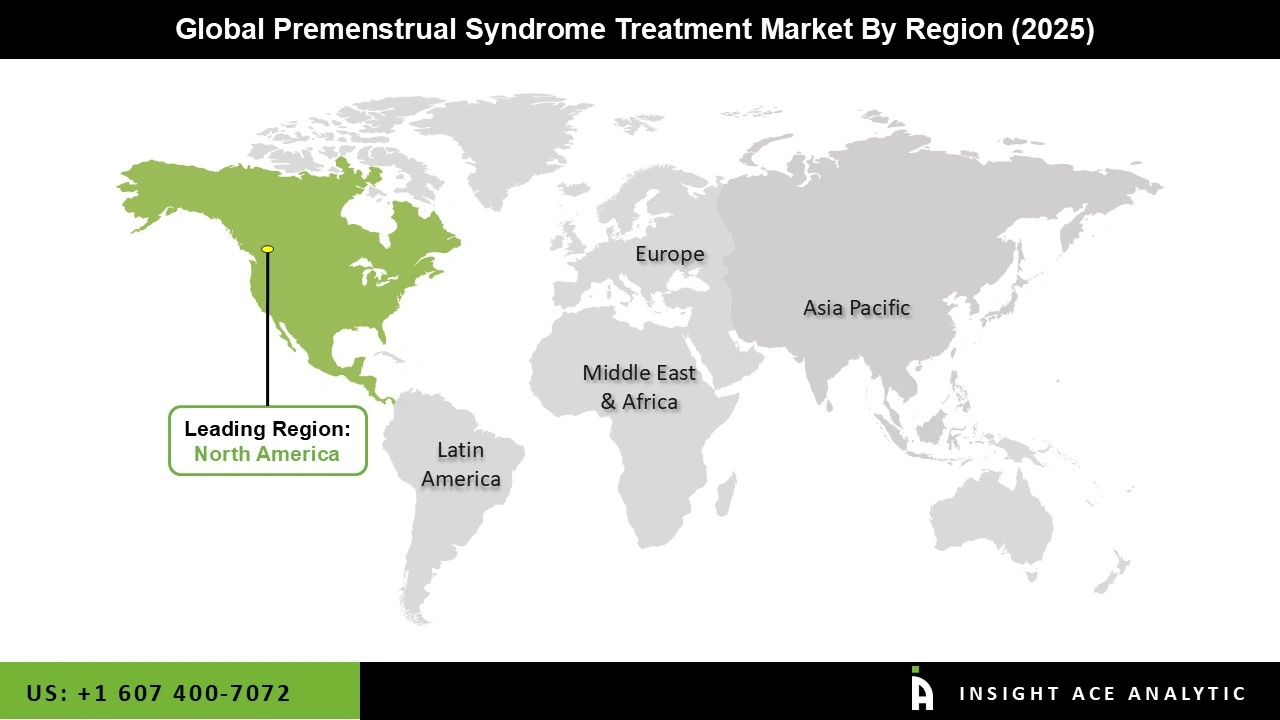
The Premenstrual Syndrome Treatment market was dominated by the North America region in 2025, because of its sophisticated healthcare infrastructure, high level of knowledge of PMS and its treatment choices, and substantial healthcare spending. A significant frequency of PMS among women and strong healthcare regulations make the US and Canada important markets in this region.
Additionally, the existence of significant pharmaceutical companies in the area, which make significant investments in R&D to launch novel and efficient premenstrual syndrome treatment, affects the dynamics of the market. Moreover, the key players concentrate on educational initiatives to increase public knowledge of PMS and its treatment, in addition to developing innovative products. The regulatory framework in the area, especially in the United States, which is made possible by the FDA, encourages quick product approvals and market entry, which accelerates the expansion of the regional premenstrual syndrome treatment market.
Premenstrual Syndrome Treatment Market Report Scope:
| Report Attribute | Specifications |
| Market size value in 2025 | USD 26.89 Bn |
| Revenue forecast in 2035 | USD 48.80 Bn |
| Growth Rate CAGR | CAGR of 6.2% from 2026 to 2035 |
| Quantitative Units | Representation of revenue in US$ Bn and CAGR from 2026 to 2035 |
| Historic Year | 2022 to 2025 |
| Forecast Year | 2026-2035 |
| Report Coverage | The forecast of revenue, the position of the company, the competitive market structure, growth prospects, and trends |
| Segments Covered | Type, Drug Type, Distribution Channel, and By Region |
| Regional Scope | North America; Europe; Asia Pacific; Latin America; Middle East & Africa |
| Country Scope | U.S.; Canada; U.K.; Germany; China; India; Japan; Brazil; Mexico; The UK; France; Italy; Spain; China; Japan; India; South Korea; Southeast Asia; South Korea; Southeast Asia |
| Competitive Landscape | GlaxoSmithKline Plc., ABBVIE INC., Bayer AG., BASF Corporation, AstraZeneca plc, Dr. Reddy’s Laboratories Ltd, Eli Lilly And Company., H. Lundbeck A/S, Pfizer Inc., and Shionogi Inc. |
| Customization Scope | Free customization report with the procurement of the report, Modifications to the regional and segment scope. Geographic competitive landscape. |
| Pricing and Available Payment Methods | Explore pricing alternatives that are customized to your particular study requirements. |
Segmentation of Premenstrual Syndrome Treatment Market :
Premenstrual Syndrome Treatment Market by Type-
- Prescription
- OTC
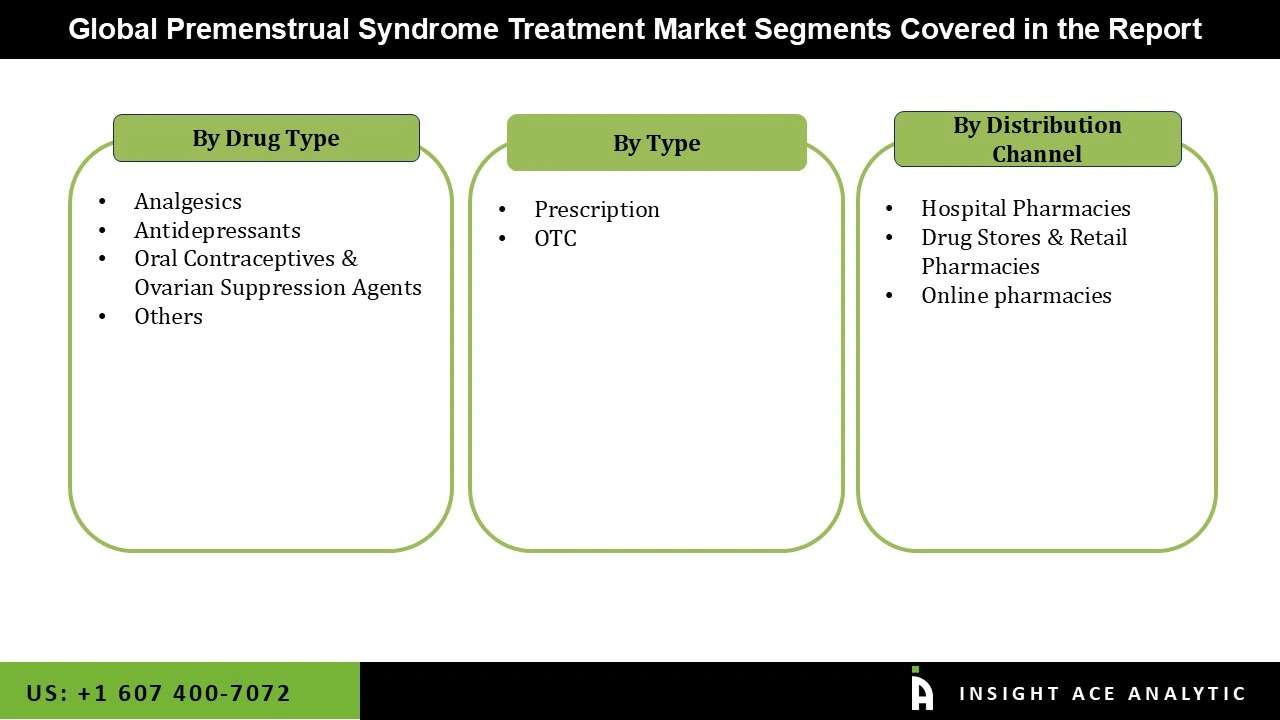
Premenstrual Syndrome Treatment Market by Drug Type-
- Antidepressants
- Analgesics
- Oral Contraceptives & Ovarian Suppression Agents
- Others
Premenstrual Syndrome Treatment Market by Distribution Channel-
- Hospital Pharmacies
- Online Pharmacies
- Drug Stores & Retail Pharmacies
Premenstrual Syndrome Treatment Market By Region-
- North America-
- The US
- Canada
- Europe-
- Germany
- The UK
- France
- Italy
- Spain
- Rest of Europe
- Asia-Pacific-
- China
- Japan
- India
- South Korea
- South East Asia
- Rest of Asia Pacific
- Latin America-
- Brazil
- Argentina
- Mexico
- Rest of Latin America
- Middle East & Africa-
- GCC Countries
- South Africa
- Rest of Middle East and Africa
Research Design and Approach
This study employed a multi-step, mixed-method research approach that integrates:
- Secondary research
- Primary research
- Data triangulation
- Hybrid top-down and bottom-up modelling
- Forecasting and scenario analysis
This approach ensures a balanced and validated understanding of both macro- and micro-level market factors influencing the market.
Secondary Research
Secondary research for this study involved the collection, review, and analysis of publicly available and paid data sources to build the initial fact base, understand historical market behaviour, identify data gaps, and refine the hypotheses for primary research.
Sources Consulted
Secondary data for the market study was gathered from multiple credible sources, including:
- Government databases, regulatory bodies, and public institutions
- International organizations (WHO, OECD, IMF, World Bank, etc.)
- Commercial and paid databases
- Industry associations, trade publications, and technical journals
- Company annual reports, investor presentations, press releases, and SEC filings
- Academic research papers, patents, and scientific literature
- Previous market research publications and syndicated reports
These sources were used to compile historical data, market volumes/prices, industry trends, technological developments, and competitive insights.

Primary Research
Primary research was conducted to validate secondary data, understand real-time market dynamics, capture price points and adoption trends, and verify the assumptions used in the market modelling.
Stakeholders Interviewed
Primary interviews for this study involved:
- Manufacturers and suppliers in the market value chain
- Distributors, channel partners, and integrators
- End-users / customers (e.g., hospitals, labs, enterprises, consumers, etc., depending on the market)
- Industry experts, technology specialists, consultants, and regulatory professionals
- Senior executives (CEOs, CTOs, VPs, Directors) and product managers
Interview Process
Interviews were conducted via:
- Structured and semi-structured questionnaires
- Telephonic and video interactions
- Email correspondences
- Expert consultation sessions
Primary insights were incorporated into demand modelling, pricing analysis, technology evaluation, and market share estimation.
Data Processing, Normalization, and Validation
All collected data were processed and normalized to ensure consistency and comparability across regions and time frames.
The data validation process included:
- Standardization of units (currency conversions, volume units, inflation adjustments)
- Cross-verification of data points across multiple secondary sources
- Normalization of inconsistent datasets
- Identification and resolution of data gaps
- Outlier detection and removal through algorithmic and manual checks
- Plausibility and coherence checks across segments and geographies
This ensured that the dataset used for modelling was clean, robust, and reliable.
Market Size Estimation and Data Triangulation
Bottom-Up Approach
The bottom-up approach involved aggregating segment-level data, such as:
- Company revenues
- Product-level sales
- Installed base/usage volumes
- Adoption and penetration rates
- Pricing analysis
This method was primarily used when detailed micro-level market data were available.

Top-Down Approach
The top-down approach used macro-level indicators:
- Parent market benchmarks
- Global/regional industry trends
- Economic indicators (GDP, demographics, spending patterns)
- Penetration and usage ratios
This approach was used for segments where granular data were limited or inconsistent.
Hybrid Triangulation Approach
To ensure accuracy, a triangulated hybrid model was used. This included:
- Reconciling top-down and bottom-up estimates
- Cross-checking revenues, volumes, and pricing assumptions
- Incorporating expert insights to validate segment splits and adoption rates
This multi-angle validation yielded the final market size.
Forecasting Framework and Scenario Modelling
Market forecasts were developed using a combination of time-series modelling, adoption curve analysis, and driver-based forecasting tools.
Forecasting Methods
- Time-series modelling
- S-curve and diffusion models (for emerging technologies)
- Driver-based forecasting (GDP, disposable income, adoption rates, regulatory changes)
- Price elasticity models
- Market maturity and lifecycle-based projections
Scenario Analysis
Given inherent uncertainties, three scenarios were constructed:
- Base-Case Scenario: Expected trajectory under current conditions
- Optimistic Scenario: High adoption, favourable regulation, strong economic tailwinds
- Conservative Scenario: Slow adoption, regulatory delays, economic constraints
Sensitivity testing was conducted on key variables, including pricing, demand elasticity, and regional adoption.
Request Customization
Add countries, segments, company profiles, or extend forecast — free 10% customization with purchase.
Customize This Report →Enquire Before Buying
Speak with our analyst team about scope, methodology, pricing, or deliverable formats.
Enquire Now →Frequently Asked Questions
Premenstrual Syndrome Treatment Market Size is valued at USD 26.89 Bn in 2025 and is predicted to reach USD 48.80 Bn by the year 2035
Premenstrual Syndrome Treatment Market is expected to grow at a 6.2% CAGR during the forecast period for 2026 to 2035
GlaxoSmithKline Plc., ABBVIE INC., Bayer AG., BASF Corporation, AstraZeneca plc, Dr. Reddy’s Laboratories Ltd, Eli Lilly And Company., H. Lundbeck A/S, Pfizer Inc., Shionogi Inc. and Others.
Premenstrual Syndrome Treatment Market is segmented into Type, Drug Type, Distribution Channel, and By Region
North America region is leading the Premenstrual Syndrome Treatment Market.