Coconut Sugar Market Size, Revenue, Forecast Report 2026 to 2035
What is Coconut Sugar Market Size?
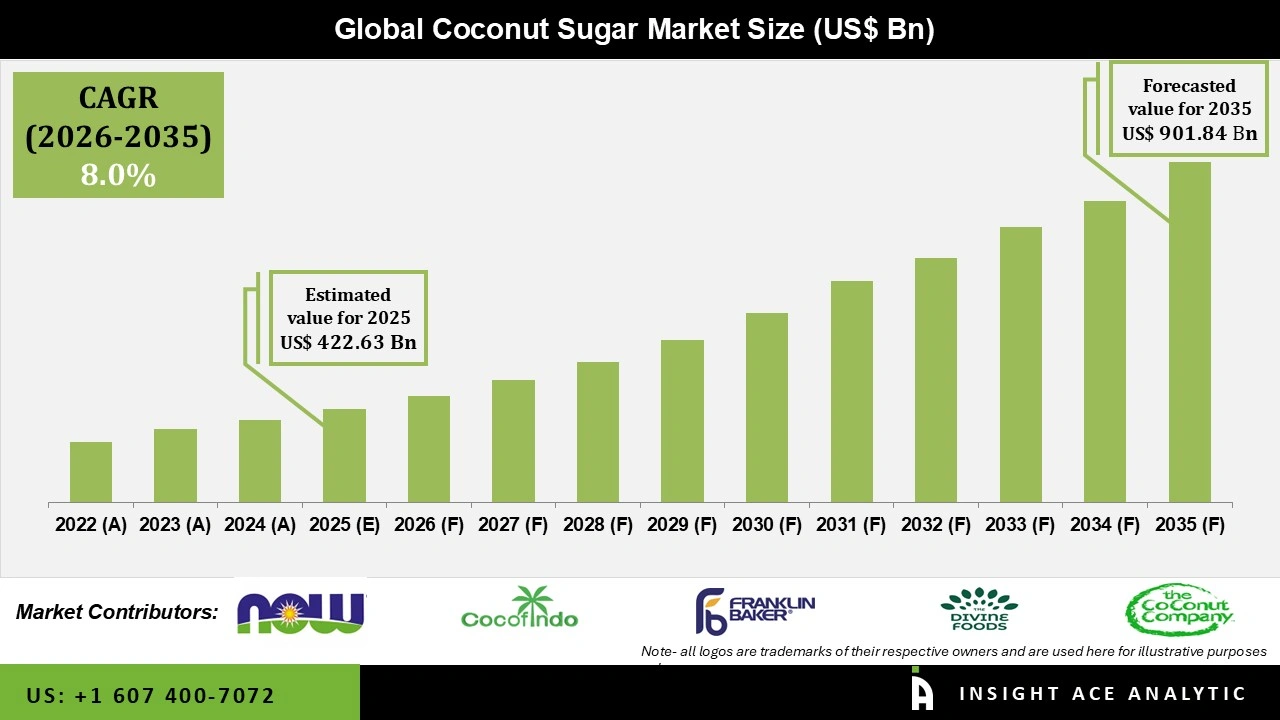
Global Coconut Sugar Market Size of the is valued at USD 422.63 Million in 2025 and is predicted to reach USD 901.84 Million by the year 2035 at an 8.0% CAGR during the forecast period for 2026 to 2035.
Coconut Sugar Market Size, Share & Trends Analysis Report By Application (Food And Beverage, Cosmetics And Personal Care), Sales Channel (Hypermarkets, Specialty Stores, E-Commerce, And Business-To-Business), Foam (Organic And Conventional) And By End User, By Region, and Segment Forecasts, 2026 to 2035.
Coconut Sugar Market Key Takeaways:
|
Key Industry Insights & Findings from the Report:
- Coconut sugar offers opportunities for product diversification, including the development of new formulations, blends, and innovative applications.
- The increasing consumer preference for natural and minimally processed sweeteners is a significant driver for the coconut sugar market.
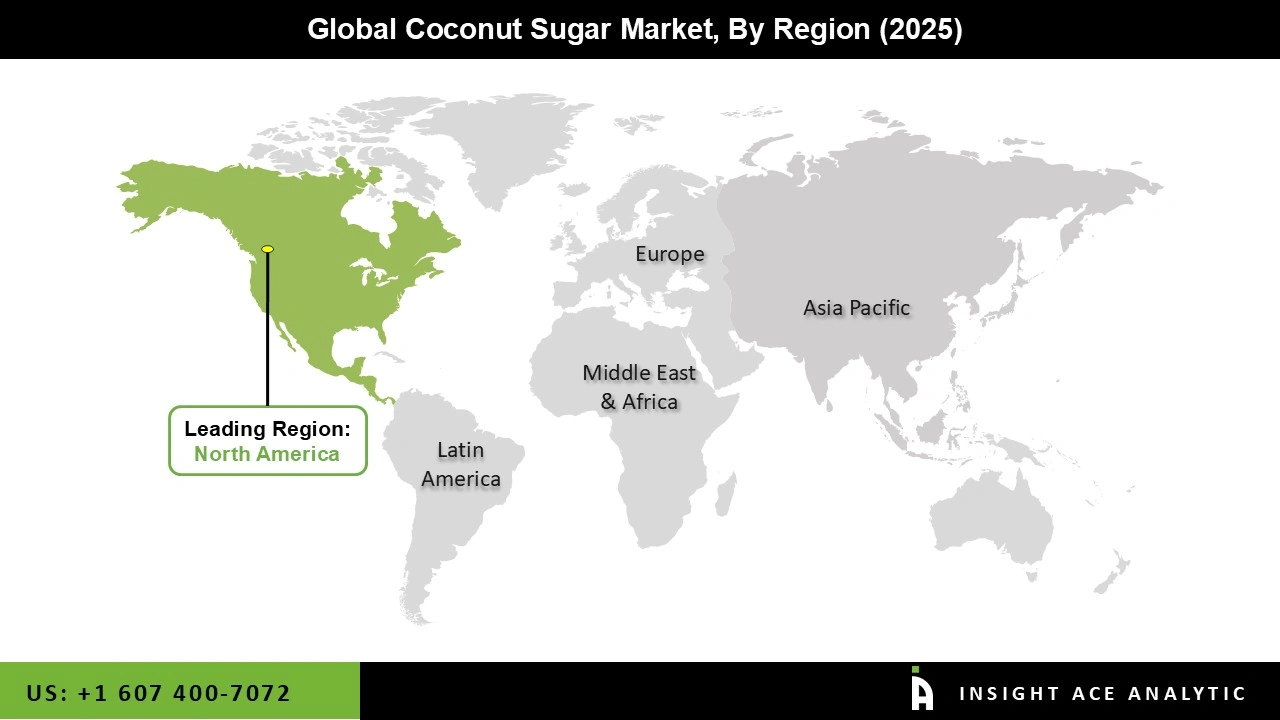
- North America dominated the market and accounted for a revenue share of global revenue in 2025.
- Challenges in the coconut sugar supply chain, including issues related to weather conditions, crop yield variations, and transportation, can lead to fluctuations in supply and impact market stability
Coconut sugar, sometimes referred to as coconut sap sugar, is made from the sap of chopped coconut palm flower buds. Granules, rocks, granules, cubed, and liquid are all variations of coconut sugar. It is a traditional sweetener used for thousands of years because it includes essential minerals, macronutrients, and micronutrients. Vegetarian products are in higher demand than ever before.
Additionally, the demand for coconut sugar has lately surged due to its use in vegan products. The market for coconut sugar is anticipated to grow due to the rising prevalence of obesity and diabetes among a sizable portion of the world's population. Rising demand for the product is anticipated to drive market expansion in producing various skincare items like body scrubs, shaving gels, and face and body creams.
Moreover, the development of the coconut sugar market is projected to be boosted by the expansion of the FMCG sector and increased consumer demand for herbal skin and hair care products. Coconut sugar's glycemic index (GI) is around half that of conventional table sugar. Because of this, coconut sugar is the greatest substitute for people with diabetes. Demand for coconut sugar is projected to increase in the coming years due to the increased prevalence of diabetes.
Competitive Landscape:
Some of the major key players in the Coconut Sugar market are:
- The Coconut Company (UK) Ltd
- The Divine Foods
- Franklin Baker
- Coco Sugar Indonesia
- Big Tree Farm
- NOW Foods
- Nutiva Inc
- Madhava Ltd.
- AGRIM PTE LTD
- Tradin Organic Agriculture B.V.
- Koperasi Nirasatria
- Singabera
- Treelife
- Groovy Food Company Ltd
- Connecticut Coconut Company
- Betterbody Foods
- Wholesome Sweetener Inc.
- celebes coconut corporation
- Amala Earth
- Brio Feed
- BetterBody Foods & Nutrition
- PT Holos Integra
- PT Mega InovasiOrganik
- Saudi Food Ingredients Factory
- SunOpta Inc.
- Tardo Filipinas Incorporated.
Market Segmentation:
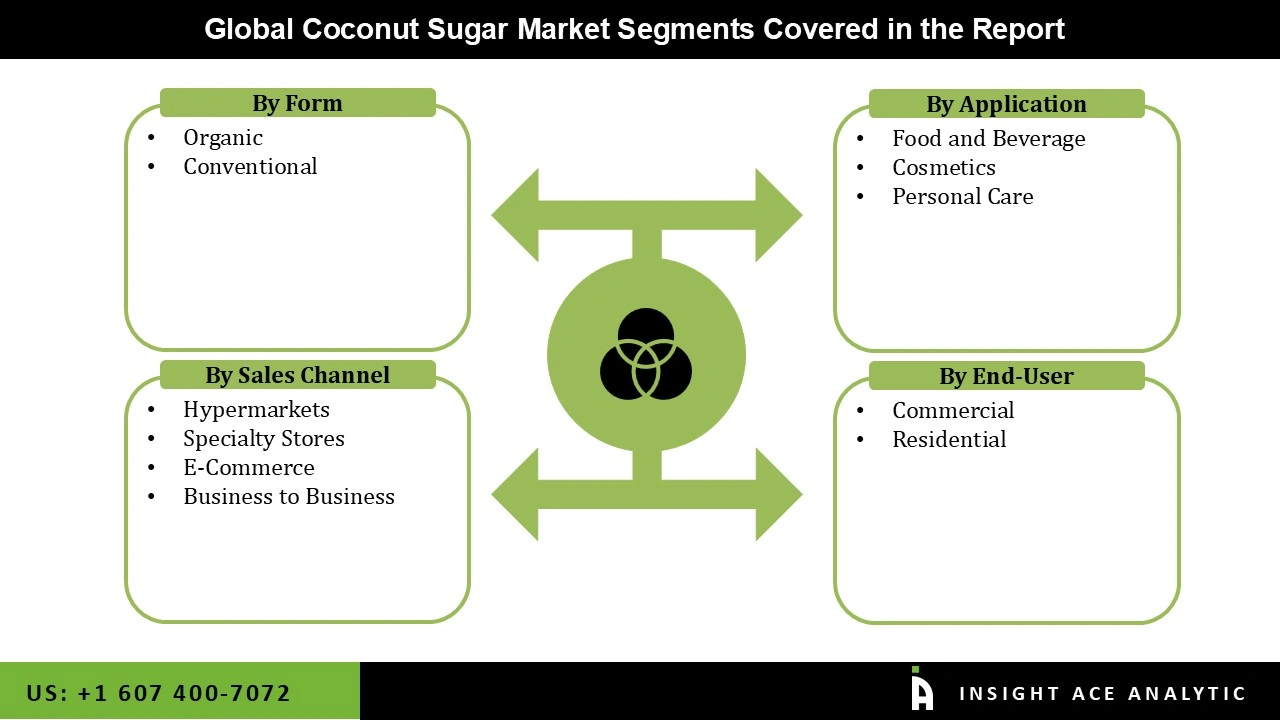
The coconut sugar market is segmented on application, sales channel, foam and end users. Based on application, the coconut sugar market is divided into food and beverage, cosmetics and personal care. Based on sales channels, the market is segmented into hypermarkets, specialty stores, e-commerce, and business-to-business. Based on foam, the market is segmented into organic and conventional. Based on end users, the market is segmented into commercial and residential.
Based On Applications, The Personal Care Segment Is A Major Contributor To The Coconut Sugar Market
The personal care category is expected to hold a significant share of the global coconut sugar market in 2021. The structural formula of coconut sugar makes it perfect for scrubs and readily dissolves in a range of personal care products. Coconut sugar is a common ingredient in body washes, shampoo, and sunscreens. Additionally, coconut sugar has a pleasant sensation on the skin, driving a desire for personal care items. Due to the iron, zinc, calcium, and potassium content of coconut sugar, it is used to make moisturizers and creams.
The Organic Segment Witnessed Growth At A Rapid Rate
The organic sector is projected to grow rapidly in the global coconut sugar market. The market for organic coconut sugar is expected to expand because of the increasing demand for organic foods worldwide. Its glycemic index is lower when compared to pure sweets and nectar when they are organic, and this prevents the circulatory system's blood sugar from rising. Due to factors like the expanding popularity of Asian cuisine, the growing need for dairy substitutes, and possible medical benefits of the industry, the market is estimated to expand throughout the anticipated period., especially in countries such as the US, Germany, the UK, China, and India.
The North American Coconut Sugar Market Holds A Significant Regional Revenue Share
The North America coconut sugar market is expected to register the highest market share in revenue soon. The market is expected that the product's prices will increase due to the growing demand on the global market. The product cost is substantially higher internationally than in the domestic market. Therefore, companies must consider prices to enhance their market share globally. Additionally, the market is anticipated to grow substantially due to rising trends of between-meal snacking and increased snack consumption in North America.
In addition, Asia Pacific is projected to grow rapidly in the global coconut sugar market. Since Malaysians and Indonesians have long utilized them as sweeteners, the Asia Pacific region is expected to experience tremendous growth. Furthermore, Indonesia produces the most coconuts worldwide, expanding the raw material supply. as consumers' discretionary cash has grown, they can buy the products for a premium cost, which has hastened the local market expansion. Asia Pacific is expected to produce most of the goods due to the readily available raw resources and technological advancement.
Recent Developments:
- In February 2022-Big Tree Farms introduced Vacuum Evaporated Coconut Nectar (VECN) In February 2022, which aims to raise the bar for consistency and quality in the organic sweetener market. By advancing its formulation, VECN elevates conventional brown coconut sugar's outstanding health advantages and distinctive warm flavour.
- In March 2021-The Philippines declared that it is attempting to enhance coconut production. In 2010, palm oil replaced coconut oil as the most popular oil in the majority of Filipino grocery stores. This is because it comes from more natural origins in Malaysia and Indonesia, which is more complex and widely available than coconut oil.
Coconut Sugar Market Report Scope :
| Report Attribute | Specifications |
| Market size value in 2025 | USD 422.63 Million |
| Revenue forecast in 2035 | USD 901.84 Million |
| Growth rate CAGR | CAGR of 8.0% from 2026 to 2035 |
| Quantitative units | Representation of revenue in US$ Million and CAGR from 2026 to 2035 |
| Historic Year | 2022 to 2025 |
| Forecast Year | 2026-2035 |
| Report coverage | The forecast of revenue, the position of the company, the competitive market structure, growth prospects, and trends |
| Segments covered | Application, Sales Channel, Form And End User |
| Regional scope | North America; Europe; Asia Pacific; Latin America; Middle East & Africa |
| Country scope | U.S.; Canada; U.K.; Germany; China; India; Japan; Brazil; Mexico ;The UK; France; Italy; Spain; China; Japan; India; South Korea; South East Asia; South Korea; South East Asia |
| Competitive Landscape | The Coconut Company (UK) Ltd, The Divine Foods, Franklin Baker, Coco Sugar Indonesia, Big Tree Farm, NOW Foods, Nutiva Inc, Madhava Ltd., AGRIM PTE LTD, Tradin Organic Agriculture B.V., Koperasi Nirasatria, Singabera, Treelife, Groovy Food Company Ltd, Connecticut Coconut Company, Betterbody Foods, Wholesome Sweetener Inc., celebes coconut corporation, Amala Earth, Brio Feed, BetterBody Foods & Nutrition, PT Holos Integra, PT Mega InovasiOrganik, Saudi Food Ingredients Factory, SunOpta Inc. , Tardo Filipinas Incorporated. |
| Customization scope | Free customization report with the procurement of the report, Modifications to the regional and segment scope. Particular Geographic competitive landscape. |
| Pricing and available payment methods | Explore pricing alternatives that are customized to your particular study requirements. |
Segmentation of Coconut Sugar Market :
Coconut Sugar Market, By Application-
- Food and Beverage
- Cosmetics
- Personal Care
Coconut Sugar Market, By Sales Channel -
- Hypermarkets
- Specialty Stores
- E-Commerce
- Business to Business
Coconut Sugar Market, By Form-
- Organic
- Conventional
Coconut Sugar Market, By End User-
- Commercial
- Residential
Coconut Sugar Market, By Region-
- North America-
- The US
- Canada
- Europe-
- Germany
- The UK
- France
- Italy
- Spain
- Rest of Europe
- Asia-Pacific-
- China
- Japan
- India
- South Korea
- South East Asia
- Rest of Asia Pacific
- Latin America-
- Brazil
- Argentina
- Mexico
- Rest of Latin America
- Middle East & Africa-
- GCC Countries
- South Africa
- Rest of Middle East and Africa
Research Design and Approach
This study employed a multi-step, mixed-method research approach that integrates:
- Secondary research
- Primary research
- Data triangulation
- Hybrid top-down and bottom-up modelling
- Forecasting and scenario analysis
This approach ensures a balanced and validated understanding of both macro- and micro-level market factors influencing the market.
Secondary Research
Secondary research for this study involved the collection, review, and analysis of publicly available and paid data sources to build the initial fact base, understand historical market behaviour, identify data gaps, and refine the hypotheses for primary research.
Sources Consulted
Secondary data for the market study was gathered from multiple credible sources, including:
- Government databases, regulatory bodies, and public institutions
- International organizations (WHO, OECD, IMF, World Bank, etc.)
- Commercial and paid databases
- Industry associations, trade publications, and technical journals
- Company annual reports, investor presentations, press releases, and SEC filings
- Academic research papers, patents, and scientific literature
- Previous market research publications and syndicated reports
These sources were used to compile historical data, market volumes/prices, industry trends, technological developments, and competitive insights.

Primary Research
Primary research was conducted to validate secondary data, understand real-time market dynamics, capture price points and adoption trends, and verify the assumptions used in the market modelling.
Stakeholders Interviewed
Primary interviews for this study involved:
- Manufacturers and suppliers in the market value chain
- Distributors, channel partners, and integrators
- End-users / customers (e.g., hospitals, labs, enterprises, consumers, etc., depending on the market)
- Industry experts, technology specialists, consultants, and regulatory professionals
- Senior executives (CEOs, CTOs, VPs, Directors) and product managers
Interview Process
Interviews were conducted via:
- Structured and semi-structured questionnaires
- Telephonic and video interactions
- Email correspondences
- Expert consultation sessions
Primary insights were incorporated into demand modelling, pricing analysis, technology evaluation, and market share estimation.
Data Processing, Normalization, and Validation
All collected data were processed and normalized to ensure consistency and comparability across regions and time frames.
The data validation process included:
- Standardization of units (currency conversions, volume units, inflation adjustments)
- Cross-verification of data points across multiple secondary sources
- Normalization of inconsistent datasets
- Identification and resolution of data gaps
- Outlier detection and removal through algorithmic and manual checks
- Plausibility and coherence checks across segments and geographies
This ensured that the dataset used for modelling was clean, robust, and reliable.
Market Size Estimation and Data Triangulation
Bottom-Up Approach
The bottom-up approach involved aggregating segment-level data, such as:
- Company revenues
- Product-level sales
- Installed base/usage volumes
- Adoption and penetration rates
- Pricing analysis
This method was primarily used when detailed micro-level market data were available.

Top-Down Approach
The top-down approach used macro-level indicators:
- Parent market benchmarks
- Global/regional industry trends
- Economic indicators (GDP, demographics, spending patterns)
- Penetration and usage ratios
This approach was used for segments where granular data were limited or inconsistent.
Hybrid Triangulation Approach
To ensure accuracy, a triangulated hybrid model was used. This included:
- Reconciling top-down and bottom-up estimates
- Cross-checking revenues, volumes, and pricing assumptions
- Incorporating expert insights to validate segment splits and adoption rates
This multi-angle validation yielded the final market size.
Forecasting Framework and Scenario Modelling
Market forecasts were developed using a combination of time-series modelling, adoption curve analysis, and driver-based forecasting tools.
Forecasting Methods
- Time-series modelling
- S-curve and diffusion models (for emerging technologies)
- Driver-based forecasting (GDP, disposable income, adoption rates, regulatory changes)
- Price elasticity models
- Market maturity and lifecycle-based projections
Scenario Analysis
Given inherent uncertainties, three scenarios were constructed:
- Base-Case Scenario: Expected trajectory under current conditions
- Optimistic Scenario: High adoption, favourable regulation, strong economic tailwinds
- Conservative Scenario: Slow adoption, regulatory delays, economic constraints
Sensitivity testing was conducted on key variables, including pricing, demand elasticity, and regional adoption.
Request Customization
Add countries, segments, company profiles, or extend forecast — free 10% customization with purchase.
Customize This Report →Enquire Before Buying
Speak with our analyst team about scope, methodology, pricing, or deliverable formats.
Enquire Now →Frequently Asked Questions
Coconut Sugar Market Size of the is valued at USD 422.63 Million in 2025 and is predicted to reach USD 901.84 Million by the year 2035
Coconut Sugar Market expected to grow at 8.0% CAGR during the forecast period for 2026 to 2035.
The Coconut Company (UK) Ltd, The Divine Foods, Franklin Baker, Coco Sugar Indonesia, Big Tree Farm, NOW Foods, Nutiva Inc, Madhava Ltd., AGRIM PTE LTD, Tradin Organic Agriculture B.V., Koperasi Nirasatria, Singabera, Treelife, Groovy Food Company Ltd, Connecticut Coconut Company, Betterbody Foods, Wholesome Sweetener Inc., celebes coconut corporation, Amala Earth, Brio Feed, BetterBody Foods & Nutrition, PT Holos Integra, PT Mega InovasiOrganik, Saudi Food Ingredients Factory, SunOpta Inc. , Tardo Filipinas Incorporated. and others.
Coconut Sugar Market is segmented in Application (Food And Beverage, Cosmetics And Personal Care), Sales Channel (Hypermarkets, Specialty Stores, E-Commerce, And Business-To-Business), Foam (Organic And Conventional) and By End User and other.
North America region is leading the Coconut Sugar Market.