Chemical Concentration Monitor Market Size, Trend, Forecast Report 2026 to 2035
Global Chemical Concentration Monitor Market Size is valued at USD 6.96 Bn in 2025 and is predicted to reach USD 12.91 Bn by the year 2035 at a 6.5% CAGR during the forecast period for 2026 to 2035.
Chemical Concentration Monitor Market Size, Share & Trends Analysis Distribution by Type (Portable Monitors and Stationary Monitors), By Offering (Software, Hardware, and Services), By Product (Inline Refractometer, Amperometri Ion Sensor, Fiber-optic Concentration Monitor, NIR/IR Analyzer, and Non-contact Optical Monitor), By Medium (Gas and Liquid), Technology (Conductivity Technology, Ultrasonic Technology, Electrochemical Technology, Optical Technology, and Others), By End-user (Food & Beverages, Semiconductor and Electronics Manufacturing, Water & Wastewater Treatment, Healthcare & Pharmaceuticals, and Others), and Segment Forecasts, 2026 to 2035
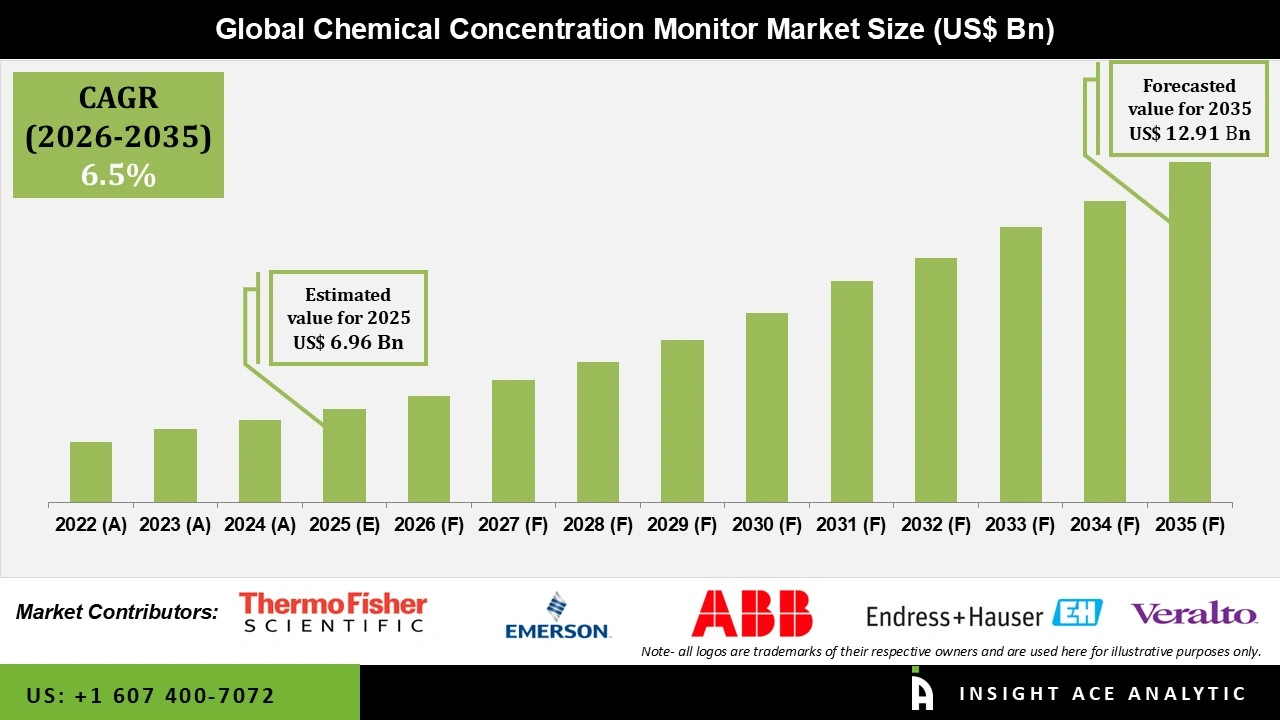
An analytical tool or system used to detect and monitor the quantity or concentration of a certain chemical substance present in a medium such as air, water, gas, or industrial process fluids is known as a chemical concentration monitor. It operates by employing sensors or detecting technologies, such as gas chromatography, infrared spectroscopy, optical sensors, or electrochemical sensors, to identify the presence and amount of substances in real time or by periodic sampling. To make sure that chemical levels stay within acceptable or necessary bounds, these monitors are frequently employed in industrial manufacturing, safety systems, laboratories, and environmental monitoring. The growing need for precise chemical concentration monitoring across a range of industries, including chemical manufacture, water treatment, pharmaceuticals, and food and beverage, is attributed to the chemical concentration monitor market's expansion.
The chemical concentration monitor market is mostly driven by the growing demand from the pharmaceutical sector. The manufacturers are being forced to use sophisticated monitoring technology due to the growing demand for strict quality control procedures. According to the Pharmaceutical Research and Manufacturers of America, the U.S. pharmaceutical industry invested over USD 83 billion in R&D in 2023, underscoring the importance of maintaining high standards. It is anticipated that this investment will boost the use of chemical concentration monitors to improve product safety and guarantee regulatory compliance. Furthermore, the chemical concentration monitor market offers a number of prospects, particularly in developing nations where manufacturing is increasing. There is a need for sophisticated monitoring systems in these areas due to the fast urbanization and expansion of the industrial and chemical processing industries.
Additionally, another important factor propelling the chemical concentration monitor market expansion is the enforcement of strict environmental rules. There is a greater need for monitoring solutions as governments throughout the world concentrate more on cutting chemical waste and emissions. This trend is anticipated to increase the use of chemical concentration monitors as businesses look to reduce their ecological imprint and adhere to environmental standards. Moreover, the chemical concentration monitor market is expanding due to technological advancements, including the creation of more precise and dependable sensors. By using inline and portable monitors for real-time concentration measurement, enterprises can minimize human error, optimize chemical usage, and cut waste. Furthermore, it is anticipated that developments in smart monitoring systems that provide remote data gathering and analysis capabilities would open up the chemical concentration monitor market expansion prospects.
Competitive Landscape
Which are the Leading Players in Chemical Concentration Monitor Market?
- Thermo Fisher Scientific Inc.
- MNM View
- Emerson Electric Co.
- ABB
- Endress+Hauser Group Services AG
- Veralto
- Ametek.Inc.
- Mettler Toledo
- Yokogawa Electric Corporation
- Xylem
- Horiba Group
- Agilent Technologies, Inc.
- Teledyne Technologies Incorporated
- Honeywell International Inc.
- Fuji Electric Co., Ltd.
- Siemens
- Entegris
- Kurabo Industries Ltd.
- Anton Paar Gmbh
- CI Semi
- Vaisala
- Shimadzu Corporation
- Sensotech Gmbh
- Servomex
- Pimacs
- Perkinelmer
- Others
Market Dynamics
Driver
Advances in Isotope Production and Supply Chain
The growing requirement for precise monitoring systems in the healthcare sector is a key driver of the chemical concentration monitor market. These monitors are essential in the medical field for guaranteeing patient safety and treatment effectiveness, especially in settings such as laboratory diagnostics, respiratory therapy, and anesthetic delivery. The chemical concentration monitoring devices are becoming more popular as a result of the growing demand for healthcare services brought on by the aging population and the rising incidence of chronic illnesses. Additionally, the efficiency and usefulness of these devices in healthcare settings are being improved by developments in miniaturized sensors and non-invasive monitoring techniques, making them more accessible to a wider range of applications.
Restrain/Challenge
Increasing Difficulty in Integrating these Monitors
The chemical concentration monitors may require expert assistance with equipment selection, calibration, and data processing. The complexity of the installation, configuration, and integration processes with other systems is a deterrent in certain businesses. When concentration measurement systems are utilized in industrial and laboratory settings, maintenance, calibration, and problem-solving are standard procedures. Therefore, the availability of qualified technicians, replacement parts, and essential services may have an impact on the purchase and deployment of these systems. The expansion of the chemical concentration monitor market is expected to be impeded by the growing complexity of integrating these monitors.
Stationary Monitors Segment is Growing at the Highest Rate in the Chemical Concentration Monitor Market
In 2025, the stationary monitors segment dominated the chemical concentration monitor market because of their exceptional accuracy, stability, and capacity for ongoing monitoring. For real-time analysis and quality control, these systems are extensively incorporated into laboratories, process facilities, and industrial production lines. In contrast to portable devices, stationary monitors provide continuous, automatic, and long-term data measurement a crucial feature for process optimization and regulatory compliance. In addition, the operational efficiency is further increased by their compatibility with digital control platforms, IoT connections, and sophisticated process automation systems. Their market domination is fueled by increasing utilization in industries like chemicals, electronics, and medicines.
Optical Technology Segment is Expected to Drive the Chemical Concentration Monitor Market
The optical technology segment held the largest share in the chemical concentration monitor market in 2025 due to its exceptional accuracy, non-contact operation, and continuous, real-time measurement capacity. Chemical compositions in a variety of media can be detected with great sensitivity and accuracy using optical techniques such as Raman spectroscopy, UV-Vis, near-infrared (NIR), and infrared (IR). They are perfect for semiconductor, chemical, and pharmaceutical applications because they can function in challenging industrial settings without sensor fouling. Additionally, integrating IoT and AI-based data analytics systems improves predictive monitoring, facilitating quicker decision-making and better process optimization across industries.
Why North America Led the Chemical Concentration Monitor Market?
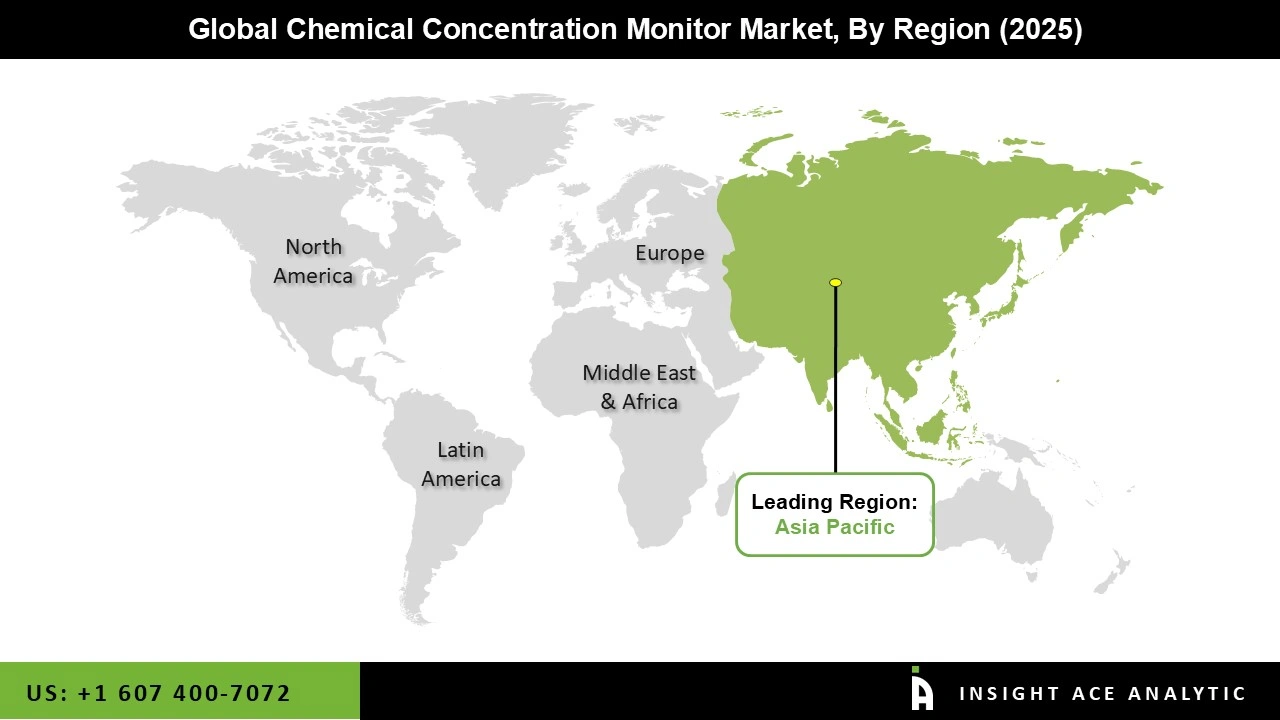
The chemical concentration monitor market was dominated by North America region in 2025 due to the region's robust pharmaceutical industry and strict regulations. The leading nation in this area is the United States, which has a thriving pharmaceutical industry that prioritizes compliance and quality control. Government programs that encourage the chemical concentration monitor market expansion include the FDA's dedication to improving drug safety.
The FDA estimates that quality problems account for over 70% of medicine recalls, underscoring the vital necessity of precise chemical concentration monitoring throughout production processes. Additionally, the growing emphasis on environmental preservation and sustainability is propelling investments in cutting-edge monitoring systems. The chemical concentration monitor market is anticipated to increase as businesses work to meet environmental standards.
Key Development
- July 2025: A new IoT-enabled chemical concentration monitor from Siemens AG incorporates real-time data analytics, allowing businesses to streamline operations and enhance decision-making.
- December 2024: ABB introduced the Sensi+ analyzer, a small laser-based tool for measuring CO2, H2S, and H2O pollutants in natural gas streams in real time.
Chemical Concentration Monitor Market Report Scope:
| Report Attribute | Specifications |
| Market size value in 2025 | USD 6.96 Bn |
| Revenue forecast in 2035 | USD 12.91 Bn |
| Growth Rate CAGR | CAGR of 6.5% from 2026 to 2035 |
| Quantitative Units | Representation of revenue in US$ Bn and CAGR from 2026 to 2035 |
| Historic Year | 2022 to 2025 |
| Forecast Year | 2026 to 2035 |
| Report Coverage | The forecast of revenue, the position of the company, the competitive market structure, growth prospects, and trends |
| Segments Covered | Type, Offering, Product, Medium, Technology, End-user, and Region |
| Regional Scope | North America; Europe; Asia Pacific; Latin America; Middle East & Africa |
| Country Scope | U.S.; Canada; U.K.; Germany; China; India; Japan; Brazil; Mexico; The UK; France; Italy; Spain; China; Japan; India; South Korea; Southeast Asia; South Korea; Southeast Asia |
| Competitive Landscape | Thermo Fisher Scientific Inc., Emerson Electric Co., ABB, Endress+Hauser Group, Veralto, AMETEK, Inc., Mettler Toledo, Yokogawa Electric Corporation, Xylem Inc., Horiba Group, Agilent Technologies, Inc., Teledyne Technologies Incorporated, Honeywell International Inc., Fuji Electric Co., Ltd., Siemens, Entegris, Kurabo Industries Ltd., Anton Paar GmbH, CI Semi, Vaisala, Shimadzu Corporation, Sensotech GmbH, Servomex, Pimacs, and PerkinElmer |
| Customization Scope | Free customization report with the procurement of the report, Modifications to the regional and segment scope. Geographic competitive landscape. |
| Pricing and Available Payment Methods | Explore pricing alternatives that are customized to your particular study requirements. |
Segmentations of Chemical Concentration Monitor Market :
Chemical Concentration Monitor Market, by Type-
- Portable Monitors
- Stationary Monitors
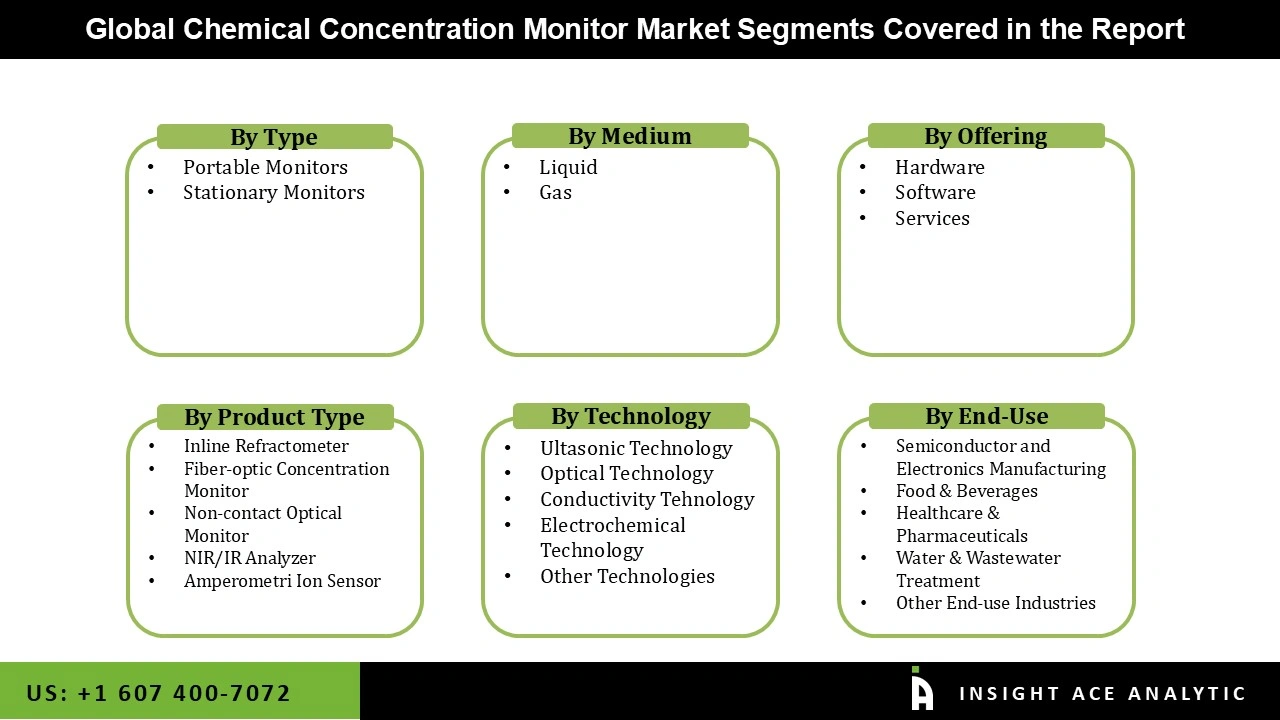
Chemical Concentration Monitor Market, by Offering-
- Software
- Hardware
- Services
Chemical Concentration Monitor Market, by Product-
- Inline Refractometer
- Amperometri Ion Sensor
- Fiber-optic Concentration Monitor
- NIR/IR Analyzer
- Non-contact Optical Monitor
Chemical Concentration Monitor Market, by Medium-
- Gas
- Liquid
Chemical Concentration Monitor Market, by Technology-
- Conductivity Technology
- Ultrasonic Technology
- Electrochemical Technology
- Optical Technology
- Others
Chemical Concentration Monitor Market, by End-user-
- Food & Beverages
- Semiconductor and Electronics Manufacturing
- Water & Wastewater Treatment
- Healthcare & Pharmaceuticals
- Others
Chemical Concentration Monitor Market, by Region-
- North America-
- The US
- Canada
- Europe-
- Germany
- The UK
- France
- Italy
- Spain
- Rest of Europe
- Asia-Pacific-
- China
- Japan
- India
- South Korea
- South East Asia
- Rest of Asia Pacific
- Latin America-
- Brazil
- Argentina
- Mexico
- Rest of Latin America
- Middle East & Africa-
- GCC Countries
- South Africa
- Rest of Middle East and Africa
Research Design and Approach
This study employed a multi-step, mixed-method research approach that integrates:
- Secondary research
- Primary research
- Data triangulation
- Hybrid top-down and bottom-up modelling
- Forecasting and scenario analysis
This approach ensures a balanced and validated understanding of both macro- and micro-level market factors influencing the market.
Secondary Research
Secondary research for this study involved the collection, review, and analysis of publicly available and paid data sources to build the initial fact base, understand historical market behaviour, identify data gaps, and refine the hypotheses for primary research.
Sources Consulted
Secondary data for the market study was gathered from multiple credible sources, including:
- Government databases, regulatory bodies, and public institutions
- International organizations (WHO, OECD, IMF, World Bank, etc.)
- Commercial and paid databases
- Industry associations, trade publications, and technical journals
- Company annual reports, investor presentations, press releases, and SEC filings
- Academic research papers, patents, and scientific literature
- Previous market research publications and syndicated reports
These sources were used to compile historical data, market volumes/prices, industry trends, technological developments, and competitive insights.

Primary Research
Primary research was conducted to validate secondary data, understand real-time market dynamics, capture price points and adoption trends, and verify the assumptions used in the market modelling.
Stakeholders Interviewed
Primary interviews for this study involved:
- Manufacturers and suppliers in the market value chain
- Distributors, channel partners, and integrators
- End-users / customers (e.g., hospitals, labs, enterprises, consumers, etc., depending on the market)
- Industry experts, technology specialists, consultants, and regulatory professionals
- Senior executives (CEOs, CTOs, VPs, Directors) and product managers
Interview Process
Interviews were conducted via:
- Structured and semi-structured questionnaires
- Telephonic and video interactions
- Email correspondences
- Expert consultation sessions
Primary insights were incorporated into demand modelling, pricing analysis, technology evaluation, and market share estimation.
Data Processing, Normalization, and Validation
All collected data were processed and normalized to ensure consistency and comparability across regions and time frames.
The data validation process included:
- Standardization of units (currency conversions, volume units, inflation adjustments)
- Cross-verification of data points across multiple secondary sources
- Normalization of inconsistent datasets
- Identification and resolution of data gaps
- Outlier detection and removal through algorithmic and manual checks
- Plausibility and coherence checks across segments and geographies
This ensured that the dataset used for modelling was clean, robust, and reliable.
Market Size Estimation and Data Triangulation
Bottom-Up Approach
The bottom-up approach involved aggregating segment-level data, such as:
- Company revenues
- Product-level sales
- Installed base/usage volumes
- Adoption and penetration rates
- Pricing analysis
This method was primarily used when detailed micro-level market data were available.

Top-Down Approach
The top-down approach used macro-level indicators:
- Parent market benchmarks
- Global/regional industry trends
- Economic indicators (GDP, demographics, spending patterns)
- Penetration and usage ratios
This approach was used for segments where granular data were limited or inconsistent.
Hybrid Triangulation Approach
To ensure accuracy, a triangulated hybrid model was used. This included:
- Reconciling top-down and bottom-up estimates
- Cross-checking revenues, volumes, and pricing assumptions
- Incorporating expert insights to validate segment splits and adoption rates
This multi-angle validation yielded the final market size.
Forecasting Framework and Scenario Modelling
Market forecasts were developed using a combination of time-series modelling, adoption curve analysis, and driver-based forecasting tools.
Forecasting Methods
- Time-series modelling
- S-curve and diffusion models (for emerging technologies)
- Driver-based forecasting (GDP, disposable income, adoption rates, regulatory changes)
- Price elasticity models
- Market maturity and lifecycle-based projections
Scenario Analysis
Given inherent uncertainties, three scenarios were constructed:
- Base-Case Scenario: Expected trajectory under current conditions
- Optimistic Scenario: High adoption, favourable regulation, strong economic tailwinds
- Conservative Scenario: Slow adoption, regulatory delays, economic constraints
Sensitivity testing was conducted on key variables, including pricing, demand elasticity, and regional adoption.
Request Customization
Add countries, segments, company profiles, or extend forecast — free 10% customization with purchase.
Customize This Report →Enquire Before Buying
Speak with our analyst team about scope, methodology, pricing, or deliverable formats.
Enquire Now →Frequently Asked Questions
Chemical Concentration Monitor Market Size is valued at USD 6.96 Bn in 2025 and is predicted to reach USD 12.91 Bn by the year 2035
The Chemical Concentration Monitor Market is expected to grow at a 6.5% CAGR during the forecast period for 2026 to 2035
Thermo Fisher Scientific Inc., Emerson Electric Co., ABB, Endress+Hauser Group, Veralto, AMETEK, Inc., Mettler Toledo, Yokogawa Electric Corporation, Xylem Inc., Horiba Group, Agilent Technologies, Inc., Teledyne Technologies Incorporated, Honeywell International Inc., Fuji Electric Co., Ltd., Siemens, Entegris, Kurabo Industries Ltd., Anton Paar GmbH, CI Semi, Vaisala, Shimadzu Corporation, Sensotech GmbH, Servomex, Pimacs, PerkinElmer and Others.
Chemical Concentration Monitor Market is segmented into Type, Offering, Product, Medium, Technology, End-user and other.
Asia Pacific region is leading the Chemical Concentration Monitor Market.