AI Osteoporosis Screening Tools Market Size, Share, Forecast Report 2026 to 2035
What is AI Osteoporosis Screening Tools Market Size?
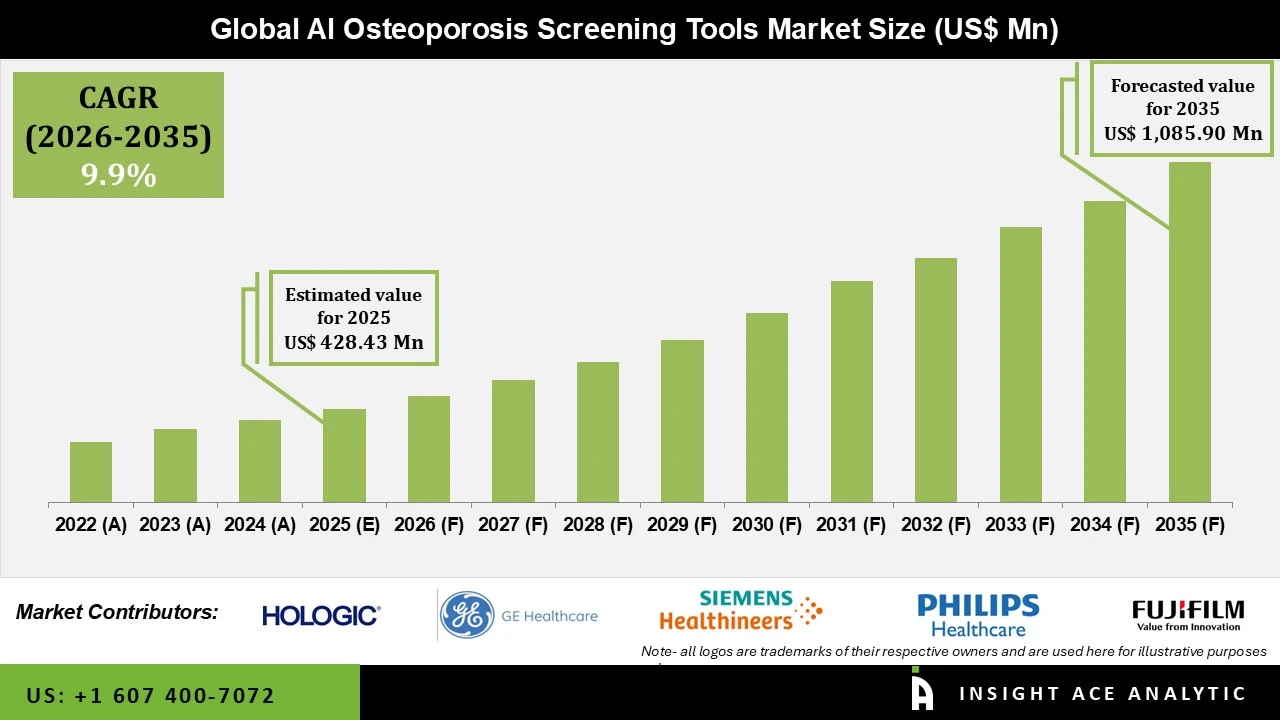
AI Osteoporosis Screening Tools Market Size is valued at USD 428.43 Mn in 2025 and is predicted to reach USD 1,085.90 Mn by the year 2035 at a 9.9% CAGR during the forecast period for 2026 to 2035.
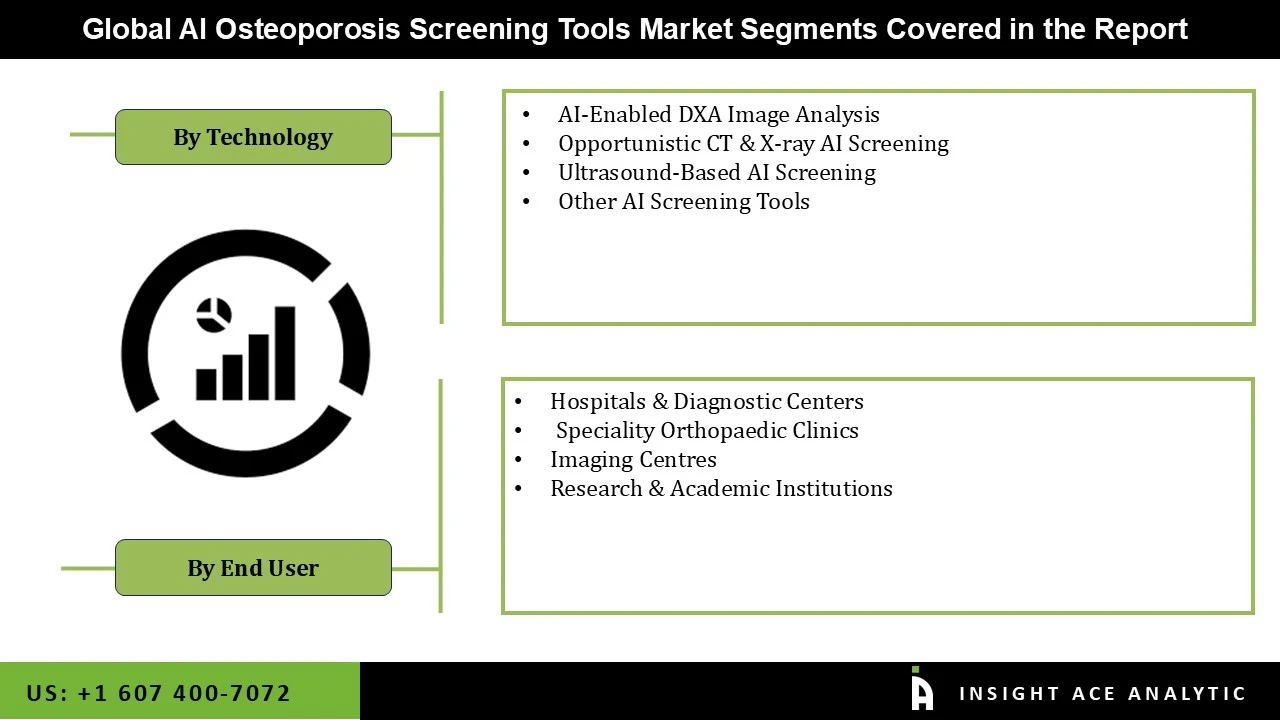
AI Osteoporosis Screening Tools Market Size, Share & Trends Analysis Distribution by Technology (AI-Enabled DXA Image Analysis, Ultrasound-Based AI Screening, Opportunistic CT & X-ray AI Screening, and Other AI Screening Tools), End-user (Hospitals & Diagnostic Centers, Imaging Centers, Research & Academic Institutions, and Specialty Orthopedic Clinics), and Segment Forecasts, 2026 to 2035
AI osteoporosis screening tools are sophisticated software programs that employ artificial intelligence, namely machine learning and deep learning, to identify and evaluate the risk of osteoporosis from medical data, including bone density pictures, CT scans, and X-rays. These instruments can detect early indicators of compromised bones, frequently even before symptoms manifest, by automatically analyzing bone density, structure, and patterns of deterioration. They provide opportunistic screening during regular imaging, such as chest or dental scans, and help healthcare providers make quicker, more accurate diagnoses by integrating with clinical workflows. The AI osteoporosis screening tools market is expanding rapidly due to the rising incidence of osteoporosis, the need for quicker and more precise diagnosis, and the growing use of AI-powered medical imaging technologies.
The growing need for sophisticated screening methods is further fueled by the aging population, which is more prone to bone-related conditions. Furthermore, the incorporation of artificial intelligence into imaging modalities such as X-rays and DXA scans is enhancing diagnostic capabilities, allowing medical practitioners to identify osteoporosis early and start therapy promptly. Growing awareness of bone health and the trend toward preventive healthcare are additional contributing factors to the AI osteoporosis screening tools market expansion. Additionally, the market landscape is being strengthened by the quick digitalization of healthcare systems and the increasing use of AI-based solutions in hospitals and diagnostic facilities. Innovation in this area is being accelerated by government programs encouraging the application of AI in healthcare, as well as higher spending in R&D.
In addition, the use of AI osteoporosis screening tools is increasing due to the growth of telemedicine and remote diagnostic services, especially in underprivileged and rural areas. Furthermore, the creation of more precise and trustworthy screening methods is made possible by developments in machine learning algorithms and the accessibility of huge healthcare datasets. The AI osteoporosis screening tools market is shifting toward personalized medicine, where AI systems can customize treatment regimens based on patient data. However, issues like high implementation costs, worries over data privacy, and legal obstacles limit the AI osteoporosis screening tools market's expansion. The adoption may also be hampered by the accessibility of traditional diagnostic techniques and the lack of awareness in some areas.
Competitive Landscape
Which are the Leading Players in the AI Osteoporosis Screening Tools Market?
• Canon Medical Systems Corporation
• Siemens Healthineers
• Philips Healthcare
• Fujifilm Healthcare
• Hologic, Inc.
• GE HealthCare
• Carestream Health
• Agfa HealthCare
• Mindray Medical International Limited
• Esaote S.p.A.
• Qure.ai Technologies Pvt. Ltd.
• Zebra Medical Vision Ltd.
• Naitive Technologies, Inc.
• 16 Bit Inc.
Market Dynamics
Driver
Growing Emphasis on Preventive Care
A growing emphasis on preventive care and changes in the population are major factors driving the AI osteoporosis screening tools market's growth. The world's aging population is increasing the number of people who are at risk for osteoporosis and fractures, which makes effective, scalable screening methods more important. Additionally, more precise measurements of bone density and fracture identification are now possible because of developments in deep learning algorithms for medical image analysis. At the same time, preventative care strategies that can lessen the long-term financial cost of osteoporotic fractures are being encouraged by public health authorities and private insurers. Furthermore, the market is positioned for long-term growth as a result of this combination of variables, which is speeding up the adoption of AI osteoporosis screening tools in both conventional medical facilities and growing "Great Health" or wellness-focused check-up clinics.
Restrain/Challenge
High Implementation and Integration Costs
A significant barrier to the AI osteoporosis screening tools market is the high implementation and integration costs. The deployment of AI-based screening systems necessitates a large investment in cloud infrastructure, cybersecurity, software platforms, and sophisticated imaging equipment. To guarantee optimal performance, healthcare providers must also set aside funds for employee training, system upkeep, and frequent updates. Widespread adoption may be hampered by these expenditures, which can be especially onerous for small hospitals, diagnostic centers, and healthcare facilities in underdeveloped nations. Furthermore, integrating AI technologies with current radiology procedures and hospital information systems can be difficult and time-consuming, frequently needing specific IT knowledge. Operational constraints are further compounded by issues with data privacy, adherence to healthcare standards, and the requirement for high-quality, standardized datasets.
AI-Enabled DXA Image Analysis Segment is Expected to Drive the AI Osteoporosis Screening Tools Market
The AI-Enabled DXA Image Analysis category held the largest share in the AI Osteoporosis Screening Tools market in 2025 because it increases the diagnostic utility of an imaging modality that is already well-established. AI algorithms enhance fracture risk assessment, picture consistency, and reporting efficiency. DXA scans are frequently used to diagnose osteoporosis. AI-driven DXA solutions are used by hospitals and diagnostic facilities to support early detection and decrease interpretation variability. Moreover, for providers, integration with current DXA hardware reduces implementation challenges. DXA-based AI products provide quicker commercialization for suppliers and technology developers because of their clinical acceptance and regulatory familiarity. Their leadership position is explained by the combination of process compatibility and clinical trust.
Hospitals & Diagnostic Centers Segment is Growing at the Highest Rate in the AI Osteoporosis Screening Tools Market
In 2025, the Hospitals & Diagnostic Centers category dominated the AI Osteoporosis Screening Tools market, since they oversee the greatest number of evaluations of bone health. AI tools can be integrated into standard DXA, CT, and X-ray workflows in these hospitals' centralized imaging departments. Faster interpretation, consistent reporting, and decision assistance are demanded due to high patient flow. AI screening tools improve preventative care pathways by assisting physicians in early identification of at-risk patients. Additionally, hospitals and diagnostic facilities offer long-term software license possibilities and scalable implementation alternatives from a supplier standpoint. Their prominence as end users can be explained by these operational and commercial aspects.
Why North America Led the AI Osteoporosis Screening Tools Market?
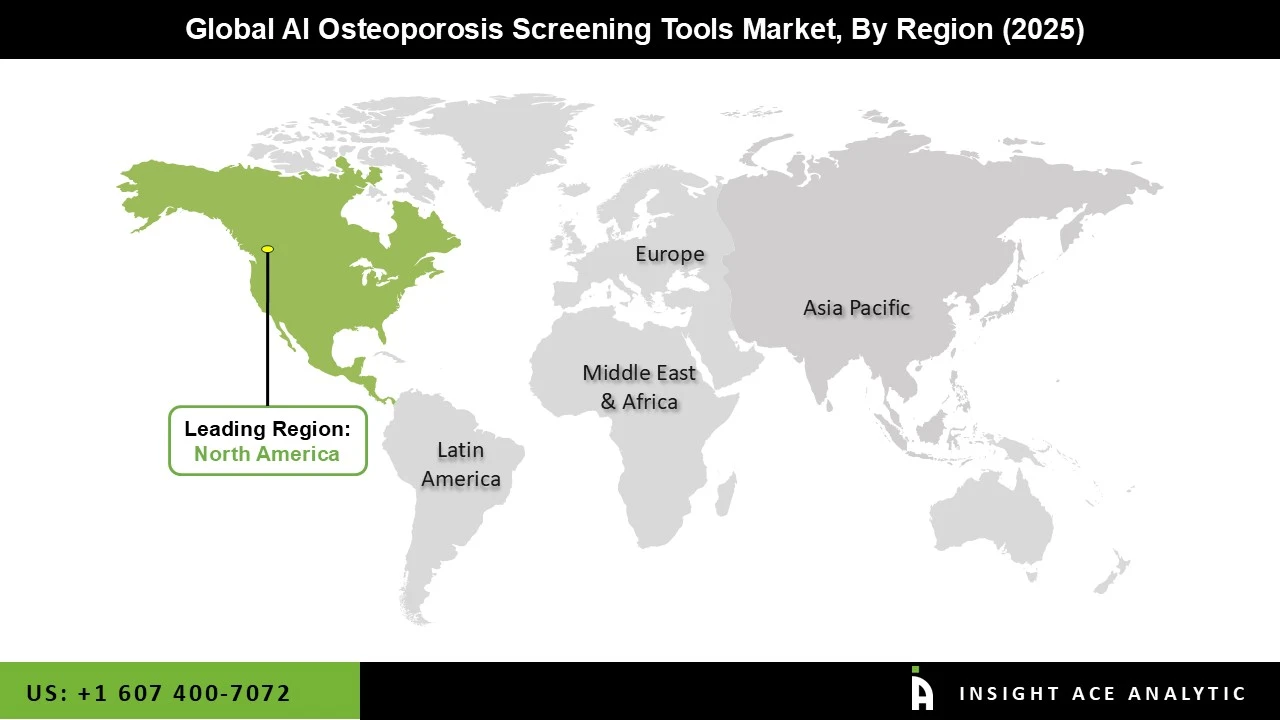
The AI Osteoporosis Screening Tools market was dominated by North America region in 2025 propelled by a cooperative blend of cutting-edge healthcare infrastructure, technology expertise, and proactive regulatory frameworks. Leading AI technology developers and producers of medical devices are concentrated in the area, especially in the United States and Canada. These companies are developing advanced algorithms for osteoporosis risk assessment, bone density monitoring, and fracture diagnosis. Additionally, in hospitals and diagnostic facilities, early and extensive adoption of digital health records and sophisticated imaging technology creates a rich data ecology that is crucial for AI model training and improvement. Moreover, the AI osteoporosis screening tools market expansion is also facilitated by advantageous reimbursement circumstances for improved diagnostic methods and a high level of knowledge regarding bone health management among healthcare providers and the aging population.
AI Osteoporosis Screening Tools Market Report Scope:
| Report Attribute | Specifications |
| Market size value in 2025 | USD 428.43 Mn |
| Revenue forecast in 2035 | USD 1,085.90 Mn |
| Growth Rate CAGR | CAGR of 9.9% from 2026 to 2035 |
| Quantitative Units | Representation of revenue in US$ Mn and CAGR from 2026 to 2035 |
| Historic Year | 2022 to 2025 |
| Forecast Year | 2026-2035 |
| Report Coverage | The forecast of revenue, the position of the company, the competitive market structure, growth prospects, and trends |
| Segments Covered | Technology, End-user, and By Region |
| Regional Scope | North America; Europe; Asia Pacific; Latin America; Middle East & Africa |
| Country Scope | U.S.; Canada; U.K.; Germany; China; India; Japan; Brazil; Mexico; The UK; France; Italy; Spain; China; Japan; India; South Korea; Southeast Asia; South Korea; Southeast Asia |
| Competitive Landscape | Canon Medical Systems Corporation, Siemens Healthineers, Philips Healthcare, Fujifilm Healthcare, Hologic, Inc., GE HealthCare, Carestream Health, Agfa HealthCare, Mindray Medical International Limited, Esaote S.p.A., Qure.ai Technologies Pvt. Ltd., Zebra Medical Vision Ltd., Naitive Technologies, Inc., and 16 Bit Inc. |
| Customization Scope | Free customization report with the procurement of the report, Modifications to the regional and segment scope. Geographic competitive landscape. |
| Pricing and Available Payment Methods | Explore pricing alternatives that are customized to your particular study requirements. |
Market Segmentation:
AI Osteoporosis Screening Tools Market by Technology-
• AI-Enabled DXA Image Analysis
• Ultrasound-Based AI Screening
• Opportunistic CT & X-ray AI Screening
• Other AI Screening Tools
AI Osteoporosis Screening Tools Market by End-user-
• Hospitals & Diagnostic Centers
• Imaging Centers
• Research & Academic Institutions
• Specialty Orthopedic Clinics
AI Osteoporosis Screening Tools Market By Region-
North America-
• The US
• Canada
Europe-
• Germany
• The UK
• France
• Italy
• Spain
• Rest of Europe
Asia-Pacific-
• China
• Japan
• India
• South Korea
• South East Asia
• Rest of Asia Pacific
Latin America-
• Brazil
• Argentina
• Mexico
• Rest of Latin America
Middle East & Africa-
• GCC Countries
• South Africa
• Rest of Middle East and Africa
Research Design and Approach
This study employed a multi-step, mixed-method research approach that integrates:
- Secondary research
- Primary research
- Data triangulation
- Hybrid top-down and bottom-up modelling
- Forecasting and scenario analysis
This approach ensures a balanced and validated understanding of both macro- and micro-level market factors influencing the market.
Secondary Research
Secondary research for this study involved the collection, review, and analysis of publicly available and paid data sources to build the initial fact base, understand historical market behaviour, identify data gaps, and refine the hypotheses for primary research.
Sources Consulted
Secondary data for the market study was gathered from multiple credible sources, including:
- Government databases, regulatory bodies, and public institutions
- International organizations (WHO, OECD, IMF, World Bank, etc.)
- Commercial and paid databases
- Industry associations, trade publications, and technical journals
- Company annual reports, investor presentations, press releases, and SEC filings
- Academic research papers, patents, and scientific literature
- Previous market research publications and syndicated reports
These sources were used to compile historical data, market volumes/prices, industry trends, technological developments, and competitive insights.

Primary Research
Primary research was conducted to validate secondary data, understand real-time market dynamics, capture price points and adoption trends, and verify the assumptions used in the market modelling.
Stakeholders Interviewed
Primary interviews for this study involved:
- Manufacturers and suppliers in the market value chain
- Distributors, channel partners, and integrators
- End-users / customers (e.g., hospitals, labs, enterprises, consumers, etc., depending on the market)
- Industry experts, technology specialists, consultants, and regulatory professionals
- Senior executives (CEOs, CTOs, VPs, Directors) and product managers
Interview Process
Interviews were conducted via:
- Structured and semi-structured questionnaires
- Telephonic and video interactions
- Email correspondences
- Expert consultation sessions
Primary insights were incorporated into demand modelling, pricing analysis, technology evaluation, and market share estimation.
Data Processing, Normalization, and Validation
All collected data were processed and normalized to ensure consistency and comparability across regions and time frames.
The data validation process included:
- Standardization of units (currency conversions, volume units, inflation adjustments)
- Cross-verification of data points across multiple secondary sources
- Normalization of inconsistent datasets
- Identification and resolution of data gaps
- Outlier detection and removal through algorithmic and manual checks
- Plausibility and coherence checks across segments and geographies
This ensured that the dataset used for modelling was clean, robust, and reliable.
Market Size Estimation and Data Triangulation
Bottom-Up Approach
The bottom-up approach involved aggregating segment-level data, such as:
- Company revenues
- Product-level sales
- Installed base/usage volumes
- Adoption and penetration rates
- Pricing analysis
This method was primarily used when detailed micro-level market data were available.

Top-Down Approach
The top-down approach used macro-level indicators:
- Parent market benchmarks
- Global/regional industry trends
- Economic indicators (GDP, demographics, spending patterns)
- Penetration and usage ratios
This approach was used for segments where granular data were limited or inconsistent.
Hybrid Triangulation Approach
To ensure accuracy, a triangulated hybrid model was used. This included:
- Reconciling top-down and bottom-up estimates
- Cross-checking revenues, volumes, and pricing assumptions
- Incorporating expert insights to validate segment splits and adoption rates
This multi-angle validation yielded the final market size.
Forecasting Framework and Scenario Modelling
Market forecasts were developed using a combination of time-series modelling, adoption curve analysis, and driver-based forecasting tools.
Forecasting Methods
- Time-series modelling
- S-curve and diffusion models (for emerging technologies)
- Driver-based forecasting (GDP, disposable income, adoption rates, regulatory changes)
- Price elasticity models
- Market maturity and lifecycle-based projections
Scenario Analysis
Given inherent uncertainties, three scenarios were constructed:
- Base-Case Scenario: Expected trajectory under current conditions
- Optimistic Scenario: High adoption, favourable regulation, strong economic tailwinds
- Conservative Scenario: Slow adoption, regulatory delays, economic constraints
Sensitivity testing was conducted on key variables, including pricing, demand elasticity, and regional adoption.
Request Customization
Add countries, segments, company profiles, or extend forecast — free 10% customization with purchase.
Customize This Report →Enquire Before Buying
Speak with our analyst team about scope, methodology, pricing, or deliverable formats.
Enquire Now →Frequently Asked Questions
AI Osteoporosis Screening Tools Market Size is valued at USD 428.43 Mn in 2025 and is predicted to reach USD 1,085.90 Mn by the year 2035
AI Osteoporosis Screening Tools Market is predicted to grow at a 9.9% CAGR during the forecast period for 2026 to 2035.
Canon Medical Systems Corporation, Siemens Healthineers, Philips Healthcare, Fujifilm Healthcare, Hologic, Inc., GE HealthCare, Carestream Health, Agfa HealthCare, Mindray Medical International Limited, Esaote S.p.A., Qure.ai Technologies Pvt. Ltd., Zebra Medical Vision Ltd., Naitive Technologies, Inc., and 16 Bit Inc.
AI Osteoporosis Screening Tools Market is segmented into By Technology, End-user, and By Region.
North America region is leading the AI Osteoporosis Screening Tools Market.