AI in Clinical Workflow Market Size, Share, Forecast Report 2026 to 2035
What is AI in Clinical Workflow Market Size?
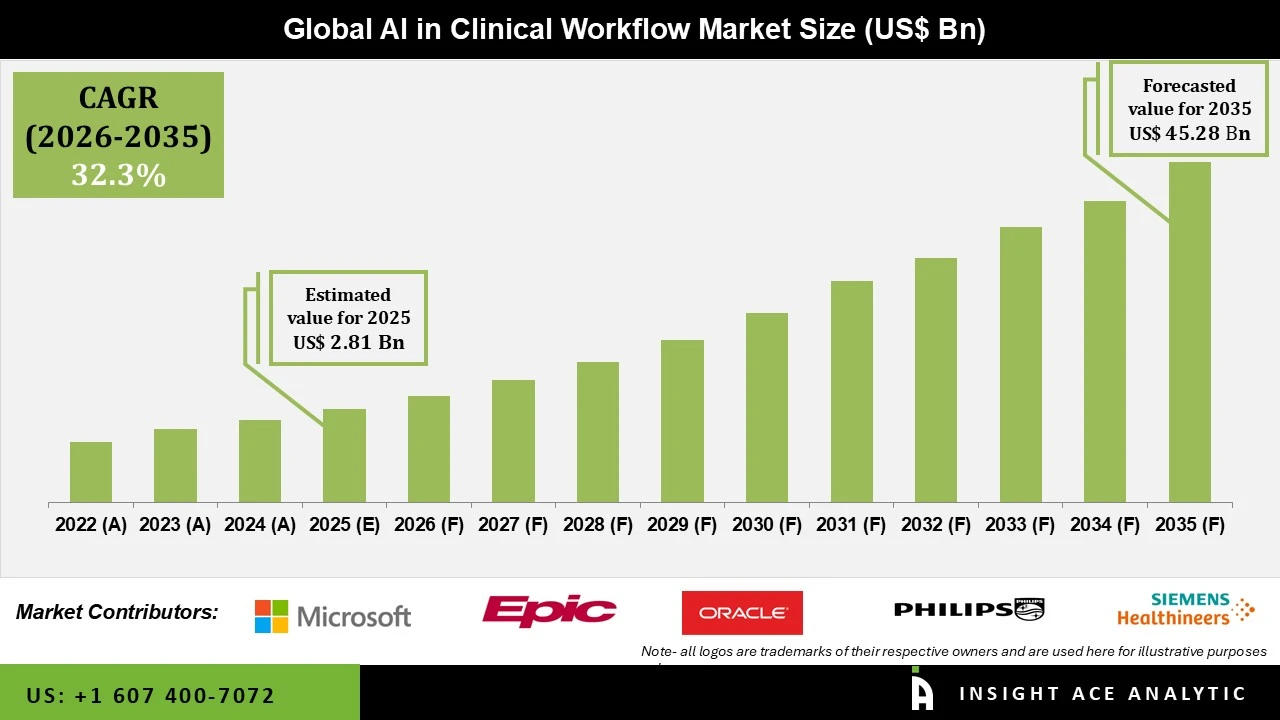
AI in Clinical Workflow Market Size is valued at USD 2.81 Bn in 2025 and is predicted to reach USD 45.28 Bn by the year 2035 at a 32.2% CAGR during the forecast period for 2026 to 2035.
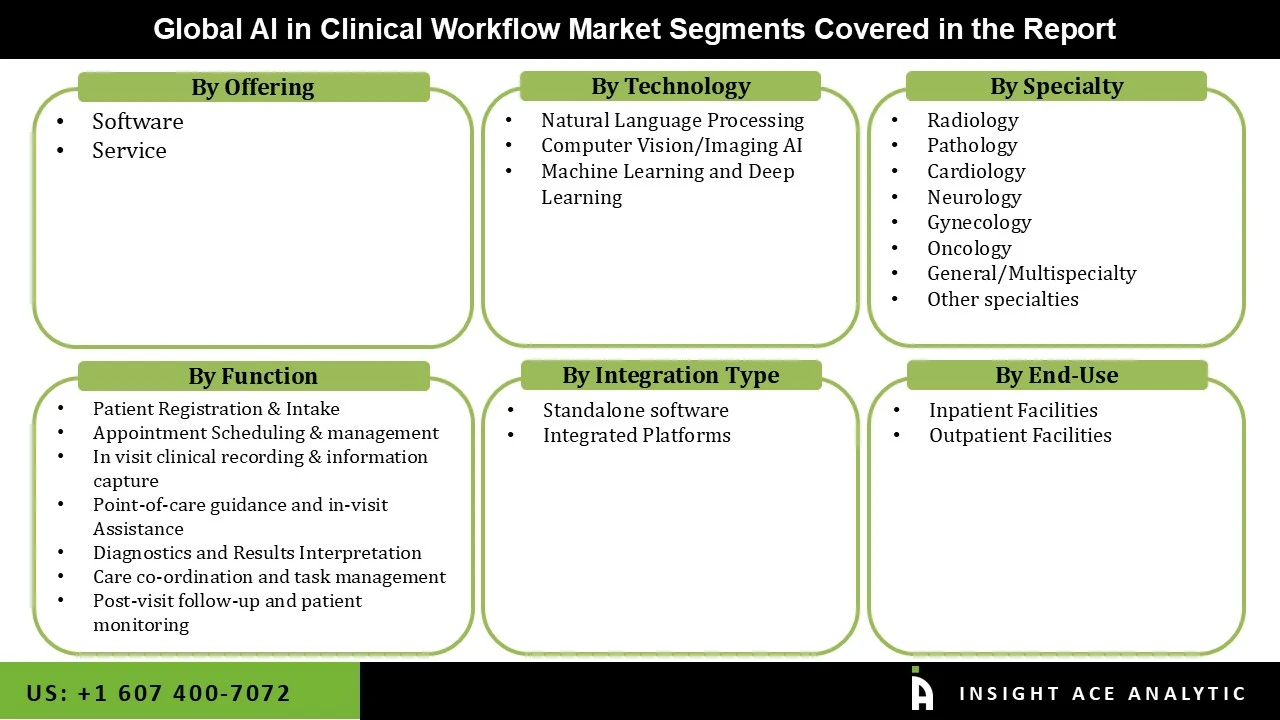
AI in Clinical Workflow Market Size, Share & Trends Analysis Distribution by Offering (Software (AI Clinical Documentation, Imaging & Diagnostic Workflow AI, Clinical Decision Support, Workflow Orchestration & Task Automation, Operational Reporting And Analytics, Clinical Care Coordination, Data Integration, Others) and Service (Maintenance, Support & Model Optimization, Implementation & System Integration)), Integration Type (Standalone Software and Integrated Platforms), Specialty (Neurology, Radiology, Cardiology, Pathology, Gynecology, General/Multi-specialty, Oncology, and Others), Technology (Natural Language Processing, Machine Learning and Deep Learning, Computer Vision/Imaging AI, and Others), Function (Patient Registration & Intake, Diagnostics and Results Interpretation, In-visit Clinical Recording & Information Capture, Point-of-care Guidance and In-visit Assistance, Care Co-ordination and Task Management, Appointment Scheduling & Management, Post-visit Follow-up and Patient Monitoring), End-user and Segment Forecasts, 2026 to 2035
In clinical workflow, artificial intelligence (AI) refers to the incorporation of sophisticated algorithms and machine learning models into medical procedures to improve productivity, precision, and decision-making throughout patient care pathways. In addition to supporting clinical duties such as diagnosis, treatment planning, and patient monitoring, it permits the automation of standard administrative tasks. AI systems can deliver real-time insights and predictive analytics by analyzing enormous volumes of medical data, such as test results, medical imaging, and electronic health records. The AI in clinical workflow market is expanding due to a number of factors, including the growing volume and complexity of clinical data, the pressure on healthcare systems to increase operational efficiency, and the growing use of workflow-embedded AI, which facilitates real-time decision-making without interfering with clinician workflows.
The growing workload of medical professionals is one of the main factors propelling the AI in clinical workflow market. Clinicians are under more strain due to aging populations, increasing patient volumes, and complex care needs. Workflow solutions powered by AI lessen administrative duties, freeing up doctors to concentrate more on patient care and increasing productivity. Furthermore, it is anticipated that the growing use of electronic health records (EHRs) would increase the use of AI clinical workflow to enhance data management. Additionally, value-based and individualized care models are becoming more prevalent in healthcare systems. Large clinical datasets may be analyzed in real time due to AI technologies, which support predictive care pathways and individualized treatment strategies. Another main factor behind adoption in AI clinical workflows is the need for data-driven insights.
In addition, the AI in clinical workflow market is expanding quickly as a result of public and private companies' increased efforts to improve healthcare delivery. For instance, CenTrak's WorkflowRT platform, which debuted in January 2023, demonstrates how advances in AI are improving clinical care workflow and communication. This adaptable platform facilitates patient mobility, reduces reliance on manual paperwork, and identifies disruptions in the process, all of which assist the AI in clinical workflow market expansion. Additionally, regulatory agencies in a number of areas are creating more precise guidelines for the use of AI in healthcare, which is promoting the AI in clinical workflow market expansion. AI-enabled clinical workflow solutions are becoming more trustworthy and being deployed more quickly across healthcare systems due to the move toward standardized validation, transparency, and compliance requirements.
Competitive Landscape
Which are the Leading Players in AI in Clinical Workflow Market?
• GE Healthcare
• Microsoft
• Koninklijke Philips N.V.
• Siemens Healthineers AG
• Epic Systems Corporation
• Oracle
• Health Catalyst, Inc.
• NextGen Healthcare
• Abridge Al, Inc.
• Aidoc Medical Ltd.
• Qure.ai Technologies Pvt. Ltd.
• Optum, Inc.
• Veradigm LLC
• Baxter International Inc. (Hillrom)
• Cisco Systems, Inc.
• Augmedix, Inc.
• Viz.ai, Inc.
• Concord Technologies, Inc.
• PathAl, Inc.
• athenahealth, Inc.
Market Dynamics
Driver
Growing Need for Automation and Workflow Efficiency
The growing desire to increase productivity and lessen the administrative load on medical personnel is one of the main factors for the growth of AI in clinical workflow market. Large amounts of patient data, paperwork, scheduling, and billing procedures are managed by hospitals and clinics; these tasks can be laborious and prone to human mistakes. These tedious chores can be automated with the use of AI-powered technologies, allowing for more efficient operations, accurate record-keeping, and quicker data processing. This enables medical professionals to focus more of their time on patient care rather than administrative tasks. Furthermore, AI improves clinical decision-making by offering predictive analytics and real-time insights that increase treatment planning and diagnostic precision. The need for AI-driven workflow automation keeps rising dramatically as healthcare institutions attempt to maximize resources and provide value-based treatment.
Restrain/Challenge
Increasing Regulatory, Security, and Data Privacy Issues
The AI in clinical workflow market is significantly constrained by worries about data security, privacy, and regulatory compliance. Healthcare data is extremely sensitive, and using AI systems necessitates having access to a lot of patient data, which increases the possibility of data breaches and illegal access. Implementing AI technologies smoothly is difficult for enterprises due to strict rules and different compliance requirements in different locations. Furthermore, the absence of uniform regulatory frameworks for AI in healthcare raises questions about responsibility, validation, and authorization. Moreover, significant infrastructure and governance expenditure is frequently necessary to ensure data integrity, protect patient privacy, and achieve regulatory compliance. The adoption may be slowed by these complications, especially for smaller healthcare providers with tighter budgets.
Machine Learning and Deep Learning Segment is Expected to Drive the AI in Clinical Workflow Market
The machine learning and deep learning category held the largest share in the AI in Clinical Workflow market in 2025, supporting the majority of instruments used in clinics and hospitals for diagnosis, prediction, and decision assistance. Large amounts of organized and unstructured clinical data, including lab results, imaging, and patient histories, can be analyzed using machine learning to find patterns that help with more precise diagnosis, risk assessment, and treatment planning. Because of its demonstrated effectiveness, scalability, and adaptability, it is now the standard technology for key clinical AI use cases, such as automated anomaly identification in imaging and clinical data and predicted patient deterioration models.
Diagnostics and Results Interpretation Segment is Growing at the Highest Rate in the AI in Clinical Workflow Market
In 2025, the diagnostics and results interpretation category dominated the AI in Clinical Workflow market due to the growing need for clinical decision-making that is quicker, more precise, and data-driven. Medical imaging, pathology, and laboratory diagnostics all make extensive use of AI-powered technologies to analyze large amounts of information and spot patterns that human observation would overlook. These methods lower clinical interpretation variability, increase early disease identification, and improve diagnostic accuracy. Automated and effective interpretation solutions are becoming more and more necessary due to the increasing amount of diagnostic tests and the growing frequency of chronic diseases. Furthermore, real-time imaging data processing is made possible by developments in deep learning and computer vision technology, which helps radiologists and doctors make prompt decisions.
Why North America Led the AI in Clinical Workflow Market?
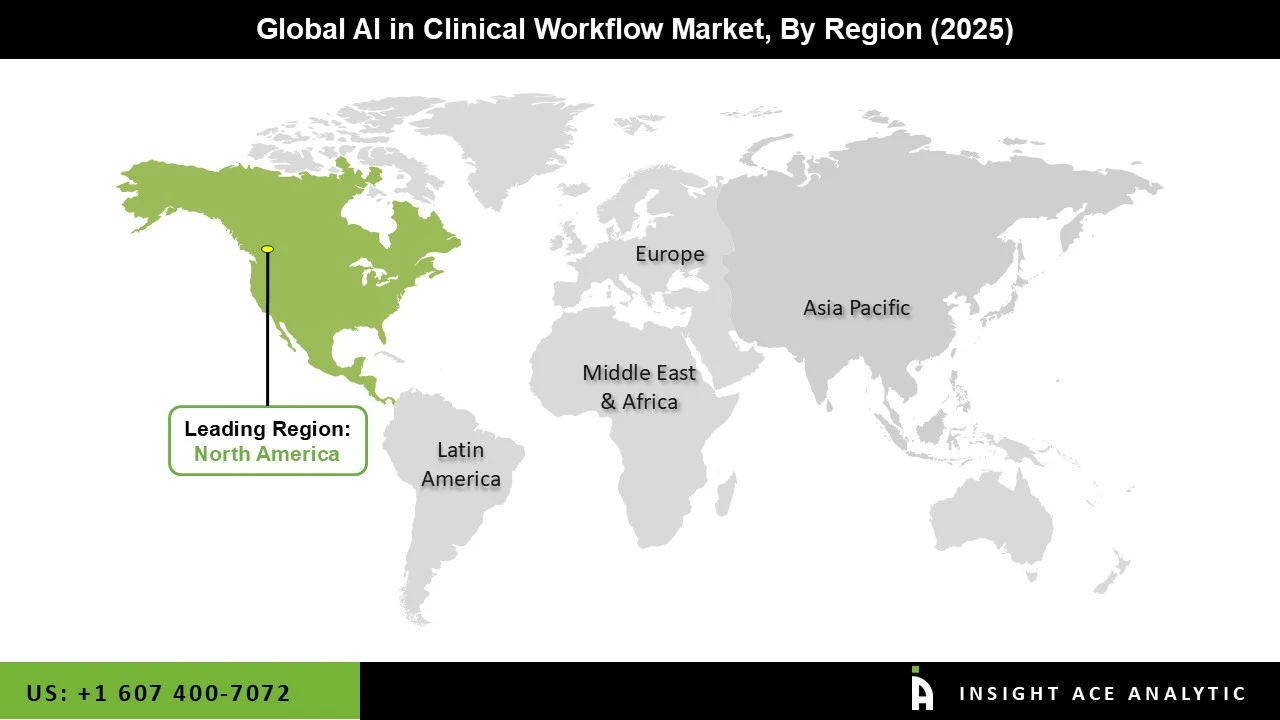
The AI in Clinical Workflow market was dominated by North America region in 2025 because of its early adoption of cutting-edge health IT infrastructure and its highly digitalized healthcare ecosystem. The amount of data being generated is significantly increasing due to the rise in research and development projects and hospital patient admissions. North America's dominant revenue share is also driven by the growth of government initiatives encouraging the effective use of interoperability, EHR, and other tools, a strong focus on patient care, and rising healthcare investments in digitization for safe data sharing among businesses. Additionally, over 70% of big hospital networks report actively using AI-based workflow technologies, which are being used by healthcare systems in the United States and Canada to improve clinical decision-making, streamline patient flow, and automate paperwork.
Key Development
October 2024: GE HealthCare (US) announced the opening of its Artificial Intelligence Innovation Lab, which includes five cutting-edge initiatives that use AI to incorporate AI across the whole care continuum. This includes efforts to maximize the early prediction of recurrence of triple-negative breast cancer using the power of deep learning, Health Companion, an agentive AI concept designed to put multidisciplinary clinical knowledge in the palm of a clinician's hands, and the use of artificial intelligence to decrease manual searches and summarizations.
AI in Clinical Workflow Market Report Scope:
| Report Attribute | Specifications |
| Market size value in 2025 | USD 2.81 Bn |
| Revenue forecast in 2035 | USD 45.28 Bn |
| Growth Rate CAGR | CAGR of 32.2% from 2026 to 2035 |
| Quantitative Units | Representation of revenue in US$ Bn and CAGR from 2026 to 2035 |
| Historic Year | 2022 to 2025 |
| Forecast Year | 2026-2035 |
| Report Coverage | The forecast of revenue, the position of the company, the competitive market structure, growth prospects, and trends |
| Segments Covered | Offering, Integration Type, Specialty, Technology, Function, End-user, and By Region |
| Regional Scope | North America; Europe; Asia Pacific; Latin America; Middle East & Africa |
| Country Scope | U.S.; Canada; U.K.; Germany; China; India; Japan; Brazil; Mexico; The UK; France; Italy; Spain; China; Japan; India; South Korea; Southeast Asia; South Korea; Southeast Asia |
| Competitive Landscape | GE Healthcare, Microsoft, Koninklijke Philips N.V., Siemens Healthineers AG, Epic Systems Corporation, Oracle, Health Catalyst, Inc., NextGen Healthcare, Abridge Al, Inc., Aidoc Medical Ltd., Qure.ai Technologies Pvt. Ltd., Optum, Inc., Veradigm LLC, Baxter International Inc. (Hillrom), Cisco Systems, Inc., Augmedix, Inc., Viz.ai, Inc., Concord Technologies, Inc., PathAl, Inc., and athenahealth, Inc. |
| Customization Scope | Free customization report with the procurement of the report, Modifications to the regional and segment scope. Geographic competitive landscape. |
| Pricing and Available Payment Methods | Explore pricing alternatives that are customized to your particular study requirements. |
Market Segmentation:
AI in Clinical Workflow Market by Offering-
- Software
-
- AI Clinical Documentation
- Operational Reporting And Analytics
- Workflow Orchestration & Task Automation
- Imaging & Diagnostic Workflow AI
- Clinical Decision Support
- Clinical Care Coordination
- Data Integration
- Others
- Service
-
- Maintenance, Support & Model Optimization
- Implementation & System Integration
AI in Clinical Workflow Market by Integration Type-
• Standalone Software
• Integrated Platforms
AI in Clinical Workflow Market by Specialty-
• Neurology
• Radiology
• Cardiology
• Pathology
• Gynecology
• General/Multi-specialty
• Oncology
• Others
AI in Clinical Workflow Market by Technology-
o Natural Language Processing
o Machine Learning and Deep Learning
o Computer Vision/Imaging AI
o Others
AI in Clinical Workflow Market by Function-
• Patient Registration & Intake
• Diagnostics and Results Interpretation
• In-visit Clinical Recording & Information Capture
• Point-of-care Guidance and In-visit Assistance
• Care Co-ordination and Task Management
• Appointment Scheduling & Management
• Post-visit Follow-up and Patient Monitoring
AI in Clinical Workflow Market by End-user-
• Inpatient Facilities
o Hospitals
o Others
• Outpatient Facilities
o Hospitals and Outpatient Facilities
o Physician Practices
o Diagnostics and Imaging Centers
o Ambulatory Surgical Centers (ASCS)
o Others
Research Design and Approach
This study employed a multi-step, mixed-method research approach that integrates:
- Secondary research
- Primary research
- Data triangulation
- Hybrid top-down and bottom-up modelling
- Forecasting and scenario analysis
This approach ensures a balanced and validated understanding of both macro- and micro-level market factors influencing the market.
Secondary Research
Secondary research for this study involved the collection, review, and analysis of publicly available and paid data sources to build the initial fact base, understand historical market behaviour, identify data gaps, and refine the hypotheses for primary research.
Sources Consulted
Secondary data for the market study was gathered from multiple credible sources, including:
- Government databases, regulatory bodies, and public institutions
- International organizations (WHO, OECD, IMF, World Bank, etc.)
- Commercial and paid databases
- Industry associations, trade publications, and technical journals
- Company annual reports, investor presentations, press releases, and SEC filings
- Academic research papers, patents, and scientific literature
- Previous market research publications and syndicated reports
These sources were used to compile historical data, market volumes/prices, industry trends, technological developments, and competitive insights.
Primary Research
Primary research was conducted to validate secondary data, understand real-time market dynamics, capture price points and adoption trends, and verify the assumptions used in the market modelling.
Stakeholders Interviewed
Primary interviews for this study involved:
- Manufacturers and suppliers in the market value chain
- Distributors, channel partners, and integrators
- End-users / customers (e.g., hospitals, labs, enterprises, consumers, etc., depending on the market)
- Industry experts, technology specialists, consultants, and regulatory professionals
- Senior executives (CEOs, CTOs, VPs, Directors) and product managers
Interview Process
Interviews were conducted via:
- Structured and semi-structured questionnaires
- Telephonic and video interactions
- Email correspondences
- Expert consultation sessions
Primary insights were incorporated into demand modelling, pricing analysis, technology evaluation, and market share estimation.
Data Processing, Normalization, and Validation
All collected data were processed and normalized to ensure consistency and comparability across regions and time frames.
The data validation process included:
- Standardization of units (currency conversions, volume units, inflation adjustments)
- Cross-verification of data points across multiple secondary sources
- Normalization of inconsistent datasets
- Identification and resolution of data gaps
- Outlier detection and removal through algorithmic and manual checks
- Plausibility and coherence checks across segments and geographies
This ensured that the dataset used for modelling was clean, robust, and reliable.
Market Size Estimation and Data Triangulation
Bottom-Up Approach
The bottom-up approach involved aggregating segment-level data, such as:
- Company revenues
- Product-level sales
- Installed base/usage volumes
- Adoption and penetration rates
- Pricing analysis
This method was primarily used when detailed micro-level market data were available.

Top-Down Approach
The top-down approach used macro-level indicators:
- Parent market benchmarks
- Global/regional industry trends
- Economic indicators (GDP, demographics, spending patterns)
- Penetration and usage ratios
This approach was used for segments where granular data were limited or inconsistent.
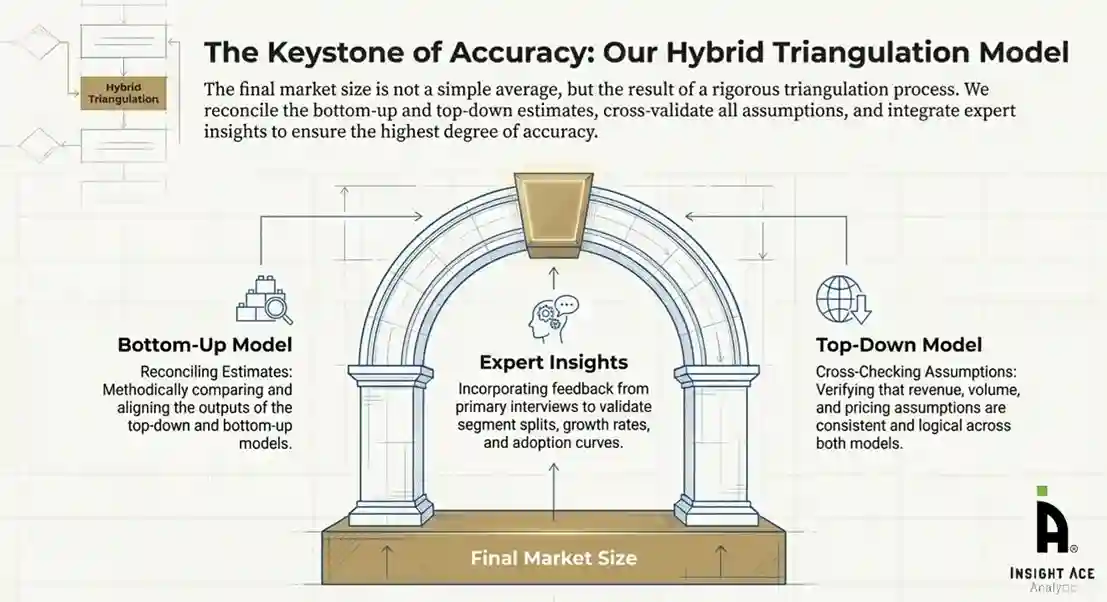
Hybrid Triangulation Approach
To ensure accuracy, a triangulated hybrid model was used. This included:
- Reconciling top-down and bottom-up estimates
- Cross-checking revenues, volumes, and pricing assumptions
- Incorporating expert insights to validate segment splits and adoption rates
This multi-angle validation yielded the final market size.
Forecasting Framework and Scenario Modelling
Market forecasts were developed using a combination of time-series modelling, adoption curve analysis, and driver-based forecasting tools.
Forecasting Methods
- Time-series modelling
- S-curve and diffusion models (for emerging technologies)
- Driver-based forecasting (GDP, disposable income, adoption rates, regulatory changes)
- Price elasticity models
- Market maturity and lifecycle-based projections
Scenario Analysis
Given inherent uncertainties, three scenarios were constructed:
- Base-Case Scenario: Expected trajectory under current conditions
- Optimistic Scenario: High adoption, favourable regulation, strong economic tailwinds
- Conservative Scenario: Slow adoption, regulatory delays, economic constraints
Sensitivity testing was conducted on key variables, including pricing, demand elasticity, and regional adoption.
Request Customization
Add countries, segments, company profiles, or extend forecast — free 10% customization with purchase.
Customize This Report →Enquire Before Buying
Speak with our analyst team about scope, methodology, pricing, or deliverable formats.
Enquire Now →Frequently Asked Questions
AI in Clinical Workflow Market Size is valued at USD 2.81 Bn in 2025 and is predicted to reach USD 45.28 Bn by the year 2035
AI in Clinical Workflow Market is expected to grow at a 32.2% CAGR during the forecast period for 2026 to 2035.
GE Healthcare, Microsoft, Koninklijke Philips N.V., Siemens Healthineers AG, Epic Systems Corporation, Oracle, Health Catalyst, Inc., NextGen Healthcare, Abridge Al, Inc., Aidoc Medical Ltd., Qure.ai Technologies Pvt. Ltd., Optum, Inc., Veradigm LLC, Baxter International Inc. (Hillrom), Cisco Systems, Inc., Augmedix, Inc., Viz.ai, Inc., Concord Technologies, Inc., PathAl, Inc., and athenahealth, Inc.
AI in Clinical Workflow Market is segmented into Offering, Integration Type, Specialty, Technology, Function, End-user, and By Region
North America region is leading the AI in Clinical Workflow Market.