Smart Pregnancy Tracker Market Size, Share & Trends Analysis Report By Application (Cardiac Monitoring, Blood Pressure Monitoring, Real-Time Contraction Tracking, Vital Sign Tracking, and Fetal Kick Monitoring), By Product Type, By End-User, By Distribution Platform, By Region, And Segment Forecasts, 2024-2031
Smart pregnancy tracker market is expected to grow at a 15.0% CAGR during the forecast period for 2025-2034.
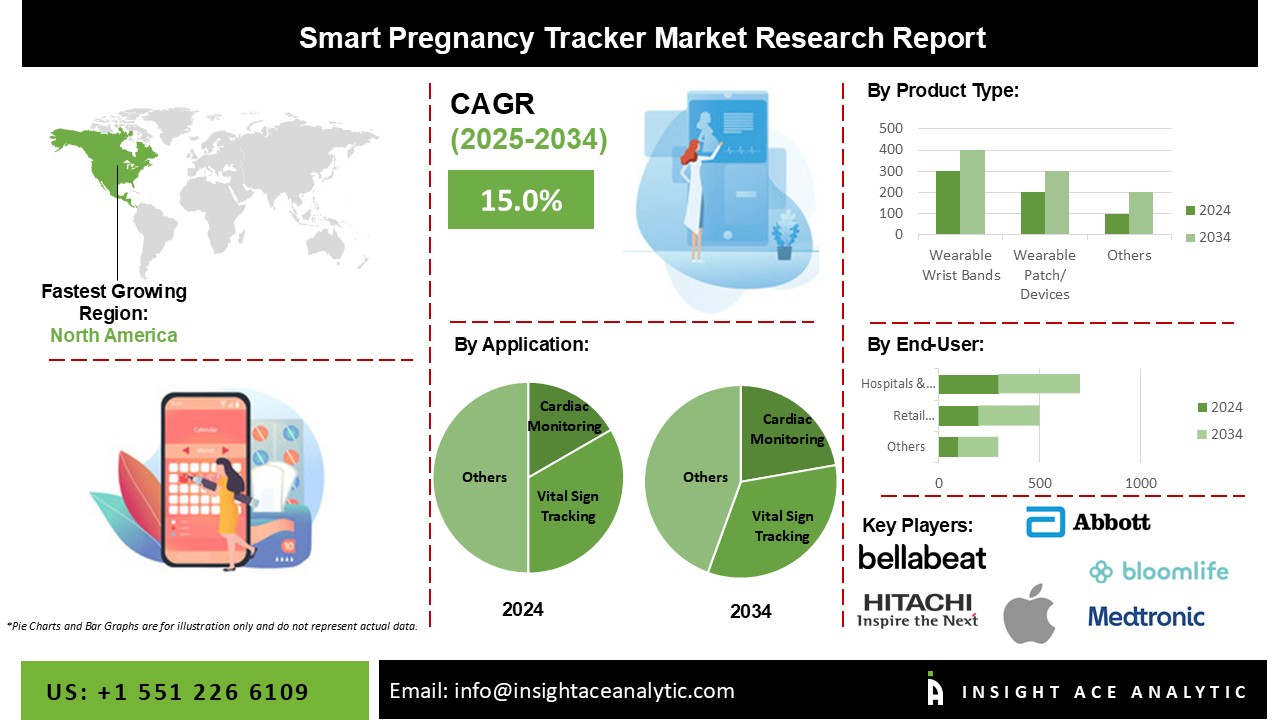
For the purpose of identifying prenatal disorders, it is becoming more and more common to regularly and in real-time monitor foetal activity as well as other vital signs of both pregnant patients and the foetus. This kind of therapy assists expectant patients in identifying health issues earlier and selecting an organized course of treatment by increasing the likelihood of a healthy, problem-free pregnancy. Innovative and smart technology that the patient can wear is being brought to the early testing industry in order to do real-time analysis of the fetal/unborn child, such as a smart pregnancy tracker. The growing frequency of cardiac diseases, rising government funding for research initiatives for maternal and unborn child's healthcare and welfare, increasing interest of manufacturers in launching innovative smart trackers, and technical improvement in real-time and non-invasive monitoring are the other main factors driving the market for smart pregnancy trackers. These benefits include early diagnosis of diseases or problems of the foetus. Many individuals who have conceived via IVF or other external methods also choose to take preventative steps to check on the unborn kid regularly. Additionally, the industry will indirectly expand due to the increasing number of successful pregnancies linked to IVF.
Uncertainty over the effectiveness of pregnancy trackers is one of the main issues limiting the business, and the lack of accurate scientific confirmation hampers the expansion of companies. The challenge of accurately deciphering physiological signals that vary considerably between women is another barrier to the widespread use of smart pregnancy trackers.
Market Segmentation:
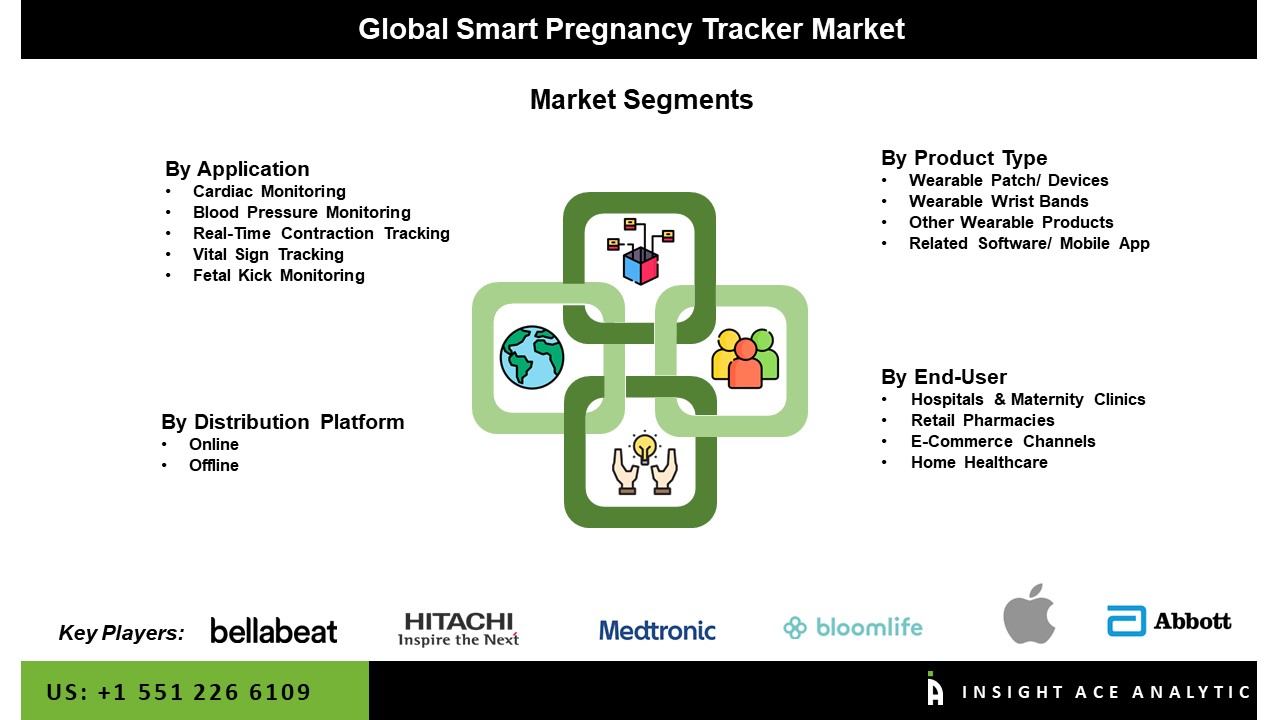
The smart pregnancy tracker market is segmented on the basis of application, product type, end-user, and distribution platform. Based on application, the market is segmented as cardiac monitoring, blood pressure monitoring, real-time contraction tracking, vital sign tracking, and fetal kick monitoring. Based on product type, the market is segmented as wearable patch/ devices, wearable wrist bands, other wearable products, and related software/ mobile apps. Based on end-user, the market is segmented as hospitals & maternity clinics, retail pharmacies, e-commerce channels, and home healthcare. Based on the distribution platform, the market is segmented as online and offline.
Based On The Application, The Foetal Kick Monitoring Segment Is expected to Account As A Major Contributor To The Smart Pregnancy Tracker Market.
Foetal kick monitoring will become more popular during the forecasted time because additional kick tracking bands are being introduced to the market. A number of factors influence the global foetal kick monitoring market, including an increase in the prevalence of cardiopulmonary diseases, technological advancements like non-invasive surgeries, an increase in government and non-government initiatives for maternal and foetal health worldwide, an increase in awareness of and willingness to invest in the development of foetal monitoring, and an increase in the number of multiple pregnancies, post-term pregnancy, and premature delivery cases. Future growth of the segment is anticipated to be fuelled by technological improvements, an increase in preterm births, rising birth rates, a rise in haemorrhage rates, premature birth rates, and the need for foetal monitoring supplements. Additionally, the development of portable and wireless goods and technologies and unexplored emerging economies offer profitable growth prospects globally.
Based On Product Type, The Wearable Patches And Devices Segment Is expected to Account As A Significant Contributor To The Smart Pregnancy Tracker Market.
Wearable patches and devices will become more popular than other goods and software due to the manufacturers' aggressive marketing campaigns for pregnancy tracking bands or patches. It is projected that the development of sectors, including home healthcare and remote patient monitoring devices, will have an impact on segment growth. In addition, it is anticipated that the growing emphasis would impact the industry on fitness and a healthy lifestyle. The COVID-19 pandemic's spike in product demand and growing public awareness of personal health monitoring are anticipated to be some of the vital segment drivers. Healthcare practitioners may use new wearable medical devices connected with the iOS and Android platforms for use with smartphones to monitor and diagnose patient outcomes more efficiently and effectively. Wearable medical gadgets are thriving as a result of advances in virtual medicine and telemedicine, notably following the COVID-19 crisis for remote healthcare and illness management.
The North America Smart Pregnancy Tracker Market Holds A Significant Revenue Share In The Region.
North America is one of the regions where sales of smart pregnancy trackers are highest. The introduction of technologically advanced trackers into the American and Canadian markets, the presence of significant players in the region, the high level of patient awareness of non-invasive tracking, and the supportive reimbursement environment for the devices provided by the American government are some of the leading causes of this. The high occurrence of preterm deliveries, the expanding purchasing power and per capita income, and the supportive government initiative towards developing healthcare infrastructure for the mother and child care sector will further support the regional market growth. The region's market is expanding due to the increasing acceptance of technologically improved products and regulatory changes to approve and use mobile-based applications. The region's growing number of digital entrepreneurs and the government's increased investment in IT infrastructure, increased awareness of reproductive health, the prevalence of OA, and better internet connectivity are fueling the market's expansion.
Competitive Landscape
Some Of The Key Players In The Smart Pregnancy Tracker Market:
- Bloomlife,
- Bellabeat,
- Wave Hello,
- Koninklijke Philips N.V.,
- Abbott,
- Aparito,
- Apple Inc.,
- 112 Motion B.V.,
- Medtronic,
- MC10,
- Biotricity Inc.,
- Brainlab AG,
- Hitachi, Ltd.,
- Varian Medical Systems, Inc.,
- XinRay Systems,
- Rubi Life,
- Babypod,
- NUVO Inc.,
- BeWell Innovation.
The Smart Pregnancy Tracker Market Report Scope
| Report Attribute | Specifications |
| Growth Rate CAGR | CAGR of 15.0% from 2025 to 2034 |
| Quantitative Units | Representation of revenue in US$ Billion and CAGR from 2025 to 2034 |
| Historic Year | 2021 to 2024 |
| Forecast Year | 2025-2034 |
| Report Coverage | The forecast of revenue, the position of the company, the competitive market structure, growth prospects, and trends |
| Segments Covered | By Application, By Product Type, By End-User, By Distribution Platform |
| Regional Scope | North America; Europe; Asia Pacific; Latin America; Middle East & Africa |
| Country Scope | U.S.; Canada; U.K.; Germany; China; India; Japan; Brazil; Mexico ;The UK; France; Italy; Spain; South Korea; South East Asia |
| Competitive Landscape | Bloomlife, Bellabeat, Wave Hello, Koninklijke Philips N.V., Abbott, Aparito, Apple Inc., 112 Motion B.V., Medtronic, MC10, Biotricity Inc., Brainlab AG, Hitachi, Ltd., Varian Medical Systems, Inc., XinRay Systems, Rubi Life, Babypod, NUVO Inc., and BeWell Innovation. |
| Customization Scope | Free customization report with the procurement of the report, Modifications to the regional and segment scope. Particular Geographic competitive landscape. |
| Pricing And Available Payment Methods | Explore pricing alternatives that are customized to your particular study requirements. |
Segmentation of Smart Pregnancy Tracker Market-
By Application
- Cardiac Monitoring
- Blood Pressure Monitoring
- Real-Time Contraction Tracking
- Vital Sign Tracking
- Fetal Kick Monitoring
By Product Type
- Wearable Patch/ Devices
- Wearable Wrist Bands
- Other Wearable Products
- Related Software/ Mobile App
By End-User
- Hospitals & Maternity Clinics
- Retail Pharmacies
- E-Commerce Channels
- Home Healthcare
By Distribution Platform
- Online
- Offline
By Region-
North America-
- The US
- Canada
Europe-
- Germany
- The UK
- France
- Italy
- Spain
- Rest of Europe
Asia-Pacific-
- China
- Japan
- India
- South Korea
- South East Asia
- Rest of Asia Pacific
Latin America-
- Brazil
- Argentina
- Mexico
- Rest of Latin America
Middle East & Africa-
- GCC Countries
- South Africa
Research Design and Approach
This study employed a multi-step, mixed-method research approach that integrates:
- Secondary research
- Primary research
- Data triangulation
- Hybrid top-down and bottom-up modelling
- Forecasting and scenario analysis
This approach ensures a balanced and validated understanding of both macro- and micro-level market factors influencing the market.
Secondary Research
Secondary research for this study involved the collection, review, and analysis of publicly available and paid data sources to build the initial fact base, understand historical market behaviour, identify data gaps, and refine the hypotheses for primary research.
Sources Consulted
Secondary data for the market study was gathered from multiple credible sources, including:
- Government databases, regulatory bodies, and public institutions
- International organizations (WHO, OECD, IMF, World Bank, etc.)
- Commercial and paid databases
- Industry associations, trade publications, and technical journals
- Company annual reports, investor presentations, press releases, and SEC filings
- Academic research papers, patents, and scientific literature
- Previous market research publications and syndicated reports
These sources were used to compile historical data, market volumes/prices, industry trends, technological developments, and competitive insights.

Primary Research
Primary research was conducted to validate secondary data, understand real-time market dynamics, capture price points and adoption trends, and verify the assumptions used in the market modelling.
Stakeholders Interviewed
Primary interviews for this study involved:
- Manufacturers and suppliers in the market value chain
- Distributors, channel partners, and integrators
- End-users / customers (e.g., hospitals, labs, enterprises, consumers, etc., depending on the market)
- Industry experts, technology specialists, consultants, and regulatory professionals
- Senior executives (CEOs, CTOs, VPs, Directors) and product managers
Interview Process
Interviews were conducted via:
- Structured and semi-structured questionnaires
- Telephonic and video interactions
- Email correspondences
- Expert consultation sessions
Primary insights were incorporated into demand modelling, pricing analysis, technology evaluation, and market share estimation.
Data Processing, Normalization, and Validation
All collected data were processed and normalized to ensure consistency and comparability across regions and time frames.
The data validation process included:
- Standardization of units (currency conversions, volume units, inflation adjustments)
- Cross-verification of data points across multiple secondary sources
- Normalization of inconsistent datasets
- Identification and resolution of data gaps
- Outlier detection and removal through algorithmic and manual checks
- Plausibility and coherence checks across segments and geographies
This ensured that the dataset used for modelling was clean, robust, and reliable.
Market Size Estimation and Data Triangulation
Bottom-Up Approach
The bottom-up approach involved aggregating segment-level data, such as:
- Company revenues
- Product-level sales
- Installed base/usage volumes
- Adoption and penetration rates
- Pricing analysis
This method was primarily used when detailed micro-level market data were available.

Top-Down Approach
The top-down approach used macro-level indicators:
- Parent market benchmarks
- Global/regional industry trends
- Economic indicators (GDP, demographics, spending patterns)
- Penetration and usage ratios
This approach was used for segments where granular data were limited or inconsistent.
Hybrid Triangulation Approach
To ensure accuracy, a triangulated hybrid model was used. This included:
- Reconciling top-down and bottom-up estimates
- Cross-checking revenues, volumes, and pricing assumptions
- Incorporating expert insights to validate segment splits and adoption rates
This multi-angle validation yielded the final market size.
Forecasting Framework and Scenario Modelling
Market forecasts were developed using a combination of time-series modelling, adoption curve analysis, and driver-based forecasting tools.
Forecasting Methods
- Time-series modelling
- S-curve and diffusion models (for emerging technologies)
- Driver-based forecasting (GDP, disposable income, adoption rates, regulatory changes)
- Price elasticity models
- Market maturity and lifecycle-based projections
Scenario Analysis
Given inherent uncertainties, three scenarios were constructed:
- Base-Case Scenario: Expected trajectory under current conditions
- Optimistic Scenario: High adoption, favourable regulation, strong economic tailwinds
- Conservative Scenario: Slow adoption, regulatory delays, economic constraints
Sensitivity testing was conducted on key variables, including pricing, demand elasticity, and regional adoption.
Request Customization
Add countries, segments, company profiles, or extend forecast — free 10% customization with purchase.
Customize This Report →Enquire Before Buying
Speak with our analyst team about scope, methodology, pricing, or deliverable formats.
Enquire Now →Frequently Asked Questions
Koninklijke Philips N.V., Abbott, Aparito, Apple Inc., 112 Motion B.V., Medtronic, MC10, Biotricity Inc., Brainlab AG, Hitachi, Ltd., Varian Medical S
The Smart Pregnancy Tracker Market is expected to grow at a 15.0% CAGR during the forecast period for 2025-2034.
Smart pregnancy tracker market is segmented on the basis of application, product type, end-user, and distribution platform.
North America region is leading the Smart pregnancy tracker market.