Digital Microsurgery Market Size, Share, Revenue Report 2026 to 2035
What is Digital Microsurgery Market Size?
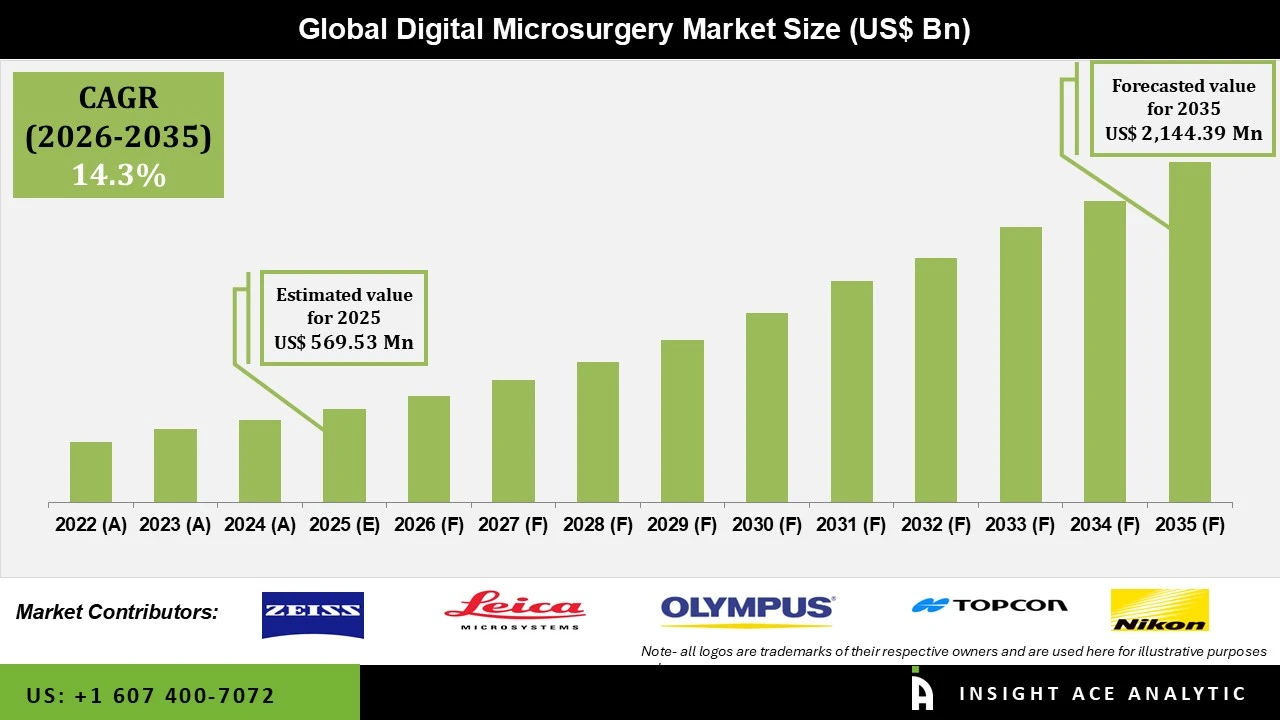
Digital Microsurgery Market Size is valued at USD 569.52 Mn in 2025 and is predicted to reach USD 2144.38 Mn by the year 2035 at a 14.3% CAGR during the forecast period for 2026 to 2035.
Digital Microsurgery Market Size, Share & Trends Analysis Distribution by Platform Type (Exoscope Systems, Digital Surgical Microscopes, and Microscope-to-Digital Upgrade Kits), Visualization (4K/3D Systems, AI-Assisted Visualization Add-ons, and HD/2D Digital Systems), Specialty (Ophthalmic, Neurosurgery, Plastics/Reconstructive & Hand, ENT & Head/Neck, and Others), End-user (Hospitals, Academic/Training Centers, Ambulatory Surgery Centers, and Others), and Segment Forecasts, 2026 to 2035
The term "digital microsurgery" describes the use of cutting-edge digital technology in conventional microsurgical techniques, including computer-guided navigation, robotic assistance, high-resolution imaging, and augmented visualization. It gives surgeons more control, accuracy, and precision when operating on incredibly tiny structures like blood arteries, nerves, and tissues. Surgeons can make better decisions during complicated surgeries by using digital microscopes and robotic devices to obtain enlarged, real-time 3D views and data overlays. Digital microsurgery is a revolutionary development in contemporary surgical practice because it facilitates teaching, recording, and remote cooperation. The digital microsurgery market is driven by the increasing desire for better results and quicker recovery periods, the expanding use of minimally invasive procedures, and technological developments in surgical equipment.
The digital microsurgery market is being driven by the increasing use of cutting-edge medical technology, which improves patient outcomes and increases surgical precision. The demand is being further increased by the rising incidence of complicated medical illnesses, such as neurological disorders, vascular diseases, and reconstructive surgeries that require sensitive procedures. Furthermore, the increasing use of high-definition digital imaging and robotic-assisted systems in operating rooms is driving the digital microsurgery market expansion since these technologies allow surgeons to conduct minimally invasive treatments more accurately and with shorter recovery times. Moreover, digital microsurgery systems are indispensable instruments in contemporary surgical procedures since they are extensively utilized in specialties such as neurology, ophthalmology, and plastic surgery.
In addition, the growth of the digital microsurgery market is anticipated to be shaped by ongoing technological breakthroughs and growing investments in healthcare infrastructure. The advancement of 3D visualization technologies, augmented reality (AR), and artificial intelligence (AI) is improving real-time decision-making and surgical planning. Furthermore, the use of cutting-edge surgical procedures is being encouraged, especially in emerging nations, by supportive government efforts and increasing financing for medical innovation. Compact, user-friendly, and extremely effective digital surgical systems designed for particular therapeutic applications are increasingly becoming more popular in the market. The digital microsurgery market is expected to rise steadily as more people become aware of the advantages of minimally invasive and precision-based surgeries.
Competitive Landscape
Which are the Leading Players in Digital Microsurgery Market?
• Olympus
• Topcon
• Medtronic
• Carl Zeiss Meditec
• Leica Microsystems
• Nikon
• Haag-Streit
• Stryker
• KARL STORZ
• Sony (medical imaging)
Market Dynamics
Driver
Growing Incidence of Chronic Diseases
One of the main factors propelling the digital microsurgery market is the rising incidence of chronic illnesses worldwide, especially neurological disorders and tumors that need reconstructive surgery. Over 20 million new instances of cancer are diagnosed globally each year; a large percentage of these cases necessitate complex surgical operations for tumor excision and subsequent repair, where high-precision instruments are essential. Similarly, the need for sophisticated neurosurgical procedures is fueled by the growing prevalence of neurological conditions, which are thought to impact hundreds of millions of people worldwide. Additionally, the digital microsurgery devices improve surgical outcomes and lower complication rates by providing the improved visibility and precision required for these delicate procedures. Due to the increasing number of patients, there is a persistent and growing demand for the advantages that digital platforms provide over conventional optical microscopes.
Restrain/Challenge
High Expenses for Operations and Capital Investment
One of the main obstacles to the digital microsurgery market's expansion is the substantial initial investment needed for digital microsurgery systems. A single sophisticated digital microscope or exoscope system can cost anywhere from several hundred thousand dollars to more than a million dollars. This is a significant financial commitment that needs to have a clear and measurable return on investment. Furthermore, operational expenses, which go beyond the initial purchase price, can make up a sizable amount of the system's lifetime total cost of ownership. Due to this high cost barrier, procurement is frequently restricted to large, well-funded university medical centers and private specialized hospitals, which limits the digital microsurgery market penetration into more general healthcare settings where financial restrictions are a major issue.
Digital Surgical Microscopes Segment is Expected to Drive the Digital Microsurgery Market
The digital surgical microscopes category held the largest share in the Digital Microsurgery market in 2025 driven by the growing need for minimally invasive, high-precision surgical techniques. Through improved magnification, real-time data integration, and high-definition 3D imaging, these microscopes provide superior visibility, allowing surgeons to carry out difficult procedures with more precision and assurance. The demand is also being driven by the increasing number of neurological, ophthalmology, and reconstructive surgeries, which call for precise viewing of sensitive anatomical features. Additionally, the transition from traditional optical microscopes to sophisticated digital systems is accelerating because of advantages such as increased documentation capabilities, decreased surgeon fatigue, and enhanced ergonomics. Furthermore, the global use of digital surgical microscopes is being accelerated by ongoing technology breakthroughs and rising investments by healthcare organizations.
Neurosurgery Segment is Growing at the Highest Rate in the Digital Microsurgery Market
In 2025, the neurosurgery category dominated the Digital Microsurgery market. The need for digital microsurgery instruments in neurosurgery procedures has been greatly increased by the rising incidence of neurological illnesses and improvements in surgical methods. To perform delicate surgeries on the brain, spine, and nervous system—where even small mistakes can result in major complications—neurosurgeons rely on high-precision equipment. By improving visibility and facilitating more precise, less invasive operations, the incorporation of digital surgical microscopes and exoscope systems into neurosurgery has completely transformed the discipline. Additionally, these technologies give surgeons access to high-definition, real-time imagery, which enhances their capacity to recognize vital structures while performing surgery. Furthermore, the growing emphasis on minimally invasive methods, which seek to shorten recovery periods and enhance patient outcomes, is a factor driving demand for digital microsurgery in neurosurgery.
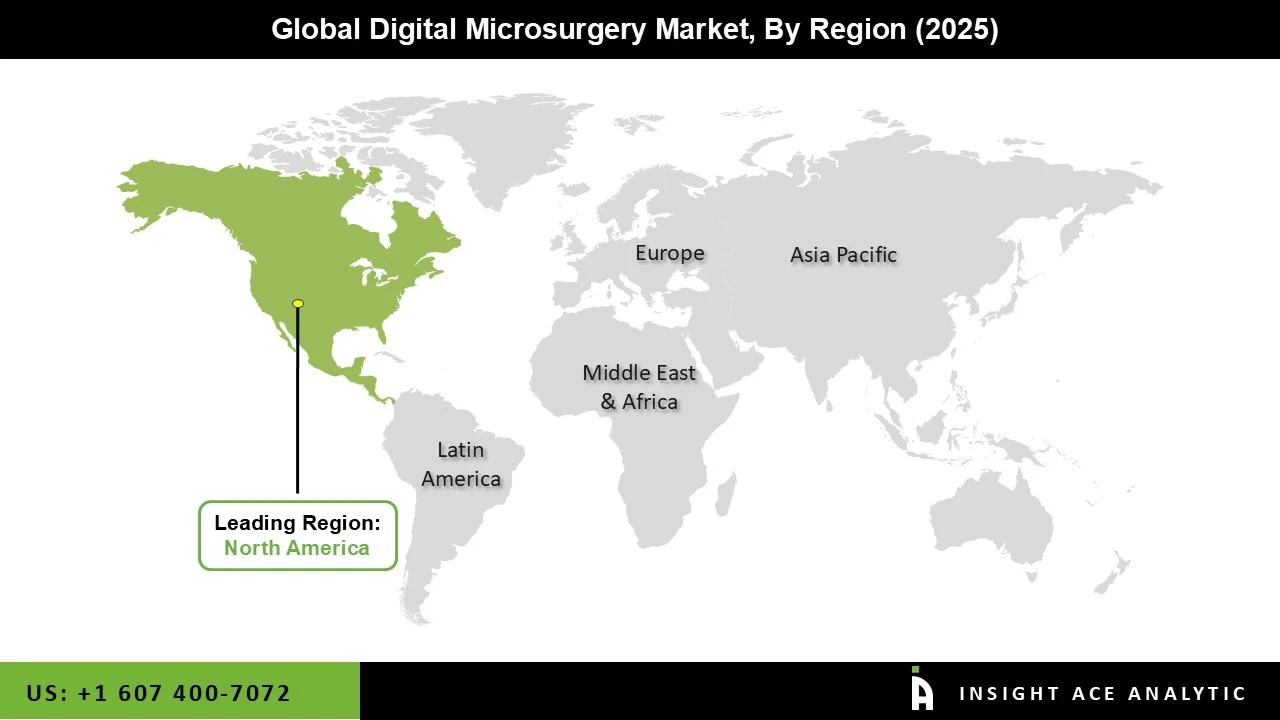
Why North America Led the Digital Microsurgery Market?
The Digital Microsurgery market was dominated by North America region in 2025. The region is expected to see an increase in neurosurgery and ophthalmic treatments, which will drive the digital microsurgery market expansion. The advanced hospital infrastructure, advantageous government and private payer reimbursement policies, robust medical device regulatory frameworks that foster innovation, high surgical volumes across several specialties, and a comprehensive infrastructure for surgeon training are all factors contributing to the region's dominant position in digital microsurgery market. Additionally, the healthcare system in the United States is quite open to innovative medical innovations, which creates a good atmosphere for the digital microsurgery market expansion. The North America region is anticipated to continue to be a significant digital microsurgery market due to the growing emphasis on enhancing patient outcomes and lowering surgical risks.
Digital Microsurgery Market Report Scope:
| Report Attribute | Specifications |
| Market size value in 2025 | USD 569.52 Mn |
| Revenue forecast in 2035 | USD 2144.38 Mn |
| Growth Rate CAGR | CAGR of 14.3% from 2026 to 2035 |
| Quantitative Units | Representation of revenue in US$ Mn and CAGR from 2026 to 2035 |
| Historic Year | 2022 to 2025 |
| Forecast Year | 2026-2035 |
| Report Coverage | The forecast of revenue, the position of the company, the competitive market structure, growth prospects, and trends |
| Segments Covered | Platform Type, Visualization, Specialty, End-user, and By Region |
| Regional Scope | North America; Europe; Asia Pacific; Latin America; Middle East & Africa |
| Country Scope | U.S.; Canada; U.K.; Germany; China; India; Japan; Brazil; Mexico; The UK; France; Italy; Spain; China; Japan; India; South Korea; Southeast Asia; South Korea; Southeast Asia |
| Competitive Landscape | Olympus, Topcon, Medtronic, Carl Zeiss Meditec, Leica Microsystems, Nikon, Haag-Streit, Stryker, KARL STORZ, and Sony (medical imaging) |
| Customization Scope | Free customization report with the procurement of the report, Modifications to the regional and segment scope. Geographic competitive landscape. |
| Pricing and Available Payment Methods | Explore pricing alternatives that are customized to your particular study requirements. |
Market Segmentation:
Digital Microsurgery Market by Platform Type-
• Exoscope Systems
• Digital Surgical Microscopes
• Microscope-to-Digital Upgrade Kits
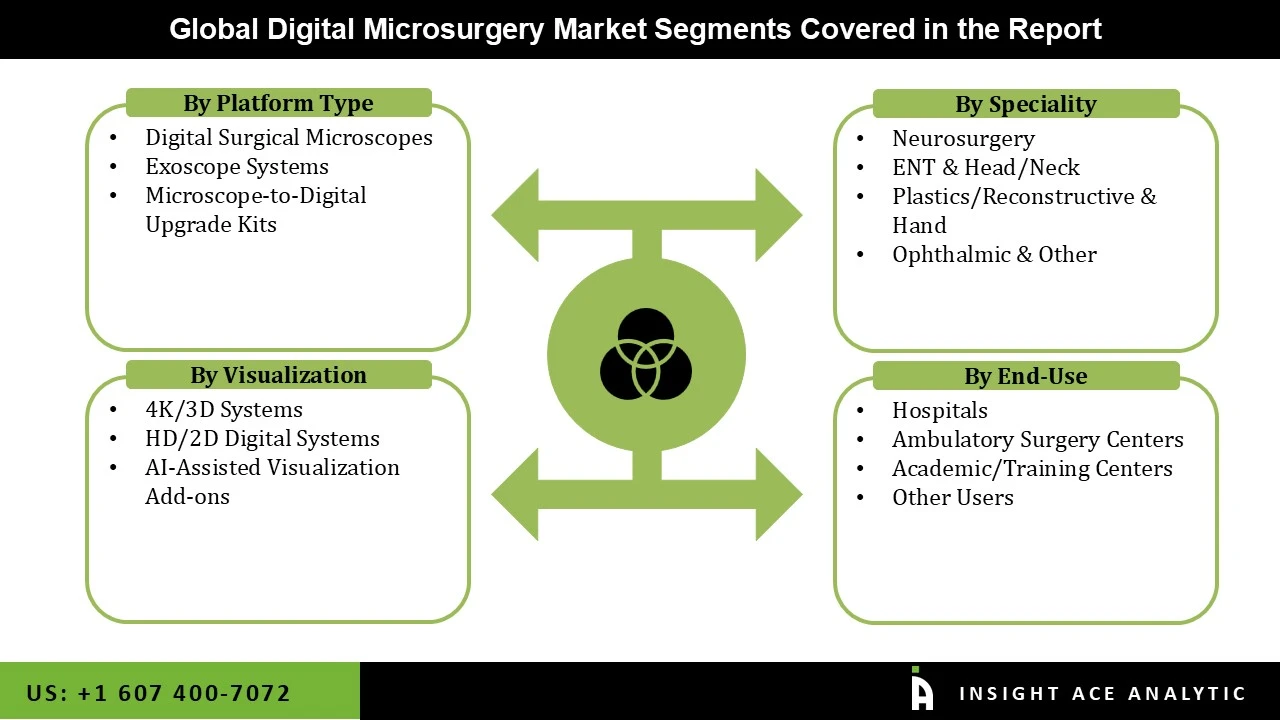
Digital Microsurgery Market by Visualization-
• 4K/3D Systems
• AI-Assisted Visualization Add-ons
• HD/2D Digital Systems
Digital Microsurgery Market by Specialty-
• Ophthalmic
• Neurosurgery
• Plastics/Reconstructive & Hand
• ENT & Head/Neck
• Others
Digital Microsurgery Market by End-user-
• Hospitals
• Academic/Training Centers
• Ambulatory Surgery Centers
• Others
Digital Microsurgery Market By Region-
North America-
• The US
• Canada
Europe-
• Germany
• The UK
• France
• Italy
• Spain
• Rest of Europe
Asia-Pacific-
• China
• Japan
• India
• South Korea
• South East Asia
• Rest of Asia Pacific
Latin America-
• Brazil
• Argentina
• Mexico
• Rest of Latin America
Middle East & Africa-
• GCC Countries
• South Africa
• Rest of Middle East and Africa
Research Design and Approach
This study employed a multi-step, mixed-method research approach that integrates:
- Secondary research
- Primary research
- Data triangulation
- Hybrid top-down and bottom-up modelling
- Forecasting and scenario analysis
This approach ensures a balanced and validated understanding of both macro- and micro-level market factors influencing the market.
Secondary Research
Secondary research for this study involved the collection, review, and analysis of publicly available and paid data sources to build the initial fact base, understand historical market behaviour, identify data gaps, and refine the hypotheses for primary research.
Sources Consulted
Secondary data for the market study was gathered from multiple credible sources, including:
- Government databases, regulatory bodies, and public institutions
- International organizations (WHO, OECD, IMF, World Bank, etc.)
- Commercial and paid databases
- Industry associations, trade publications, and technical journals
- Company annual reports, investor presentations, press releases, and SEC filings
- Academic research papers, patents, and scientific literature
- Previous market research publications and syndicated reports
These sources were used to compile historical data, market volumes/prices, industry trends, technological developments, and competitive insights.

Primary Research
Primary research was conducted to validate secondary data, understand real-time market dynamics, capture price points and adoption trends, and verify the assumptions used in the market modelling.
Stakeholders Interviewed
Primary interviews for this study involved:
- Manufacturers and suppliers in the market value chain
- Distributors, channel partners, and integrators
- End-users / customers (e.g., hospitals, labs, enterprises, consumers, etc., depending on the market)
- Industry experts, technology specialists, consultants, and regulatory professionals
- Senior executives (CEOs, CTOs, VPs, Directors) and product managers
Interview Process
Interviews were conducted via:
- Structured and semi-structured questionnaires
- Telephonic and video interactions
- Email correspondences
- Expert consultation sessions
Primary insights were incorporated into demand modelling, pricing analysis, technology evaluation, and market share estimation.
Data Processing, Normalization, and Validation
All collected data were processed and normalized to ensure consistency and comparability across regions and time frames.
The data validation process included:
- Standardization of units (currency conversions, volume units, inflation adjustments)
- Cross-verification of data points across multiple secondary sources
- Normalization of inconsistent datasets
- Identification and resolution of data gaps
- Outlier detection and removal through algorithmic and manual checks
- Plausibility and coherence checks across segments and geographies
This ensured that the dataset used for modelling was clean, robust, and reliable.
Market Size Estimation and Data Triangulation
Bottom-Up Approach
The bottom-up approach involved aggregating segment-level data, such as:
- Company revenues
- Product-level sales
- Installed base/usage volumes
- Adoption and penetration rates
- Pricing analysis
This method was primarily used when detailed micro-level market data were available.

Top-Down Approach
The top-down approach used macro-level indicators:
- Parent market benchmarks
- Global/regional industry trends
- Economic indicators (GDP, demographics, spending patterns)
- Penetration and usage ratios
This approach was used for segments where granular data were limited or inconsistent.
Hybrid Triangulation Approach
To ensure accuracy, a triangulated hybrid model was used. This included:
- Reconciling top-down and bottom-up estimates
- Cross-checking revenues, volumes, and pricing assumptions
- Incorporating expert insights to validate segment splits and adoption rates
This multi-angle validation yielded the final market size.
Forecasting Framework and Scenario Modelling
Market forecasts were developed using a combination of time-series modelling, adoption curve analysis, and driver-based forecasting tools.
Forecasting Methods
- Time-series modelling
- S-curve and diffusion models (for emerging technologies)
- Driver-based forecasting (GDP, disposable income, adoption rates, regulatory changes)
- Price elasticity models
- Market maturity and lifecycle-based projections
Scenario Analysis
Given inherent uncertainties, three scenarios were constructed:
- Base-Case Scenario: Expected trajectory under current conditions
- Optimistic Scenario: High adoption, favourable regulation, strong economic tailwinds
- Conservative Scenario: Slow adoption, regulatory delays, economic constraints
Sensitivity testing was conducted on key variables, including pricing, demand elasticity, and regional adoption.
Request Customization
Add countries, segments, company profiles, or extend forecast — free 10% customization with purchase.
Customize This Report →Enquire Before Buying
Speak with our analyst team about scope, methodology, pricing, or deliverable formats.
Enquire Now →Frequently Asked Questions
Digital Microsurgery Market Size is valued at USD 569.52 Mn in 2025 and is predicted to reach USD 2144.38 Mn by the year 2035
Digital Microsurgery Market is expected to grow at a 14.3% CAGR during the forecast period for 2026 to 2035.
Olympus, Topcon, Medtronic, Carl Zeiss Meditec, Leica Microsystems, Nikon, Haag-Streit, Stryker, KARL STORZ, and Sony (medical imaging)
Digital Microsurgery Market is segmented into Platform Type, Visualization, Specialty, End-user, and By Region
North America region is leading the Digital Microsurgery Market.