Insurance Platform Market Size, Scope, Revenue Report 2026 to 2035
Segmentation of Insurance Platform Market :
Insurance Platform Market By Offering-
- Software
- Intelligent Document Processing
- Digital Document Depository
- Document Collaboration
- Document Verification
- Document Version Control
- Insurance Lead Management
- Lead Tracking & Assignment
- Lead Scoring & Nurturing
- Lead Analytics
- Cross-Selling & Upselling
- Insurance Workflow Automation
- Claims Workflow Automation
- Underwriting Workflow Automation
- Customer Onboarding Automation
- Compliance Workflow Automation
- Policy Management
- Policy Insurance & Renewal
- Policy Documentation
- Policy Premium Calculations
- Policy Quotation Management
- Video KYC/eKYC
- Identity & Biometric Verification
- Compliance Reporting
- Audit Trails
- API & Micro-Services
- API-Driven Insurance Integration Platforms
- Partner Ecosystem Integration Platforms
- API-Enabled Insurance Distribution Platforms
- Micro-services
- Rating Microservices
- Document Generation Microservices
- Transaction Microservices
- Workflow Microservices
- Rating Microservices
- Utility Microservices
- Metadata Microservices
- Product Management Microservices
- Others
- Services
- Professional Services
- Consulting & Advisory Services
- Integration & Implementation Services
- Custom Platform Design & Development Services
- Training & Education Services
- Managed Services
- Professional Services
- Intelligent Document Processing
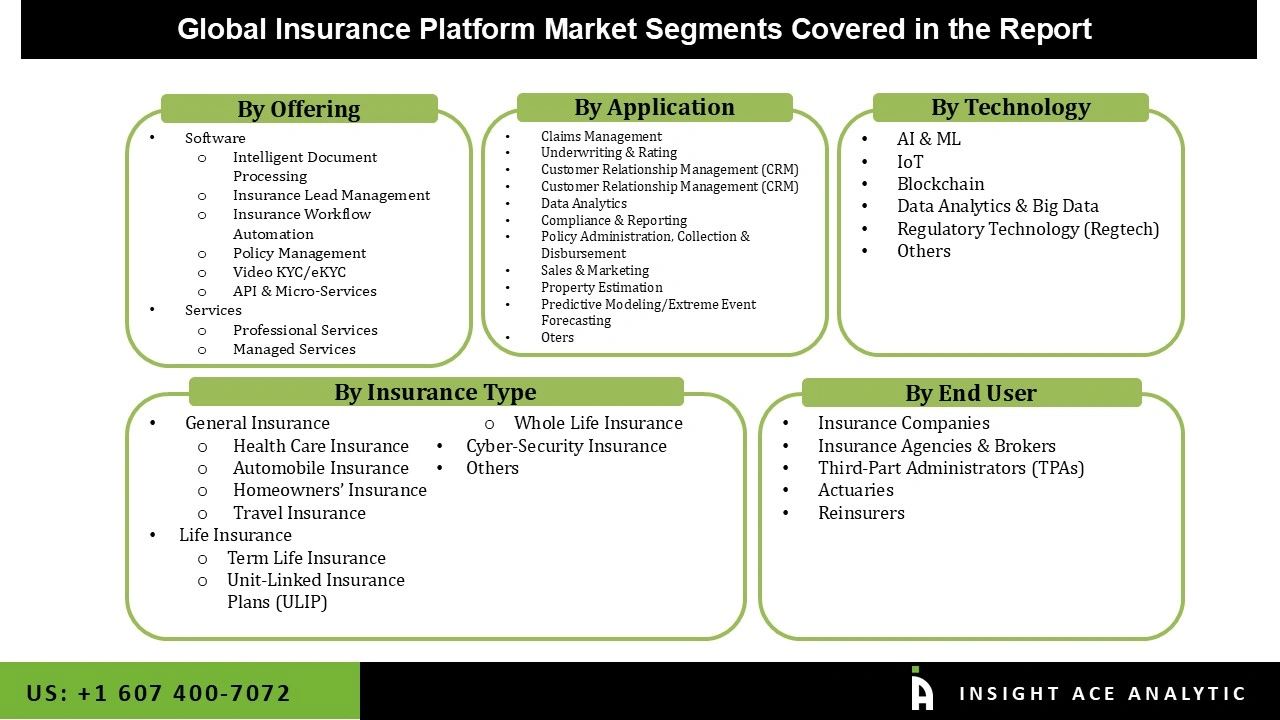
Insurance Platform Market By Application-
- Claims Management
- Virtual Claims Handling
- Claims Processing
- Claims Analytics
- Underwriting & Rating
- Group Insurance Underwriting
- Customer Risk Profiling
- Collaboration & Self-Services
- Pricing & Quote Management
- Customer Relationship Management (CRM)
- Customer Data Management
- Customer Interaction & Engagement
- Customer Support & Services
- Billing & Payments
- Premium Billing & Invoicing
- Online Payment Processing
- Reconciliation & Accounting
- Data Analytics
- Subrogation Analytics
- Performance Tracking & Reporting
- Fraud Detection & Prevention
- Compliance & Reporting
- Regulatory Compliance Management
- Reporting Automation
- Policy Administration, Collection & Disbursement
- Policy Creation & Modification
- Premium Collection
- Payout & Disbursement Management
- Sales & Marketing
- Agent & Broker Management
- Direct-To-Consumer Sales
- Digital Sales Enablement
- Property Estimation
- Property Valuation
- Claims Estimation
- Property Inspection
- Predictive Modeling/Extreme Event Forecasting
- Claims Severity Modelling
- Policy Recommendation Engines
- Extreme Event Analysis
- Catastrophe Modeling
- Others
Insurance Platform Market By Insurance Type-
- General Insurance
- Health Care Insurance
- Individual Health Insurance
- Family Floater Insurance
- Critical Illness Coverage
- Senior Citizen Health Insurance
- Group Health Insurance
- Automobile Insurance
- Car Insurance
- Bike Insurance
- Commercial Vehicle Insurance
- Homeowners’ Insurance
- Home Building Insurance
- Public Liability Coverage
- Standard Fire & Special Perils Policy
- Travel Insurance
- Trip Cancellation
- Medical Coverage
- Baggage Loss
- Life Insurance
- Term Life Insurance
- Level Term Life Insurance
- Increasing Term Insurance<
- Decreasing Term Insurance
- Return Of Premium Term Insurance
- Convertible Term Plans
- Unit-Linked Insurance Plans (ULIP)
- Type 1 ULIP
- Type 2 ULIP
- Whole Life Insurance
- Indexed Whole Life Insurance
- Guaranteed Issue Whole Life Insurance
- Limited Payment Whole Life Insurance
- Joint Whole Life Insurance
- Modified Whole Life Insurance
- Reduced Paid-Up Whole Life Insurance
- Simplified Issue Whole Life Insurance
- Single-Premium Whole Life Insurance
- Variable Whole Life Insurance
- Whole Life Insurance For Children
- Cyber-Security Insurance
- Data Breach Coverage
- Cyber Extortion & Ransomware Coverage
- Regulatory Fines & Penalties Coverage
- Cyber Terrorism Insurance
- Others
- Term Life Insurance
- Health Care Insurance
Insurance Platform Market By Technology-
- AI & ML
- Ai-Powered Underwriting Platforms
- ML-Based Claims Processing Platforms
- Ai-Driven Customer Service & Chatbot Platforms
- Insurance platform-Based Content Marketing
- Robotic Process Automation
- Others
- IoT
- IoT-Enabled Telematics Platforms
- Connected Home & Property Insurance Platforms
- Wearable Device Integration for Health Insurance
- Others
- Blockchain
- Blockchain-Based Insurance Platforms
- Smart Contract Insurance Platform
- Decentralized Insurance Platforms
- Others
- Data Analytics & Big Data
- Big Data Analytics For Risk Assessment
- Predictive Analytics For Pricing and underwriting
- Data-Driven Claims Processing Platforms
- Others
- Regulatory Technology (Regtech)
- Regulatory Compliance & Reporting Platforms
- KYC & AML Compliance Solutions
- Regulatory Risk Assessment & Management
- Others
- Others
Insurance Platform Market By End-User-
- Insurance Companies
- Large Carriers
- Mid-Sized Carriers
- Small & Startup Insurers
- Insurance Agencies & Brokers
- Independent Agencies
- Brokerage Firms
- Online Aggregators
- Third-Part Administrators (TPAs)
- Claims Handing Firms
- Policy Management Service Providers
- Actuaries
- Reinsurers
Insurance Platform Market By Region-
- North America-
- The US
- Canada
- Europe-
- Germany
- The UK
- France
- Italy
- Spain
- Rest of Europe
- Asia-Pacific-
- China
- Japan
- India
- South Korea
- South East Asia
- Rest of Asia Pacific
- Latin America-
- Brazil
- Argentina
- Mexico
- Rest of Latin America
- Middle East & Africa-
- GCC Countries
- South Africa
- Rest of Middle East and Africa
Chapter 1. Methodology and Scope
1.1. Research Methodology
1.2. Research Scope & Assumptions
Chapter 2. Executive Summary
Chapter 3. Global Insurance Platform Market Snapshot
Chapter 4. Global Insurance Platform Market Variables, Trends & Scope
4.1. Market Segmentation & Scope
4.2. Drivers
4.3. Challenges
4.4. Trends
4.5. Investment and Funding Analysis
4.6. Industry Analysis – Porter’s Five Forces Analysis
4.7. Competitive Landscape & Market Share Analysis
4.8. Impact of Covid-19 Analysis
Chapter 5. Market Segmentation 1: By Offering Estimates & Trend Analysis
5.1. By Offering, & Market Share, 2025 & 2035
5.2. Market Size (Value US$ Mn) & Forecasts and Trend Analyses, 2022 to 2035 for the following By Offering:
5.2.1. Software
5.2.1.1. Intelligent Document Processing
5.2.1.1.1. Digital Document Depository
5.2.1.1.2. Document Collaboration
5.2.1.1.3. Document Verification
5.2.1.1.4. Document Version Control
5.2.1.2. Insurance Lead Management
5.2.1.2.1. Lead Tracking & Assignment
5.2.1.2.2. Lead Scoring & Nurturing
5.2.1.2.3. Lead Analytics
5.2.1.2.4. Cross-Selling & Upselling
5.2.2. Insurance Workflow Automation
5.2.2.1.1. Claims Workflow Automation
5.2.2.1.2. Underwriting Workflow Automation
5.2.2.1.3. Customer Onboarding Automation
5.2.2.1.4. Compliance Workflow Automation
5.2.3. Policy Management
5.2.3.1.1. Policy Issuance & Renewal
5.2.3.1.2. Policy Documentation
5.2.3.1.3. Policy Premium Calculations
5.2.3.1.4. Policy Quotation Management
5.2.4. Video KYC/eKYC
5.2.4.1.1. Identity & Biometric Verification
5.2.4.1.2. Compliance Reporting
5.2.4.1.3. Audit Trails
5.2.5. API & Microservices
5.2.5.1.1. API-Driven Insurance Integration Platforms
5.2.5.1.2. Partner Ecosystem Integration Platforms
5.2.5.1.3. API-Enabled Insurance Distribution Platforms
5.2.5.1.4. Microservices
5.2.5.1.4.1. Rating Microservices
5.2.5.1.4.2. Document Generation Microservices
5.2.5.1.4.3. Transaction Microservices
5.2.5.1.4.4. Workflow Microservices
5.2.5.1.4.5. Rating Microservices
5.2.5.1.4.6. Utility Microservices
5.2.5.1.4.7. Metadata Microservices
5.2.5.1.4.8. Product Management Microservices
5.2.6. Others
Chapter 6. Market Segmentation 2: By End-user Estimates & Trend Analysis
6.1. By End-user & Market Share, 2025 & 2035
6.2. Market Size (Value US$ Mn) & Forecasts and Trend Analyses, 2022 to 2035 for the following By End-user:
6.2.1. Claims Management
6.2.1.1.1. Virtual Claims Handling
6.2.1.1.2. Claims Processing
6.2.1.1.3. Claims Analytics
6.2.2. Underwriting & Rating
6.2.2.1.1. Group Insurance Underwriting
6.2.2.1.2. Customer Risk Profiling
6.2.2.1.3. Collaboration & Self-Service
6.2.2.1.4. Pricing & Quote Management
6.2.3. Customer Relationship Management (CRM)
6.2.3.1.1. Customer Data Management
6.2.3.1.2. Customer Interaction & Engagement
6.2.3.1.3. Customer Support & Service
6.2.4. Billing & Payments
6.2.4.1.1. Premium Billing & Invoicing
6.2.4.1.2. Online Payment Processing
6.2.4.1.3. Reconciliation & Accounting
6.2.5. Data Analytics
6.2.5.1.1. Subrogation Analytics
6.2.5.1.2. Performance Tracking & Reporting
6.2.5.1.3. Fraud Detection & Prevention
6.2.6. Compliance & Reporting
6.2.6.1.1. Regulatory Compliance Management
6.2.6.1.2. Reporting Automation
6.2.7. Policy Administration, Collection & Disbursement
6.2.7.1.1. Policy Creation & Modification
6.2.7.1.2. Premium Collection
6.2.7.1.3. Payout & Disbursement Management
6.2.8. Sales & Marketing
6.2.8.1.1. Agent & Broker Management
6.2.8.1.2. Direct-To-Consumer Sales
6.2.8.1.3. Digital Sales Enablement
6.2.9. Property Estimation
6.2.9.1.1. Property Valuation
6.2.9.1.2. Claims Estimation
6.2.9.1.3. Property Inspection
6.2.10. Predictive Modeling/Extreme Event Forecasting
6.2.10.1.1. Claims Severity Modelling
6.2.10.1.2. Policy Recommendation Engines
6.2.10.1.3. Extreme Event Analysis
6.2.10.1.4. Catastrophe Modeling
6.2.11. Others
Chapter 7. Market Segmentation 3: By Insurance Type Estimates & Trend Analysis
7.1. By Insurance Type & Market Share, 2025 & 2035
7.2. Market Size (Value US$ Mn) & Forecasts and Trend Analyses, 2022 to 2035 for the following By Insurance Type:
7.2.1. General Insurance
7.2.1.1. Health Care Insurance
7.2.1.1.1. Individual Health Insurance
7.2.1.1.2. Family Floater Insurance
7.2.1.1.3. Critical Illness Coverage
7.2.1.1.4. Senior Citizen Health Insurance
7.2.1.1.5. Group Health Insurance
7.2.1.2. Automobile Insurance
7.2.1.2.1. Car Insurance
7.2.1.2.2. Bike Insurance
7.2.1.2.3. Commercial Vehicle Insurance
7.2.1.3. Homeowners' Insurance
7.2.1.3.1. Home Building Insurance
7.2.1.3.2. Public Liability Coverage
7.2.1.3.3. Standard Fire & Special Perils Policy
7.2.1.4. Travel Insurance
7.2.1.4.1. Trip Cancellation
7.2.1.4.2. Medical Coverage
7.2.1.4.3. Baggage Loss
7.2.2. Life Insurance
7.2.2.1. Term Life Insurance
7.2.2.1.1. Level Term Life Insurance
7.2.2.1.2. Increasing Term Insurance
7.2.2.1.3. Decreasing Term Insurance
7.2.2.1.4. Return Of Premium Term Insurance
7.2.2.1.5. Convertible Term Plans
7.2.2.2. Unit-Linked Insurance Plans (ULIP)
7.2.2.2.1. Type 1 ULIP
7.2.2.2.2. Type 2 ULIP
7.2.2.3. Whole Life Insurance
7.2.2.3.1. Indexed Whole Life Insurance
7.2.2.3.2. Guaranteed Issue Whole Life Insurance
7.2.2.3.3. Limited Payment Whole Life Insurance
7.2.2.3.4. Joint Whole Life Insurance
7.2.2.3.5. Modified Whole Life Insurance
7.2.2.3.6. Reduced Paid-Up Whole Life Insurance
7.2.2.3.7. Simplified Issue Whole Life Insurance
7.2.2.3.8. Single-Premium Whole Life Insurance
7.2.2.3.9. Variable Whole Life Insurance
7.2.2.3.10. Whole Life Insurance For Children
7.2.3. Cybersecurity Insurance
7.2.3.1.1. Data Breach Coverage
7.2.3.1.2. Cyber Extortion & Ransomware Coverage
7.2.3.1.3. Regulatory Fines & Penalties Coverage
7.2.3.1.4. Cyber Terrorism Insurance
7.2.4. Others
Chapter 8. Market Segmentation 4: By Technology Estimates & Trend Analysis
8.1. By Technology & Market Share, 2025 & 2035
8.2. Market Size (Value US$ Mn) & Forecasts and Trend Analyses, 2022 to 2035 for the following By Technology:
8.2.1. AI & ML
8.2.1.1. Ai-Powered Underwriting Platforms
8.2.1.2. ML-Based Claims Processing Platforms
8.2.1.3. Ai-Driven Customer Service & Chatbot Platforms
8.2.1.4. insurance platform-Based Content Marketing
8.2.1.5. Robotic Process Automation
8.2.1.6. Others
8.2.2. IoT
8.2.2.1. IoT-Enabled Telematics Platforms
8.2.2.2. Connected Home & Property Insurance Platforms
8.2.2.3. Wearable Device Integration for Health Insurance
8.2.2.4. Others
8.2.3. Blockchain
8.2.3.1. Blockchain-Based Insurance Platforms
8.2.3.2. Smart Contract Insurance Platforms
8.2.3.3. Decentralized Insurance Platforms
8.2.3.4. Others
8.2.4. Data Analytics & Big Data
8.2.4.1. Big Data Analytics For Risk Assessment
8.2.4.2. Predictive Analytics For Pricing & Underwriting
8.2.4.3. Data-Driven Claims Processing Platforms
8.2.4.4. Others
8.2.5. Regulatory Technology (Regtech)
8.2.5.1. Regulatory Compliance & Reporting Platforms
8.2.5.2. KYC & AML Compliance Solutions
8.2.5.3. Regulatory Risk Assessment & Management
8.2.5.4. Others
8.2.6. Others
Chapter 9. Market Segmentation 5: By End-user Estimates & Trend Analysis
9.1. By End-user & Market Share, 2025 & 2035
9.2. Market Size (Value US$ Mn) & Forecasts and Trend Analyses, 2022 to 2035 for the following By End-user:
9.2.1. Insurance Companies
9.2.1.1. Large Carriers
9.2.1.2. Mid-Sized Carriers
9.2.1.3. Small & Startup Insurers
9.2.2. Insurance Agencies & Brokers
9.2.2.1. Independent Agencies
9.2.2.2. Brokerage Firms
9.2.2.3. Online Aggregators
9.2.3. Third-Party Administrators (TPAs)
9.2.3.1. Claims Handing Firms
9.2.3.2. Policy Management Service Providers
9.2.4. Actuaries
9.2.5. Reinsurers
Chapter 10. Insurance Platform Market Segmentation 6: Regional Estimates & Trend Analysis
10.1. North America
10.1.1. North America Insurance Platform Market revenue (US$ Million) estimates and forecasts By Offering, 2022-2035
10.1.2. North America Insurance Platform Market revenue (US$ Million) estimates and forecasts By End-user, 2022-2035
10.1.3. North America Insurance Platform Market revenue (US$ Million) estimates and forecasts By Insurance Type, 2022-2035
10.1.4. North America Insurance Platform Market revenue (US$ Million) estimates and forecasts By Technology, 2022-2035
10.1.5. North America Insurance Platform Market revenue (US$ Million) estimates and forecasts By End-user, 2022-2035
10.1.6. North America Insurance Platform Market revenue (US$ Million) estimates and forecasts by country, 2022-2035
10.2. Europe
10.2.1. Europe Insurance Platform Market revenue (US$ Million) By Offering, 2022-2035
10.2.2. Europe Insurance Platform Market revenue (US$ Million) By End-user, 2022-2035
10.2.3. Europe Insurance Platform Market revenue (US$ Million) By Insurance Type, 2022-2035
10.2.4. Europe Insurance Platform Market revenue (US$ Million) By Technology, 2022-2035
10.2.5. Europe Insurance Platform Market revenue (US$ Million) By End-user, 2022-2035
10.2.6. Europe Insurance Platform Market revenue (US$ Million) by country, 2022-2035
10.3. Asia Pacific
10.3.1. Asia Pacific Insurance Platform Market revenue (US$ Million) By Offering, 2022-2035
10.3.2. Asia Pacific Insurance Platform Market revenue (US$ Million) By End-user, 2022-2035
10.3.3. Asia Pacific Insurance Platform Market revenue (US$ Million) By Insurance Type, 2022-2035
10.3.4. Asia Pacific Insurance Platform Market revenue (US$ Million) By Technology, 2022-2035
10.3.5. Asia Pacific Insurance Platform Market revenue (US$ Million) By End-user, 2022-2035
10.3.6. Asia Pacific Insurance Platform Market revenue (US$ Million) by country, 2022-2035
10.4. Latin America
10.4.1. Latin America Insurance Platform Market revenue (US$ Million) By Offering, (US$ Million) 2022-2035
10.4.2. Latin America Insurance Platform Market revenue (US$ Million) By End-user, (US$ Million) 2022-2035
10.4.3. Latin America Insurance Platform Market revenue (US$ Million) By Insurance Type, (US$ Million) 2022-2035
10.4.4. Latin America Insurance Platform Market revenue (US$ Million) By Technology, (US$ Million) 2022-2035
10.4.5. Latin America Insurance Platform Market revenue (US$ Million) By End-user, (US$ Million) 2022-2035
10.4.6. Latin America Insurance Platform Market revenue (US$ Million) by country, 2022-2035
10.5. Middle East & Africa
10.5.1. Middle East & Africa Insurance Platform Market revenue (US$ Million) By Offering, (US$ Million) 2022-2035
10.5.2. Middle East & Africa Insurance Platform Market revenue (US$ Million) By End-user, (US$ Million) 2022-2035
10.5.3. Middle East & Africa Insurance Platform Market revenue (US$ Million) By Insurance Type, (US$ Million) 2022-2035
10.5.4. Middle East & Africa Insurance Platform Market revenue (US$ Million) By Technology, (US$ Million) 2022-2035
10.5.5. Middle East & Africa Insurance Platform Market revenue (US$ Million) By End-user, (US$ Million) 2022-2035
10.5.6. Middle East & Africa Insurance Platform Market revenue (US$ Million) by country, 2022-2035
Chapter 11. Competitive Landscape
11.1. Major Mergers and Acquisitions/Strategic Alliances
11.2. Company Profiles
11.2.1. Microsoft (US)
11.2.2. Adobe (US)
11.2.3. Salesforce (US)
11.2.4. IBM (US)
11.2.5. Oracle (US)
11.2.6. SAP (Germany)
11.2.7. Pegasystems (US)
11.2.8. Accenture (Ireland)
11.2.9. DXC Technology (US)
11.2.10. Guidewire Software (US)
11.2.11. Duck Creek Technologies (US)
11.2.12. Applied Systems (US)
11.2.13. Fineos (Ireland)
11.2.14. Cognizant (US)
11.2.15. Appian (US)
11.2.16. LTIMindtree (India)
11.2.17. Prima Solutions (France)
11.2.18. Majesco (US)
11.2.19. EIS Group (US)
11.2.20. Cogitate Technology Solutions (US)
11.2.21. Vertafore (US)
11.2.22. Sapiens International Corporation (Israel)
11.2.23. Bolt Insurance (US)
11.2.24. Inzura (UK)
11.2.25. Britecore (US)
11.2.26. Shift Technology (France
11.2.27. Zipari (US)
11.2.28. Qauntemplate (US)
11.2.29. PerfectQuote (US)
11.2.30. Outsystems (US)
11.2.31. Zywave (US)
11.2.32. Socotra (US)
11.2.33. InsuredMine (US)
11.2.34. InsuredHQ (New Zealand)
11.2.35. CodeMetro (US)
11.2.36. AgencySmart (US)
11.2.37. OneShield (US)
Research Design and Approach
This study employed a multi-step, mixed-method research approach that integrates:
- Secondary research
- Primary research
- Data triangulation
- Hybrid top-down and bottom-up modelling
- Forecasting and scenario analysis
This approach ensures a balanced and validated understanding of both macro- and micro-level market factors influencing the market.
Secondary Research
Secondary research for this study involved the collection, review, and analysis of publicly available and paid data sources to build the initial fact base, understand historical market behaviour, identify data gaps, and refine the hypotheses for primary research.
Sources Consulted
Secondary data for the market study was gathered from multiple credible sources, including:
- Government databases, regulatory bodies, and public institutions
- International organizations (WHO, OECD, IMF, World Bank, etc.)
- Commercial and paid databases
- Industry associations, trade publications, and technical journals
- Company annual reports, investor presentations, press releases, and SEC filings
- Academic research papers, patents, and scientific literature
- Previous market research publications and syndicated reports
These sources were used to compile historical data, market volumes/prices, industry trends, technological developments, and competitive insights.

Primary Research
Primary research was conducted to validate secondary data, understand real-time market dynamics, capture price points and adoption trends, and verify the assumptions used in the market modelling.
Stakeholders Interviewed
Primary interviews for this study involved:
- Manufacturers and suppliers in the market value chain
- Distributors, channel partners, and integrators
- End-users / customers (e.g., hospitals, labs, enterprises, consumers, etc., depending on the market)
- Industry experts, technology specialists, consultants, and regulatory professionals
- Senior executives (CEOs, CTOs, VPs, Directors) and product managers
Interview Process
Interviews were conducted via:
- Structured and semi-structured questionnaires
- Telephonic and video interactions
- Email correspondences
- Expert consultation sessions
Primary insights were incorporated into demand modelling, pricing analysis, technology evaluation, and market share estimation.
Data Processing, Normalization, and Validation
All collected data were processed and normalized to ensure consistency and comparability across regions and time frames.
The data validation process included:
- Standardization of units (currency conversions, volume units, inflation adjustments)
- Cross-verification of data points across multiple secondary sources
- Normalization of inconsistent datasets
- Identification and resolution of data gaps
- Outlier detection and removal through algorithmic and manual checks
- Plausibility and coherence checks across segments and geographies
This ensured that the dataset used for modelling was clean, robust, and reliable.
Market Size Estimation and Data Triangulation
Bottom-Up Approach
The bottom-up approach involved aggregating segment-level data, such as:
- Company revenues
- Product-level sales
- Installed base/usage volumes
- Adoption and penetration rates
- Pricing analysis
This method was primarily used when detailed micro-level market data were available.

Top-Down Approach
The top-down approach used macro-level indicators:
- Parent market benchmarks
- Global/regional industry trends
- Economic indicators (GDP, demographics, spending patterns)
- Penetration and usage ratios
This approach was used for segments where granular data were limited or inconsistent.
Hybrid Triangulation Approach
To ensure accuracy, a triangulated hybrid model was used. This included:
- Reconciling top-down and bottom-up estimates
- Cross-checking revenues, volumes, and pricing assumptions
- Incorporating expert insights to validate segment splits and adoption rates
This multi-angle validation yielded the final market size.
Forecasting Framework and Scenario Modelling
Market forecasts were developed using a combination of time-series modelling, adoption curve analysis, and driver-based forecasting tools.
Forecasting Methods
- Time-series modelling
- S-curve and diffusion models (for emerging technologies)
- Driver-based forecasting (GDP, disposable income, adoption rates, regulatory changes)
- Price elasticity models
- Market maturity and lifecycle-based projections
Scenario Analysis
Given inherent uncertainties, three scenarios were constructed:
- Base-Case Scenario: Expected trajectory under current conditions
- Optimistic Scenario: High adoption, favourable regulation, strong economic tailwinds
- Conservative Scenario: Slow adoption, regulatory delays, economic constraints
Sensitivity testing was conducted on key variables, including pricing, demand elasticity, and regional adoption.
Request Customization
Add countries, segments, company profiles, or extend forecast — free 10% customization with purchase.
Customize This Report →Enquire Before Buying
Speak with our analyst team about scope, methodology, pricing, or deliverable formats.
Enquire Now →Frequently Asked Questions
Insurance Platform Market Size is valued at USD 109.54 Bn in 2025 and is predicted to reach USD 345.56 Bn by the year 2035
Insurance Platform Market is expected to grow at a 12.3% CAGR during the forecast period for 2026 to 2035.
Microsoft (US), Adobe (US), Salesforce (US), IBM (US), Oracle (US), SAP (Germany), Pegasystems (US), Accenture (Ireland), DXC Technology (US), Guidewire Software (US), Duck Creek Technologies (US), Applied Systems (US), Fineos (Ireland), Cognizant (US), Appian (US), LTIMindtree (India), Prima Solutions (France), Majesco (US), EIS Group (US), Cogitate Technology Solutions (US), Vertafore (US), Sapiens International Corporation (Israel), Bolt Insurance (US), Inzura (UK), Britecore (US), Shift Technology (France), Zipari (US), Qauntemplate (US), PerfectQuote (US), Outsystems (US), Zywave (US), Socotra (US), InsuredMine (US), InsuredHQ (New Zealand), CodeMetro (US), AgencySmart (US), and OneShield (US). and Others.
Offering, Application, Insurance Type, Technology and End-user are the key segments of the Insurance Platform Market.
North America region is leading the Insurance Platform Market.