Co Packaged Optics (CPO) Market Size, Scope, Forecast Report 2026 to 2035
What is Co Packaged Optics (CPO) Market Size?
Co Packaged Optics (CPO) Market is estimated to grow at a 38.0% CAGR during the forecast period for 2026 to 2035.
Co Packaged Optics (CPO) Market Size, Share & Trends Analysis Distribution by Interconnect Domain & Integration Target (Scale-Out – Switch-Integrated CPO, Scale-Up – Accelerator / XPU Optical I/O), By Integration Architecture (Co-Packaged Optics (CPO), Near-Packaged Optics (NPO)), By Building Block / Offering (Co-Packaged Optical Engine (PIC + EIC + Fiber-Array Attach), External Laser Source (ELS / ELSFP), Optical Connectivity & Fiber-Attach), By Application / End-Use (AI/ML Training & Inference Fabric, General Cloud & Hyperscale Data Center Networking, Telecom, Carrier & Edge, High-Performance & Scientific Computing (HPC), Others), By Route to Market / Channel (Vertically Integrated Design-In, Foundry / OSAT-Mediated, Merchant Optical Engine & Module) and Segment Forecasts, 2026 to 2035
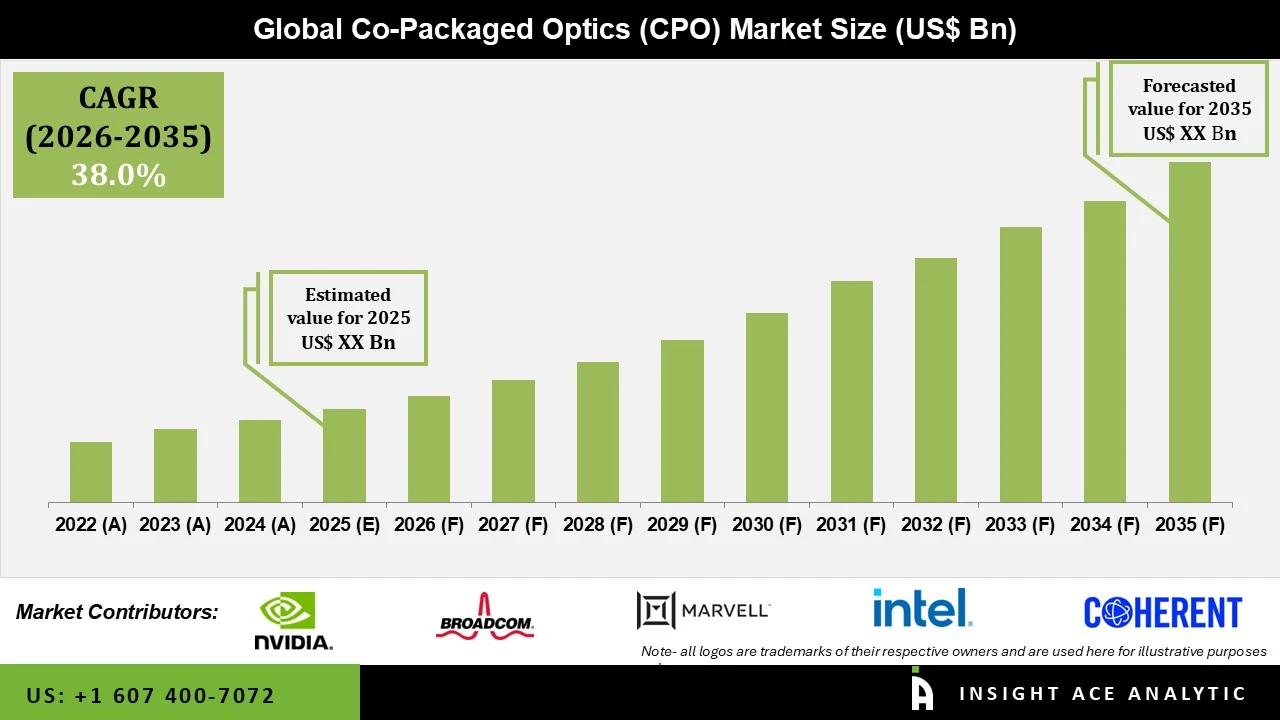
Co-packaged optics (CPO) is an advanced optical interconnect architecture in which an optical engine is integrated closely with high-performance electronic silicon, such as a switch ASIC or compute accelerator, within a common package or closely coupled substrate. Unlike conventional pluggable optical transceivers positioned at the front panel of networking equipment, CPO places the optical interface substantially closer to the host silicon, reducing the electrical interconnect distance between computing and switching components. This architecture is designed to support high-bandwidth data transmission while addressing increasing requirements for bandwidth density, signal integrity, power efficiency, and interconnect performance in advanced computing systems.
A CPO solution typically brings together photonic integrated circuits (PICs), electronic integrated circuits (EICs), laser sources, and optical fiber or fiber-array assemblies within a tightly integrated optical engine. Depending on the system architecture, the optical engine may be co-packaged directly with the host silicon or positioned in a near-packaged configuration in close proximity to the processor or switch. These approaches enable optical connectivity to be integrated more closely with high-performance computing and networking components, supporting increasingly demanding data-transfer requirements.
The co-packaged optics market encompasses the design, development, manufacturing, integration, supply, and commercialization of optical engines, external laser sources, optical connectivity, and associated technologies used for high-speed communication within computing and networking systems. The market covers both scale-out interconnects, where optical engines are integrated with Ethernet, InfiniBand, or other high-performance switches, and scale-up interconnects, where optical I/O technologies provide high-bandwidth connectivity among accelerators, processors, and other compute elements.
The market ecosystem spans semiconductor manufacturers, photonic technology developers, semiconductor and photonic foundries, outsourced semiconductor assembly and test (OSAT) providers, optical component manufacturers, and system technology companies. The development of CPO is closely associated with advances in photonic integration, semiconductor packaging, optical engine design, fiber attachment, laser technologies, and high-speed interconnect architectures. The degree of integration across these components can vary depending on the system design and manufacturing approach.
CPO is increasingly being evaluated for AI and machine learning infrastructure, hyperscale data centers, high-performance computing (HPC), and advanced switching and compute platforms, where rapidly increasing data volumes place greater demands on interconnect bandwidth and power efficiency. The technology is particularly relevant to architectures requiring high-speed communication between switches, processors, accelerators, and other compute elements. As computing systems continue to evolve toward higher bandwidth and greater levels of semiconductor and photonic integration, CPO is becoming an increasingly important technology within the broader optical networking and advanced semiconductor packaging ecosystem.
Competitive Landscape
Which are the Leading Players in the Co-Packaged Optics (CPO) Market?
• NVIDIA Corporation
• Broadcom Inc.
• Marvell Technology, Inc.
• Intel Corporation
• Coherent Corp.
• Lumentum Holdings Inc.
• Taiwan Semiconductor Manufacturing Company (TSMC)
• GlobalFoundries Inc.
• Tower Semiconductor Ltd.
• Ayar Labs, Inc.
• Lightmatter, Inc.
• Ranovus Inc.
• Micas Networks
• Delta Electronics, Inc.
• Corning Incorporated
• SENKO Advanced Components
• Molex LLC
• POET Technologies Inc.
• Polaris Electro-Optics, Inc.
• Celestica Inc.
• Jabil Inc.
• NewPhotonics Ltd.
• Quanta Cloud Technology (QCT)
• Advantest Corporation
• VIAVI Solutions Inc.
Market Dynamics
Driver
Rapid Expansion of AI and Hyperscale Data Centers
The explosive growth of AI infrastructure and hyperscale data centres is a primary driver of the co-packaged optics market. The increasing deployment of GPUs, AI accelerators and HPC systems is generating enormous volumes of data traffic between processors, servers and networking switches. The scale of AI training and inference workloads requires high bandwidth, low latency communication to enable the efficient movement of data in a distributed computing environment. Conventional electrical interconnects are hitting their limits in terms of power consumption, signal integrity and bandwidth density as data rates go up. Co-packaged optics is the solution to this, with optical engines being integrated much closer to the switching and computing silicon to provide the required data throughput at a much improved energy efficiency. The continued ramp in investment in AI data centre infrastructure and in next gen networking architectures will see the market for co-packaged optics grow.
Restrain/Challenge
High Manufacturing and Integration Complexity
Co-packaged optics is the integration of photonic integrated circuits (PICs), electronic integrated circuits (EICs), laser sources and optical fibre connections into a single compact semiconductor package. It's about the integration of all of those elements and it requires a very high degree of alignment of the optical components, very sophisticated packaging processes, thermal management and reliable electrical to optical interfaces. It's quite different to the conventional pluggable transceiver where you can just swap the optical module. In CPO the optical engine is co-packaged with the host processor and the host switching ASICs so you can't just swap the module out. You're going to have issues with yield, you're going to have issues with package reliability, you're going to have issues with optical coupling loss and you're going to have a whole host of testing issues. All of those things add to the complexity of the manufacturing process and all of that has a direct impact on the cost of production and can therefore impact on commercial scalability. It can quite easily be a barrier to the kind of widespread adoption that you might otherwise expect of co-packaged optics in the data centre and HPC space.
Scale-Out – Switch-Integrated CPO Segment is Expected to Drive the Co-Packaged Optics (CPO) Market
The scale-out – switch integrated CPO is the segment expected to lead the co-packaged optics market. This is being driven by the increasing deployment of high bandwidth Ethernet and InfiniBand switches in AI and hyperscale data centres. The demand for 800G and 1.6T switching is driving the integration of optical engines directly onto the switching ASICs to provide higher capacity, better energy efficiency and greater bandwidth density. The continued ramp up in investment in AI networking and next gen data centre connectivity is also underpinning the uptake of switch integrated co-packaged optics.
Co-Packaged Optics (CPO) Segment is Growing at the Highest Rate in the Co-Packaged Optics (CPO) Market
The co-packaged optics (CPO) segment is expected to grow at the highest rate in the co-packaged optics market during the forecast period. Increasing adoption of optical engines integrated directly with switching ASICs and compute processors is supporting demand for CPO solutions across AI and hyperscale data centers. The technology offers higher bandwidth density, reduced electrical signal transmission distances, and improved power efficiency compared with conventional optical interconnect architectures. Growing investments in next-generation AI networking infrastructure and advancements in silicon photonics and advanced semiconductor packaging are further accelerating the adoption of CPO technology.
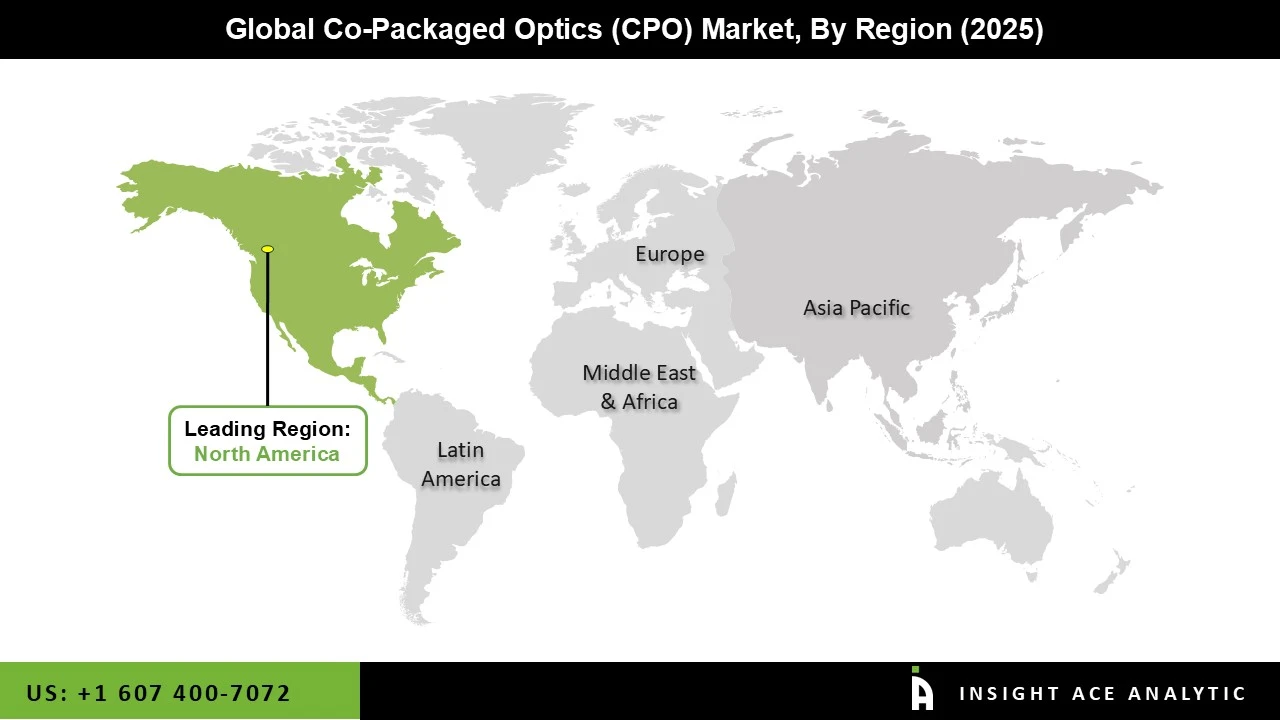
Why North America Led the Co-Packaged Optics (CPO) Market?
North America is expected to lead the co-packaged optics market, driven by the strong presence of hyperscale data center operators, leading semiconductor companies, and AI technology developers across the U.S. The demand for high bandwidth, low power optical interconnects is being driven by the massive investments that the major cloud service providers are making in AI infrastructure. The region is also well served by the presence of key players such as Broadcom, NVIDIA, Intel and Marvell Technology and the continued development of silicon photonics and advanced packaging is enabling the early commercialisation and uptake of co-packaged optics.
Key Development
October 2026: Celestica introduced the DS6005, a co-packaged optics (CPO) data center switch built on Broadcom's Tomahawk 6 switch chip, delivering up to 102.4 Tbps switching capacity. The system integrates optical engines with the switch ASIC and features liquid cooling and field-replaceable external laser modules to improve bandwidth density, power efficiency, and reliability in next-generation AI/ML scale-up and scale-out data center networks.
Co-Packaged Optics (CPO) Market Report Scope:
| Report Attribute | Specifications |
| Market size value in 2025 | USD XX Bn |
| Revenue forecast in 2035 | USD XX Bn |
| Growth Rate CAGR | CAGR of 38.0% from 2026 to 2035 |
| Quantitative Units | Representation of revenue in US$ Bn and CAGR from 2026 to 2035 |
| Historic Year | 2022 to 2025 |
| Forecast Year | 2026-2035 |
| Report Coverage | The forecast of revenue, the position of the company, the competitive market structure, growth prospects, and trends |
| Segments Covered | Interconnect Domain & Integration Target, Integration Architecture, Building Block / Offering, Application / End-Use, Route to Market / Channel and By Region |
| Regional Scope | North America; Europe; Asia Pacific; Latin America; Middle East & Africa |
| Country Scope | U.S.; Canada; U.K.; Germany; China; India; Japan; Brazil; Mexico; France; Italy; Spain; South Korea; Southeast Asia |
| Competitive Landscape | NVIDIA Corporation, Broadcom Inc., Marvell Technology, Inc., Intel Corporation, Coherent Corp., Lumentum Holdings Inc., Taiwan Semiconductor Manufacturing Company (TSMC), GlobalFoundries Inc., Tower Semiconductor Ltd., Ayar Labs, Inc. |
| Customization Scope | Free customization report with the procurement of the report, Modifications to the regional and segment scope. Geographic competitive landscape. |
| Pricing and Available Payment Methods | Explore pricing alternatives that are customized to your particular study requirements. |
Market Segmentation:
Co-Packaged Optics (CPO) Market by Interconnect Domain & Integration Target -
• Scale-Out – Switch-Integrated CPO
o Ethernet Switch CPO
o InfiniBand / Proprietary-Fabric Switch CPO
• Scale-Up – Accelerator / XPU Optical I/O
o Optical-I/O Chiplets (UCIe / Edge-of-Die)
o Photonic Fabric / Interposer (Any-to-Any On-Die)
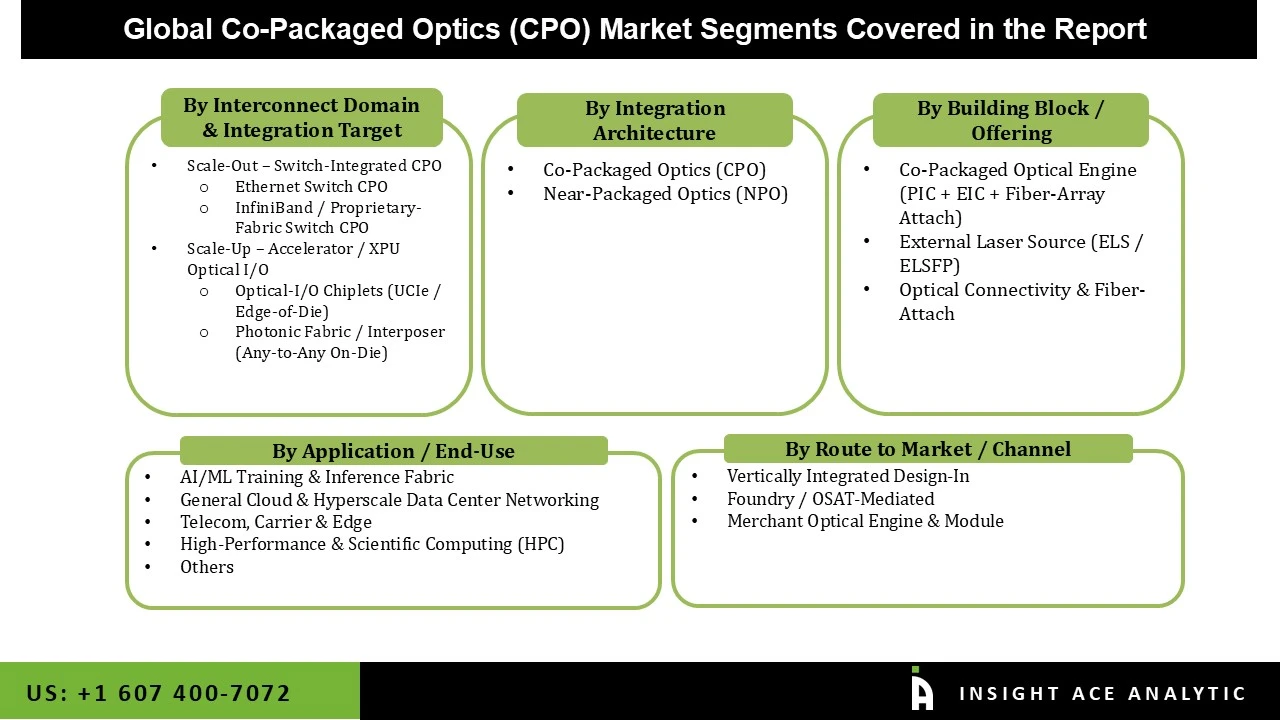
Co-Packaged Optics (CPO) Market by Integration Architecture -
• Co-Packaged Optics (CPO)
• Near-Packaged Optics (NPO)
Co-Packaged Optics (CPO) Market by Building Block / Offering -
• Co-Packaged Optical Engine (PIC + EIC + Fiber-Array Attach)
• External Laser Source (ELS / ELSFP)
• Optical Connectivity & Fiber-Attach
Co-Packaged Optics (CPO) Market by Application / End-Use -
• AI/ML Training & Inference Fabric
• General Cloud & Hyperscale Data Center Networking
• Telecom, Carrier & Edge
• High-Performance & Scientific Computing (HPC)
• Others
Co-Packaged Optics (CPO) Market by Route to Market / Channel -
• Vertically Integrated Design-In
• Foundry / OSAT-Mediated
• Merchant Optical Engine & Module
Co-Packaged Optics (CPO) Market by Region-
North America-
• The US
• Canada
• Mexico
Europe-
• Germany
• The UK
• France
• Italy
• Spain
• Rest of Europe
Asia-Pacific-
• China
• Japan
• India
• South Korea
• South East Asia
• Rest of Asia Pacific
Latin America-
• Brazil
• Argentina
• Rest of Latin America
Middle East & Africa-
• GCC Countries
• South Africa
• Rest of Middle East and Africa
Research Design and Approach
This study employed a multi-step, mixed-method research approach that integrates:
- Secondary research
- Primary research
- Data triangulation
- Hybrid top-down and bottom-up modelling
- Forecasting and scenario analysis
This approach ensures a balanced and validated understanding of both macro- and micro-level market factors influencing the market.
Secondary Research
Secondary research for this study involved the collection, review, and analysis of publicly available and paid data sources to build the initial fact base, understand historical market behaviour, identify data gaps, and refine the hypotheses for primary research.
Sources Consulted
Secondary data for the market study was gathered from multiple credible sources, including:
- Government databases, regulatory bodies, and public institutions
- International organizations (WHO, OECD, IMF, World Bank, etc.)
- Commercial and paid databases
- Industry associations, trade publications, and technical journals
- Company annual reports, investor presentations, press releases, and SEC filings
- Academic research papers, patents, and scientific literature
- Previous market research publications and syndicated reports
These sources were used to compile historical data, market volumes/prices, industry trends, technological developments, and competitive insights.

Primary Research
Primary research was conducted to validate secondary data, understand real-time market dynamics, capture price points and adoption trends, and verify the assumptions used in the market modelling.
Stakeholders Interviewed
Primary interviews for this study involved:
- Manufacturers and suppliers in the market value chain
- Distributors, channel partners, and integrators
- End-users / customers (e.g., hospitals, labs, enterprises, consumers, etc., depending on the market)
- Industry experts, technology specialists, consultants, and regulatory professionals
- Senior executives (CEOs, CTOs, VPs, Directors) and product managers
Interview Process
Interviews were conducted via:
- Structured and semi-structured questionnaires
- Telephonic and video interactions
- Email correspondences
- Expert consultation sessions
Primary insights were incorporated into demand modelling, pricing analysis, technology evaluation, and market share estimation.
Data Processing, Normalization, and Validation
All collected data were processed and normalized to ensure consistency and comparability across regions and time frames.
The data validation process included:
- Standardization of units (currency conversions, volume units, inflation adjustments)
- Cross-verification of data points across multiple secondary sources
- Normalization of inconsistent datasets
- Identification and resolution of data gaps
- Outlier detection and removal through algorithmic and manual checks
- Plausibility and coherence checks across segments and geographies
This ensured that the dataset used for modelling was clean, robust, and reliable.
Market Size Estimation and Data Triangulation
Bottom-Up Approach
The bottom-up approach involved aggregating segment-level data, such as:
- Company revenues
- Product-level sales
- Installed base/usage volumes
- Adoption and penetration rates
- Pricing analysis
This method was primarily used when detailed micro-level market data were available.
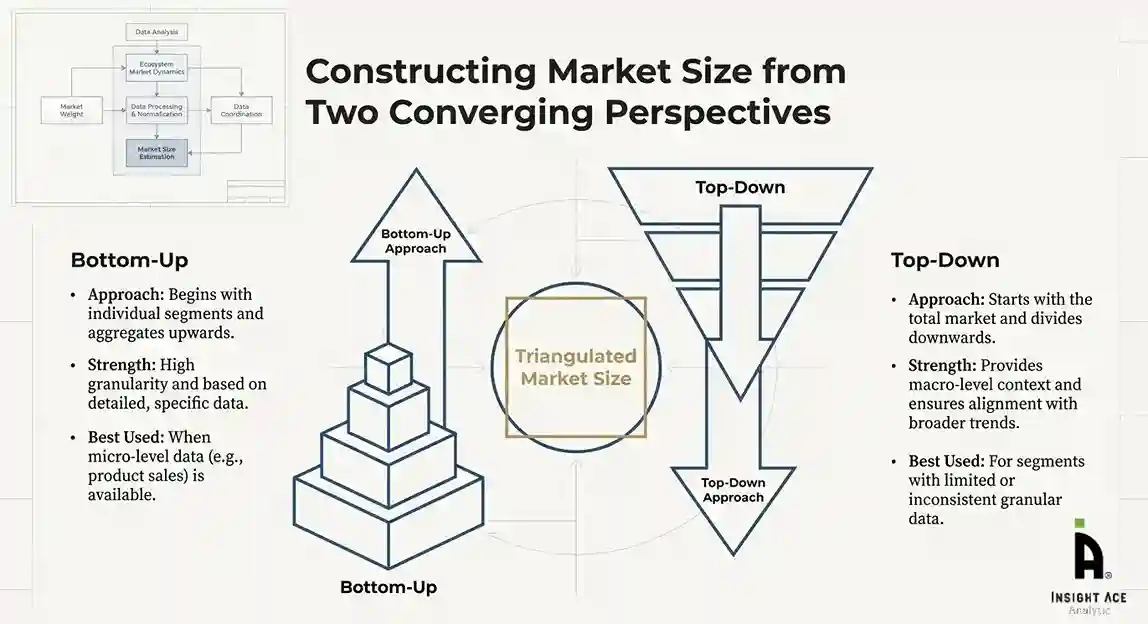
Top-Down Approach
The top-down approach used macro-level indicators:
- Parent market benchmarks
- Global/regional industry trends
- Economic indicators (GDP, demographics, spending patterns)
- Penetration and usage ratios
This approach was used for segments where granular data were limited or inconsistent.
Hybrid Triangulation Approach
To ensure accuracy, a triangulated hybrid model was used. This included:
- Reconciling top-down and bottom-up estimates
- Cross-checking revenues, volumes, and pricing assumptions
- Incorporating expert insights to validate segment splits and adoption rates
This multi-angle validation yielded the final market size.
Forecasting Framework and Scenario Modelling
Market forecasts were developed using a combination of time-series modelling, adoption curve analysis, and driver-based forecasting tools.
Forecasting Methods
- Time-series modelling
- S-curve and diffusion models (for emerging technologies)
- Driver-based forecasting (GDP, disposable income, adoption rates, regulatory changes)
- Price elasticity models
- Market maturity and lifecycle-based projections
Scenario Analysis
Given inherent uncertainties, three scenarios were constructed:
- Base-Case Scenario: Expected trajectory under current conditions
- Optimistic Scenario: High adoption, favourable regulation, strong economic tailwinds
- Conservative Scenario: Slow adoption, regulatory delays, economic constraints
Sensitivity testing was conducted on key variables, including pricing, demand elasticity, and regional adoption.
Request Customization
Add countries, segments, company profiles, or extend forecast — free 10% customization with purchase.
Customize This Report →Enquire Before Buying
Speak with our analyst team about scope, methodology, pricing, or deliverable formats.
Enquire Now →Frequently Asked Questions
Co Packaged Optics (CPO) Market is estimated to grow at a 38.0% CAGR during the forecast period for 2026 to 2035.
NVIDIA Corporation, Broadcom Inc., Marvell Technology, Inc., Intel Corporation, Coherent Corp., Lumentum Holdings Inc., Taiwan Semiconductor Manufacturing Company (TSMC), GlobalFoundries Inc., Tower Semiconductor Ltd., Ayar Labs, Inc.
Co Packaged Optics (CPO) Market is segmented into Interconnect Domain & Integration Target, Integration Architecture, Building Block / Offering, Application / End-Use, Route to Market / Channel and By Region
North America region is leading the Co Packaged Optics (CPO) Market.