Transgenic Animal Model Market Size, Share, Trend Report 2026 to 2035
Transgenic Animal Model Market Latest Overview:
What is Transgenic Animal Model Market Size?
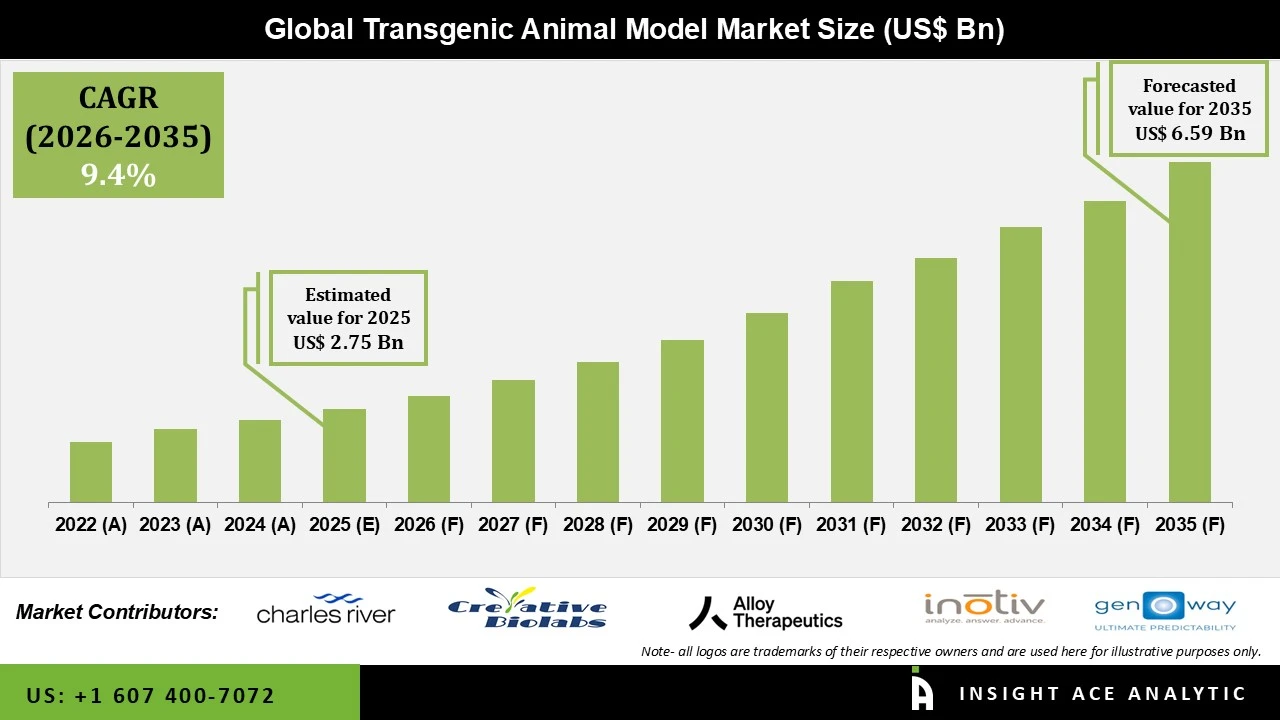
Transgenic Animal Model Market Size is valued at USD 2.75 Bn in 2025 and is predicted to reach USD 6.59 Bn by the year 2035 at a 9.4% CAGR during the forecast period for 2026 to 2035.
Transgenic Animal Model Market Size, Share & Trends Analysis by Animal Type (Rodent (Mice & Rats), Pigs, Rabbits, and Others), Technology (CRISPR/CAS-9, Embryonic Stem Cell Injections, Microinjections, and Others), Application (Drug Discovery and Development, Toxicology and Safety Testing, Gene Function Studies, Disease Research, and Others), End-user (Pharmaceutical & Biotechnology Companies, Contract Research Organizations (CROs), and Academic & Research Institutes), and Segment Forecasts, 2026 to 2035
An organism, usually a mouse or other laboratory animal, that has been genetically modified to carry and express foreign DNA (a transgene) inserted into its genome using methods of genetic engineering and biotechnology, is known as a transgenic animal model. These models are designed to investigate gene function, understand the molecular causes of disease, and assess novel medications or treatments in a controlled biological system that mimics real-world conditions. Scientists can find gene roles and disease causes, such as cancer, neurological disorders, and metabolic diseases, by inserting, deleting, or altering certain genes and observing the subsequent changes in physiology, development, or behavior. The transgenic animal model market is expanding significantly due to advances in genetic engineering and the growing demand for accurate preclinical testing.
The transgenic animal model market is currently undergoing significant evolution driven by advances in biotechnology and genetic engineering. Research, pharmaceuticals, and agriculture are just a few of the many uses that fall under this sector. The growing demand for genetically modified organisms, especially in livestock, points to a change toward increased disease resistance and productivity. Additionally, the creation of transgenic models for human diseases and the rising interest in customized medicine point to a bright future for the transgenic animal model market. The potential for innovation in the transgenic animal market seems to grow as legal frameworks change, encouraging cooperation between research and business. Furthermore, the development of transgenic animal models has been transformed by technological developments in genetic engineering, such as CRISPR/Cas9 and other gene-editing instruments, further driving market expansion.
In addition, ethical issues related to the use of transgenic animal models are gaining attention. Stakeholders are becoming more conscious of the need for ethical behavior and openness in genetic engineering. Stricter regulations and standards may be established as a result of this awareness, potentially affecting the dynamics of the transgenic animal model market. Moreover, the expansion of the transgenic animal model market has also been greatly aided by financing programs and regulatory support from both public and private entities. Many nations have enacted laws that support biotechnology and life sciences research and innovation. Furthermore, public and commercial investments in translational research have increased the demand for transgenic animal models across a variety of application areas, driven by the growing prevalence of chronic diseases and the pressing need for efficient treatment interventions.
Competitive Landscape
Which are the Leading Players in Transgenic Animal Model Market?
• Charles River Laboratories International, Inc.
• Biocytogen Pharmaceuticals (Beijing) Co., Ltd.
• Sigma-Aldrich Co. (Merck Group)
• Ingenious Targeting Laboratory
• OmniAb, Inc.
• Creative Biolabs
• Alloy Therapeutics, Inc.
• Inotiv
• Taconic Biosciences
• HuidaGene
• genOway
• Janvier Group (Janvier Labs)
Market Dynamics
Driver
Increasing Demand for Predictive Preclinical Models in Drug Discovery
The growing need for accurate and predictive preclinical models in drug discovery and development is one of the main drivers of the transgenic animal model market. Transgenic animal models have become essential for assessing therapeutic efficacy and safety profiles as pharmaceutical and biotechnology companies work to lower late-stage drug failures and accelerate time-to-market. These models, especially transgenic mice and rats, allow scientists to accurately replicate human disease pathways, improving the results of translational research. Additionally, the development of precise genetic changes has become easier with the growing use of CRISPR and other genome-editing technologies, making transgenic models more affordable and accessible for a wider range of research organizations. Furthermore, new opportunities for market expansion are provided by the growing use of transgenic models in cutting-edge disciplines like gene therapy, immuno-oncology, and regenerative medicine.
Restrain/Challenge
Strict Ethical Laws and Increased Public Attention Over Animal Welfare
The growth of the global transgenic animal model market is significantly hampered by strict ethical laws and increased public attention over animal welfare. Globally, regulatory frameworks are imposing ever-tougher requirements on firms, requiring them to go through thorough ethical evaluations and show that they strictly adhere to the replacement, reduction, and refinement principles. These compliance requirements require a large investment in oversight and paperwork, which greatly increases operational costs and lengthens development timetables. As a result, this setting opposes the growth of animal-based research and encourages the use of alternative, non-animal techniques. Additionally, stricter rules and supervision procedures controlling the production, usage, and disposal of transgenic animals have been put in place as a result of the growing scrutiny from animal welfare groups and regulatory bodies. This will limit the transgenic animal model market expansion over the forecast period.
Rodent Segment is Expected to Drive the Transgenic Animal Model Market
The rodent category held the largest share in the Transgenic Animal Model market in 2025 because it has a broad range of applications in biomedical research. Rodents are favored over larger animals due to their cost-effectiveness, short reproductive cycles, simplicity of genetic manipulation, and genetic closeness to humans. The development of transgenic rodent models has been hastened by the availability of well-characterized inbred strains and the quick development of gene-editing technologies such as CRISPR/Cas9. These models are essential in drug development and toxicological investigations because they are widely utilized in the study of cancer, neurological disorders, metabolic diseases, and immunological problems. The increase of pharmaceutical R&D activities and rising funding for life sciences research are also contributing to the growth of the rodent category in this market.
Drug Discovery and Development Segment is Growing at the Highest Rate in the Transgenic Animal Model Market
In 2025, the drug discovery and development category dominated the Transgenic Animal Model market because preclinical testing technologies that are effective, dependable, and predictive are becoming more and more necessary. In order to determine and validate pharmacological targets, comprehend disease pathways, and assess the safety and effectiveness of novel therapeutic molecules prior to clinical trials, transgenic animal models are essential. Pharmaceutical and biotechnology businesses are increasingly depending on genetically modified models to speed up the medication development process due to the growing prevalence of complicated and chronic diseases like cancer, Alzheimer's disease, and cardiovascular ailments. Furthermore, the accuracy of preclinical results has improved due to the quick development of highly specialized disease models made possible by developments in gene-editing technologies, including CRISPR/Cas9 and other genome engineering techniques.
Why North America Led the Transgenic Animal Model Market?
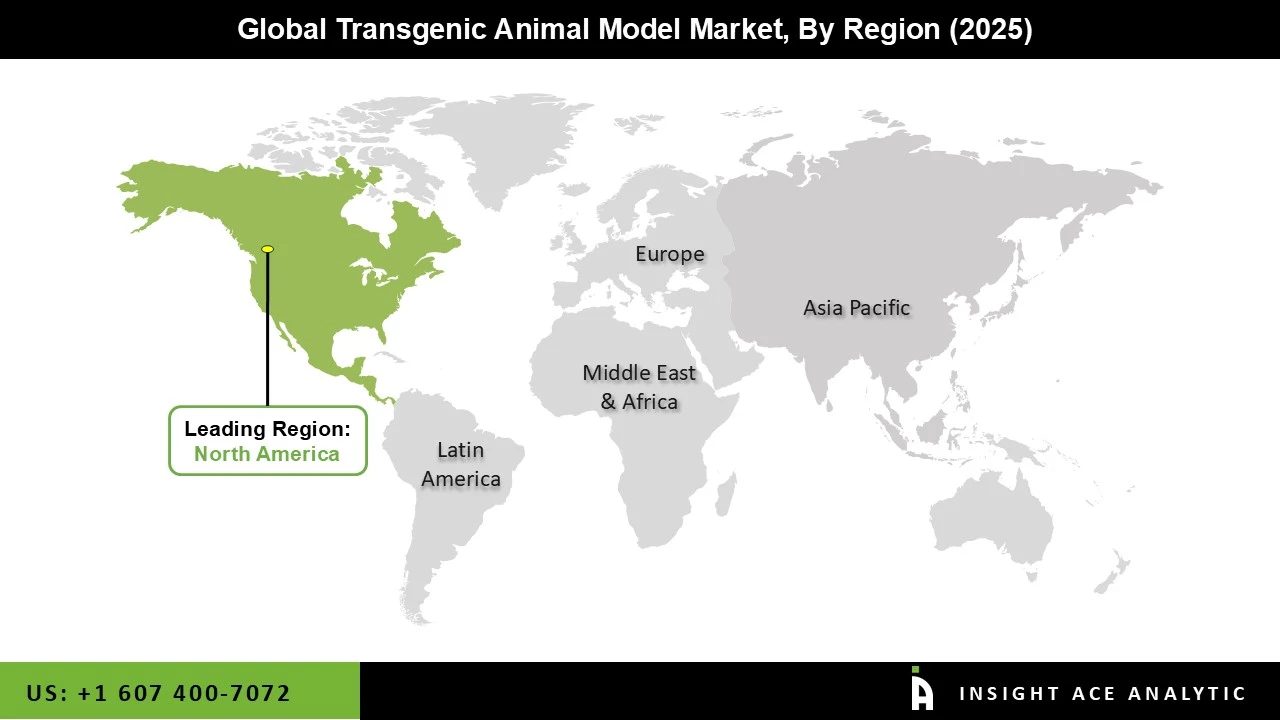
The Transgenic Animal Model market was dominated by North America region in 2025. The existence of top pharmaceutical and biotechnology firms, cutting-edge research facilities, and robust government backing for life sciences research are all credited with this leadership. Particularly in the United States, there are many research and academic institutions, as well as a thriving network of CROs and businesses with expertise in animal modeling and genetic engineering. North America is becoming the center of innovation in the transgenic animal models industry due to favorable regulatory frameworks and significant R&D investments. Additionally, a favorable regulatory environment and significant government support for biomedical research have stimulated innovation and advanced the use of transgenic animal models. These factors are anticipated to boost the transgenic animal model market expansion over the forecast period.
Key Development
September 2025: AlivaMab Mouse has been validated and made available by Ablexis, a U.S.-based biotechnology business that specializes in antibody discovery. For the purpose of finding fully human antibodies, the platform broadens its portfolio of transgenic mice. According to Ablexis, transgenic animal models facilitate enhanced antibody quality and quicker pharmaceutical development.
June 2025: To increase the range of gene-editing services it offers, Taconic Biosciences signed an exclusive license deal with Helmholtz Munich, a preeminent biomedical research facility. Through this strategic alliance, the company was given permission to use cutting-edge CRISPR/Cas9 technology created by the institution and tailored for the accurate production of genetically altered animal models. The company sought to speed up the creation of intricate transgenic rodent models by incorporating these state-of-the-art techniques into its current ExpressMODEL platform.
December 2024: Oxitec Australia was established in collaboration with Oxitec, a biological pest management company based in the United Kingdom, and CSIRO, Australia's national science organization. The program controls disease-carrying Aedes species by using transgenic animal mosquito technology. Male mosquitoes that have undergone genetic engineering lower female populations without biting people. The show focuses on the threats posed by Zika and dengue on Australia's mainland.
Transgenic Animal Model Market Report Scope:
| Report Attribute | Specifications |
| Market size value in 2025 | USD 2.75 Bn |
| Revenue forecast in 2035 | USD 6.59 Bn |
| Growth Rate CAGR | CAGR of 9.4% from 2026 to 2035 |
| Quantitative Units | Representation of revenue in US$ Bn and CAGR from 2026 to 2035 |
| Historic Year | 2022 to 2025 |
| Forecast Year | 2026-2035 |
| Report Coverage | The forecast of revenue, the position of the company, the competitive market structure, growth prospects, and trends |
| Segments Covered | Animal Type, Technology, Application, End-user, Distribution Channel, and By Region |
| Regional Scope | North America; Europe; Asia Pacific; Latin America; Middle East & Africa |
| Country Scope | U.S.; Canada; U.K.; Germany; China; India; Japan; Brazil; Mexico; The UK; France; Italy; Spain; China; Japan; India; South Korea; Southeast Asia; South Korea; Southeast Asia |
| Competitive Landscape | Charles River Laboratories International, Inc., Biocytogen Pharmaceuticals (Beijing) Co., Ltd., Sigma-Aldrich Co. (Merck Group), Ingenious Targeting Laboratory, OmniAb, Inc., Creative Biolabs, Alloy Therapeutics, Inc., Inotiv, Taconic Biosciences, HuidaGene, genOway, and Janvier Group (Janvier Labs). |
| Customization Scope | Free customization report with the procurement of the report, Modifications to the regional and segment scope. Geographic competitive landscape. |
| Pricing and Available Payment Methods | Explore pricing alternatives that are customized to your particular study requirements. |
Transgenic Animal Model Market Segmentation:
Transgenic Animal Model Market by Animal Type-
• Rodent (Mice & Rats)
• Pigs
• Rabbits
• Others
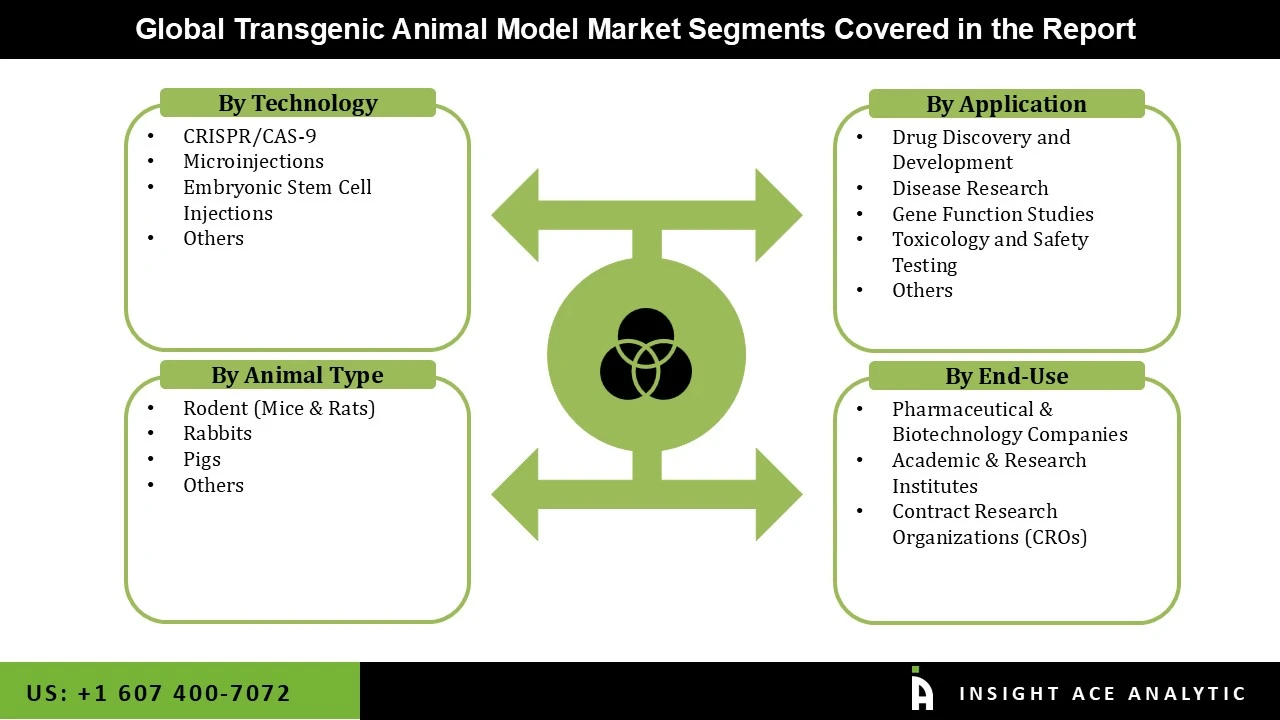
Transgenic Animal Model Market by Technology-
• CRISPR/CAS-9
• Embryonic Stem Cell Injections
• Microinjections
• Others
Transgenic Animal Model Market by Application-
• Drug Discovery and Development
• Toxicology and Safety Testing
• Gene Function Studies
• Disease Research
• Others
Transgenic Animal Model Market by End-user-
• Pharmaceutical & Biotechnology Companies
• Contract Research Organizations (CROs)
• Academic & Research Institutes
Transgenic Animal Model Market by Region
North America-
• The US
• Canada
Europe-
• Germany
• The UK
• France
• Italy
• Spain
• Rest of Europe
Asia-Pacific-
• China
• Japan
• India
• South Korea
• South East Asia
• Rest of Asia Pacific
Latin America-
• Brazil
• Mexico
• Argentina
• Rest of Latin America
Middle East & Africa-
• GCC Countries
• South Africa
• Rest of Middle East and Africa
Research Design and Approach
This study employed a multi-step, mixed-method research approach that integrates:
- Secondary research
- Primary research
- Data triangulation
- Hybrid top-down and bottom-up modelling
- Forecasting and scenario analysis
This approach ensures a balanced and validated understanding of both macro- and micro-level market factors influencing the market.
Secondary Research
Secondary research for this study involved the collection, review, and analysis of publicly available and paid data sources to build the initial fact base, understand historical market behaviour, identify data gaps, and refine the hypotheses for primary research.
Sources Consulted
Secondary data for the market study was gathered from multiple credible sources, including:
- Government databases, regulatory bodies, and public institutions
- International organizations (WHO, OECD, IMF, World Bank, etc.)
- Commercial and paid databases
- Industry associations, trade publications, and technical journals
- Company annual reports, investor presentations, press releases, and SEC filings
- Academic research papers, patents, and scientific literature
- Previous market research publications and syndicated reports
These sources were used to compile historical data, market volumes/prices, industry trends, technological developments, and competitive insights.

Primary Research
Primary research was conducted to validate secondary data, understand real-time market dynamics, capture price points and adoption trends, and verify the assumptions used in the market modelling.
Stakeholders Interviewed
Primary interviews for this study involved:
- Manufacturers and suppliers in the market value chain
- Distributors, channel partners, and integrators
- End-users / customers (e.g., hospitals, labs, enterprises, consumers, etc., depending on the market)
- Industry experts, technology specialists, consultants, and regulatory professionals
- Senior executives (CEOs, CTOs, VPs, Directors) and product managers
Interview Process
Interviews were conducted via:
- Structured and semi-structured questionnaires
- Telephonic and video interactions
- Email correspondences
- Expert consultation sessions
Primary insights were incorporated into demand modelling, pricing analysis, technology evaluation, and market share estimation.
Data Processing, Normalization, and Validation
All collected data were processed and normalized to ensure consistency and comparability across regions and time frames.
The data validation process included:
- Standardization of units (currency conversions, volume units, inflation adjustments)
- Cross-verification of data points across multiple secondary sources
- Normalization of inconsistent datasets
- Identification and resolution of data gaps
- Outlier detection and removal through algorithmic and manual checks
- Plausibility and coherence checks across segments and geographies
This ensured that the dataset used for modelling was clean, robust, and reliable.
Market Size Estimation and Data Triangulation
Bottom-Up Approach
The bottom-up approach involved aggregating segment-level data, such as:
- Company revenues
- Product-level sales
- Installed base/usage volumes
- Adoption and penetration rates
- Pricing analysis
This method was primarily used when detailed micro-level market data were available.

Top-Down Approach
The top-down approach used macro-level indicators:
- Parent market benchmarks
- Global/regional industry trends
- Economic indicators (GDP, demographics, spending patterns)
- Penetration and usage ratios
This approach was used for segments where granular data were limited or inconsistent.
Hybrid Triangulation Approach
To ensure accuracy, a triangulated hybrid model was used. This included:
- Reconciling top-down and bottom-up estimates
- Cross-checking revenues, volumes, and pricing assumptions
- Incorporating expert insights to validate segment splits and adoption rates
This multi-angle validation yielded the final market size.
Forecasting Framework and Scenario Modelling
Market forecasts were developed using a combination of time-series modelling, adoption curve analysis, and driver-based forecasting tools.
Forecasting Methods
- Time-series modelling
- S-curve and diffusion models (for emerging technologies)
- Driver-based forecasting (GDP, disposable income, adoption rates, regulatory changes)
- Price elasticity models
- Market maturity and lifecycle-based projections
Scenario Analysis
Given inherent uncertainties, three scenarios were constructed:
- Base-Case Scenario: Expected trajectory under current conditions
- Optimistic Scenario: High adoption, favourable regulation, strong economic tailwinds
- Conservative Scenario: Slow adoption, regulatory delays, economic constraints
Sensitivity testing was conducted on key variables, including pricing, demand elasticity, and regional adoption.
Request Customization
Add countries, segments, company profiles, or extend forecast — free 10% customization with purchase.
Customize This Report →Enquire Before Buying
Speak with our analyst team about scope, methodology, pricing, or deliverable formats.
Enquire Now →Frequently Asked Questions
Transgenic Animal Model Market Size is valued at USD 2.75 Bn in 2025 and is predicted to reach USD 6.59 Bn by the year 2035
Transgenic Animal Model Market is expected to grow at a 9.4% CAGR during the forecast period for 2026 to 2035.
Charles River Laboratories International, Inc., Biocytogen Pharmaceuticals (Beijing) Co., Ltd., Sigma-Aldrich Co. (Merck Group), Ingenious Targeting Laboratory, OmniAb, Inc., Creative Biolabs, Alloy Therapeutics, Inc., Inotiv, Taconic Biosciences, HuidaGene, genOway, and Janvier Group (Janvier Labs).
Transgenic Animal Model Market is segmented into Animal Type, Technology, Application, End-user, Distribution Channel, and By Region
North America region is leading the Transgenic Animal Model Market.