Topical Drug Delivery Market Size, Share & Trends Analysis Report By Type (Semi-solids (Creams, Gels, Lotions), Solids (Suppositories), Liquids (Solutions), Transdermal Products), Route (Dermal, Ophthalmic), Facility of Use (Homecare setting, Hospitals, Burn Centres), Region And Segment Forecasts, 2023-2031
Topical Drug Delivery Market Size is valued at USD 208.25 billion in 2022 and is predicted to reach USD 418.70 billion by the year 2031 at a 8.1% CAGR during the forecast period for 2023-2031.
Key Industry Insights & Findings from the Report:
- The main reasons driving this market's growth are the rising rates of minor illnesses like acne and psoriasis as well as skin diseases like eczema.
- Transdermal delivery of biologics is one of the newest trends in the topical medication delivery sector. Big molecules can be delivered transdermal with significant patient benefits, including painless medicine administration and economical care.
- North America dominated the market and accounted for a global revenue share in 2023.
- The topical medicine delivery market is expected to face challenges from technical obstacles related to skin permeability and irritation.
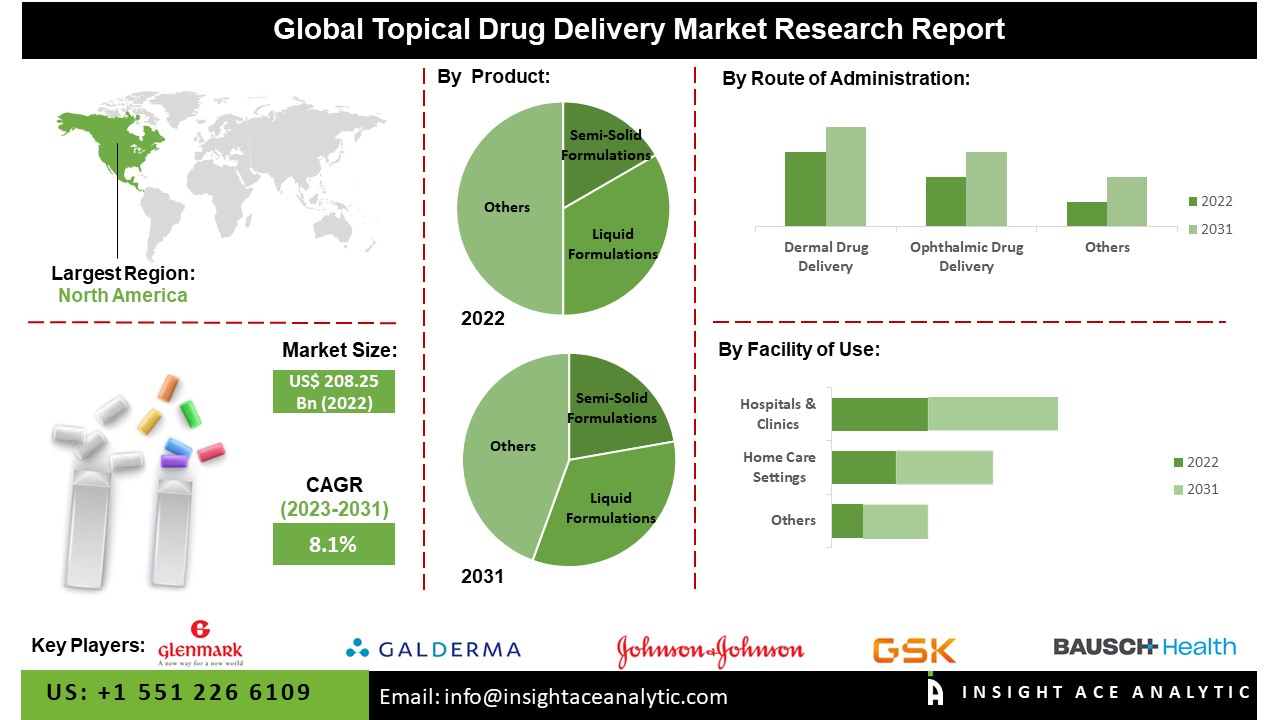
The application of drugs or therapeutic agents directly to the skin or mucous membranes for the targeted treatment of various medical problems is referred to as topical drug delivery. The increased incidence of skin conditions including psoriasis and eczema, as well as minor ailments like acne, are the main drivers of this market's expansion. Additionally, it is anticipated that the rising usage of medications to treat diabetic neuropathic pain and foot ulcers, as well as the rising occurrences of burn injuries, diabetes prevalence, and eye illnesses, would all contribute to the market growth. Moreover, the transdermal patch, a non-invasive method of drug delivery, has seen a rise in popularity and widespread use in the market.
The entire market is expected to develop as a result of this adoption pattern. The primary market driver is also believed to be the tendency towards self-care or self-treatment at the point of care.
However, lockdowns, travel restrictions, and other issues caused interruptions in the pharmaceutical supply chain. The pandemic caused numerous clinical trials for innovative medicine formulations or delivery technologies to be postponed or interrupted. This might have delayed the release of ground-breaking topical products.
Competitive Landscape
Some of the Topical Drug Delivery Market players are:
- 3M (US)
- AbbVie Inc. (US)
- Bausch Health Companies Inc. (Canada)
- Bayer AG (Germany)
- Boehringer Ingelheim International GmBH (Germany)
- Bristol Myers Squibb (US)
- Cipla (India)
- CMP Pharma, Inc. (Germany)
- Crescita Therpeautics Inc. (Canada)
- Encore Dermatology, Inc. (US)
- Galderma (Switzerland)
- GlaxoSmithKline Plc. (UK)
- Glenmark Pharmaceuticals Ltd. (India)
- Hisamitsu Pharmaceuticals Inc. (Japan)
- Johnson & Johnson Private Limited (US)
- Lavipharm (Greece)
- Lead Chemical Co., Ltd. (Japan)
- Merck & Co. Inc.. (Germany)
- Novartis International AG (Switzerland)
- Pfizer Inc. (US)
- Prosolus Inc. (US)
- Purdue Pharma L.P. (US)
- Rusan Pharma Ltd. (India)
- Teva Pharmaceuticals Industries Ltd. (Israel)
- Viatris Inc. (Mylan N.V.) (US)
Market Segmentation:
The Topical Drug Delivery Market is categorized based on product, route of administration, and facility of use. The product category comprises semi-solid, solid, liquid, and transdermal products. The semi-solid formulations segment includes creams, ointments, lotions, gels, and pastes. By liquid formulations, the market is segmented into suspensions and solutions.
The solid formulations segment includes powders and suppositories. By liquid formulations, the market is segmented into suspensions and solutions. Based on transdermal products, the market is segmented as transdermal patches and transdermal semi-solids. Route of administration, the market category comprises ophthalmic drug delivery, rectal drug delivery, dermal drug delivery, vaginal drug delivery, and nasal drug delivery. Facility of use category includes homecare settings, hospitals clinics, burn centers, and other facilities.
Based On Product, The Semi-Solid Formulations Segment Is Accounted As A Major Contributor In The Topical Drug Delivery Market.
The semi-solid formulations category is expected to hold a significant share of the global Topical Drug Delivery Market in 2022. The semi-solid medication segment will develop the fastest and be the largest market during the projection period due to reasons such as the ease of application of semi-solid medications and their capacity to deliver a broad variety of therapeutic molecules. Semi-solid formulations are practical for patients because they are simple to spread and apply to the skin. Higher patient acceptance and compliance are a result of their non-invasiveness and comfortable application.
The Burn Centers Segment Witnessed Growth At A Rapid Rate
The burn centers segment is projected to grow at a rapid rate in the global Topical Drug Delivery Market. The rise in the number of burn care facilities is due to the much higher risk of mortality and morbidity that are related to burn patients. For deep second- and third-degree burns, topical treatments include silver sulfadiazine cream, nanocrystalline silver dressings, mafenide acetate cream, and hypochlorous antiseptic solutions, which are recommended in burn centers. Therefore, the market offers prospects for growth as a result of the rise in burn care facilities.
In The Region, The North America Topical Drug Delivery Market Holds A Significant Revenue Share.
The North America Topical Drug Delivery Market is expected to register the highest market share in terms of revenue in the near future. This is mainly due to rising demand for self-administered medications, greater preference for painless drug delivery, and the development of skin conditions. Moreover, the region's dominance is mostly due to the high frequency of skin illnesses and rising spending on topical dermatological products. However, during the forecast period, Asia-Pacific is anticipated to experience a significant growth rate. The Asia-Pacific topical medication delivery market has grown owing to the rising demand from developing nations like China and India, as well as an increase in the number of people with skin diseases.
Recent Developments:
- In December 2023, Bausch Health, LAVAL, QC, The company's innovative topical prescription medication, DUOBRIITM (0.01% w/w halobetasol propionate and 0.045% w/w tazarotene), is now available to patients enrolled in Quebec's public drug plan administered by the Régie de l'assurance maladie du Québec (RAMQ). This medication is intended to help adult patients with moderate to chronic plaque psoriasis by reducing their symptoms. A branch of Bausch Health Companies Inc., Bausch Health, Canada made this announcement.
Topical Drug Delivery Market Report Scope
| Report Attribute | Specifications |
| Market Size Value In 2022 | USD 208.25 Bn |
| Revenue Forecast In 2031 | USD 418.70 Bn |
| Growth Rate CAGR | CAGR of 8.1% from 2023 to 2031 |
| Quantitative Units | Representation of revenue in US$ Bn and CAGR from 2023 to 2031 |
| Historic Year | 2019 to 2022 |
| Forecast Year | 2023-2031 |
| Report Coverage | The forecast of revenue, the position of the company, the competitive market structure, growth prospects, and trends |
| Segments Covered | By Product, Route Of Administration, And Facility Of Use |
| Regional Scope | North America; Europe; Asia Pacific; Latin America; Middle East & Africa |
| Country Scope | U.S.; Canada; U.K.; Germany; China; India; Japan; Brazil; Mexico; The UK; France; Italy; Spain; China; Japan; India; South Korea; Southeast Asia; South Korea; South East Asia |
| Competitive Landscape | Galderma (Switzerland), Johnson & Johnson Private Limited (US), GlaxoSmithKline Plc. (UK), Glenmark Pharmaceuticals Ltd. (India), Rusan Pharma Ltd. (India), Bausch Health Companies Inc. (Canada), Hisamitsu Pharmaceuticals Inc. (Japan), Cipla (India), Bayer AG (Germany), Viatris Inc. (Mylan N.V.) (US), 3M (US), Merck & Co.Inc.. (Germany), Crescita Therpeautics Inc. (Canada), Novartis International AG (Switzerland), Boehringer Ingelheim International GmBH (Germany), Pfizer Inc. (US), Teva Pharmaceuticals Industries Ltd. (Israel), Bristol Myers Squibb (US), Lavipharm (Greece), AbbVie Inc. (US), CMP Pharma, Inc. (Germany), Encore Dermatology, Inc. (US), Prosolus Inc. (US), Lead Chemical Co., Ltd. (Japan), and Purdue Pharma L.P. (US). |
| Customization Scope | Free customization report with the procurement of the report, Modifications to the regional and segment scope. Particular Geographic competitive landscape. |
| Pricing And Available Payment Methods | Explore pricing alternatives that are customized to your particular study requirements. |
Segmentation of Topical Drug Delivery Market-
By Product-
- Semi-Solid Formulations
- Creams
- Ointments
- Lotions
- Gel
- Pastes
- Liquid Formulations
- Suspensions
- Solutions
- Solid Formulations
- Powders
- Suppositories
- Transdermal Products
- Transdermal Patches
- Transdermal Semi-Solids
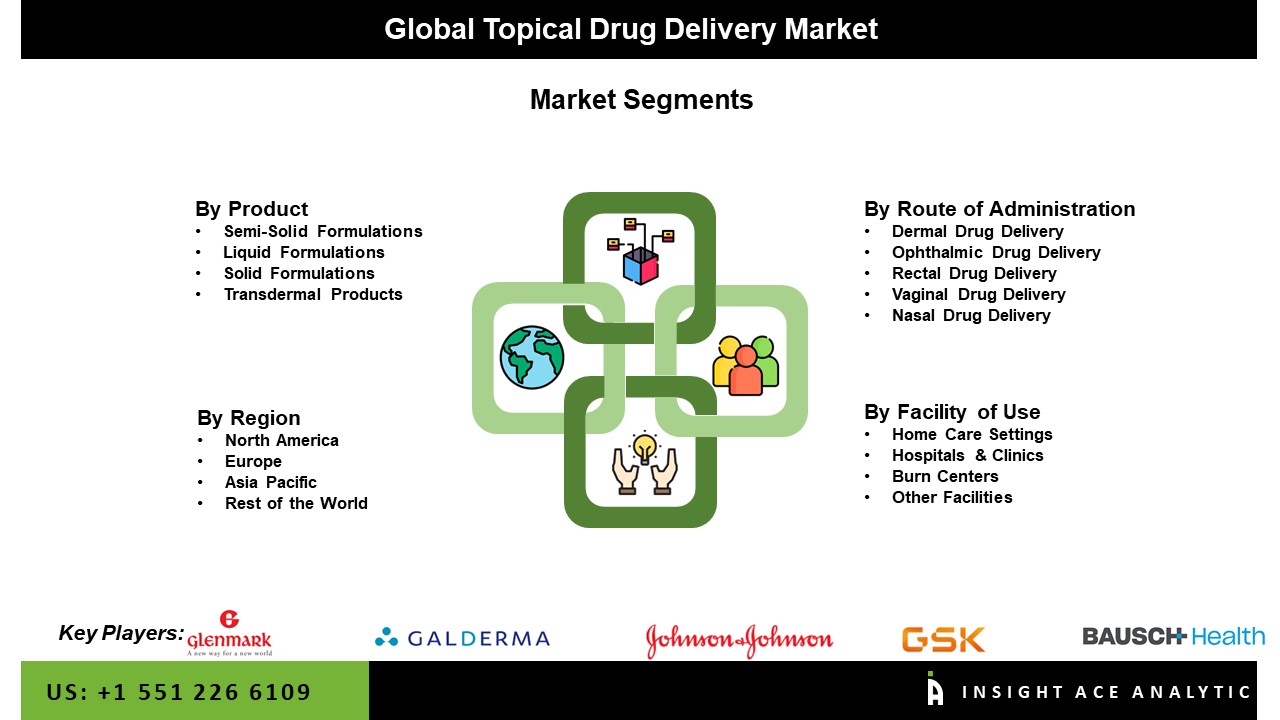
By Route of Administration-
- Dermal Drug Delivery
- Ophthalmic Drug Delivery
- Rectal Drug Delivery
- Vaginal Drug Delivery
- Nasal Drug Delivery
By Facility of Use-
- Homecare Settings
- Hospitals & Clinics
- Burn Centers
- Other Facilities
By Region-
North America-
- The US
- Canada
- Mexico
Europe-
- Germany
- The UK
- France
- Italy
- Spain
- Rest of Europe
Asia-Pacific-
- China
- Japan
- India
- South Korea
- Southeast Asia
- Rest of Asia Pacific
Latin America-
- Brazil
- Argentina
- Rest of Latin America
Middle East & Africa-
- GCC Countries
- South Africa
- Rest of Middle East and Africa
Research Design and Approach
This study employed a multi-step, mixed-method research approach that integrates:
- Secondary research
- Primary research
- Data triangulation
- Hybrid top-down and bottom-up modelling
- Forecasting and scenario analysis
This approach ensures a balanced and validated understanding of both macro- and micro-level market factors influencing the market.
Secondary Research
Secondary research for this study involved the collection, review, and analysis of publicly available and paid data sources to build the initial fact base, understand historical market behaviour, identify data gaps, and refine the hypotheses for primary research.
Sources Consulted
Secondary data for the market study was gathered from multiple credible sources, including:
- Government databases, regulatory bodies, and public institutions
- International organizations (WHO, OECD, IMF, World Bank, etc.)
- Commercial and paid databases
- Industry associations, trade publications, and technical journals
- Company annual reports, investor presentations, press releases, and SEC filings
- Academic research papers, patents, and scientific literature
- Previous market research publications and syndicated reports
These sources were used to compile historical data, market volumes/prices, industry trends, technological developments, and competitive insights.

Primary Research
Primary research was conducted to validate secondary data, understand real-time market dynamics, capture price points and adoption trends, and verify the assumptions used in the market modelling.
Stakeholders Interviewed
Primary interviews for this study involved:
- Manufacturers and suppliers in the market value chain
- Distributors, channel partners, and integrators
- End-users / customers (e.g., hospitals, labs, enterprises, consumers, etc., depending on the market)
- Industry experts, technology specialists, consultants, and regulatory professionals
- Senior executives (CEOs, CTOs, VPs, Directors) and product managers
Interview Process
Interviews were conducted via:
- Structured and semi-structured questionnaires
- Telephonic and video interactions
- Email correspondences
- Expert consultation sessions
Primary insights were incorporated into demand modelling, pricing analysis, technology evaluation, and market share estimation.
Data Processing, Normalization, and Validation
All collected data were processed and normalized to ensure consistency and comparability across regions and time frames.
The data validation process included:
- Standardization of units (currency conversions, volume units, inflation adjustments)
- Cross-verification of data points across multiple secondary sources
- Normalization of inconsistent datasets
- Identification and resolution of data gaps
- Outlier detection and removal through algorithmic and manual checks
- Plausibility and coherence checks across segments and geographies
This ensured that the dataset used for modelling was clean, robust, and reliable.
Market Size Estimation and Data Triangulation
Bottom-Up Approach
The bottom-up approach involved aggregating segment-level data, such as:
- Company revenues
- Product-level sales
- Installed base/usage volumes
- Adoption and penetration rates
- Pricing analysis
This method was primarily used when detailed micro-level market data were available.

Top-Down Approach
The top-down approach used macro-level indicators:
- Parent market benchmarks
- Global/regional industry trends
- Economic indicators (GDP, demographics, spending patterns)
- Penetration and usage ratios
This approach was used for segments where granular data were limited or inconsistent.
Hybrid Triangulation Approach
To ensure accuracy, a triangulated hybrid model was used. This included:
- Reconciling top-down and bottom-up estimates
- Cross-checking revenues, volumes, and pricing assumptions
- Incorporating expert insights to validate segment splits and adoption rates
This multi-angle validation yielded the final market size.
Forecasting Framework and Scenario Modelling
Market forecasts were developed using a combination of time-series modelling, adoption curve analysis, and driver-based forecasting tools.
Forecasting Methods
- Time-series modelling
- S-curve and diffusion models (for emerging technologies)
- Driver-based forecasting (GDP, disposable income, adoption rates, regulatory changes)
- Price elasticity models
- Market maturity and lifecycle-based projections
Scenario Analysis
Given inherent uncertainties, three scenarios were constructed:
- Base-Case Scenario: Expected trajectory under current conditions
- Optimistic Scenario: High adoption, favourable regulation, strong economic tailwinds
- Conservative Scenario: Slow adoption, regulatory delays, economic constraints
Sensitivity testing was conducted on key variables, including pricing, demand elasticity, and regional adoption.
Request Customization
Add countries, segments, company profiles, or extend forecast — free 10% customization with purchase.
Customize This Report →Enquire Before Buying
Speak with our analyst team about scope, methodology, pricing, or deliverable formats.
Enquire Now →Frequently Asked Questions
Topical Drug Delivery Market Size is valued at USD 208.25 billion in 2022 and is predicted to reach USD 418.70 billion by the year 2031
Topical Drug Delivery Market is expected to grow at a 8.1% CAGR during the forecast period for 2023-2031.
Teva Pharmaceuticals Industries Ltd. (Israel), Bristol Myers Squibb (US), Lavipharm (Greece), AbbVie Inc. (US), CMP Pharma, Inc. (Germany), Encore Der