Solar Tracker Installation Market Current Trends Analysis 2026 to 2035
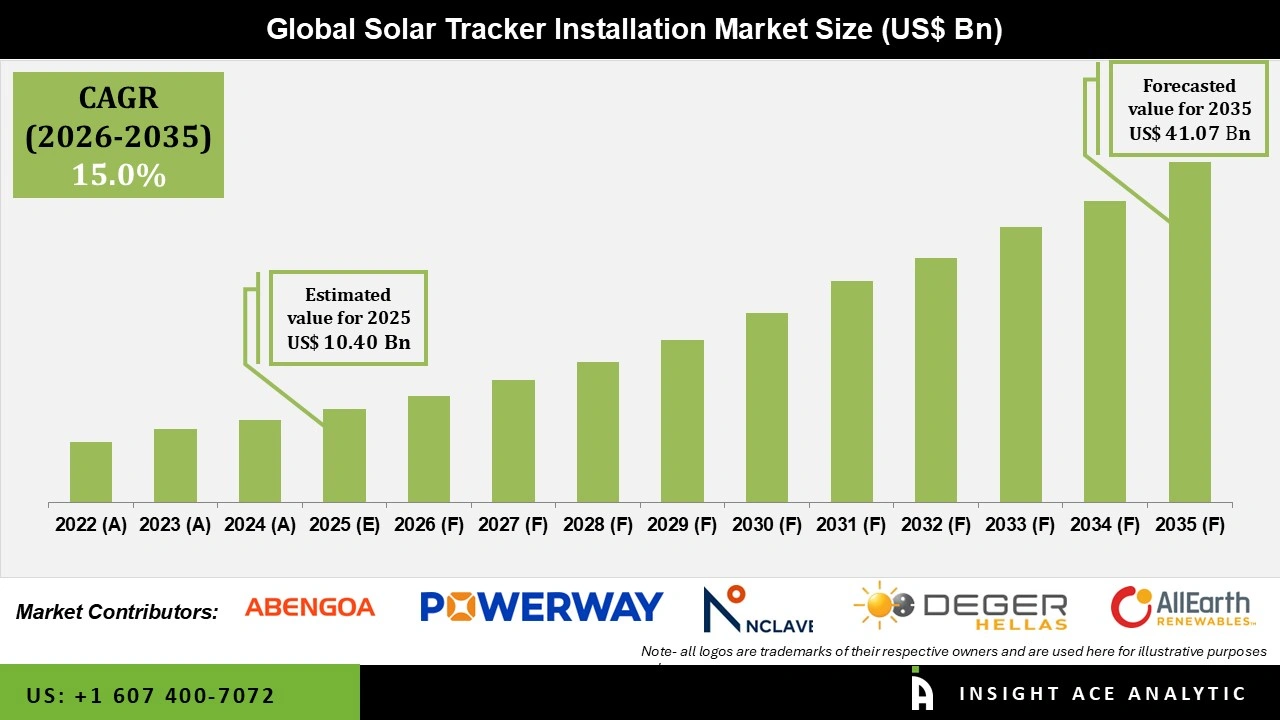
Global Solar Tracker Installation Market Size is valued at USD 10.40 Bn in 2025 and is predicted to reach USD 41.07 Bn by the year 2035 at a 15.0% CAGR during the forecast period for 2026 to 2035.
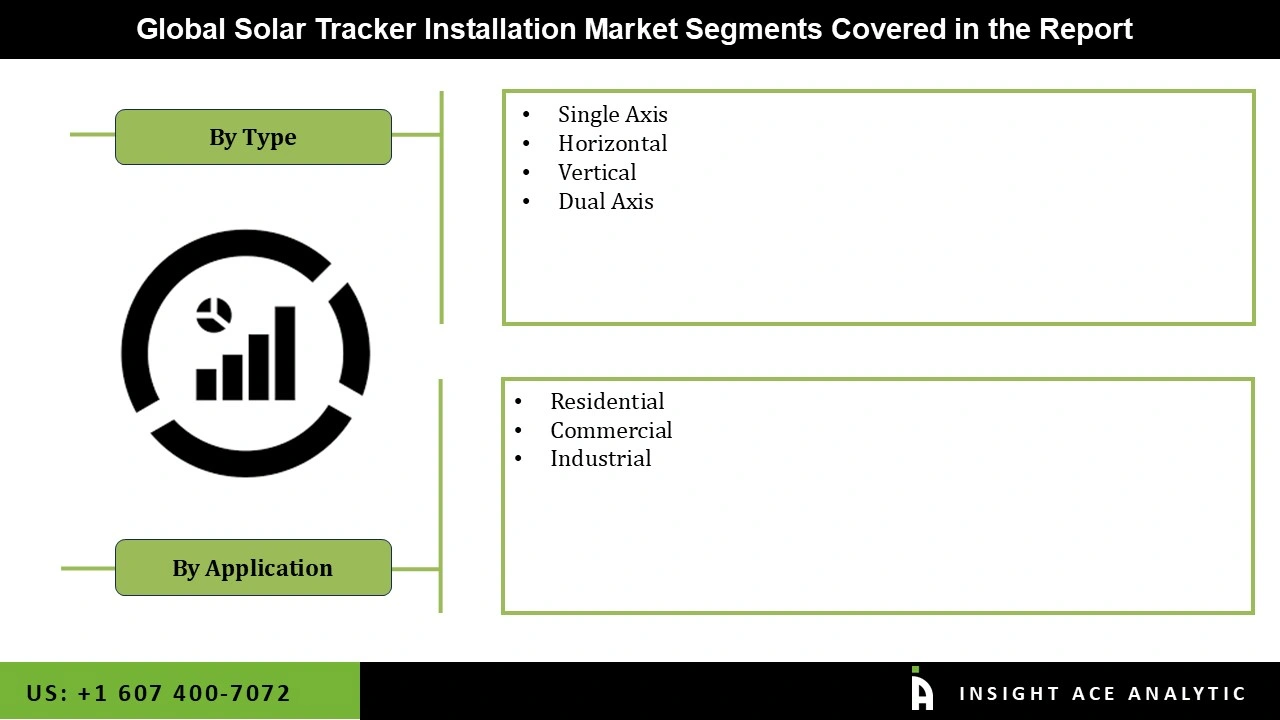
Solar Tracker Installation Market Size, Share & Trends Analysis Distribution by Type (Single Axis, Vertical, Horizontal, and Dual Axis), Application (Residential, Industrial, and Commercial), and Segment Forecasts, 2026 to 2035.
Solar tracking installation systems are devices that allow solar panels or solar thermal collectors to track the passage of the sun during the day, which is referred to as solar tracker installation. The goal of solar trackers is to improve the amount of sunlight that reaches the solar panels, which will boost their energy output. During the installation of the solar tracker, the parts and equipment are put together and set up to guarantee optimal performance. This involves attaching the solar panels to the trackers, which are devices that enable the panels to move and change their position in response to the sun's position in the sky. The demand for energy security and growing concerns about greenhouse gas emissions are anticipated to fuel the expansion of the global solar tracker installation market.
The solar tracker installation is expanding due to rising demand for solar energy. To reduce energy output from fossil fuels, lower emissions, and have a beneficial environmental impact, the energy business is seeing an increase in demand for renewable energy sources, such as solar panels. Additionally, as more people use solar panels for domestic use, there will be a greater need for solar trackers to boost the rate of electricity conversion. Moreover, the demand for energy security and growing environmental concerns about greenhouse gas emissions are driving the growth of the solar tracker installation market. The Centre for Climate and Energy Solutions states that the primary sources of greenhouse gas emissions are energy and heat (31%), forestry (6%), transportation (15%), agriculture (11%), and manufacturing (12%). In both the home and commercial sectors, the solar tracker installation systems are growing in popularity.
In addition, the growing government policies that encourage the installation of solar panels are also driving the expansion of the solar tracker installation market. Government regulations have a favorable effect on the global market for solar tracker installations. The installation of solar panels is being driven by these laws. The demands of state renewable electricity mandates have been the primary driver of solar investments in the United States, China, and other nations. However, the high cost of installing and maintaining solar trackers is one of the main issues facing the solar tracker installation market. When compared to fixed-tilt systems, solar trackers can increase energy production by as much as 25%. Thus, these systems are more costly to buy and implement due to the extra hardware and electronics needed for active sun tracking.
Competitive Landscape
Which are the Leading Players in the Solar Tracker Installation Market?
- Array Technologies Inc.
- DEGERenergie GmbH & Co. KG
- Nclave
- Soltec Tracker
- Trina Solar Limited
- Abengoa Solar S.A.
- AllEarth Renewables
- SunPower Corporation
- Powerway Renewable Energy Co. Ltd.
- Titan Tracker
Market Dynamics
Driver
Growing International Government Policies
Globally, governments are developing laws and programs that assist the production of solar-powered renewable energy. They are realizing that in order to lower carbon emissions and improve energy security, they must switch to greener energy. Additionally, both commercial and residential customers choosing rooftop solar installations are eligible for substantial financial benefits. To entice investors to solar projects, many nations offer accelerated capital cost depreciation. A favourable regulatory environment contributes to a robust demand for all related solar technologies in the solar tracker installation market. Thus, the market is expanding as a result of the global legislative initiatives that are promoting the wider use of solar tracking systems.
Restrain/Challenge
High Cost of Solar Tracker Installation
The large upfront infrastructure investments are necessary for the development of new renewable resources. Particularly in the early years, these investments raise the cost of renewable electricity. Initially, the developers need to locate locations that are well-liked by the general people, have adequate supplies, and are close to transmission lines. Determining whether a location is suitable for solar power requires years of observation. Additionally, workers need to be trained on how to install, use, and maintain the new tools. For some renewable energy sources to function at their best, specific meteorological conditions must be met. Because of all these factors, installing solar panels is more costly, which raises the price of solar trackers. Therefore, it is anticipated that the high cost of solar tracker installation will impede market expansion.
Single Axis Segment is Expected to Drive the Solar Tracker Installation Market
The Single Axis category held the largest share in the solar tracker installation market in 2024, since single-axis trackers are more affordable and easier to install. Additionally, single-axis solar trackers are environmentally and financially sustainable, improving a solar farm's ability to produce more renewable energy, reducing carbon emissions, and raising the project's return on investment. Furthermore, as single-axis trackers have fewer moving parts than dual-axis trackers, they frequently last longer. For large solar arrays, their simplicity of use also makes initial construction and maintenance much easier. In addition, significant stakeholders are working to increase the usage of solar energy in difficult areas.
Residential Segment is Growing at the Highest Rate in the Solar Tracker Installation Market
In 2025, the Residential category dominated the Solar Tracker Installation market. The homeowners' growing environmental consciousness is fueling the growth of the residential solar industry. By using renewable energy sources, many people want to lower their electricity costs and carbon footprint. Additionally, home demand is stimulated by government regulations that favour distributed solar energy. For homes, rooftop solar panels combined with trackers are a desirable choice. Compared to fixed panels, they increase energy yields and maximise available roof space. A typical household system may provide 100% of its yearly electricity needs with the installation of solar trackers.
Why North America Led the Solar Tracker Installation Market?
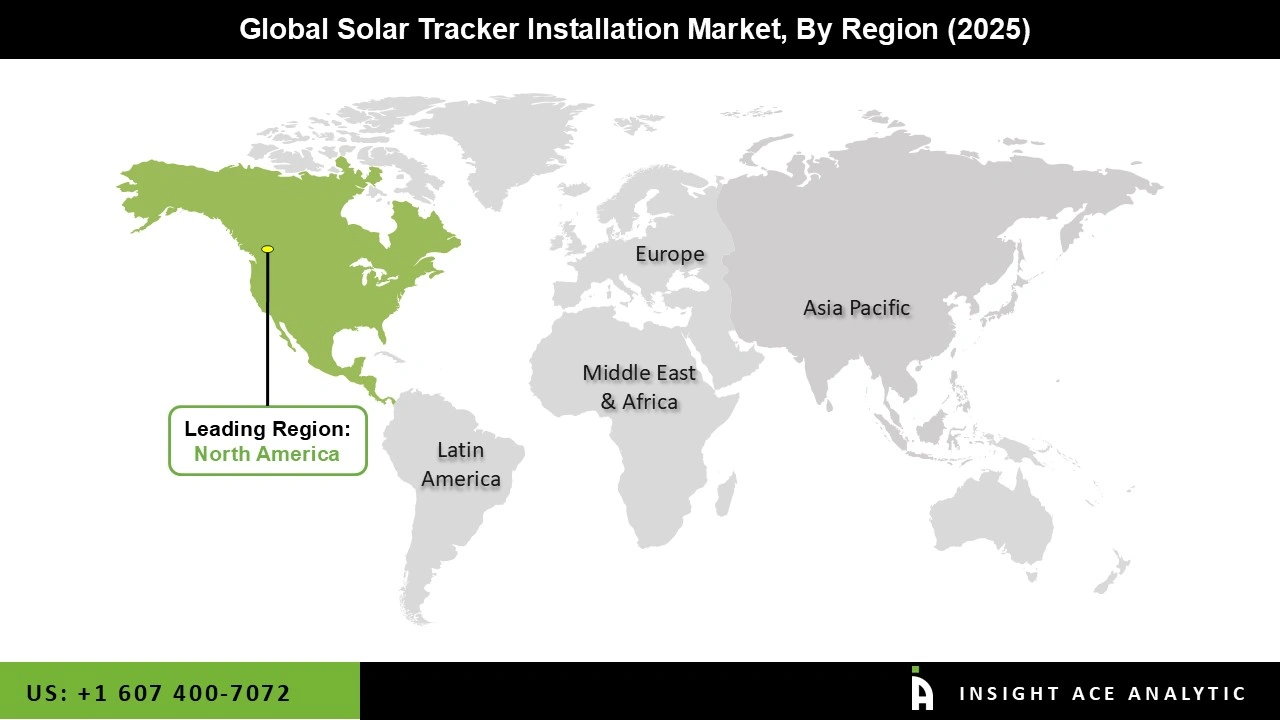
The Solar Tracker Installation market was dominated by the North America region in 2025. The region's plentiful solar resources, especially in regions like the southwestern United States and parts of Canada, are responsible for the notable expansion of solar tracker installations in North America. Due to their abundance of sunlight, these areas are ideal for producing solar energy.
Additionally, solar power installations have increased significantly, and many large-scale projects have opted to use solar trackers to maximise energy efficiency. The expansion of the solar tracker installation business in North America has also been greatly aided by favourable government policies and incentives.
Key Developments
In August 5, 2025 : ARRAY Technologies announced it will supply solar trackers that are verified to be 100% U.S.-made for a 200-megawatt solar farm in Indiana. This allows the project to qualify for a significant federal tax credit bonus.
Solar Tracker Installation Market Report Scope :
| Report Attribute | Specifications |
| Market size value in 2025 | USD 10.40 Bn |
| Revenue forecast in 2035 | USD 41.07 Bn |
| Growth Rate CAGR | CAGR of 15.0% from 2026 to 2035 |
| Quantitative Units | Representation of revenue in US$ Bn and CAGR from 2026 to 2035 |
| Historic Year | 2022 to 2025 |
| Forecast Year | 2026-2035 |
| Report Coverage | The forecast of revenue, the position of the company, the competitive market structure, growth prospects, and trends |
| Segments Covered | Type, Application, and By Region |
| Regional Scope | North America; Europe; Asia Pacific; Latin America; Middle East & Africa |
| Country Scope | U.S.; Canada; U.K.; Germany; China; India; Japan; Brazil; Mexico; The UK; France; Italy; Spain; China; Japan; India; South Korea; Southeast Asia; South Korea; Southeast Asia |
| Competitive Landscape | Array Technologies Inc., DEGERenergie GmbH & Co. KG, Nclave, Soltec Tracker, Trina Solar Limited, Abengoa Solar S.A., AllEarth Renewables, SunPower Corporation, Powerway Renewable Energy Co. Ltd., and Titan Tracker |
| Customization Scope | Free customization report with the procurement of the report, Modifications to the regional and segment scope. Geographic competitive landscape. |
| Pricing and Available Payment Methods | Explore pricing alternatives that are customized to your particular study requirements. |
Segmentation of Solar Tracker Installation Market :
Solar Tracker Installation Market, By Type-
- Single Axis
- Vertical
- Horizontal
- Dual Axis
Solar Tracker Installation Market, By Application-
- Residential
- Industrial
- Commercial
Solar Tracker Installation Market, By Region-
- North America-
- The US
- Canada
- Europe-
- Germany
- The UK
- France
- Italy
- Spain
- Rest of Europe
- Asia-Pacific-
- China
- Japan
- India
- South Korea
- South East Asia
- Rest of Asia Pacific
- Latin America-
- Brazil
- Argentina
- Mexico
- Rest of Latin America
- Middle East & Africa-
- GCC Countries
- South Africa
- Rest of Middle East and Africa
Research Design and Approach
This study employed a multi-step, mixed-method research approach that integrates:
- Secondary research
- Primary research
- Data triangulation
- Hybrid top-down and bottom-up modelling
- Forecasting and scenario analysis
This approach ensures a balanced and validated understanding of both macro- and micro-level market factors influencing the market.
Secondary Research
Secondary research for this study involved the collection, review, and analysis of publicly available and paid data sources to build the initial fact base, understand historical market behaviour, identify data gaps, and refine the hypotheses for primary research.
Sources Consulted
Secondary data for the market study was gathered from multiple credible sources, including:
- Government databases, regulatory bodies, and public institutions
- International organizations (WHO, OECD, IMF, World Bank, etc.)
- Commercial and paid databases
- Industry associations, trade publications, and technical journals
- Company annual reports, investor presentations, press releases, and SEC filings
- Academic research papers, patents, and scientific literature
- Previous market research publications and syndicated reports
These sources were used to compile historical data, market volumes/prices, industry trends, technological developments, and competitive insights.

Primary Research
Primary research was conducted to validate secondary data, understand real-time market dynamics, capture price points and adoption trends, and verify the assumptions used in the market modelling.
Stakeholders Interviewed
Primary interviews for this study involved:
- Manufacturers and suppliers in the market value chain
- Distributors, channel partners, and integrators
- End-users / customers (e.g., hospitals, labs, enterprises, consumers, etc., depending on the market)
- Industry experts, technology specialists, consultants, and regulatory professionals
- Senior executives (CEOs, CTOs, VPs, Directors) and product managers
Interview Process
Interviews were conducted via:
- Structured and semi-structured questionnaires
- Telephonic and video interactions
- Email correspondences
- Expert consultation sessions
Primary insights were incorporated into demand modelling, pricing analysis, technology evaluation, and market share estimation.
Data Processing, Normalization, and Validation
All collected data were processed and normalized to ensure consistency and comparability across regions and time frames.
The data validation process included:
- Standardization of units (currency conversions, volume units, inflation adjustments)
- Cross-verification of data points across multiple secondary sources
- Normalization of inconsistent datasets
- Identification and resolution of data gaps
- Outlier detection and removal through algorithmic and manual checks
- Plausibility and coherence checks across segments and geographies
This ensured that the dataset used for modelling was clean, robust, and reliable.
Market Size Estimation and Data Triangulation
Bottom-Up Approach
The bottom-up approach involved aggregating segment-level data, such as:
- Company revenues
- Product-level sales
- Installed base/usage volumes
- Adoption and penetration rates
- Pricing analysis
This method was primarily used when detailed micro-level market data were available.

Top-Down Approach
The top-down approach used macro-level indicators:
- Parent market benchmarks
- Global/regional industry trends
- Economic indicators (GDP, demographics, spending patterns)
- Penetration and usage ratios
This approach was used for segments where granular data were limited or inconsistent.
Hybrid Triangulation Approach
To ensure accuracy, a triangulated hybrid model was used. This included:
- Reconciling top-down and bottom-up estimates
- Cross-checking revenues, volumes, and pricing assumptions
- Incorporating expert insights to validate segment splits and adoption rates
This multi-angle validation yielded the final market size.
Forecasting Framework and Scenario Modelling
Market forecasts were developed using a combination of time-series modelling, adoption curve analysis, and driver-based forecasting tools.
Forecasting Methods
- Time-series modelling
- S-curve and diffusion models (for emerging technologies)
- Driver-based forecasting (GDP, disposable income, adoption rates, regulatory changes)
- Price elasticity models
- Market maturity and lifecycle-based projections
Scenario Analysis
Given inherent uncertainties, three scenarios were constructed:
- Base-Case Scenario: Expected trajectory under current conditions
- Optimistic Scenario: High adoption, favourable regulation, strong economic tailwinds
- Conservative Scenario: Slow adoption, regulatory delays, economic constraints
Sensitivity testing was conducted on key variables, including pricing, demand elasticity, and regional adoption.
Request Customization
Add countries, segments, company profiles, or extend forecast — free 10% customization with purchase.
Customize This Report →Enquire Before Buying
Speak with our analyst team about scope, methodology, pricing, or deliverable formats.
Enquire Now →Frequently Asked Questions
Solar Tracker Installation Market Size is valued at USD 10.40 Bn in 2025 and is predicted to reach USD 41.07 Bn by the year 2035.
Solar Tracker Installation Market is expected to grow at a 15.0% CAGR during the forecast period for 2026 to 2035
Array Technologies Inc., DEGERenergie GmbH & Co. KG, Nclave, Soltec Tracker, Trina Solar Limited, Abengoa Solar S.A., AllEarth Renewables, SunPower Corporation, Powerway Renewable Energy Co. Ltd., , Titan Tracker and Others.
Solar Tracker Installation Market is segmented in Type (Single Axis, Vertical, Horizontal, and Dual Axis), Application (Residential, Industrial, and Commercial) and Other.
North America region is leading the Solar Tracker Installation Market.