Recycled Elastomers Market Size, Trend, Forecast Report 2026 to 2035
What is Recycled Elastomers Market Size?
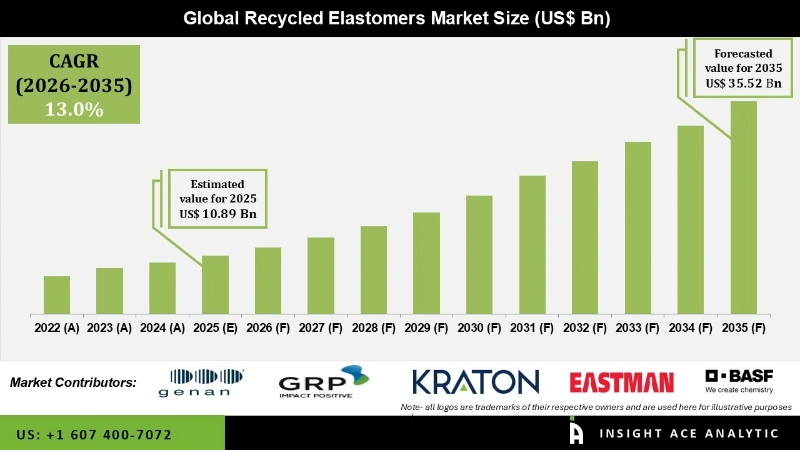
Recycled Elastomers Market Size is valued at USD 10.89 Bn in 2025 and is predicted to reach USD 35.52 Bn by the year 2035 at a 13.0% CAGR during the forecast period for 2026 to 2035.
Recycled Elastomers Market Size, Share & Trends Analysis Report By Material Type (Synthetic and Natural), Synthetic Type (Thermoset and Thermoplastic), Thermoset (Recycled Rubber, Recycled Polyurethane, and Other Thermosets), Thermoplastic (Styrenic Block Copolymers (SBC), Thermoplastic Polyurethane (TPU), Thermoplastic Vulcanizate (TPV), and Other Thermoplastics), Application, By Region, And By Segment Forecasts, 2026 to 2035.
Recycled Elastomers Market Key Takeaways:
|
Recycled elastomers refer to rubber materials that have undergone reclamation or reprocessing from abandoned rubber items, including tires, industrial rubber debris, and consumer goods. Elastomer recycling is a crucial element of the rubber business as it promotes environmental sustainability through waste reduction and resource conservation. The method entails a series of procedures to convert scrap rubber into a viable form for new applications.
Several industries are driving the market expansion with their increasing use of elastomers. Healthcare and automotive sectors also make extensive use of elastomers in the production of items like tires and medical tubes. Because elastomers do not biodegrade and can build up to dangerous levels of chemical fumes that are harmful to humans, the increasing demand for these products creates sustainability concerns; thus, recycling elastomers is becoming more popular. Also, recycling gives you a leg up when it comes to trash management and helps the environment, so it’s a good choice for reusing elastomers. Because of these reasons, the worldwide market for recycled elastomers is expected to develop. The need for recycled elastomers is on the rise due to advancements in energy efficiency and sustainable resource reliance, as well as the electrical, automotive, and aerospace industries. It is expected to boost market expansion in the coming years.
However, the market expansion is being hindered by issues such as raw material price volatility, low awareness in developing nations, high costs of recycled elastomers, a lack of experience, a shortage of workforce, and the widespread usage of recycled elastomers. The market for recycled elastomers is being propelled by rising ecological consciousness coupled with strict legislation targeted at diminishing landfill trash and encouraging sustainable material utilization. Industries are being pushed to recycle elastomers into their manufacturing processes due to the increasing recognition and dedication to circular economies, which is growing the demand of the market in the coming years.
Competitive Landscape
Some Major Key Players In The Recycled Elastomers Market:
- Genan Holding Ltd.
- GRP LTD
- Kraton Corporation
- Eastman Chemical Company
- BASF SE
- Liberty Tier Recycling, LLC
- Allcock & Sons Ltd
- Austin Rubber Company, LLC
- Tire Disposal & Recycling
- Monmouth Rubber & Plastics
- Audia Elastomers
- Rubberfrom Recycled Products, LLC
- Rubber Green
- Emanual Tier, LLC
- ExxonMobil
- Zeon Corporation
- Versalis S.p.A.
- Dow, Inc.,
- PolyOne Corporation
- Kuraray Co., Ltd
- Texnor Apex Company
- Mitsubishi Chemical Advanced Materials
- Kraiburg TPE
- RTP Company
- Hexpol TPE
- Avient
- Other Market Players
Market Segmentation:
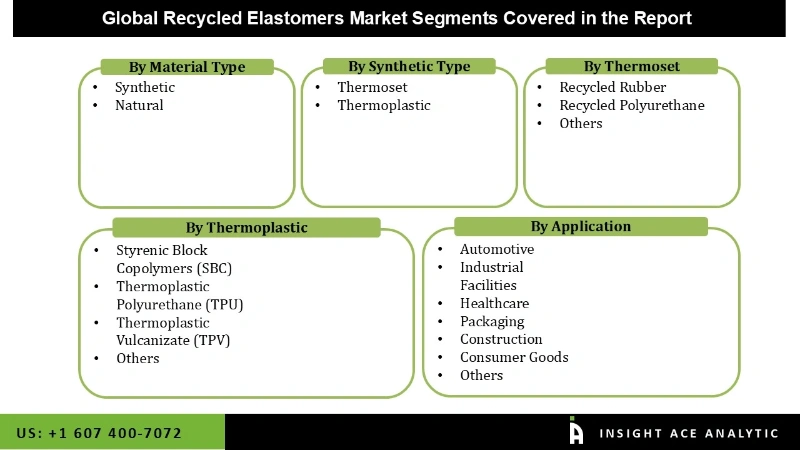
The recycled elastomers market is segmented based on material type, synthetic type, thermoset, thermoplastic, and application. Based on material type, the market is segmented into synthetic and natural. By synthetic type, the market is segmented into thermoset and thermoplastic. By thermoset, the market is segmented into recycled rubber, recycled polyurethane, and others. By thermoplastic, the market is segmented into styrene block copolymers (SBC), thermoplastic polyurethane (TPU), thermoplastic vulcanizate (TPV), and others. The application segment is categorized into automotive, industrial facilities, healthcare, packaging, construction, consumer goods, and others.
Based On The Material Type, The Synthetic Segment Is Accounted As A Major Contributor To The Recycled Elastomers Market.
The synthetic category is expected to hold a major share of the global recycled elastomers market in 2023. It is attributed to the possibility of creating synthetic recycled elastomers in a lab by dispersing petroleum polymers in water. Due to their adaptability, high strength, and water resistance, these polymers find ideal use in a wide variety of industrial settings. During the projected period, the demand for synthetic recycled elastomers from the construction and automotive industries is expected to boost market growth. Furthermore, they are extensively utilized in a wide range of building materials, including paints, varnishes, sealants, adhesives, and more, to enhance binding, reduce cracking, and boost elastomer qualities.
The Automotive Segment Witnessed A Rapid Growth.
The automotive segment is predicted to grow rapidly in the global recycled elastomers market due to the growing number of sustainability projects and the tightening of environmental standards. Automotive companies are making great strides in using recycled materials in their products to lessen their production costs and their impact on the environment. Tires, gaskets, and seals made of recycled elastomers are fueling the segment's expansion due to their long lifespan and low production costs.
In The Region, The Asia Pacific Recycled Elastomers Market Holds A Significant Revenue Share.
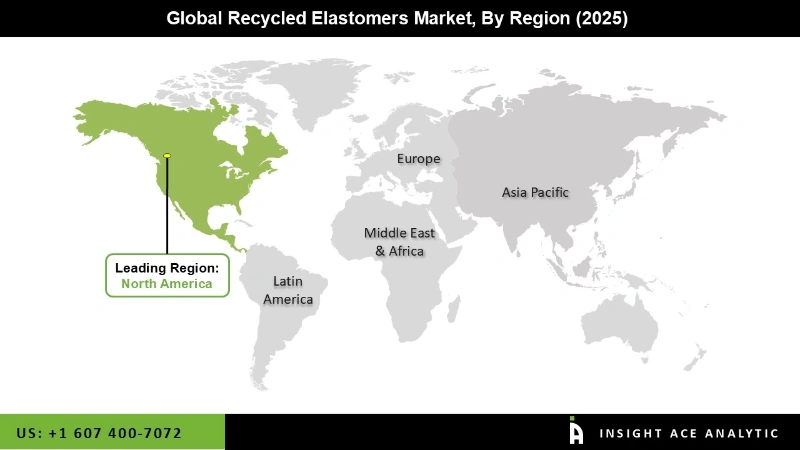
The North American recycled elastomers market is anticipated to record the maximum market revenue share. It can be attributed to the abundance of land and the low cost of labor. The government’s growing support in the elastomer business is a boon to recycling efforts. The recycled elastomers market in the region is being boosted by a combination of factors, including government aid and economic stability, which lead to increasing consumption of machinery and equipment. In addition, North America is projected to grow rapidly in the global recycled elastomers market because of factors such as the increasing population, the need for more cars, the increased consumption of consumer products, and the rising industrialization.
Recent Developments:
- In April 2023, KRAIBURG TPE introduced its environmentally friendly THERMOLAST® R TPE for the Asia Pacific region. The TPE series incorporated a maximum of 35% post-consumer recycled (PCR) material, with the amount varying depending on the hardness. The latest environmentally-friendly thermoplastic elastomers (TPEs) have been introduced to the consumer market and adopted by The First Thai Brush Co. Ltd, Thailand's prominent toothbrush producer, for their innovative Victory toothbrush.
- In July 2023, Avient Corporation introduced two new reSound™ REC Recycled Content Thermoplastic Elastomers (TPEs). The latest grades for car interior applications were developed using post-consumer recycled (PCR) content, offering a more environmentally friendly thermoplastic elastomer (TPE) alternative that performs similarly to conventional TPEs.
Recycled Elastomers Market Report Scope
| Report Attribute | Specifications |
| Market Size Value In 2025 | USD 10.89 Bn |
| Revenue Forecast In 2035 | USD 35.52 Bn |
| Growth Rate CAGR | CAGR of 13.0 % from 2026 to 2035 |
| Quantitative Units | Representation of revenue in US$ Bn, Volume (KT) and CAGR from 2026 to 2035 |
| Historic Year | 2022 to 2024 |
| Forecast Year | 2026-2035 |
| Report Coverage | The forecast of revenue, the position of the company, the competitive market structure, growth prospects, and trends |
| Segments Covered | By Material Type, Synthetic Type, Thermoset, Thermoplastic, And Application |
| Regional Scope | North America; Europe; Asia Pacific; Latin America; Middle East & Africa |
| Country Scope | U.S.; Canada; U.K.; Germany; China; India; Japan; Brazil; Mexico; France; Italy; Spain; Southeast Asia; South Korea |
| Competitive Landscape | Genan Holding Ltd., GRP LTD, Kraton Corporation, Eastman Chemical Company, BASF SE, Liberty Tier Recycling, LLC, J. Allcock & Sons Ltd, Austin Rubber Company, LLC, Tire Disposal & Recycling, Monmouth Rubber & Plastics, Audia Elastomers, Rubberfrom Recycled Products, LLC, Rubber Green, Emanual Tier, LLC, ExxonMobil, Zeon Corporation, Versalis S.p.A., Dow, Inc., PolyOne Corporation, Kuraray Co., Ltd, Texnor Apex Company, Mitsubishi Chemical Advanced Materials, Kraiburg TPE, RTP Company, Hexpol TPE. |
| Customization Scope | Free customization report with the procurement of the report and modifications to the regional and segment scope. Particular Geographic competitive landscape. |
| Pricing And Available Payment Methods | Explore pricing alternatives that are customized to your particular study requirements. |
Segmentation of Recycled Elastomers Market-
Recycled Elastomers Market By Material Type-
- Synthetic
- Natural
Recycled Elastomers Market By Synthetic Type-
- Thermoset
- Thermoplastic
Recycled Elastomers Market By Thermoset-
- Recycled Rubber
- Recycled Polyurethane
- Others
Recycled Elastomers Market By Thermoplastic-
- Styrenic Block Copolymers (SBC)
- Thermoplastic Polyurethane (TPU)
- Thermoplastic Vulcanizate (TPV)
- Others
Recycled Elastomers Market By Applications-
- Automotive
- Industrial Facilities
- Healthcare
- Packaging
- Construction
- Consumer Goods
- Others
Recycled Elastomers Market By Region-
North America-
- The US
- Canada
- Mexico
Europe-
- Germany
- The UK
- France
- Italy
- Spain
- Rest of Europe
Asia-Pacific-
- China
- Japan
- India
- South Korea
- South East Asia
- Rest of Asia Pacific
Latin America-
- Brazil
- Argentina
- Rest of Latin America
Middle East & Africa-
- GCC Countries
- South Africa
- Rest of the Middle East and Africa
Research Design and Approach
This study employed a multi-step, mixed-method research approach that integrates:
- Secondary research
- Primary research
- Data triangulation
- Hybrid top-down and bottom-up modelling
- Forecasting and scenario analysis
This approach ensures a balanced and validated understanding of both macro- and micro-level market factors influencing the market.
Secondary Research
Secondary research for this study involved the collection, review, and analysis of publicly available and paid data sources to build the initial fact base, understand historical market behaviour, identify data gaps, and refine the hypotheses for primary research.
Sources Consulted
Secondary data for the market study was gathered from multiple credible sources, including:
- Government databases, regulatory bodies, and public institutions
- International organizations (WHO, OECD, IMF, World Bank, etc.)
- Commercial and paid databases
- Industry associations, trade publications, and technical journals
- Company annual reports, investor presentations, press releases, and SEC filings
- Academic research papers, patents, and scientific literature
- Previous market research publications and syndicated reports
These sources were used to compile historical data, market volumes/prices, industry trends, technological developments, and competitive insights.

Primary Research
Primary research was conducted to validate secondary data, understand real-time market dynamics, capture price points and adoption trends, and verify the assumptions used in the market modelling.
Stakeholders Interviewed
Primary interviews for this study involved:
- Manufacturers and suppliers in the market value chain
- Distributors, channel partners, and integrators
- End-users / customers (e.g., hospitals, labs, enterprises, consumers, etc., depending on the market)
- Industry experts, technology specialists, consultants, and regulatory professionals
- Senior executives (CEOs, CTOs, VPs, Directors) and product managers
Interview Process
Interviews were conducted via:
- Structured and semi-structured questionnaires
- Telephonic and video interactions
- Email correspondences
- Expert consultation sessions
Primary insights were incorporated into demand modelling, pricing analysis, technology evaluation, and market share estimation.
Data Processing, Normalization, and Validation
All collected data were processed and normalized to ensure consistency and comparability across regions and time frames.
The data validation process included:
- Standardization of units (currency conversions, volume units, inflation adjustments)
- Cross-verification of data points across multiple secondary sources
- Normalization of inconsistent datasets
- Identification and resolution of data gaps
- Outlier detection and removal through algorithmic and manual checks
- Plausibility and coherence checks across segments and geographies
This ensured that the dataset used for modelling was clean, robust, and reliable.
Market Size Estimation and Data Triangulation
Bottom-Up Approach
The bottom-up approach involved aggregating segment-level data, such as:
- Company revenues
- Product-level sales
- Installed base/usage volumes
- Adoption and penetration rates
- Pricing analysis
This method was primarily used when detailed micro-level market data were available.

Top-Down Approach
The top-down approach used macro-level indicators:
- Parent market benchmarks
- Global/regional industry trends
- Economic indicators (GDP, demographics, spending patterns)
- Penetration and usage ratios
This approach was used for segments where granular data were limited or inconsistent.
Hybrid Triangulation Approach
To ensure accuracy, a triangulated hybrid model was used. This included:
- Reconciling top-down and bottom-up estimates
- Cross-checking revenues, volumes, and pricing assumptions
- Incorporating expert insights to validate segment splits and adoption rates
This multi-angle validation yielded the final market size.
Forecasting Framework and Scenario Modelling
Market forecasts were developed using a combination of time-series modelling, adoption curve analysis, and driver-based forecasting tools.
Forecasting Methods
- Time-series modelling
- S-curve and diffusion models (for emerging technologies)
- Driver-based forecasting (GDP, disposable income, adoption rates, regulatory changes)
- Price elasticity models
- Market maturity and lifecycle-based projections
Scenario Analysis
Given inherent uncertainties, three scenarios were constructed:
- Base-Case Scenario: Expected trajectory under current conditions
- Optimistic Scenario: High adoption, favourable regulation, strong economic tailwinds
- Conservative Scenario: Slow adoption, regulatory delays, economic constraints
Sensitivity testing was conducted on key variables, including pricing, demand elasticity, and regional adoption.
Request Customization
Add countries, segments, company profiles, or extend forecast — free 10% customization with purchase.
Customize This Report →Enquire Before Buying
Speak with our analyst team about scope, methodology, pricing, or deliverable formats.
Enquire Now →Frequently Asked Questions
Recycled Elastomers Market Size is valued at USD 10.89 Bn in 2025 and is predicted to reach USD 35.52 Bn by the year 2035.
Recycled Elastomers Market is expected to grow at a 13.0% CAGR during the forecast period for 2026-2035.
Zeon Corporation, Versalis S.p.A., Dow, Inc., PolyOne Corporation, Kuraray Co., Ltd, Texnor Apex Company, Mitsubishi Chemical Advanced Materials, Krai
Recycled elastomers market is segmented based on material type, synthetic type, thermoset, thermoplastic, and application.
North American region is leading the Recycled elastomers market.