Recycled Advanced Recycling Feedstock Market Report with Forecast 2025 to 2034
Global Recycled Advanced Recycling Feedstock Market Size is predicted to grow at a 8.5% CAGR during the forecast period for 2025-2034.
Recycled Advanced Recycling Feedstock Market Size, Share & Trends Analysis Distribution by Type (Textiles, Rubber, Plastics, and Others), Application (Energy Recovery, Chemical Feedstock, Material Recovery, and Others), End-use (Manufacturing, Petrochemicals, Energy, and Others), and Segment Forecasts, 2025 to 2034
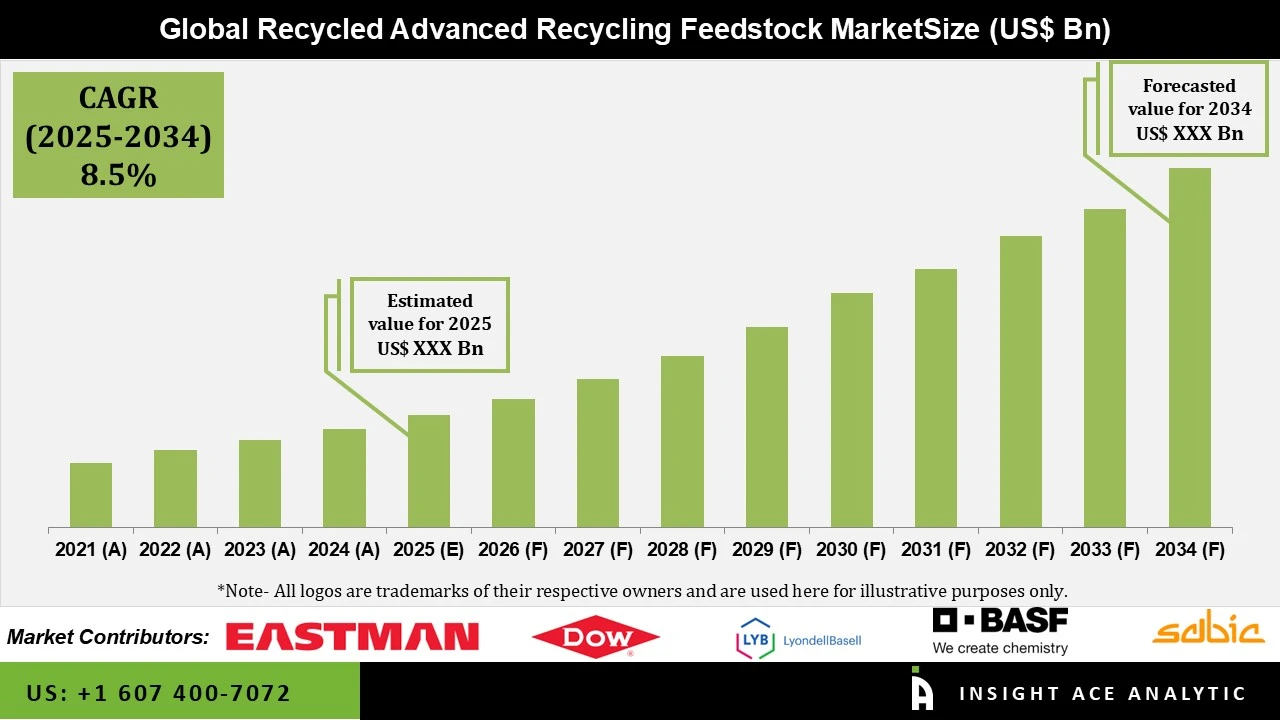
Recycled advanced recycling feedstock is plastic waste that has been reduced to its most basic chemical components through advanced recycling techniques such as gasification, pyrolysis, or depolymerization. Advanced recycling transforms challenging-to-recycle materials (such as mixed, contaminated, or multilayer plastics) into high-quality feedstock that can be used to produce new, virgin-grade plastics or chemicals, unlike conventional mechanical recycling, which only melts and remolds polymers. By reducing reliance on fossil-based raw materials, reducing environmental impact, and allowing industry to repurpose plastics that would otherwise wind up in landfills or be incinerated, this feedstock helps close the loop in the circular economy. The primary driver of the recycled advanced recycling feedstock market’s strong expansion is the growing emphasis on sustainability and circular-economy projects around the world, which has forced governments and businesses to seek creative ways to reduce packaging waste and use resources more effectively.
The Environmental Protection Agency (EPA) and other organizations have implemented strict environmental regulations, such as the Restriction of Hazardous Substances (RoHS) and the Registration, Evaluation, Authorization, and Restriction of Chemicals (REACH), which are expected to increase demand for recycled advanced recycling feedstock technologies. Additionally, the need for sophisticated recycling technology is being driven by mechanical recycling restrictions, such as weakening fiber, difficulties in recovering mixed plastic waste, and the prohibition on being used in various industries. Moreover, growing investments from packaging companies and a global emphasis on circular-economy models are additional factors supporting the growth of the recycled advanced recycling feedstock market. The recycled advanced recycling feedstock is emerging as a key component of global sustainable packaging projects as both the public and private sectors intensify efforts to lower landfill waste and carbon footprints.
In addition, secondary feedstocks are becoming increasingly competitive alternatives to petrochemical feedstocks due to technological advancements in chemical and thermochemical processes (pyrolysis, depolymerization, and upgrading). Additionally, growing investor and corporate commitments, along with increasing capital flows into advanced recycling projects, are funding supply-chain integration and scale-up, further accelerating the expansion of the recycled advanced recycling feedstock market. The costs and commercial uptake of pyrolysis oils and recycled intermediates are also supported by increased demand for alternative feedstocks for fuels, industrial heating, and petrochemicals. However, for small and medium-sized businesses (SMEs), in particular, the high cost of modern recycling technology can be a major obstacle in the growth of the recycled advanced recycling feedstock market. Many of these technologies are expensive to implement, which may discourage businesses from doing so. Furthermore, the effectiveness of recycling procedures may be hampered by insufficient infrastructure for garbage collection and processing.
Competitive Landscape
Which are the Leading Players in Recycled Advanced Recycling Feedstock Market?
- BASF SE
- LyondellBasell Industries Holdings B.V.
- Dow Inc.
- Eastman Chemical Company
- SABIC
- Loop Industries, Inc.
- Agilyx Corporation
- Covestro AG
- Indorama Ventures Public Company Limited
- Pyrowave Inc.
- Others
Market Dynamics
Driver
Growing Demand for Premium Recycled Polymers
The recycled advanced recycling feedstock market is mostly driven by the growing demand for premium recycled polymers from the consumer goods, automotive, and packaging sectors worldwide. The need for recycled inputs that have the same performance, consistency, and purity as virgin polymers qualities that conventional mechanical recycling frequently fails to provide is growing as companies in these industries move toward sustainable materials. Additionally, the advanced recycling techniques, such as pyrolysis and depolymerization, generate feedstock that may be used to make premium consumer goods, durable vehicle parts, and food-grade packaging, which attracts a lot of downstream businesses. Moreover, investments and adoption of advanced recycling feedstock are accelerating due to the growing need for high-quality, circular-grade materials.
Restrain/Challenge
High Capital Costs and Technological Complexity
The widespread use of recycled advanced recycling feedstock technology is still hampered by high capital costs and technological complexity. Scalability is a problem for small and mid-sized firms because setting up chemical recycling factories demands a large expenditure. Additionally, process efficiency and product yield are impacted by uncertainty about feedstock quality and supply consistency, making it challenging to ensure constant outputs. Since standards for chemically recovered materials are still developing, regional regulatory variations make the recycled advanced recycling feedstock market expansion even more difficult.
Plastics Segment is Expected to Drive the Recycled Advanced Recycling Feedstock Market
The plastics category held the largest share in the recycled advanced recycling feedstock market in 2024 as businesses look for superior recycled substitutes for virgin plastic more and more. Multilayer films, flexible packaging, complicated resins, and other mixed, contaminated, or difficult-to-recycle plastic trash can all be transformed into high-purity feedstock that can be used to create new polymers thanks to advanced recycling processes. The packaging, automobile, textile, and consumer goods industries all of which demand materials with virgin-like performance are rapidly adopting this capacity. Additionally, the demand is being further accelerated by increasing regulatory pressure to decrease plastic waste and obligatory recycled-content requirements in certain locations.
Petrochemicals Segment is Growing at the Highest Rate in the Recycled Advanced Recycling Feedstock Market
In 2024, the petrochemicals category dominated the recycled advanced recycling feedstock market. Major chemical firms' sustainability pledges, supply chain diversification tactics, and regulatory pressure to cut carbon emissions are some of the factors driving this segment's growth. The prominent petrochemical companies are constructing new plants and upgrading old ones to process recycled feedstock in addition to or instead of virgin resources. Additionally, the use of advanced recycling feedstock is accelerated by its smooth integration into the current infrastructure for petrochemical processing. Petrochemical manufacturers are placing advanced recycling feedstock as a strategic input, greatly propelling growth within this market segment as demand for high-purity recycled polymers used in consumer products, automobiles, and packaging rises.
Why North America Led the Recycled Advanced Recycling Feedstock Market?
The Recycled Advanced Recycling Feedstock market was dominated by the North America region in 2024, driven by growing interest in and funding for these recycling solutions from both the public and commercial sectors, expanding environmental concerns, growing regulatory demands, rising demand for recovered plastics, and increased investment in waste management infrastructure.
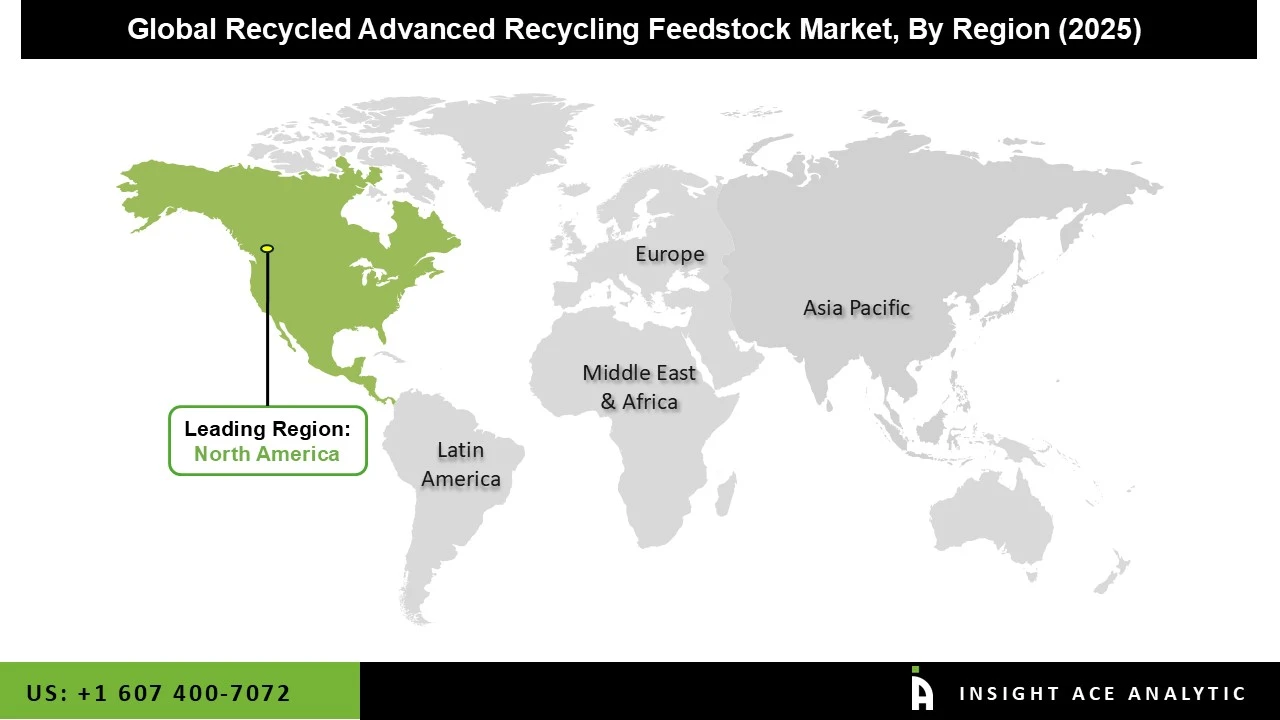
Furthermore, it is anticipated that the growing shift to the circular economy would accelerate the North American region's adoption of cutting-edge recycled advanced recycling feedstock technologies. Additionally, the government actively participates in trash management by promoting sustainable habits nationwide and introducing laws and policies to reduce plastic waste.
Key Development :
• September 2025: Greenback Recycling Technologies announced that its Enval advanced recycling module would be deployed for the first time in the UK at the Amcor's facility in Heanor, Derbyshire. The module will go through a six-month commissioning and trial period there. By showcasing the possibility of co-locating modular recycling units within current industrial infrastructure, the partnership with Amcor hopes to advance the circular economy.
• July 2024: LyondellBasell Industries announced the successful opening of its state-of-the-art recycling facility in Germany. This facility uses MoReTec technology to transform plastic waste into feedstock for the manufacturing of new plastic, reaching 95% conversion efficiency and creating materials that are on par with virgin quality.
• June 2024: Loop Industries and SK Geo Centric reached a final agreement to construct a 70,000-ton PET recycling facility in South Korea. The facility will use Loop's exclusive depolymerization technology to turn waste PET into virgin-quality materials for food-grade packaging applications
Recycled Advanced Recycling Feedstock Market Report Scope:
| Report Attribute | Specifications |
| Growth Rate CAGR | CAGR of 8.5% from 2025 to 2034 |
| Quantitative Units | Representation of revenue in US$ Bn and CAGR from 2024 to 2034 |
| Historic Year | 2021 to 2023 |
| Forecast Year | 2024-2034 |
| Report Coverage | The forecast of revenue, the position of the company, the competitive market structure, growth prospects, and trends |
| Segments Covered | By Type, Application, End-use, and By Region |
| Regional Scope | North America; Europe; Asia Pacific; Latin America; Middle East & Africa |
| Country Scope | U.S.; Canada; U.K.; Germany; China; India; Japan; Brazil; Mexico; The UK; France; Italy; Spain; China; Japan; India; South Korea; Southeast Asia; South Korea; Southeast Asia |
| Competitive Landscape | BASF SE, LyondellBasell Industries Holdings B.V., Dow Inc., Eastman Chemical Company, SABIC, Loop Industries, Inc., Agilyx Corporation, Covestro AG, Indorama Ventures Public Company Limited, and Pyrowave Inc. |
| Customization Scope | Free customization report with the procurement of the report, Modifications to the regional and segment scope. Geographic competitive landscape. |
| Pricing and Available Payment Methods | Explore pricing alternatives that are customized to your particular study requirements. |
Segmentation of Recycled Advanced Recycling Feedstock Market :
Recycled Advanced Recycling Feedstock Market by Type-
- Textiles
- Rubber
- Plastics
- Others
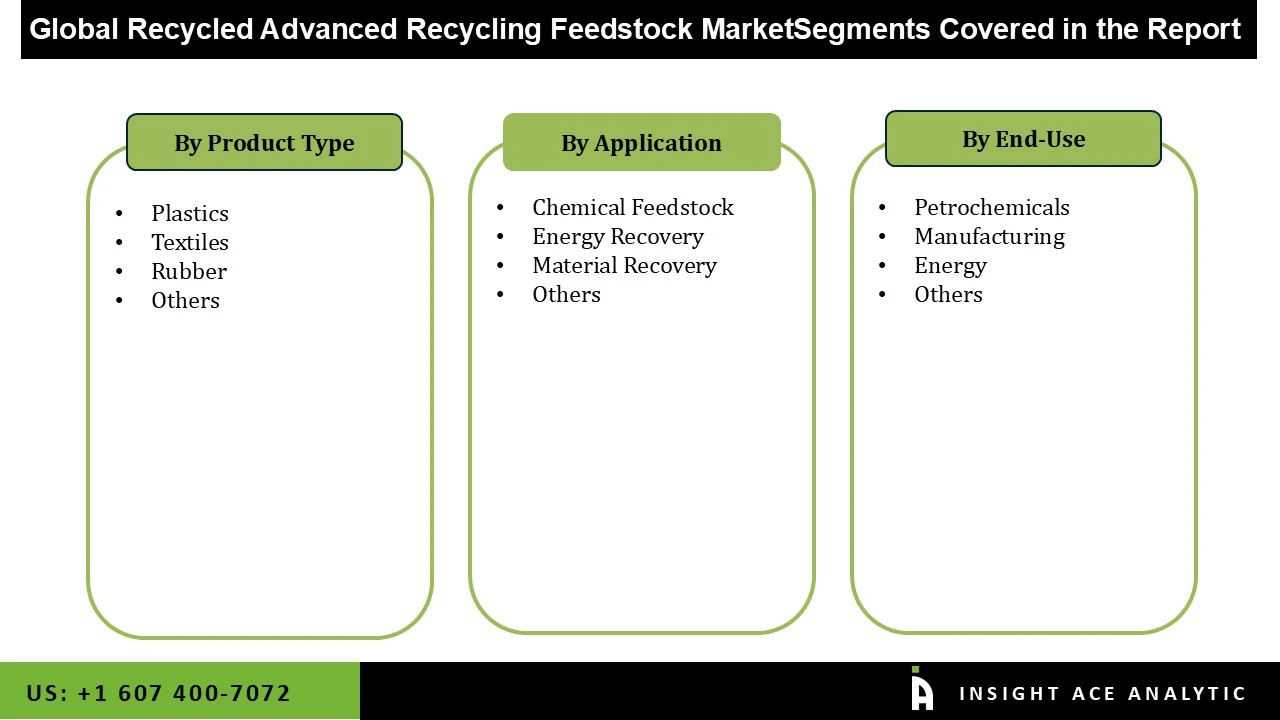
Recycled Advanced Recycling Feedstock Market by Application-
- Energy Recovery
- Chemical Feedstock
- Material Recovery
- Others
Recycled Advanced Recycling Feedstock Market by End-use-
- Manufacturing
- Petrochemicals
- Energy
- Others
Recycled Advanced Recycling Feedstock Market By Region-
- North America-
- The US
- Canada
- Europe-
- Germany
- The UK
- France
- Italy
- Spain
- Rest of Europe
- Asia-Pacific-
- China
- Japan
- India
- South Korea
- South East Asia
- Rest of Asia Pacific
- Latin America-
- Brazil
- Argentina
- Mexico
- Rest of Latin America
- Middle East & Africa-
- GCC Countries
- South Africa
- Rest of Middle East and Africa
Research Design and Approach
This study employed a multi-step, mixed-method research approach that integrates:
- Secondary research
- Primary research
- Data triangulation
- Hybrid top-down and bottom-up modelling
- Forecasting and scenario analysis
This approach ensures a balanced and validated understanding of both macro- and micro-level market factors influencing the market.
Secondary Research
Secondary research for this study involved the collection, review, and analysis of publicly available and paid data sources to build the initial fact base, understand historical market behaviour, identify data gaps, and refine the hypotheses for primary research.
Sources Consulted
Secondary data for the market study was gathered from multiple credible sources, including:
- Government databases, regulatory bodies, and public institutions
- International organizations (WHO, OECD, IMF, World Bank, etc.)
- Commercial and paid databases
- Industry associations, trade publications, and technical journals
- Company annual reports, investor presentations, press releases, and SEC filings
- Academic research papers, patents, and scientific literature
- Previous market research publications and syndicated reports
These sources were used to compile historical data, market volumes/prices, industry trends, technological developments, and competitive insights.

Primary Research
Primary research was conducted to validate secondary data, understand real-time market dynamics, capture price points and adoption trends, and verify the assumptions used in the market modelling.
Stakeholders Interviewed
Primary interviews for this study involved:
- Manufacturers and suppliers in the market value chain
- Distributors, channel partners, and integrators
- End-users / customers (e.g., hospitals, labs, enterprises, consumers, etc., depending on the market)
- Industry experts, technology specialists, consultants, and regulatory professionals
- Senior executives (CEOs, CTOs, VPs, Directors) and product managers
Interview Process
Interviews were conducted via:
- Structured and semi-structured questionnaires
- Telephonic and video interactions
- Email correspondences
- Expert consultation sessions
Primary insights were incorporated into demand modelling, pricing analysis, technology evaluation, and market share estimation.
Data Processing, Normalization, and Validation
All collected data were processed and normalized to ensure consistency and comparability across regions and time frames.
The data validation process included:
- Standardization of units (currency conversions, volume units, inflation adjustments)
- Cross-verification of data points across multiple secondary sources
- Normalization of inconsistent datasets
- Identification and resolution of data gaps
- Outlier detection and removal through algorithmic and manual checks
- Plausibility and coherence checks across segments and geographies
This ensured that the dataset used for modelling was clean, robust, and reliable.
Market Size Estimation and Data Triangulation
Bottom-Up Approach
The bottom-up approach involved aggregating segment-level data, such as:
- Company revenues
- Product-level sales
- Installed base/usage volumes
- Adoption and penetration rates
- Pricing analysis
This method was primarily used when detailed micro-level market data were available.

Top-Down Approach
The top-down approach used macro-level indicators:
- Parent market benchmarks
- Global/regional industry trends
- Economic indicators (GDP, demographics, spending patterns)
- Penetration and usage ratios
This approach was used for segments where granular data were limited or inconsistent.
Hybrid Triangulation Approach
To ensure accuracy, a triangulated hybrid model was used. This included:
- Reconciling top-down and bottom-up estimates
- Cross-checking revenues, volumes, and pricing assumptions
- Incorporating expert insights to validate segment splits and adoption rates
This multi-angle validation yielded the final market size.
Forecasting Framework and Scenario Modelling
Market forecasts were developed using a combination of time-series modelling, adoption curve analysis, and driver-based forecasting tools.
Forecasting Methods
- Time-series modelling
- S-curve and diffusion models (for emerging technologies)
- Driver-based forecasting (GDP, disposable income, adoption rates, regulatory changes)
- Price elasticity models
- Market maturity and lifecycle-based projections
Scenario Analysis
Given inherent uncertainties, three scenarios were constructed:
- Base-Case Scenario: Expected trajectory under current conditions
- Optimistic Scenario: High adoption, favourable regulation, strong economic tailwinds
- Conservative Scenario: Slow adoption, regulatory delays, economic constraints
Sensitivity testing was conducted on key variables, including pricing, demand elasticity, and regional adoption.
Request Customization
Add countries, segments, company profiles, or extend forecast — free 10% customization with purchase.
Customize This Report →Enquire Before Buying
Speak with our analyst team about scope, methodology, pricing, or deliverable formats.
Enquire Now →Frequently Asked Questions
Global Recycled Advanced Recycling Feedstock Market Size is predicted to grow at a 8.5% CAGR during the forecast period for 2025-2034.
BASF SE, LyondellBasell Industries Holdings B.V., Dow Inc., Eastman Chemical Company, SABIC, Loop Industries, Inc., Agilyx Corporation, Covestro AG, Indorama Ventures Public Company Limited, and Pyrowave Inc.
Type, Application, End-use, and Region are the key segments of the Recycled Advanced Recycling Feedstock Market.
North America region is leading the Recycled Advanced Recycling Feedstock Market.