Mental Wellness Market Size, Share, Trend Report 2026 to 2035
What is Mental Wellness Market Size?
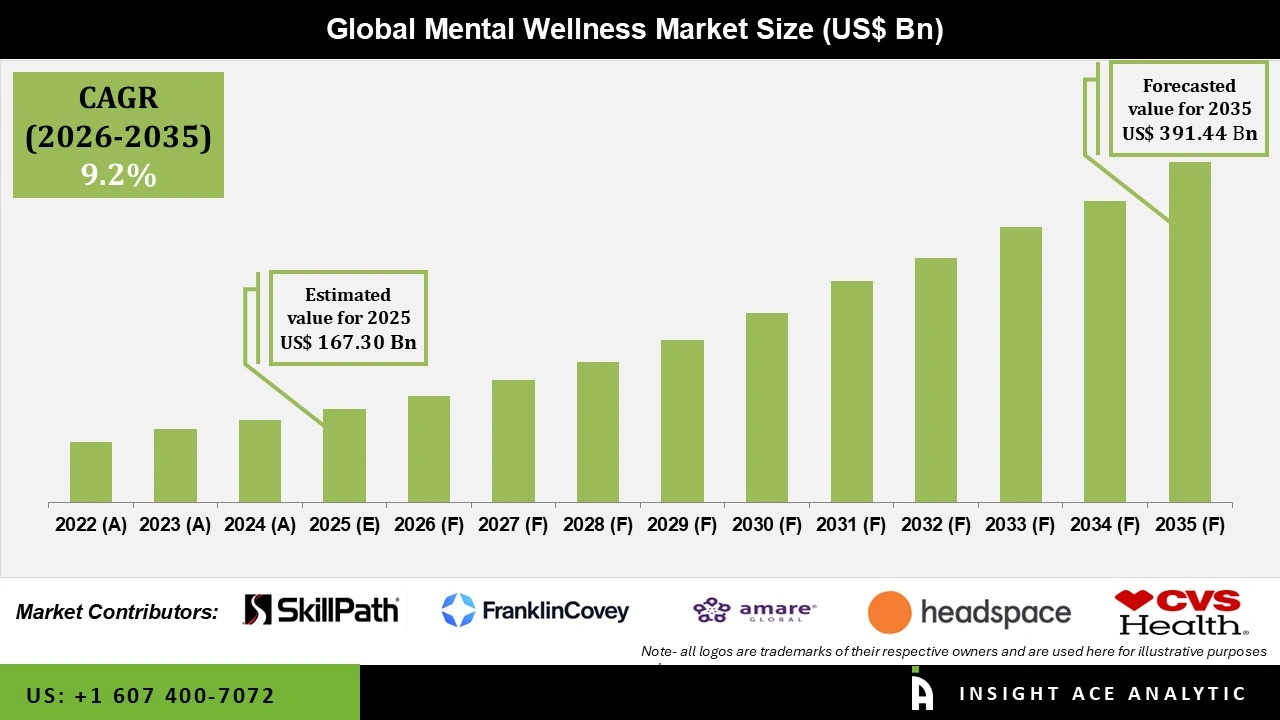
Global Mental Wellness Market Size is valued at USD 167.30 Billion in 2025 and is predicted to reach USD 391.44 Billion by the year 2035 at an 9.2% CAGR during the forecast period for 2026 to 2035.
Mental Wellness Market Size, Share & Trends Analysis Report By Disorder, By Type, By Age Group (Adults, Geriatric, Teenager), By Distribution Platform, By Region, And By Segment Forecasts, 2026 to 2035.
Mental Wellness Market Key Takeaways:
|
Key Industry Insights & Findings from the Report:
- Increased smartphone adoption and mHealth therapies are driving the mental wellness market.
- Growing Awareness of Stress Management is driving the mental wellness market.
- North America dominated the market and accounted for a global revenue share in 2025.
- The key challenge for the mental wellness market is the shortage of mental health professionals.
The enlarged definition of mental wellbeing in the modern-day strives to give people a sense of control over their health and happiness instead of just encouraging good lifestyle choices that may have a positive impact on overall wellness. The most recent investigation being conducted to solve these issues applies CBT to smartphones. Stress also has a negative impact on an employee's capacity to balance their personal and professional lives. During the foreseeable period, mental health treatment programs are expected to be crucial. Worldwide, the prevalence of mental health diseases is currently rising. This is one of the main causes supporting the market's growth, along with a person's lifestyle, usage of illicit substances, past trauma or abuse, and biological variables like genes or brain chemistry.
In addition, the coronavirus illness (COVID-19) outbreak and lockdown limitations imposed by governing bodies of various nations have harmed people's pre-existing mental health symptoms and brought on relapses everywhere. This is helping the industry expand, along with the rising need for hospital services brought on by the growing number of patients who need mental health solutions to encourage self-care.
The demand for mental health services may be constrained by a number of issues, such as limited access to mental health providers, a shortage of educated mental health care professionals, poor general community awareness of treatment alternatives, and limitations on primary care services. In spite of the fact that health services relating to people's behavioral patterns have undergone a phenomenal change in recent years, there is a lack of widely funded research and studies in the fields of physical and mental health, which has led to a lack of data that can be correlated for the precise diagnosis of disorders.
Competitive Landscape
Some Major Key Players In The Mental Wellness Market:
- SkillPath,
- FranklinCovey,
- Amare Global,
- Headspace,
- CVS Health (Active Health),
- CuraLinc Healthcare,
- Fitbit,
- Wellsource,
- Vitality,
- Virgin Pulse,
- Aduro,
- HealthCheck360,
- Lifestart,
- Castlight,
- Acadia Healthcare,
- Calm,
- Universal Health Services,
- Behavioral Health Network,
- Pyramid Healthcare
- Promises Behavioral Healt
Market Segmentation:
The Mental Wellness Market is segmented on the basis of Disorder, Type, and Age Group. Based on Disorder, the market is segmented as Depression, Anxiety, Schizophrenia, Substance Use Disorder, Bipolar Disorder, Alcohol Use Disorder, Post-Traumatic Stress Disorder, Eating Disorder, and Others. Based on Type, the market is segmented as Senses Spaces, Sleep, Brain Boosting Nutraceuticals & Botanicals, Self-Improvement, and Meditation and Mindfulness, Based on Age Group, the market is segmented as Adults, Geriatric, and Teenager.
Based On Disorder, The Anxiety Segment Is Accounted As A Major Contributor To The Mental Wellness Market.
In several nations around the world, anxiety disorders are the most common. This is a result of pressure from work and personal relationships, academic stress, and socioeconomic strain. Additionally, rising living expenses are exacerbating people's concerns. As a result, many are shifting to mental health specialists for the treatment of anxiety disorders. Further, during the forecast period, the market expansion is anticipated to be accelerated by cooperative efforts between pharmaceutical firms, NGOs, mental health organizations, and government programs to raise public awareness. The high success rates of treatments and drugs and the availability of proper reimbursement systems in developed nations are expected to fuel expansion over the projected period.
Based On The Product, The Mindfulness And Meditation Segment Is Accounted As A Significant Contributor To The Mental Wellness Market.
The fastest growth rate is also anticipated for mindfulness and meditation. A mind-body activity known as meditation has a long history of use for strengthening mental and physical wellbeing, increasing tranquillity and physical relaxation, balancing the mind and body, dealing with illness, and enhancing general health. To improve patients' mental health, the healthcare systems require apps and programs that are incredibly successful. The big market participants are therefore placing a lot of emphasis on app launches and product approvals. The demand for meditation apps has increased as a result of advanced research and development spending and raising public awareness of meditation. The market is expanding as a result of both the increased incidence of mental diseases and their corresponding surge in prevalence.
In The Region, The North America Mental Wellness Market Holds A Significant Revenue Share.
In terms of revenue, North America dominated the global market for mental wellness. Additionally, it is anticipated to increase at the fastest rate during the projection period. The population has become more involved in mental health initiatives as a result of factors including the increased use of smartphones and tablets in emerging nations. In the US, 88.56 percent of income in 2021 was attributable to the need for mental wellbeing.
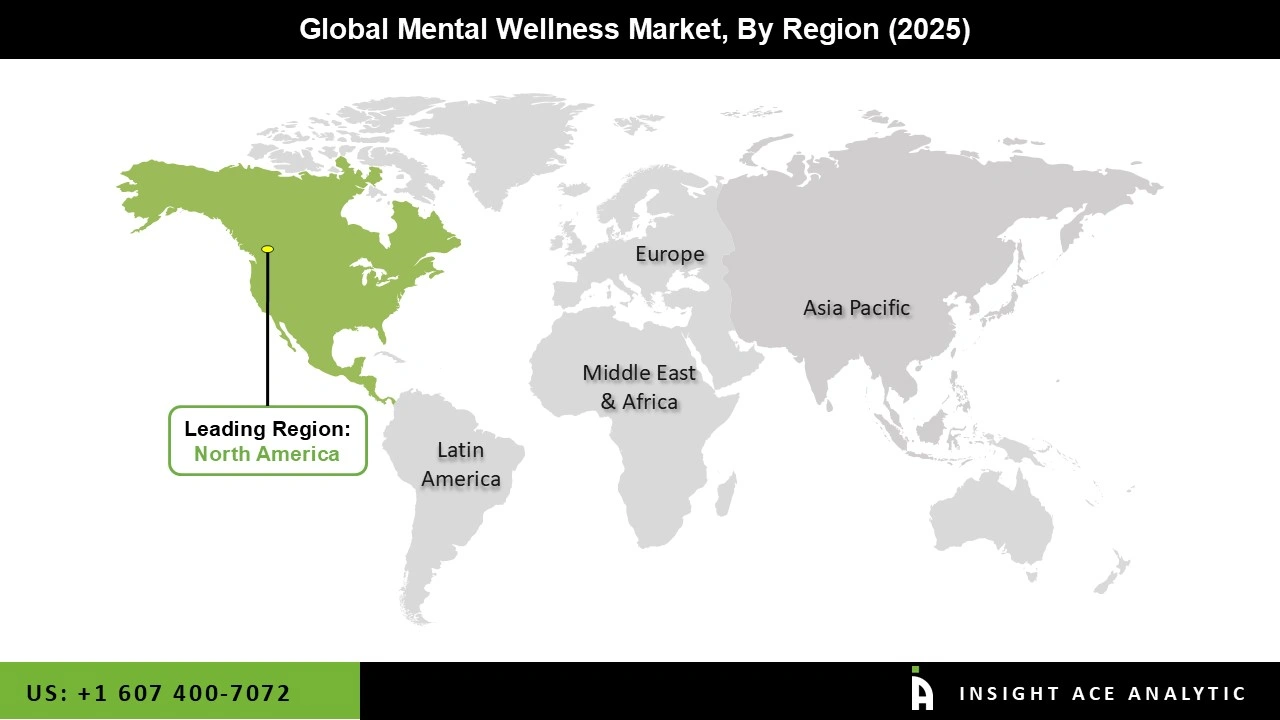
The market in the area is being driven by several reasons, including an increase in smartphone penetration, advancements in coverage networks, and an increase in the occurrence of health issues that influence mental wellness. As a result of the adoption of supportive federal and state policies, mental health services are expanding at an exceptional rate in the region.
Recent Developments:
- In July 2023, Spotify and Calm collaborated to offer tranquil mental wellness content for listeners. Spotify collaborated with Calm, the widely-used meditation and sleep application, to introduce content centred around well-being on its platform. The collaboration sought to offer a diverse selection of calming content from Calm in order to assist consumers in their mental health journey. The content is now available on Spotify's podcast collection.
Mental Wellness Market Report Scope :
| Report Attribute | Specifications |
| Market Size Value In 2025 | USD 167.30 Billion |
| Revenue Forecast In 2035 | USD 391.44 Billion |
| Growth Rate CAGR | CAGR of 9.2% from 2026 to 2035 |
| Quantitative Units | Representation of revenue in US$ Billion and CAGR from 2026 to 2035 |
| Historic Year | 2022 to 2025 |
| Forecast Year | 2026-2035 |
| Report Coverage | The forecast of revenue, the position of the company, the competitive market structure, growth prospects, and trends |
| Segments Covered | Disorder, Type, Age Group, Distribution Platform |
| Regional Scope | North America; Europe; Asia Pacific; Latin America; Middle East & Africa |
| Country Scope | U.S.; Canada; U.K.; Germany; China; India; Japan; Brazil; Mexico ;The UK; France; Italy; Spain; China; Japan; India; South Korea; South East Asia; South Korea; South East Asia |
| Competitive Landscape | SkillPath, FranklinCovey, Amare Global, Headspace, CVS Health (Active Health), CuraLinc Healthcare, Fitbit, Wellsource, Vitality, Virgin Pulse, Aduro, HealthCheck360, Lifestart, Castlight, Acadia Healthcare, Calm, Universal Health Services, Behavioral Health Network, Pyramid Healthcare, and Promises Behavioral Healt |
| Customization Scope | Free customization report with the procurement of the report, Modifications to the regional and segment scope. Particular Geographic competitive landscape. |
| Pricing And Available Payment Methods | Explore pricing alternatives that are customized to your particular study requirements. |
Segmentation of Mental Wellness Market :
Mental Wellness Market, By Disorder-
- Depression
- Anxiety
- Schizophrenia
- Substance Use Disorder
- Bipolar Disorder
- Alcohol Use Disorder
- Post-Traumatic Stress Disorder
- Eating Disorder
- Others
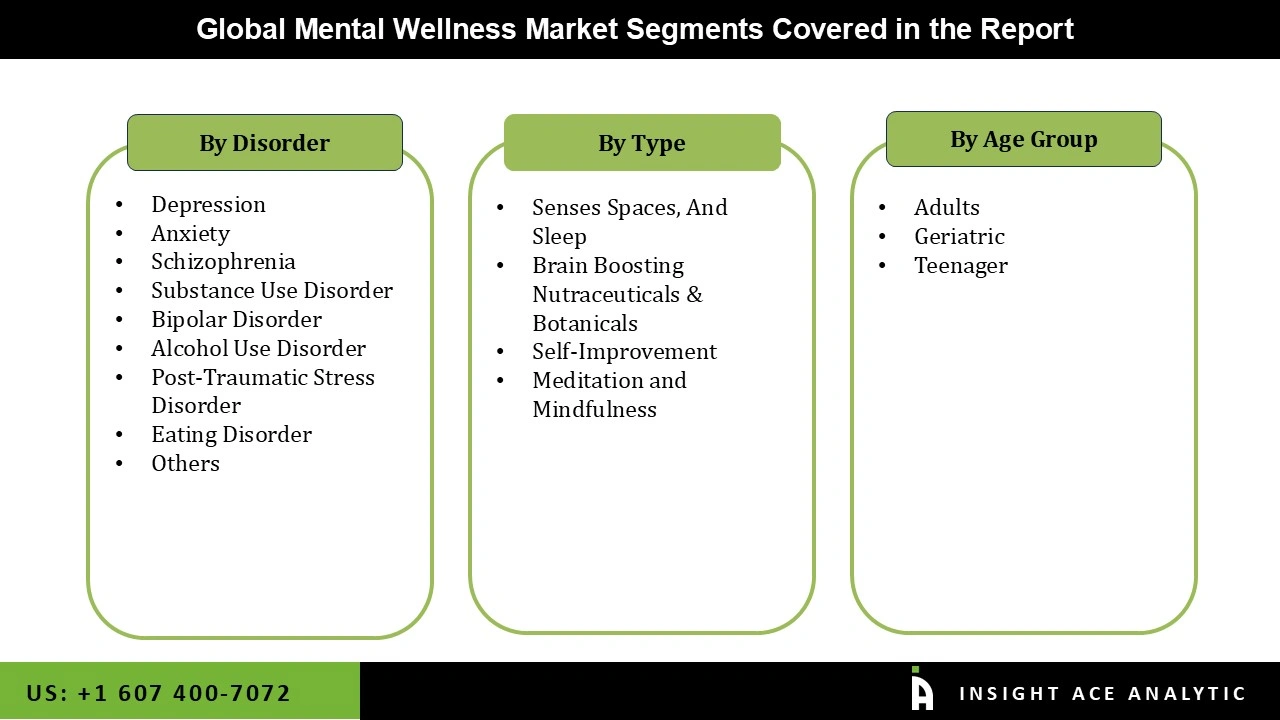
Mental Wellness Market, By Type-
- Senses Spaces, And Sleep
- Brain Boosting Nutraceuticals & Botanicals
- Self-Improvement
- Meditation and Mindfulness
Mental Wellness Market, By Age Group-
- Adults
- Geriatric
- Teenager
Mental Wellness Market, By Region-
- North America-
- The US
- Canada
- Europe-
- Germany
- The UK
- France
- Italy
- Spain
- Rest of Europe
- Asia-Pacific-
- China
- Japan
- India
- South Korea
- South East Asia
- Rest of Asia Pacific
- Latin America-
- Brazil
- Argentina
- Mexico
- Rest of Latin America
- Middle East & Africa-
- GCC Countries
- South Africa
- Rest of Middle East and Africa
Research Design and Approach
This study employed a multi-step, mixed-method research approach that integrates:
- Secondary research
- Primary research
- Data triangulation
- Hybrid top-down and bottom-up modelling
- Forecasting and scenario analysis
This approach ensures a balanced and validated understanding of both macro- and micro-level market factors influencing the market.
Secondary Research
Secondary research for this study involved the collection, review, and analysis of publicly available and paid data sources to build the initial fact base, understand historical market behaviour, identify data gaps, and refine the hypotheses for primary research.
Sources Consulted
Secondary data for the market study was gathered from multiple credible sources, including:
- Government databases, regulatory bodies, and public institutions
- International organizations (WHO, OECD, IMF, World Bank, etc.)
- Commercial and paid databases
- Industry associations, trade publications, and technical journals
- Company annual reports, investor presentations, press releases, and SEC filings
- Academic research papers, patents, and scientific literature
- Previous market research publications and syndicated reports
These sources were used to compile historical data, market volumes/prices, industry trends, technological developments, and competitive insights.

Primary Research
Primary research was conducted to validate secondary data, understand real-time market dynamics, capture price points and adoption trends, and verify the assumptions used in the market modelling.
Stakeholders Interviewed
Primary interviews for this study involved:
- Manufacturers and suppliers in the market value chain
- Distributors, channel partners, and integrators
- End-users / customers (e.g., hospitals, labs, enterprises, consumers, etc., depending on the market)
- Industry experts, technology specialists, consultants, and regulatory professionals
- Senior executives (CEOs, CTOs, VPs, Directors) and product managers
Interview Process
Interviews were conducted via:
- Structured and semi-structured questionnaires
- Telephonic and video interactions
- Email correspondences
- Expert consultation sessions
Primary insights were incorporated into demand modelling, pricing analysis, technology evaluation, and market share estimation.
Data Processing, Normalization, and Validation
All collected data were processed and normalized to ensure consistency and comparability across regions and time frames.
The data validation process included:
- Standardization of units (currency conversions, volume units, inflation adjustments)
- Cross-verification of data points across multiple secondary sources
- Normalization of inconsistent datasets
- Identification and resolution of data gaps
- Outlier detection and removal through algorithmic and manual checks
- Plausibility and coherence checks across segments and geographies
This ensured that the dataset used for modelling was clean, robust, and reliable.
Market Size Estimation and Data Triangulation
Bottom-Up Approach
The bottom-up approach involved aggregating segment-level data, such as:
- Company revenues
- Product-level sales
- Installed base/usage volumes
- Adoption and penetration rates
- Pricing analysis
This method was primarily used when detailed micro-level market data were available.

Top-Down Approach
The top-down approach used macro-level indicators:
- Parent market benchmarks
- Global/regional industry trends
- Economic indicators (GDP, demographics, spending patterns)
- Penetration and usage ratios
This approach was used for segments where granular data were limited or inconsistent.
Hybrid Triangulation Approach
To ensure accuracy, a triangulated hybrid model was used. This included:
- Reconciling top-down and bottom-up estimates
- Cross-checking revenues, volumes, and pricing assumptions
- Incorporating expert insights to validate segment splits and adoption rates
This multi-angle validation yielded the final market size.
Forecasting Framework and Scenario Modelling
Market forecasts were developed using a combination of time-series modelling, adoption curve analysis, and driver-based forecasting tools.
Forecasting Methods
- Time-series modelling
- S-curve and diffusion models (for emerging technologies)
- Driver-based forecasting (GDP, disposable income, adoption rates, regulatory changes)
- Price elasticity models
- Market maturity and lifecycle-based projections
Scenario Analysis
Given inherent uncertainties, three scenarios were constructed:
- Base-Case Scenario: Expected trajectory under current conditions
- Optimistic Scenario: High adoption, favourable regulation, strong economic tailwinds
- Conservative Scenario: Slow adoption, regulatory delays, economic constraints
Sensitivity testing was conducted on key variables, including pricing, demand elasticity, and regional adoption.
Request Customization
Add countries, segments, company profiles, or extend forecast — free 10% customization with purchase.
Customize This Report →Enquire Before Buying
Speak with our analyst team about scope, methodology, pricing, or deliverable formats.
Enquire Now →Frequently Asked Questions
Mental Wellness Market Size is valued at USD 167.30 Billion in 2025 and is predicted to reach USD 391.44 Billion by the year 2035
Mental Wellness Market is expected to grow at an 9.2% CAGR during the forecast period for 2026 to 2035
SkillPath, FranklinCovey, Amare Global, Headspace, CVS Health (Active Health), CuraLinc Healthcare, Fitbit, Wellsource, Vitality, Virgin Pulse, Aduro, HealthCheck360, Lifestart, Castlight, Acadia Healthcare, Calm, Universal Health Services, Behavioral Health Network, Pyramid Healthcare, and Promises Behavioral Healt and Others.
Disorder, Type, Age Group and Distribution Platform are the key segments of the Mental Wellness Market
North American region is leading the Mental Wellness Market.