Particle Size Analysis Market Size, Share, Trend, Scope Report 2026 to 2035
What is Particle Size Analysis Market Size?
Particle Size Analysis Market Size is valued at USD 487.06 Mn in 2025 and is predicted to reach USD 888.30 Mn by the year 2035 at a 6.2% CAGR during the forecast period for 2026 to 2035.
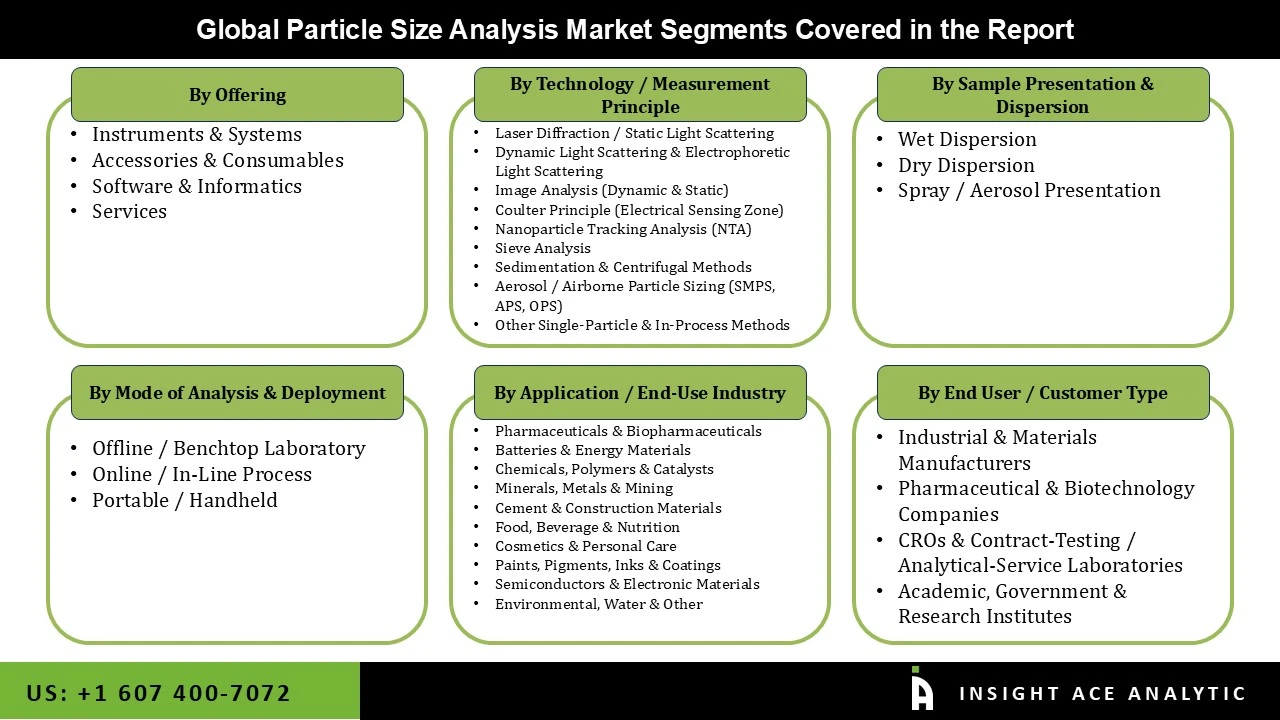
Particle Size Analysis Market Size, Share & Trends Analysis By Offering (Instruments & Systems, Accessories & Consumables, Software & Informatics, and Services), By Technology / Measurement Principle (Laser Diffraction / Static Light Scattering, Dynamic Light Scattering & Electrophoretic Light Scattering, Image Analysis (Dynamic & Static), Coulter Principle (Electrical Sensing Zone), Nanoparticle Tracking Analysis (NTA), Sieve Analysis, Sedimentation & Centrifugal Methods, Aerosol / Airborne Particle Sizing (SMPS, APS, OPS), and Other Single-Particle & In-Process Methods), By Sample Presentation & Dispersion (Wet Dispersion, Dry Dispersion, and Spray / Aerosol Presentation), By Mode of Analysis & Deployment (Offline / Benchtop Laboratory, Online / In-Line Process, and Portable / Handheld), By Application / End-Use Industry (Pharmaceuticals & Biopharmaceuticals, Batteries & Energy Materials, Chemicals, Polymers & Catalysts, Minerals, Metals & Mining, Cement & Construction Materials, Food, Beverage & Nutrition, Cosmetics & Personal Care, Paints, Pigments, Inks & Coatings, Semiconductors & Electronic Materials, and Environmental, Water & Other), By End User / Customer Type (Industrial & Materials Manufacturers, Pharmaceutical & Biotechnology Companies, CROs & Contract-Testing / Analytical-Service Laboratories, and Academic, Government & Research Institutes), By Region, and Segment Forecasts, 2026 to 2035
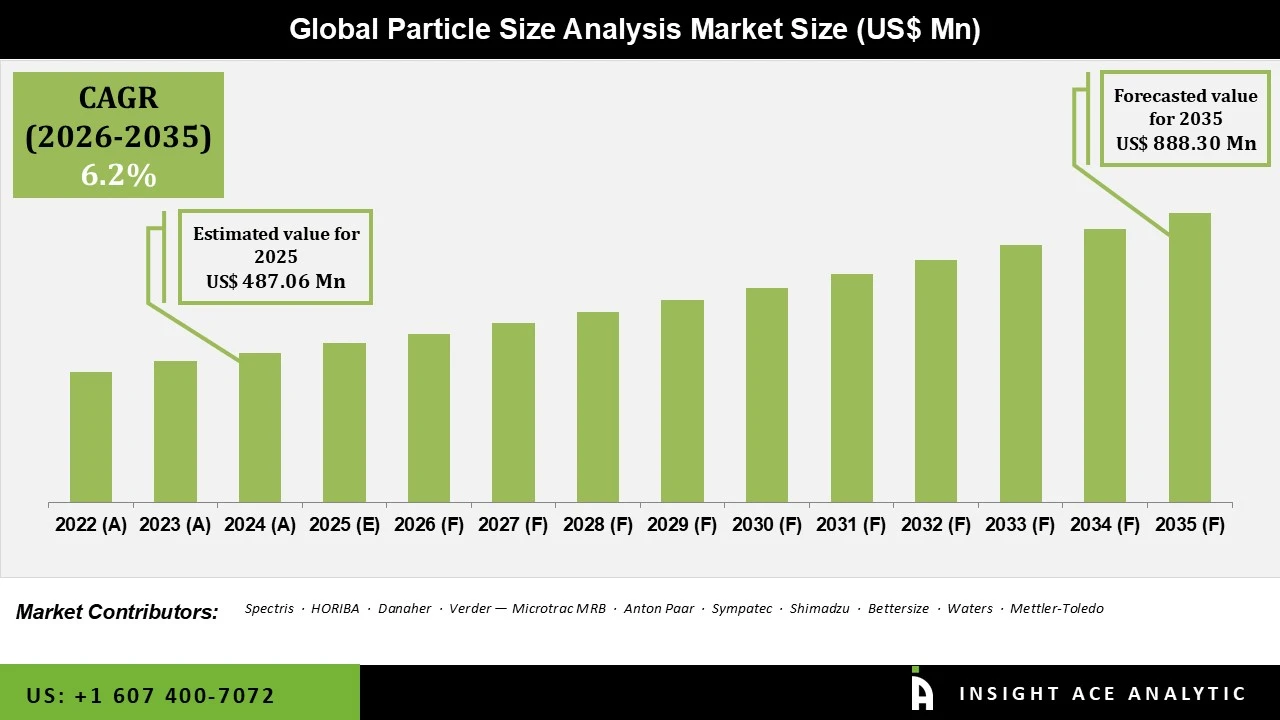
Particle size analysis is a method employed to ascertain the size distribution of particles inside a sample. Particle size is a crucial metric in various industries, such as medicines, chemicals, food, and materials science, as it can affect product performance, quality, stability, and process efficiency. Hence, the adoption of Particle Size Analysis is expected to increase in the near future as concerns grow over the development of nanotechnology. Growing advancement in particle size analysis tools and software improve their speed, accuracy, and ease of use. These factors are expected to propel the growth of the global Particle Size Analysis market. Moreover, rising consumer buying power, the easy availability of pharmaceuticals, and advancements in diagnostics are some of the other factors may augment the target market growth. The increasing demand for pharmaceutical products globally is expected to boost the market expansion in the coming years.
However, the high cost of particle size analysis, coupled with the COVID-19 outbreak, are factors that may hinder the growth of the target market during the forecast period. Furthermore, rapidly increasing R&D activities, government initiatives to use advanced technology for production, and investments by prominent players are factors expected to create lucrative growth opportunities in terms of revenue for players operating in the global Particle Size Analysis market over the forecast period.
Competitive Landscape
Some Major Key Players In The Particle Size Analysis Market:
- Spectris plc
- HORIBA, Ltd.
- Danaher Corporation
- Anton Paar GmbH
- Bettersize Instruments Ltd.
- Brookhaven Instruments Corporation
- Fritsch GmbH - Milling and Sizing
- LS Instruments AG
- Mettler-Toledo International Inc.
- Micromeritics Instrument Corporation
- Microtrac Retsch GmbH
- Shimadzu Corporation
- Sympatec GmbH
- TSI Incorporated
- Dandong HMKTest Instrument Co., Ltd.
- Micromeritics Instrument Corporation
- PAMAS Partikelmess- und Analysesysteme GmbH
- Jinan Winner Particle Instrument Stock Co., Ltd.
- 3P Instruments GmbH & Co. KG
- Izon Science Limited
- CSC Scientific Company, Inc.
- InProcess-LSP B.V.
- Yokogawa Fluid Imaging Technologies, Inc.
- APIX Analytics S.A.
- Genizer LLC
- TechnoValue Solutions Pvt. Ltd.
- Other Market Players
Market Segmentation:
The Particle Size Analysis market is categorised on the basis of technology, dispersion, type, and end user. The technology segment cosists of laser diffraction, dynamic light scattering, imaging, (dynamic imaging, static imaging), coulter principle, nanoparticle tracking analysis (NTA), sieve analysis, and other technologies. By dispersion, the market is segmented into wet dispersion, dry dispersion, and spray dispersion. By type, the market is segmented into bench-tope analyzers and portable analyzers. By end user, the market is segmented into the healthcare industry, cosmetic industry, chemicals & petroleum industry, mining, food & beverage industry, minerals and cement industry, and other industries.
Based On Technology, The Laser Diffraction Segment Accounts For A Major Contributor To The Particle Size Analysis Market.
The laser diffraction category is expected to hold a major share of the global Particle Size Analysis market. This is attributed to its high accuracy and precision in measuring the distribution of particle size. Thus, compliance with stringent regulatory frameworks in several industries requires precise particle size analysis, making it an efficient tool. Additionally, with the increasing demand for precise measurements, laser diffraction provides detailed and trustworthy information about particle sizes.
The Healthcare Segment Witnessed A Rapid Growth.
The healthcare sector is likely to grow at a rapid rate in the global Particle Size Analysis market owing to the development of medical tools and devices like drug-eluting stents and implants. Moreover, it is also utilized in the development of diagnostic assays and tests, such as lateral flow tests, immunoassays, and point-of-care diagnostics. Hence, there is an increase in demand for Particle Size Analysis in the healthcare sector.
In The Region, The North American Particle Size Analysis Market Holds A Significant Revenue Share.
The North American Particle Size Analysis market is expected to report the prominent market revenue share in the near future. This can be attributed to the strong focus on nanotechnology development in the region, with the increasing adoption of Particle Size Analysis in different industries due to its accuracy, ease of use, and mean range of particle size. In addition, the increasing awareness about nanotechnology, government reforms and regulations for product quality, and high industry standards in the region are factors increasing the growth of the target market in the region. Also, the Asia Pacific is projected to grow at a rapid rate in the global Particle Size Analysis market due to a huge range of industries, such as pharmaceuticals, food & beverages, chemicals, and electronics, government initiatives, and increasing funding in various industries.
Recent Developments:
- In June 2024, Advantest Corporation introduced the WEL2100, a state-of-the-art nanoSCOUTER. The new product is made specifically to monitor particles, such as viruses, exosomes, and liquid nanoparticles used in medicine delivery. It can quickly and precisely quantify the number, size, and zeta potential of each particle, meeting the needs of biotechnology and pharmaceutical R&D.
Particle Size Analysis Market Report Scope
| Report Attribute | Specifications |
| Market Size Value In 202 | USD 487.06 Mn |
| Revenue Forecast In 2035 | USD 888.30 Mn |
| Growth Rate CAGR | CAGR of 6.2% from 2026 to 2035 |
| Quantitative Units | Representation of revenue in US$ Mn and CAGR from 2026 to 2035 |
| Historic Year | 2022 to 2024 |
| Forecast Year | 2026-2035 |
| Report Coverage | The forecast of revenue, the position of the company, the competitive market structure, growth prospects, and trends |
| Segments Covered | By Technology, Dispersion, Type, And End User |
| Regional Scope | North America; Europe; Asia Pacific; Latin America; Middle East & Africa |
| Country Scope | U.S.; Canada; U.K.; Germany; China; India; Japan; Brazil; Mexico; France; Italy; Spain; South East Asia; South Korea |
| Competitive Landscape | HORIBA, Danaher, Anton Paar GmbH, Bettersize Instruments Ltd., Brookhaven Instruments, Fristsch GmbH, LS Instruments, Mettler Toledo, Micromeritics Instrument Corporation, Microtrac Retsch GmbH, Shimadzu Corporation, Sympatec GmbH, TSI. And Others |
| Customization Scope | Free customization report with the procurement of the report and modifications to the regional and segment scope. Particular Geographic competitive landscape. |
| Pricing And Available Payment Methods | Explore pricing alternatives that are customized to your particular study requirements. |
Segmentation of Particle Size Analysis Market-
Particle Size Analysis Market By Offering:
• Instruments & Systems
◦ Benchtop Laser-Diffraction & Light-Scattering Analysers
◦ Dynamic Light Scattering & Zeta-Potential Systems
◦ Image-Analysis Systems (Dynamic & Static)
◦ Coulter-Principle (Electrical Sensing Zone) Analysers
◦ Nanoparticle-Tracking & Single-Particle Systems (NTA, TRPS)
◦ Sieve Shakers & Sedimentation Systems
◦ Aerosol / Airborne Particle Sizers (SMPS, APS, OPS)
◦ In-Line / Process Particle-Sizing Systems
• Accessories & Consumables
◦ Dispersion Units, Cells, Cuvettes & Sample Handlers
◦ Reference & Calibration Standards (CRMs)
◦ Nanopores, Apertures, Filters & Replaceable Optical Components
• Software & Informatics
◦ Instrument Control & Data-Reduction Software
◦ Data-Integrity, 21 CFR Part 11 & Fleet-Management Software
◦ AI/ML Data-Quality, Method-Development & Morphology-Classification Software
• Services
◦ Installation, IQ/OQ/PQ, Calibration & Preventive Maintenance
◦ Method Development, Validation & Training
◦ Contract Particle-Sizing & Analytical Testing
Particle Size Analysis Market By Technology / Measurement Principle
• Laser Diffraction / Static Light Scattering
• Dynamic Light Scattering & Electrophoretic Light Scattering
• Image Analysis (Dynamic & Static)
• Coulter Principle (Electrical Sensing Zone)
• Nanoparticle Tracking Analysis (NTA)
• Sieve Analysis
• Sedimentation & Centrifugal Methods
• Aerosol / Airborne Particle Sizing (SMPS, APS, OPS)
• Other Single-Particle & In-Process Methods (TRPS, FBRM, Acoustic)
Particle Size Analysis Market By Sample Presentation & Dispersion
• Wet Dispersion
• Dry Dispersion
• Spray / Aerosol Presentation
Particle Size Analysis Market By Mode of Analysis & Deployment
• Offline / Benchtop Laboratory
• Online / In-Line Process
• Portable / Handheld
Particle Size Analysis Market By Application / End-Use Industry
• Pharmaceuticals & Biopharmaceuticals
• Batteries & Energy Materials
• Chemicals, Polymers & Catalysts
• Minerals, Metals & Mining
• Cement & Construction Materials
• Food, Beverage & Nutrition
• Cosmetics & Personal Care
• Paints, Pigments, Inks & Coatings
• Semiconductors & Electronic Materials
• Environmental, Water & Other
Particle Size Analysis Market By End User / Customer Type
• Industrial & Materials Manufacturers
• Pharmaceutical & Biotechnology Companies
• CROs & Contract-Testing / Analytical-Service Laboratories
• Academic, Government & Research Institutes
Particle Size Analysis Market By Region
North America-
• United States
• Canada
• Mexico
Europe-
• Germany
• United Kingdom
• France
• Italy
• Spain
• Switzerland
• Nordics
• Rest of Europe
Asia Pacific-
• China
• Japan
• India
• South Korea
• Taiwan
• Australia
• Rest of Asia Pacific
Latin America-
• Brazil
• Argentina
• Rest of Latin America
Middle East & Africa-
• GCC
• Israel
• South Africa
• Rest of MEA
Research Design and Approach
This study employed a multi-step, mixed-method research approach that integrates:
- Secondary research
- Primary research
- Data triangulation
- Hybrid top-down and bottom-up modelling
- Forecasting and scenario analysis
This approach ensures a balanced and validated understanding of both macro- and micro-level market factors influencing the market.
Secondary Research
Secondary research for this study involved the collection, review, and analysis of publicly available and paid data sources to build the initial fact base, understand historical market behaviour, identify data gaps, and refine the hypotheses for primary research.
Sources Consulted
Secondary data for the market study was gathered from multiple credible sources, including:
- Government databases, regulatory bodies, and public institutions
- International organizations (WHO, OECD, IMF, World Bank, etc.)
- Commercial and paid databases
- Industry associations, trade publications, and technical journals
- Company annual reports, investor presentations, press releases, and SEC filings
- Academic research papers, patents, and scientific literature
- Previous market research publications and syndicated reports
These sources were used to compile historical data, market volumes/prices, industry trends, technological developments, and competitive insights.

Primary Research
Primary research was conducted to validate secondary data, understand real-time market dynamics, capture price points and adoption trends, and verify the assumptions used in the market modelling.
Stakeholders Interviewed
Primary interviews for this study involved:
- Manufacturers and suppliers in the market value chain
- Distributors, channel partners, and integrators
- End-users / customers (e.g., hospitals, labs, enterprises, consumers, etc., depending on the market)
- Industry experts, technology specialists, consultants, and regulatory professionals
- Senior executives (CEOs, CTOs, VPs, Directors) and product managers
Interview Process
Interviews were conducted via:
- Structured and semi-structured questionnaires
- Telephonic and video interactions
- Email correspondences
- Expert consultation sessions
Primary insights were incorporated into demand modelling, pricing analysis, technology evaluation, and market share estimation.
Data Processing, Normalization, and Validation
All collected data were processed and normalized to ensure consistency and comparability across regions and time frames.
The data validation process included:
- Standardization of units (currency conversions, volume units, inflation adjustments)
- Cross-verification of data points across multiple secondary sources
- Normalization of inconsistent datasets
- Identification and resolution of data gaps
- Outlier detection and removal through algorithmic and manual checks
- Plausibility and coherence checks across segments and geographies
This ensured that the dataset used for modelling was clean, robust, and reliable.
Market Size Estimation and Data Triangulation
Bottom-Up Approach
The bottom-up approach involved aggregating segment-level data, such as:
- Company revenues
- Product-level sales
- Installed base/usage volumes
- Adoption and penetration rates
- Pricing analysis
This method was primarily used when detailed micro-level market data were available.

Top-Down Approach
The top-down approach used macro-level indicators:
- Parent market benchmarks
- Global/regional industry trends
- Economic indicators (GDP, demographics, spending patterns)
- Penetration and usage ratios
This approach was used for segments where granular data were limited or inconsistent.
Hybrid Triangulation Approach
To ensure accuracy, a triangulated hybrid model was used. This included:
- Reconciling top-down and bottom-up estimates
- Cross-checking revenues, volumes, and pricing assumptions
- Incorporating expert insights to validate segment splits and adoption rates
This multi-angle validation yielded the final market size.
Forecasting Framework and Scenario Modelling
Market forecasts were developed using a combination of time-series modelling, adoption curve analysis, and driver-based forecasting tools.
Forecasting Methods
- Time-series modelling
- S-curve and diffusion models (for emerging technologies)
- Driver-based forecasting (GDP, disposable income, adoption rates, regulatory changes)
- Price elasticity models
- Market maturity and lifecycle-based projections
Scenario Analysis
Given inherent uncertainties, three scenarios were constructed:
- Base-Case Scenario: Expected trajectory under current conditions
- Optimistic Scenario: High adoption, favourable regulation, strong economic tailwinds
- Conservative Scenario: Slow adoption, regulatory delays, economic constraints
Sensitivity testing was conducted on key variables, including pricing, demand elasticity, and regional adoption.
Request Customization
Add countries, segments, company profiles, or extend forecast — free 10% customization with purchase.
Customize This Report →Enquire Before Buying
Speak with our analyst team about scope, methodology, pricing, or deliverable formats.
Enquire Now →Frequently Asked Questions
The Particle Size Analysis Market Size is valued at USD 431.9 Mn in 2023 and is predicted to reach USD 698.5 Mn by the year 2031
The Particle Size Analysis Market is expected to grow at a 6.4% CAGR during the forecast period for 2024-2031.
HORIBA, Danaher, Anton Paar GmbH, Bettersize Instruments Ltd., Brookhaven Instruments, Fristsch GmbH, LS Instruments, Mettler Toledo, Micromeritics In
Technology, Dispersion, Type, and End User are the key segments of the Particle Size Analysis Market.
North American region is leading the Particle Size Analysis Market.