Oncology CDMO Market Size, Share, Trend, Scope Report 2026 to 2035
What is Oncology CDMO Market Size?
Oncology CDMO Market Size is valued at US$ 48.77 Bn in 2025 and is predicted to reach US$ 127.37 Bn by the year 2035 at an 10.2% CAGR during the forecast period for 2026 to 2035.
Oncology CDMO Market Size, Share & Trends Analysis Distribution By Service Type (Process Development & Optimization, Active Pharmaceutical Ingredient (API) Manufacturing, Drug Product Manufacturing (Formulation & Fill-Finish), Analytical & Quality Testing, Packaging & Labeling, Regulatory & Compliance Support, and Cell & Gene Therapy CDMO Services), By Drug Type (Small Molecules, Biologics, Monoclonal Antibodies, Antibody-Drug Conjugates (ADCs), Cell & Gene Therapies, and Vaccines), By Phase (Preclinical, Clinical (Phase I, II, III), and Commercial), By End User, By The Oncology Therapy Area, and Segment Forecasts, 2026 to 2035
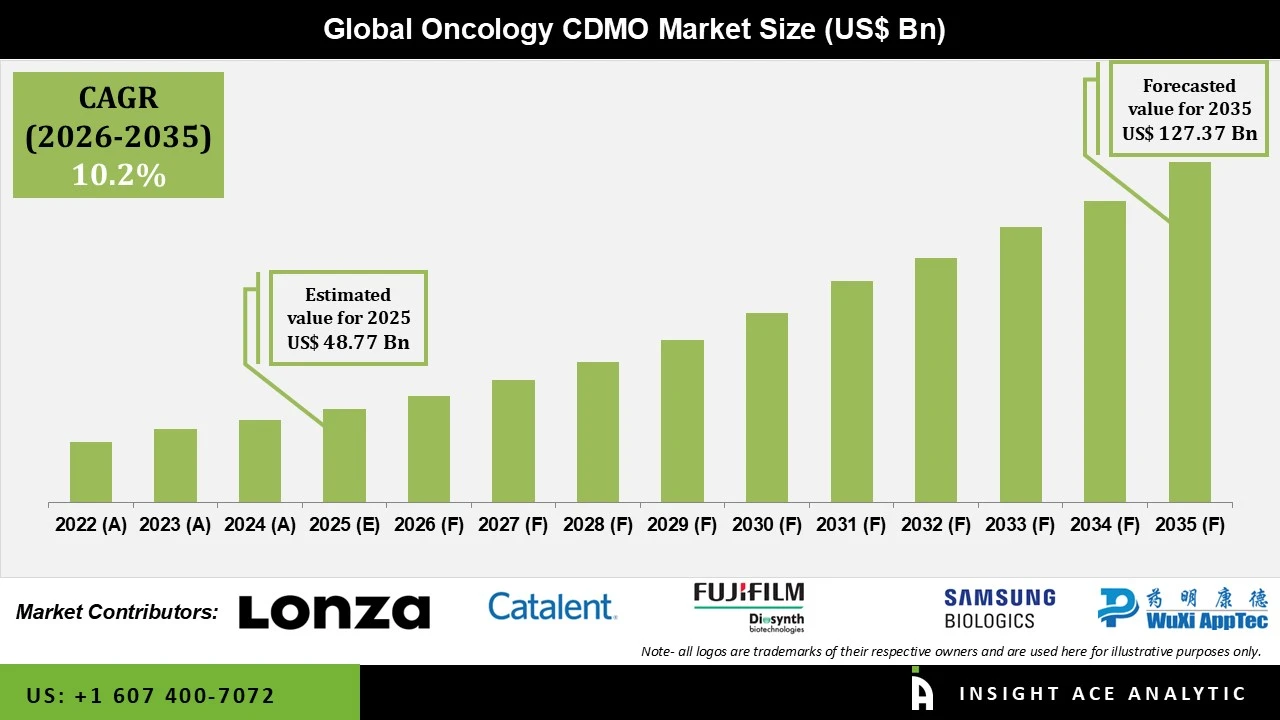
Oncology CDMOs are essential in assisting pharmaceutical companies in transforming early ideas for cancer treatments into products that are ready for the market. From process development and scale-up to GMP production of complicated small compounds, biologics, ADCs, and cell or gene treatments, they offer end-to-end support. Businesses depend on these partners for innovative manufacturing platforms, specialist knowledge, and regulatory advice that expedites development. They are crucial for expediting the delivery of cutting-edge cancer treatments because of their adaptable capability and technical proficiency. The global market for oncology CDMO is expanding due to the complexity of cancer drug development, which forces businesses to look for specialist partners that can manage complicated compounds and sophisticated production requirements.
The need for effective, scalable outsourcing partners is another element propelling the oncology CDMO market. The market is expanding because quick development of complicated cancer treatments that call for specific production and development skills. The NIH estimates that there breast, lung, colon, and prostate cancer were the most frequent malignancies worldwide in 2022, with an anticipated 20 million new cases and 9.7 million cancer deaths. However, steep investment needed for high-containment facilities, advanced technologies, and skilled scientists who can manage biologics, ADCs, and personalized therapies are some of the obstacles impeding the growth of the oncology CDMO sector. Over the course of the forecast period, opportunities for the oncology CDMO market will be created by specific expanding pipeline of next-generation therapeutics.
Competitive Landscape
Some of the Key Players in Oncology CDMO Market:
• Lonza Group Ltd
• Catalent, Inc. — a Novo Holdings company
• WuXi AppTec Co., Ltd. — WuXi STA
• WuXi Biologics Cayman Inc. — WuXi Biologics and WuXi XDC
• Samsung Biologics Co., Ltd.
• FUJIFILM Biotechnologies
• Thermo Fisher Scientific Inc. — Patheon
• Boehringer Ingelheim — BioXcellence
• AbbVie Inc. — AbbVie Contract Manufacturing
• Siegfried Holding AG
• Recipharm AB
• AGC Inc. — AGC Biologics
• Jubilant Biosys Limited
• Asymchem Laboratories Tianjin Co., Ltd.
• Piramal Pharma Limited
Market Segmentation:
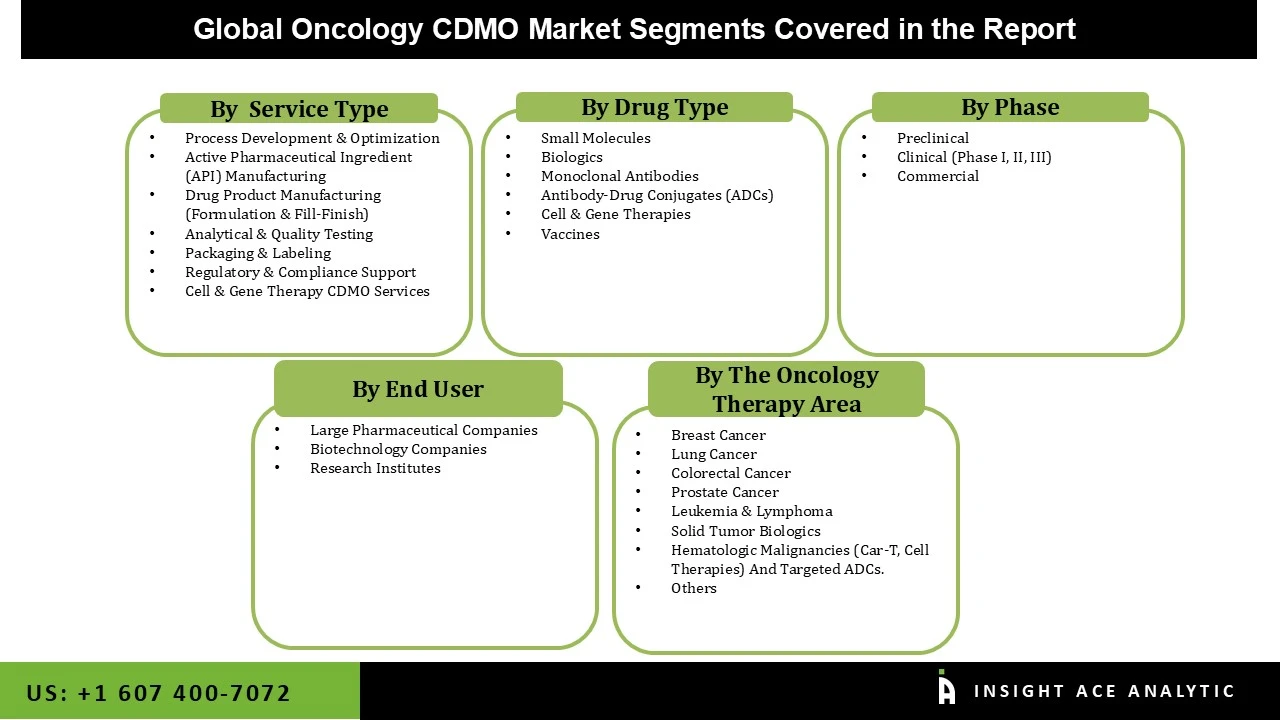
The oncology cdmo market is segmented by service type, drug type, phase, end user, and the oncology therapy area. By service type, the market is segmented into process development & optimization, active pharmaceutical ingredient (API) manufacturing, drug product manufacturing (formulation & fill-finish), analytical & quality testing, packaging & labeling, regulatory & compliance support, and cell & gene therapy CDMO services. By drug type, the market is segmented into small molecules, biologics, monoclonal antibodies, antibody-drug conjugates (ADCs), cell & gene therapies, and vaccines. By phase, the market is segmented into preclinical, clinical (phase I, II, III), and commercial. by end user, the market is segmented into large pharmaceutical companies, biotechnology companies, and research institutes. By the oncology therapy area, the market is segmented into breast cancer, lung cancer, colorectal cancer, prostate cancer, leukemia & lymphoma, solid tumor biologics, hematologic malignancies (CAR-T, cell therapies) and targeted adcs., and others.
By Service Type, the Drug Product Manufacturing (Formulation & Fill-Finish) Segment is Expected to Drive the Oncology CDMO Market
The drug product manufacturing (formulation & fill-finish) category led the oncology CDMO market in 2025. As the vital link between medication development and patient delivery, drug product manufacturing has grown to be a dominant force in the cancer CDMO industry. These services, which are essential for oncology treatments, include formulation development, sterile fill-finish operations, packaging, and quality assurance. The significance of this market is further highlighted by the growing need for parenteral oncology medications, especially injectables. Its long-term supremacy is ensured by the requirement for scalability, from clinical batches to commercial supplies. Ultimately, by connecting innovation and patient care, drug product manufacturing serves as the foundation for oncology CDMO services.
Monoclonal Antibodies Segment by Drug Type is Growing at the Highest Rate in the Oncology CDMO Market
The largest and fastest-growing drug type is monoclonal antibodies, followed by small compounds, recombinant proteins, and other biologics designed to modify disease at the molecular level. These treatments continue to be the main source of outsourced CDMO services since oncology research is firmly grounded in molecular pathways. Their importance is further reinforced by their wide range of uses in solid tumors, hematologic malignancies, and uncommon oncology diseases. Molecular biology-focused CDMOs offer analytical support for characterisation, stability, and quality control in addition to production capabilities. This dominance emphasizes how crucial molecular biology is to the development of oncology drugs.
Regionally, North America Led the Oncology CDMO Market
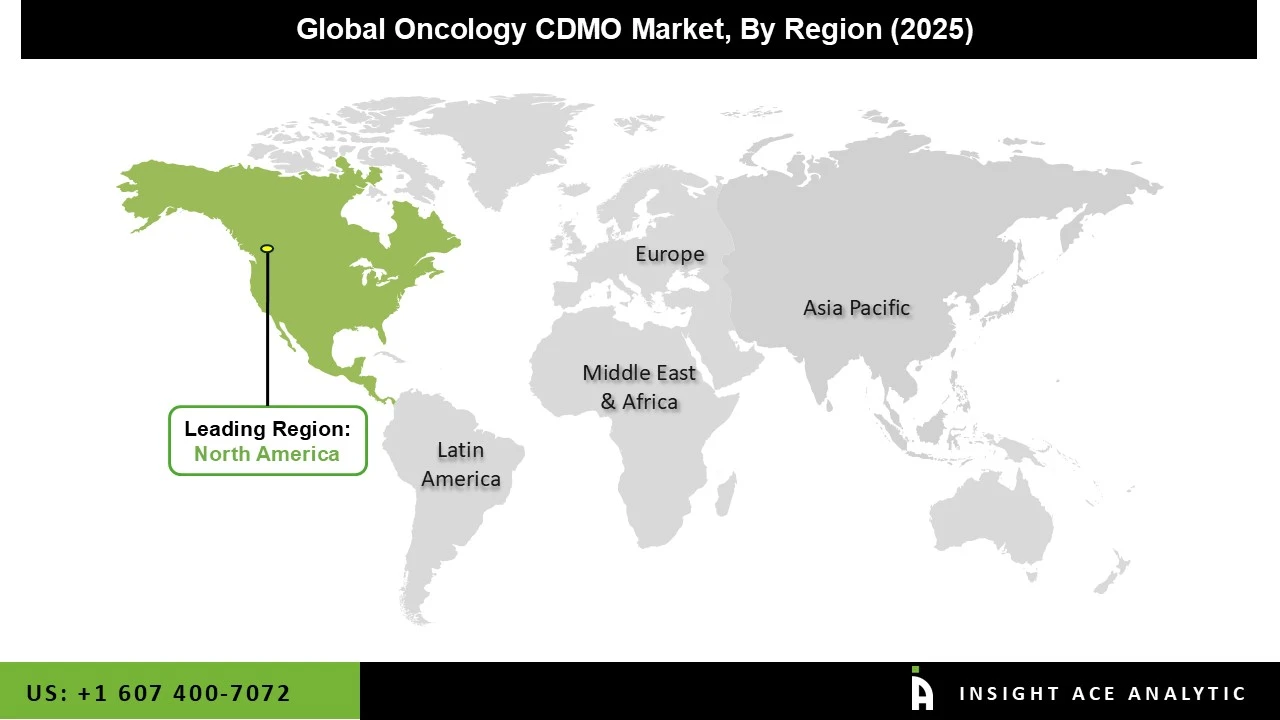
North America dominated the oncology CDMO market in 2025. The United States is at the forefront of this expansion. This is due to the region has a robust foundation of pharmaceutical and biotech businesses with extensive pipelines in cancer research. It gains from a highly skilled workforce in science and regulation, early adoption of new manufacturing technology, and sophisticated R&D infrastructure. The region's capacity to assist complicated oncology drug development is further strengthened by large funding amounts, robust clinical trial activity, and the existence of top CDMOs.
Rapid expansion of manufacturing capacity is becoming more and more common in the Asia-Pacific area, the oncology CDMO market is expanding at the strongest and fastest rate in this region. Additionally, significant investments in high-end biologics and oncology research is fueling market growth. Lower production costs, expanding scientific talent, and aggressive investment from both governments and private players are drawing global companies to outsource more work to APAC.
Oncology CDMO Market Report Scope:
| Report Attribute | Specifications |
| Market Size Value In 2025 | USD 48.77 Bn |
| Revenue Forecast In 2035 | USD 127.36 Bn |
| Growth Rate CAGR | CAGR of 10.2% from 2026 to 2035 |
| Quantitative Units | Representation of revenue in US$ Bn and CAGR from 2026 to 2035 |
| Historic Year | 2022 to 2025 |
| Forecast Year | 2026-2035 |
| Report Coverage | The forecast of revenue, the position of the company, the competitive market structure, growth prospects, and trends |
| Segments Covered | By Service Type, By Drug Type, By Phase, By End User, By The Oncology Therapy Area, and By Region |
| Regional Scope | North America; Europe; Asia Pacific; Latin America; Middle East & Africa |
| Country Scope | U.S.; Canada; Germany; The UK; France; Italy; Spain; Rest of Europe; China; Japan; India; South Korea; Southeast Asia; Rest of Asia Pacific; Brazil; Argentina; Mexico; Rest of Latin America; GCC Countries; South Africa; Rest of the Middle East and Africa |
| Competitive Landscape | Lonza Group Ltd., Catalent, Inc., a Novo Holdings company, WuXi AppTec Co., Ltd. through WuXi STA, WuXi Biologics Cayman Inc. through WuXi Biologics and WuXi XDC, Samsung Biologics Co., Ltd., FUJIFILM Biotechnologies, Thermo Fisher Scientific Inc. through Patheon, Boehringer Ingelheim through BioXcellence, AbbVie Inc. through AbbVie Contract Manufacturing, Siegfried Holding AG, Recipharm AB, AGC Inc. through AGC Biologics, Jubilant Biosys Limited, Asymchem Laboratories Tianjin Co., Ltd., and Piramal Pharma Limited through Piramal Pharma Solutions. |
| Customization Scope | Free customization report with the procurement of the report, Modifications to the regional and segment scope. Geographic competitive landscape. |
| Pricing and Available Payment Methods | Explore pricing alternatives that are customized to your particular study requirements. |
Segmentation of Oncology CDMO Market -
Oncology CDMO Market by Service Type-
• Process Development & Optimization
• Active Pharmaceutical Ingredient (API) Manufacturing
• Drug Product Manufacturing (Formulation & Fill-Finish)
• Analytical & Quality Testing
• Packaging & Labeling
• Regulatory & Compliance Support
• Cell & Gene Therapy CDMO Services
Oncology CDMO Market by Drug Type-
• Small Molecules
• Biologics
• Monoclonal Antibodies
• Antibody-Drug Conjugates (ADCs)
• Cell & Gene Therapies
• Vaccines
Oncology CDMO Market by Phase-
• Preclinical
• Clinical (Phase I, II, III)
• Commercial
Oncology CDMO Market by End User-
• Large Pharmaceutical Companies
• Biotechnology Companies
• Research Institutes
Oncology CDMO Market by The Oncology Therapy Area-
• Breast Cancer
• Lung Cancer
• Colorectal Cancer
• Prostate Cancer
• Leukemia & Lymphoma
• Solid Tumor Biologics
• Hematologic Malignancies (Car-T, Cell Therapies) And Targeted ADCs.
• Others
Oncology CDMO Market by Region-
North America-
• The US
• Canada
Europe-
• Germany
• The UK
• France
• Italy
• Spain
• Rest of Europe
Asia-Pacific-
• China
• Japan
• India
• South Korea
• Southeast Asia
• Rest of Asia Pacific
Latin America-
• Brazil
• Argentina
• Mexico
• Rest of Latin America
Middle East & Africa-
• GCC Countries
• South Africa
• Rest of the Middle East and Africa
Research Design and Approach
This study employed a multi-step, mixed-method research approach that integrates:
- Secondary research
- Primary research
- Data triangulation
- Hybrid top-down and bottom-up modelling
- Forecasting and scenario analysis
This approach ensures a balanced and validated understanding of both macro- and micro-level market factors influencing the market.
Secondary Research
Secondary research for this study involved the collection, review, and analysis of publicly available and paid data sources to build the initial fact base, understand historical market behaviour, identify data gaps, and refine the hypotheses for primary research.
Sources Consulted
Secondary data for the market study was gathered from multiple credible sources, including:
- Government databases, regulatory bodies, and public institutions
- International organizations (WHO, OECD, IMF, World Bank, etc.)
- Commercial and paid databases
- Industry associations, trade publications, and technical journals
- Company annual reports, investor presentations, press releases, and SEC filings
- Academic research papers, patents, and scientific literature
- Previous market research publications and syndicated reports
These sources were used to compile historical data, market volumes/prices, industry trends, technological developments, and competitive insights.

Primary Research
Primary research was conducted to validate secondary data, understand real-time market dynamics, capture price points and adoption trends, and verify the assumptions used in the market modelling.
Stakeholders Interviewed
Primary interviews for this study involved:
- Manufacturers and suppliers in the market value chain
- Distributors, channel partners, and integrators
- End-users / customers (e.g., hospitals, labs, enterprises, consumers, etc., depending on the market)
- Industry experts, technology specialists, consultants, and regulatory professionals
- Senior executives (CEOs, CTOs, VPs, Directors) and product managers
Interview Process
Interviews were conducted via:
- Structured and semi-structured questionnaires
- Telephonic and video interactions
- Email correspondences
- Expert consultation sessions
Primary insights were incorporated into demand modelling, pricing analysis, technology evaluation, and market share estimation.
Data Processing, Normalization, and Validation
All collected data were processed and normalized to ensure consistency and comparability across regions and time frames.
The data validation process included:
- Standardization of units (currency conversions, volume units, inflation adjustments)
- Cross-verification of data points across multiple secondary sources
- Normalization of inconsistent datasets
- Identification and resolution of data gaps
- Outlier detection and removal through algorithmic and manual checks
- Plausibility and coherence checks across segments and geographies
This ensured that the dataset used for modelling was clean, robust, and reliable.
Market Size Estimation and Data Triangulation
Bottom-Up Approach
The bottom-up approach involved aggregating segment-level data, such as:
- Company revenues
- Product-level sales
- Installed base/usage volumes
- Adoption and penetration rates
- Pricing analysis
This method was primarily used when detailed micro-level market data were available.

Top-Down Approach
The top-down approach used macro-level indicators:
- Parent market benchmarks
- Global/regional industry trends
- Economic indicators (GDP, demographics, spending patterns)
- Penetration and usage ratios
This approach was used for segments where granular data were limited or inconsistent.
Hybrid Triangulation Approach
To ensure accuracy, a triangulated hybrid model was used. This included:
- Reconciling top-down and bottom-up estimates
- Cross-checking revenues, volumes, and pricing assumptions
- Incorporating expert insights to validate segment splits and adoption rates
This multi-angle validation yielded the final market size.
Forecasting Framework and Scenario Modelling
Market forecasts were developed using a combination of time-series modelling, adoption curve analysis, and driver-based forecasting tools.
Forecasting Methods
- Time-series modelling
- S-curve and diffusion models (for emerging technologies)
- Driver-based forecasting (GDP, disposable income, adoption rates, regulatory changes)
- Price elasticity models
- Market maturity and lifecycle-based projections
Scenario Analysis
Given inherent uncertainties, three scenarios were constructed:
- Base-Case Scenario: Expected trajectory under current conditions
- Optimistic Scenario: High adoption, favourable regulation, strong economic tailwinds
- Conservative Scenario: Slow adoption, regulatory delays, economic constraints
Sensitivity testing was conducted on key variables, including pricing, demand elasticity, and regional adoption.
Request Customization
Add countries, segments, company profiles, or extend forecast — free 10% customization with purchase.
Customize This Report →Enquire Before Buying
Speak with our analyst team about scope, methodology, pricing, or deliverable formats.
Enquire Now →Frequently Asked Questions
Oncology CDMO Market Size is valued at US$ 48.77 Bn in 2025 and is predicted to reach US$ 127.37 Bn by the year 2035
Oncology CDMO Market is expected to grow at an 10.2% CAGR during the forecast period for 2026 to 2035.
Lonza Group Ltd., Catalent, Inc., a Novo Holdings company, WuXi AppTec Co., Ltd. through WuXi STA, WuXi Biologics Cayman Inc. through WuXi Biologics and WuXi XDC, Samsung Biologics Co., Ltd., FUJIFILM Biotechnologies, Thermo Fisher Scientific Inc. through Patheon, Boehringer Ingelheim through BioXcellence, AbbVie Inc. through AbbVie Contract Manufacturing, Siegfried Holding AG, Recipharm AB, AGC Inc. through AGC Biologics, Jubilant Biosys Limited, Asymchem Laboratories Tianjin Co., Ltd., and Piramal Pharma Limited through Piramal Pharma Solutions.
Oncology CDMO Market is segmented into By Service Type, By Drug Type, By Phase, By End User, By The Oncology Therapy Area, and By Region
North America region is leading the Oncology CDMO Market.