Next-Generation Biodegradable Plastics Market Size, Share, Trend, Revenue Report 2026 to 2035
What is Next-Generation Biodegradable Plastics Market Size?
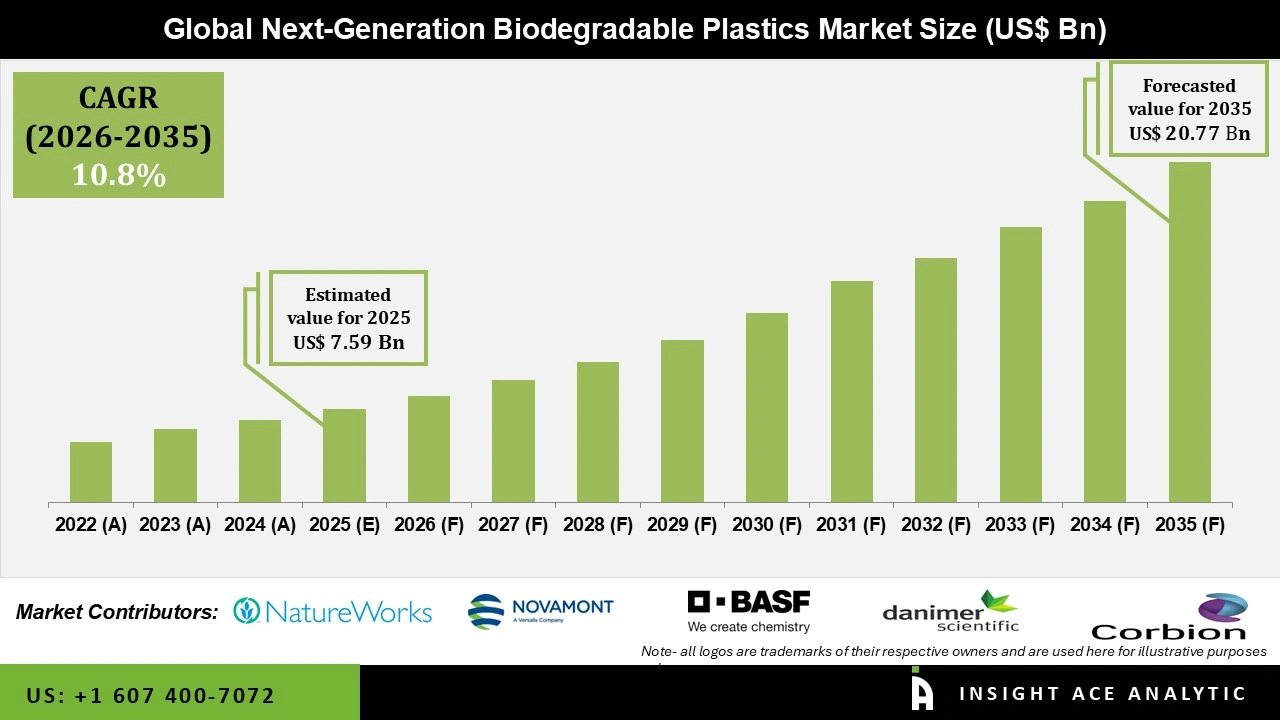
Global Next-Generation Biodegradable Plastics Market Size is valued at USD 7.59 Bn in 2025 and is predicted to reach USD 20.77 Bn by the year 2035 at a 10.8% CAGR during the forecast period for 2026 to 2035.
Next-Generation Biodegradable Plastics Market Size, Share & Trends Analysis Distribution by Type (Starch-Based Plastics, Polylactic Acid (PLA), Polybutylene Adipate Terephthalate (PBAT), Polyhydroxyalkanoates (PHA), and Others), Application (Automotive, Packaging, Consumer Goods, Textiles, Agriculture, and Others), End-user (Retail, Food & Beverage, Agriculture, Healthcare, and Others), and Segment Forecasts, 2026 to 2035
Next-generation biodegradable plastics are advanced polymers designed to decompose efficiently and safely within natural ecosystems. Synthesized from renewable feedstocks such as plant-based polymers, starch, or microbial sources these materials break down into non-toxic components like water, carbon dioxide, and biomass under specific environmental conditions. While retaining the strength, flexibility, and usability of conventional plastics, these plastics seek to lessen long-term environmental contamination, particularly in landfills and oceans. As part of sustainable development initiatives, they are being used more and more in packaging, agricultural, and medical applications. The next-generation biodegradable plastics market is growing rapidly toward sustainable packaging solutions due to stricter environmental regulations and shifting consumer preferences for environmentally friendly substitutes.
The next-generation biodegradable plastics are becoming more and more in demand as the industry looks for sustainable substitutes for traditional petroleum-based materials due to strict rules on plastic waste and growing environmental concerns. The next-generation biodegradable plastics market is expanding more quickly as a result of the growing usage of these polymers in packaging applications, especially in light of the quick growth of e-commerce and changing customer preferences for eco-friendly goods. Furthermore, the food and beverage sector is implementing biodegradable packaging options to lessen its impact on the environment and adhere to changing legal requirements. It is anticipated that the trend will continue as governments and businesses prioritize sustainable material usage and circular economy strategies. Moreover, the industry is being driven by improvements in biodegradable plastics' strength, flexibility, and functional qualities brought about by advances in material science.
In addition, the next-generation biodegradable plastics market will probably be influenced by ongoing advancements in manufacturing techniques as well as the growing accessibility of bio-based raw materials. Manufacturers are being further encouraged to invest in research and development by regulations that support environmentally friendly alternatives and provide regulatory support. Additionally, specialty biodegradable polymers made for certain end-use applications are becoming increasingly prevalent in the next-generation biodegradable plastics market, suggesting an emphasis on high-performance and application-specific solutions. The market for these cutting-edge biodegradable materials is anticipated to increase gradually as awareness of plastic pollution and environmental sustainability grows, especially in emerging economies where consumer and industrial adoption is growing quickly.
Competitive Landscape
Which are the Leading Players in Next-Generation Biodegradable Plastics Market?
- Mitsubishi Chemical Corporation
- NatureWorks LLC
- BASF SE
- Danimer Scientific, Inc.
- Novamont S.p.A.
- Biome Bioplastics
- Kaneka Corporation
- Biotec GmbH & Co.
- Corbion N.V.
- Total Corbion PLA
Market Dynamics
Driver
Rising Customer Demand for Environmentally Friendly Products
The next-generation biodegradable plastics market is anticipated to develop in the future due to growing customer demand for environmentally friendly products. Growing consumer knowledge of environmental issues, ethical concerns, and a desire to lessen carbon footprints and promote eco-friendly activities are driving growing demand for sustainable products. Single-use plastics are prohibited or restricted in many nations, and regulations supporting sustainable materials have also been put in place.Simultaneously, customers are actively favoring eco-friendly products, particularly in packaging and everyday items, as they become more ecologically conscious. The next-generation biodegradable plastics market will be driven by rising customer demand for sustainable products.
Restrain/Challenge
Absence of Sufficient Infrastructure for Composting and Trash Management
A major barrier to the next-generation biodegradable polymers market is the absence of sufficient infrastructure for composting and trash management. Many of these plastics need industrial composting facilities with regulated temperature, humidity, and microbial activity to properly decompose, even though they are made to break down under certain conditions. Such infrastructure is scarce or unevenly dispersed in places such as India and other developing nations, which results in inappropriate disposal in landfills or traditional recycling streams, where degradation does not take place as planned. In addition to diminishing their environmental benefits, this may lead to customer uncertainty about disposal procedures. Additionally, recycling procedures may be hampered by the blending of biodegradable and conventional plastics, creating operational difficulties. Because of this, despite the sustainability benefits of these materials, their full potential is still untapped, which slows their general adoption.
Starch-Based Plastics Segment is Expected to Drive the Next-Generation Biodegradable Plastics Market
The starch-based plastics category held the largest share in the Next-Generation Biodegradable Plastics market in 2025 because of their superior biodegradability, renewable supply, and adaptability in a variety of applications, including consumer items and packaging. Starch-based plastics are a recommended option for sectors looking for sustainable alternatives to traditional plastics due to their eco-friendliness and compatibility with current manufacturing methods. Additionally, starch-based plastics are very biodegradable, which fits in nicely with growing customer demand for eco-friendly goods and more stringent laws around plastic waste. Moreover, improvements in processing methods have increased the next-generation starch-based materials' strength and flexibility, allowing them to be used in a wider variety of applications at comparatively inexpensive costs.
Packaging Segment is Growing at the Highest Rate in the Next-Generation Biodegradable Plastics Market
In 2025, the packaging category dominated the Next-Generation Biodegradable Plastics market. The packaging category is expanding due to rising consumer demand, population expansion, improved lifestyles, and higher disposable income. The growth prospects for next-generation biodegradable plastics market include increased demand from developing countries, increased consumer awareness, and the expansion of e-commerce platforms. Additionally, the next-generation biodegradable plastics market’s demand has increased due to growing environmental concerns and increased knowledge of recycling and trash disposal. The market participants have been motivated to employ biodegradable materials by the need to reduce the environmental impact of packaging and adopt sustainable packaging choices.
Why North America Led the Next-Generation Biodegradable Plastics Market?
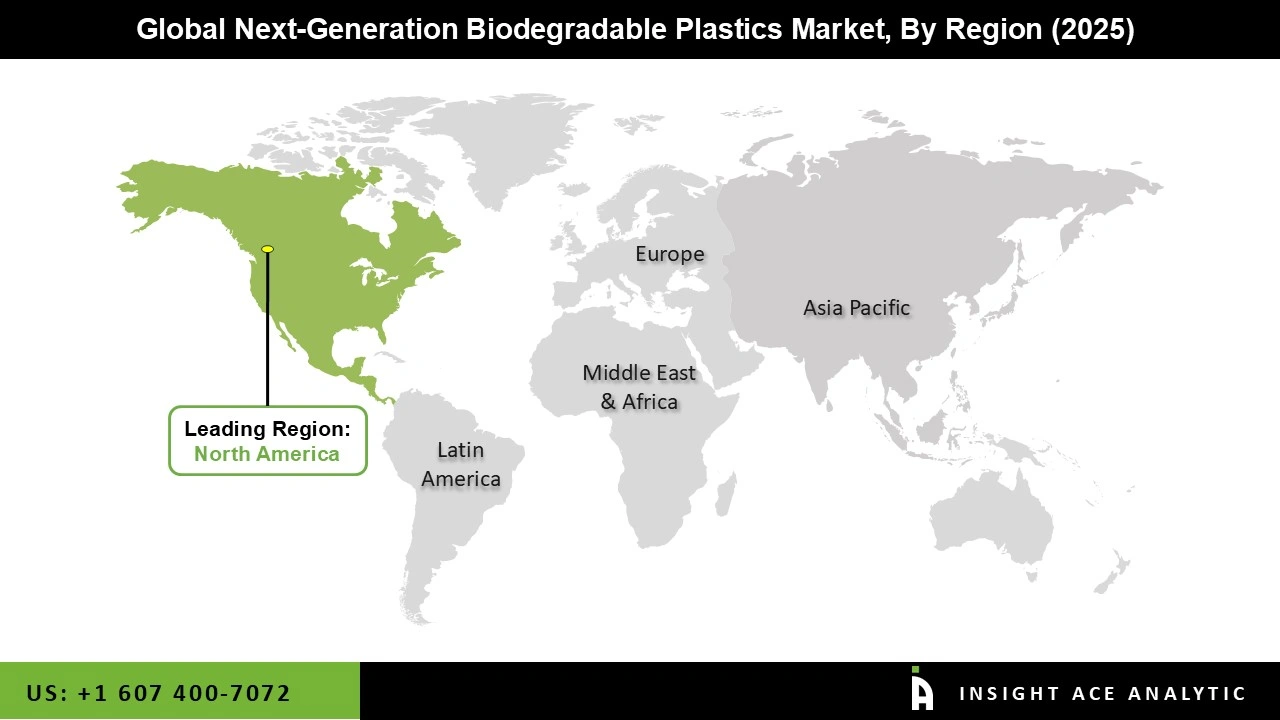
The Next-Generation Biodegradable Plastics market was dominated by North America region in 2025 because consumers are very aware of environmental sustainability, and there is substantial regulatory support for it. Single-use plastics are being outlawed, and environmentally friendly substitutes are being promoted by governments, especially in the US and Canada. The development and commercialization of biodegradable materials are being accelerated by the existence of cutting-edge research institutes and top businesses.
Additionally, in order to satisfy both consumer expectations and business environmental aims, prominent brands are also implementing sustainable packaging solutions. Furthermore, North America is a major contributor to worldwide growth because of its well-developed waste management infrastructure, which includes composting facilities in some areas and further helps the next-generation biodegradable plastics market expansion.
Key Development
- September 2024: PepsiCo and Danimer Scientific collaborated to create biodegradable packaging options for snack food applications. The partnership focuses on developing PHA-based films that preserve food freshness and offer marine biodegradability for less of an impact on the environment.
Next-Generation Biodegradable Plastics Market Report Scope :
| Report Attribute | Specifications |
| Market size value in 2025 | USD 7.59 Bn |
| Revenue forecast in 2035 | USD 20.77 Bn |
| Growth Rate CAGR | CAGR of 10.8% from 2026 to 2035 |
| Quantitative Units | Representation of revenue in US$ Bn and CAGR from 2026 to 2035 |
| Historic Year | 2022 to 2025 |
| Forecast Year | 2026 to 2035 |
| Report Coverage | The forecast of revenue, the position of the company, the competitive market structure, growth prospects, and trends |
| Segments Covered | Type, Application, End-user, and By Region |
| Regional Scope | North America; Europe; Asia Pacific; Latin America; Middle East & Africa |
| Country Scope | U.S.; Canada; U.K.; Germany; China; India; Japan; Brazil; Mexico; The UK; France; Italy; Spain; China; Japan; India; South Korea; Southeast Asia; South Korea; Southeast Asia |
| Competitive Landscape | Mitsubishi Chemical Corporation, NatureWorks LLC, BASF SE, Danimer Scientific, Inc., Novamont S.p.A., Biome Bioplastics, Kaneka Corporation, Biotec GmbH & Co., Corbion N.V., and Total Corbion PLA |
| Customization Scope | Free customization report with the procurement of the report, Modifications to the regional and segment scope. Geographic competitive landscape. |
| Pricing and Available Payment Methods | Explore pricing alternatives that are customized to your particular study requirements. |
Segmentations of Next-Generation Biodegradable Plastics Market :
Next-Generation Biodegradable Plastics Market by Type-
- Starch-Based Plastics
- Polylactic Acid (PLA)
- Polybutylene Adipate Terephthalate (PBAT)
- Polyhydroxyalkanoates (PHA)
- Others
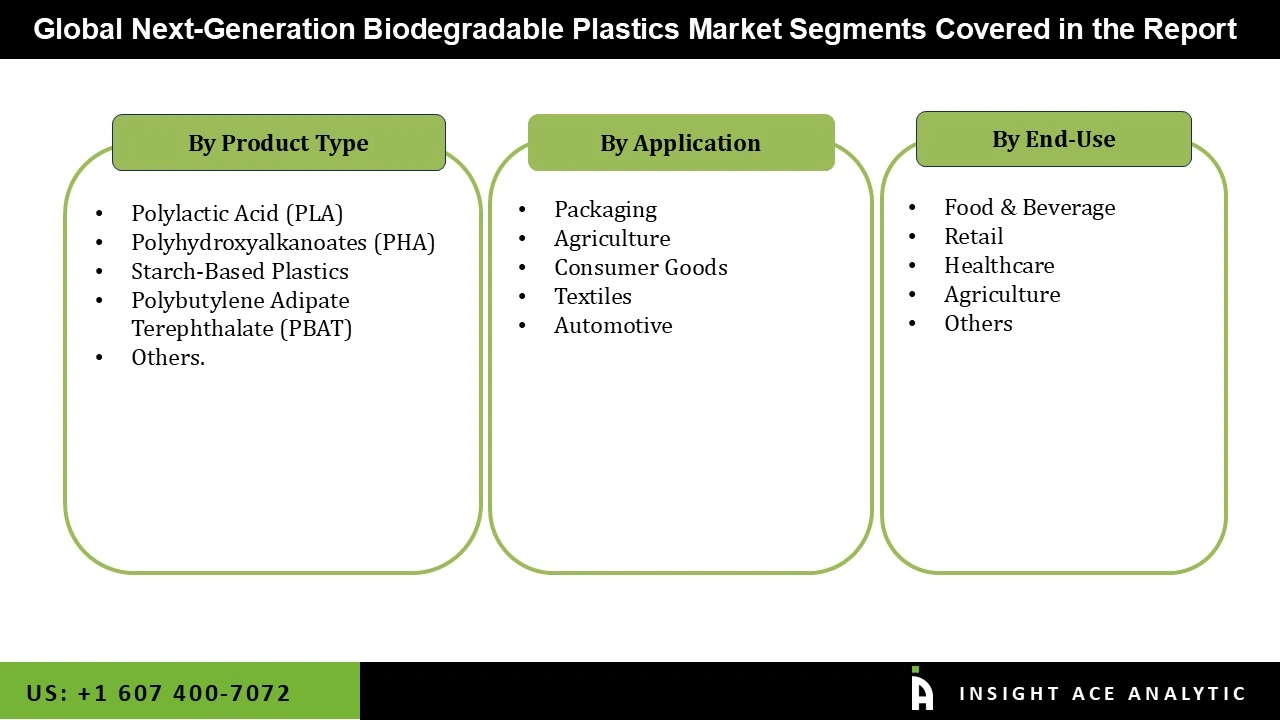
Next-Generation Biodegradable Plastics Market by Application-
- Automotive
- Packaging
- Consumer Goods
- Textiles
- Agriculture
- Others
Next-Generation Biodegradable Plastics Market by End-user-
- Retail
- Food & Beverage
- Agriculture
- Healthcare
- Others
Next-Generation Biodegradable Plastics Market By Region-
- North America-
- The US
- Canada
- Europe-
- Germany
- The UK
- France
- Italy
- Spain
- Rest of Europe
- Asia-Pacific-
- China
- Japan
- India
- South Korea
- South East Asia
- Rest of Asia Pacific
- Latin America-
- Brazil
- Argentina
- Mexico
- Rest of Latin America
- Middle East & Africa-
- GCC Countries
- South Africa
- Rest of Middle East and Africa
Research Design and Approach
This study employed a multi-step, mixed-method research approach that integrates:
- Secondary research
- Primary research
- Data triangulation
- Hybrid top-down and bottom-up modelling
- Forecasting and scenario analysis
This approach ensures a balanced and validated understanding of both macro- and micro-level market factors influencing the market.
Secondary Research
Secondary research for this study involved the collection, review, and analysis of publicly available and paid data sources to build the initial fact base, understand historical market behaviour, identify data gaps, and refine the hypotheses for primary research.
Sources Consulted
Secondary data for the market study was gathered from multiple credible sources, including:
- Government databases, regulatory bodies, and public institutions
- International organizations (WHO, OECD, IMF, World Bank, etc.)
- Commercial and paid databases
- Industry associations, trade publications, and technical journals
- Company annual reports, investor presentations, press releases, and SEC filings
- Academic research papers, patents, and scientific literature
- Previous market research publications and syndicated reports
These sources were used to compile historical data, market volumes/prices, industry trends, technological developments, and competitive insights.

Primary Research
Primary research was conducted to validate secondary data, understand real-time market dynamics, capture price points and adoption trends, and verify the assumptions used in the market modelling.
Stakeholders Interviewed
Primary interviews for this study involved:
- Manufacturers and suppliers in the market value chain
- Distributors, channel partners, and integrators
- End-users / customers (e.g., hospitals, labs, enterprises, consumers, etc., depending on the market)
- Industry experts, technology specialists, consultants, and regulatory professionals
- Senior executives (CEOs, CTOs, VPs, Directors) and product managers
Interview Process
Interviews were conducted via:
- Structured and semi-structured questionnaires
- Telephonic and video interactions
- Email correspondences
- Expert consultation sessions
Primary insights were incorporated into demand modelling, pricing analysis, technology evaluation, and market share estimation.
Data Processing, Normalization, and Validation
All collected data were processed and normalized to ensure consistency and comparability across regions and time frames.
The data validation process included:
- Standardization of units (currency conversions, volume units, inflation adjustments)
- Cross-verification of data points across multiple secondary sources
- Normalization of inconsistent datasets
- Identification and resolution of data gaps
- Outlier detection and removal through algorithmic and manual checks
- Plausibility and coherence checks across segments and geographies
This ensured that the dataset used for modelling was clean, robust, and reliable.
Market Size Estimation and Data Triangulation
Bottom-Up Approach
The bottom-up approach involved aggregating segment-level data, such as:
- Company revenues
- Product-level sales
- Installed base/usage volumes
- Adoption and penetration rates
- Pricing analysis
This method was primarily used when detailed micro-level market data were available.

Top-Down Approach
The top-down approach used macro-level indicators:
- Parent market benchmarks
- Global/regional industry trends
- Economic indicators (GDP, demographics, spending patterns)
- Penetration and usage ratios
This approach was used for segments where granular data were limited or inconsistent.
Hybrid Triangulation Approach
To ensure accuracy, a triangulated hybrid model was used. This included:
- Reconciling top-down and bottom-up estimates
- Cross-checking revenues, volumes, and pricing assumptions
- Incorporating expert insights to validate segment splits and adoption rates
This multi-angle validation yielded the final market size.
Forecasting Framework and Scenario Modelling
Market forecasts were developed using a combination of time-series modelling, adoption curve analysis, and driver-based forecasting tools.
Forecasting Methods
- Time-series modelling
- S-curve and diffusion models (for emerging technologies)
- Driver-based forecasting (GDP, disposable income, adoption rates, regulatory changes)
- Price elasticity models
- Market maturity and lifecycle-based projections
Scenario Analysis
Given inherent uncertainties, three scenarios were constructed:
- Base-Case Scenario: Expected trajectory under current conditions
- Optimistic Scenario: High adoption, favourable regulation, strong economic tailwinds
- Conservative Scenario: Slow adoption, regulatory delays, economic constraints
Sensitivity testing was conducted on key variables, including pricing, demand elasticity, and regional adoption.
Request Customization
Add countries, segments, company profiles, or extend forecast — free 10% customization with purchase.
Customize This Report →Enquire Before Buying
Speak with our analyst team about scope, methodology, pricing, or deliverable formats.
Enquire Now →Frequently Asked Questions
Next-Generation Biodegradable Plastics Market Size is valued at USD 7.59 Bn in 2025 and is predicted to reach USD 20.77 Bn by the year 2035
The Next-Generation Biodegradable Plastics Market is expected to grow at a 10.8% CAGR during the forecast period for 2026 to 2035
Mitsubishi Chemical Corporation, NatureWorks LLC, BASF SE, Danimer Scientific, Inc., Novamont S.p.A., Biome Bioplastics, Kaneka Corporation, Biotec GmbH & Co., Corbion N.V., Total Corbion PLA and Others.
Next-Generation Biodegradable Plastics Market is segmented into Type, Application, End-user and other.
North America region is leading the Next-Generation Biodegradable Plastics Market.