Low GWP Medical Propellants Market Size, Revenue, Trend Report 2026 to 2035
What is Low GWP Medical Propellants Market Size ?
Low GWP Medical Propellants Market is likely to grow with a 30.0% CAGR during the forecast period for 2026 to 2035.
Low GWP Medical Propellants Market Size, Share & Trends Analysis Distribution by Propellant Type (HFA-152a (1,1-Difluoroethane), HFO-1234ze(E) (trans-1,3,3,3-Tetrafluoropropene), Transitional HFA-134a (GWP 1,430), Transitional HFA-227ea (GWP 3,220), Emerging Alternatives (CO₂, hydrocarbons, compressed air)), By Inhaler Therapy Class (Short-Acting Beta-Agonists (SABA), Inhaled Corticosteroids (ICS) Monotherapy, ICS/LABA Combinations, ICS/LABA/LAMA Triple Therapy, SABA/ICS Rescue Combinations, Other Therapy Classes — Cromones, Anticholinergics monotherapy, LABA monotherapy) and Segment Forecasts, 2026 to 2035
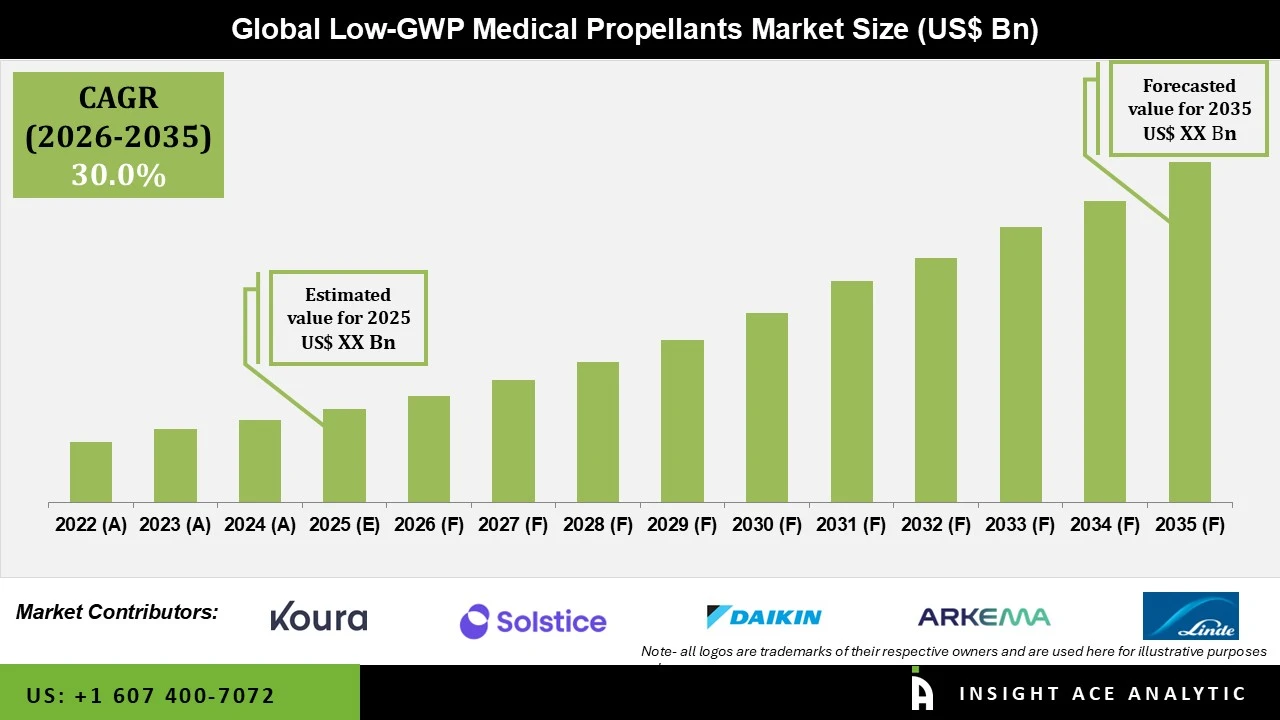
Low-global warming potential (Low-GWP) medical propellants are aerosol propellants designed for pharmaceutical use, mainly in pressurized metered-dose inhalers (pMDIs). These propellants create the pressure needed to deliver accurate doses of medication as fine aerosols into the respiratory tract. This ensures effective treatment of respiratory conditions while keeping the product stable, safe, and performing consistently. They are made to meet strict pharmaceutical quality standards and work well with many inhalation drug formulations.
Conventional pMDIs have typically used hydrofluoroalkane (HFA) propellants. While these are safe for patients and do not harm the ozone layer, they have a relatively high global warming potential (GWP). To tackle environmental issues, the pharmaceutical industry is shifting to next-generation propellants like HFA-152a and HFO-1234ze(E). These new options significantly lower greenhouse gas emissions while maintaining the effectiveness and reliability of inhalation therapies. Using these propellants marks a big step forward in providing high-quality patient care while considering long-term environmental sustainability.
The low-GWP medical propellants market covers the research, development, manufacturing, supply, and commercialization of environmentally friendly propellants for pharmaceutical aerosol products. This market includes propellant manufacturers, pharmaceutical companies, inhaler component suppliers, contract development and manufacturing organizations (CDMOs), and regulatory service providers who work on developing and marketing next-generation inhalation systems. It also involves activities like propellant production, formulation development, inhaler compatibility testing, regulatory compliance, and commercial manufacturing. As sustainable healthcare practices gain more focus and respiratory drug delivery technologies improve, the market is becoming a key segment in the pharmaceutical and inhalation drug delivery fields.
Competitive Landscape
Which are the Leading Players in the Low-GWP Medical Propellants Market?
Propellant Manufacturers
• Koura (Orbia Fluor & Energy Materials)
• Solstice Advanced Materials (Honeywell Performance Materials spin-out)
• Daikin Industries, Ltd.
• Arkema S.A.
• Linde plc (Medical Gases division)
Originator Respiratory Pharma
• AstraZeneca plc
• Chiesi Farmaceutici S.p.A.
• GSK plc
• Boehringer Ingelheim
• Sanofi S.A.
Generic and Authorised-Generic Manufacturers
• Cipla Limited
• Lupin Limited
• Glenmark Pharmaceuticals Limited
• Teva Pharmaceutical Industries Ltd. — Israel
• Viatris Inc. — USA
• Hikma Pharmaceuticals plc
Inhalation CDMOs
• Bespak
• Kindeva Drug Delivery
• Recipharm AB
• Catalent, Inc.
Market Dynamics
Driver
Increasing transition to environmentally sustainable inhalers
Growing efforts around the world to cut greenhouse gas emissions are leading to the use of low-GWP medical propellants in pressurized metered-dose inhalers (pMDIs). Traditional HFA propellants, though safe for patients, add significantly to the carbon footprint of inhalers. This has pushed regulatory bodies and drug manufacturers to speed up the move toward new alternatives like HFA-152a and HFO-1234ze(E). Healthcare providers, governments, and pharmaceutical companies are putting more money into sustainable inhalation technologies that keep therapeutic effectiveness while reducing environmental harm. This shift is driving the creation of compatible formulations, inhaler parts, and manufacturing skills. Sustainability initiatives are the main factor fueling growth in the Low-GWP Medical Propellants Market.
Restrain/Challenge
High development costs and complex product transition
Transitioning to low-GWP medical propellants involves significant changes to inhaled medicines. This includes redesigning inhaler parts, testing for compatibility, upgrading manufacturing, and securing regulatory approvals. Current pressurized metered-dose inhalers (pMDIs) are designed for standard HFA propellants. Switching to alternatives like HFA-152a and HFO-1234ze(E) is a challenging and resource-heavy process. Pharmaceutical companies also need to invest in new filling systems, confirm long-term product stability and safety, and maintain supply chains during commercialization. These technical, regulatory, and financial challenges extend development timelines and increase costs. This makes it hard to widely adopt low-GWP medical propellants.
HFA-152a (1,1-Difluoroethane) Segment is Expected to Drive the Low-GWP Medical Propellants Market
The HFA-152a (1,1-Difluoroethane) segment is expected to drive the low-GWP medical propellants market owing to its favorable balance of environmental performance, technical feasibility, and commercial readiness. With a global warming potential (GWP) of approximately 138, HFA-152a offers a substantial reduction in greenhouse gas emissions compared to conventional propellants such as HFA-134a and HFA-227ea, making it one of the most practical low-GWP alternatives for pressurized metered-dose inhalers (pMDIs). Its ability to deliver therapeutic performance comparable to existing propellants while supporting lower carbon emissions has led to increasing adoption by pharmaceutical manufacturers. In addition, growing investments in HFA-152a-based inhaler development, dedicated manufacturing infrastructure, and commercial-scale production are accelerating its market penetration. Although product reformulation is required, its compatibility with current pMDI technology makes the transition more practical than entirely new propulsion systems, while increasing regulatory emphasis on sustainable healthcare and carbon reduction further strengthens its position as the leading propellant type in the market.
CBD (Cannabidiol) Segment is Growing at the Highest Rate in the Low-GWP Medical Propellants Market
The ICS/LABA/LAMA Triple Therapy segment is expected to grow the most because of the rising use of single-inhaler triple therapy for managing moderate-to-severe chronic obstructive pulmonary disease (COPD) and some asthma patients. Clinical guidelines increasingly suggest triple therapy for patients who still show symptoms with dual therapy, as it improves lung function, reduces flare-ups, and helps patients stick to their treatment by combining three medications in one inhaler. Pharmaceutical companies are shifting these valuable inhaler products to low-GWP propellants to meet sustainability goals and changing environmental rules. Additionally, new triple-combination formulations and the increasing global burden of chronic respiratory diseases are likely to boost demand, making ICS/LABA/LAMA Triple Therapy the fastest-growing inhaler therapy class in the Low-GWP Medical Propellants Market.
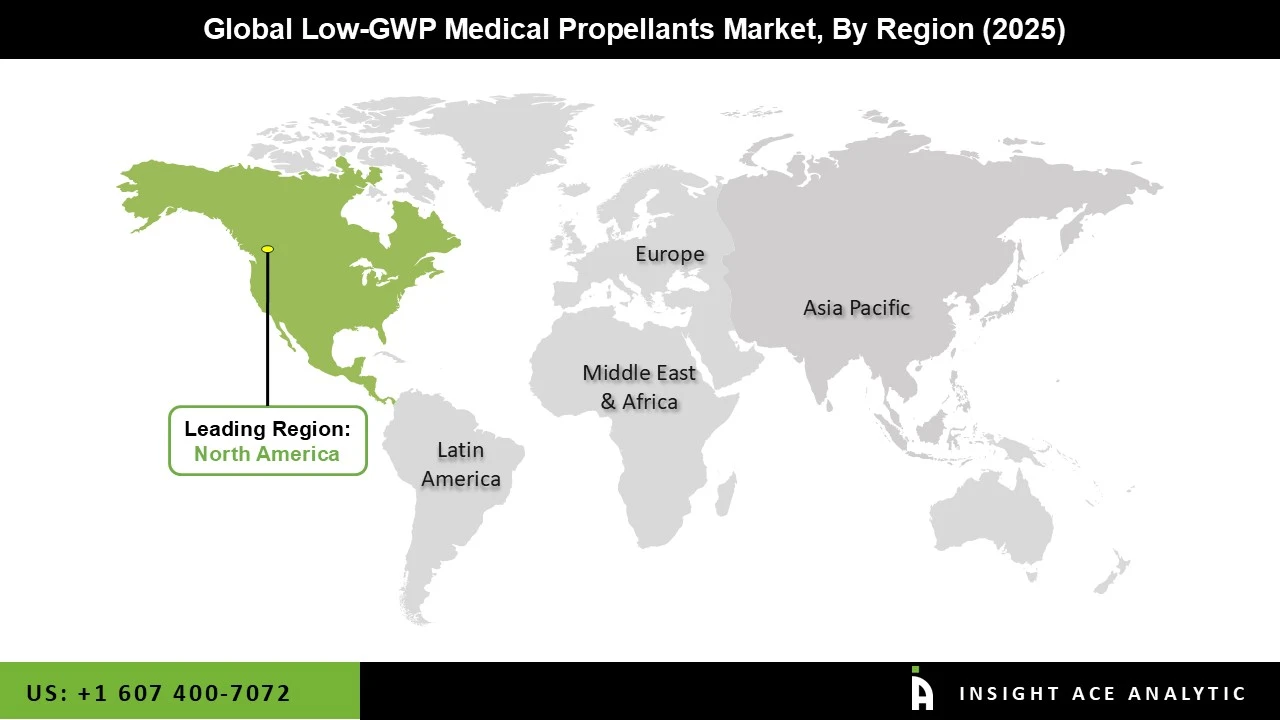
Why North America Led the Low-GWP Medical Propellants Market?
North America dominates the market because it has a strong pharmaceutical industry and major inhalation drug manufacturers. The region also has solid research and development focused on sustainable respiratory drug delivery. There have been considerable investments in developing and commercializing low-global warming potential (Low-GWP) propellants, especially HFA-152a-based pressurized metered-dose inhalers (pMDIs). This has been supported by partnerships among pharmaceutical companies, contract development and manufacturing organizations (CDMOs), and propellant suppliers. Furthermore, strict environmental regulations and strong government support for cutting greenhouse gas emissions are driving the shift from traditional HFA propellants to low-GWP options. High healthcare spending, widespread use of innovative inhalation therapies, and the rising rates of asthma and chronic obstructive pulmonary disease (COPD) also boost North America's position in the Low-GWP Medical Propellants Market.
Key Development
• In September 2025, Chiesi announced completion of its clinical development program for carbon-minimal pMDIs and confirmed HFA-152a as the next-generation propellant selected for its transition program.
Low-GWP Medical Propellants Market Report Scope:
| Report Attribute | Specifications |
| Growth Rate CAGR | CAGR of 30.0% from 2026 to 2035 |
| Quantitative Units | Representation of revenue in US$ Bn and CAGR from 2026 to 2035 |
| Historic Year | 2022 to 2025 |
| Forecast Year | 2026-2035 |
| Report Coverage | The forecast of revenue, the position of the company, the competitive market structure, growth prospects, and trends |
| Segments Covered | Propellant Type, Inhaler Therapy Class, End-User, Distribution Channel and By Region |
| Regional Scope | North America; Europe; Asia Pacific; Latin America; Middle East & Africa |
| Country Scope | U.S.; Canada; U.K.; Germany; China; India; Japan; Brazil; Mexico; The UK; France; Italy; Spain; China; Japan; India; South Korea; Southeast Asia; South Korea; Southeast Asia |
| Competitive Landscape | Koura (Orbia Fluor & Energy Materials), Solstice Advanced Materials (Honeywell Performance Materials spin-out), Daikin Industries, Ltd., Arkema S.A., Linde plc (Medical Gases division), AstraZeneca plc, Chiesi Farmaceutici S.p.A., GSK plc, Boehringer Ingelheim, Sanofi S.A. |
| Customization Scope | Free customization report with the procurement of the report, Modifications to the regional and segment scope. Geographic competitive landscape. |
| Pricing and Available Payment Methods | Explore pricing alternatives that are customized to your particular study requirements. |
Market Segmentation:
Low-GWP Medical Propellants Market by Propellant Type -
• HFA-152a (1,1-Difluoroethane)
• HFO-1234ze(E) (trans-1,3,3,3-Tetrafluoropropene)
• Transitional HFA-134a (GWP 1,430)
• Transitional HFA-227ea (GWP 3,220)
• Emerging Alternatives (CO₂, hydrocarbons, compressed air)
Low-GWP Medical Propellants Market by Inhaler Therapy Class -
• Short-Acting Beta-Agonists (SABA)
• Inhaled Corticosteroids (ICS) Monotherapy
• ICS/LABA Combinations
• ICS/LABA/LAMA Triple Therapy
• SABA/ICS Rescue Combinations
• Other Therapy Classes — Cromones, Anticholinergics monotherapy, LABA monotherapy
Low-GWP Medical Propellants Market by End User-
• Originator Pharma — branded pMDI manufacturers
• Generic and Authorised-Generic Manufacturers
• Inhalation CDMOs — contract development & fill-finish
Low-GWP Medical Propellants Market by Distribution Channel-
• Retail Pharmacy
• Hospital Pharmacy
• Online / Mail-Order Pharmacy
Low-GWP Medical Propellants Market by Region-
North America-
• The US
• Canada
• Mexico
Europe-
• Germany
• The UK
• France
• Italy
• Spain
• Rest of Europe
Asia-Pacific-
• China
• Japan
• India
• South Korea
• South East Asia
• Rest of Asia Pacific
Latin America-
• Brazil
• Argentina
• Rest of Latin America
Middle East & Africa-
• GCC Countries
• South Africa
• Rest of Middle East and Africa
Research Design and Approach
This study employed a multi-step, mixed-method research approach that integrates:
- Secondary research
- Primary research
- Data triangulation
- Hybrid top-down and bottom-up modelling
- Forecasting and scenario analysis
This approach ensures a balanced and validated understanding of both macro- and micro-level market factors influencing the market.
Secondary Research
Secondary research for this study involved the collection, review, and analysis of publicly available and paid data sources to build the initial fact base, understand historical market behaviour, identify data gaps, and refine the hypotheses for primary research.
Sources Consulted
Secondary data for the market study was gathered from multiple credible sources, including:
- Government databases, regulatory bodies, and public institutions
- International organizations (WHO, OECD, IMF, World Bank, etc.)
- Commercial and paid databases
- Industry associations, trade publications, and technical journals
- Company annual reports, investor presentations, press releases, and SEC filings
- Academic research papers, patents, and scientific literature
- Previous market research publications and syndicated reports
These sources were used to compile historical data, market volumes/prices, industry trends, technological developments, and competitive insights.

Primary Research
Primary research was conducted to validate secondary data, understand real-time market dynamics, capture price points and adoption trends, and verify the assumptions used in the market modelling.
Stakeholders Interviewed
Primary interviews for this study involved:
- Manufacturers and suppliers in the market value chain
- Distributors, channel partners, and integrators
- End-users / customers (e.g., hospitals, labs, enterprises, consumers, etc., depending on the market)
- Industry experts, technology specialists, consultants, and regulatory professionals
- Senior executives (CEOs, CTOs, VPs, Directors) and product managers
Interview Process
Interviews were conducted via:
- Structured and semi-structured questionnaires
- Telephonic and video interactions
- Email correspondences
- Expert consultation sessions
Primary insights were incorporated into demand modelling, pricing analysis, technology evaluation, and market share estimation.
Data Processing, Normalization, and Validation
All collected data were processed and normalized to ensure consistency and comparability across regions and time frames.
The data validation process included:
- Standardization of units (currency conversions, volume units, inflation adjustments)
- Cross-verification of data points across multiple secondary sources
- Normalization of inconsistent datasets
- Identification and resolution of data gaps
- Outlier detection and removal through algorithmic and manual checks
- Plausibility and coherence checks across segments and geographies
This ensured that the dataset used for modelling was clean, robust, and reliable.
Market Size Estimation and Data Triangulation
Bottom-Up Approach
The bottom-up approach involved aggregating segment-level data, such as:
- Company revenues
- Product-level sales
- Installed base/usage volumes
- Adoption and penetration rates
- Pricing analysis
This method was primarily used when detailed micro-level market data were available.

Top-Down Approach
The top-down approach used macro-level indicators:
- Parent market benchmarks
- Global/regional industry trends
- Economic indicators (GDP, demographics, spending patterns)
- Penetration and usage ratios
This approach was used for segments where granular data were limited or inconsistent.
Hybrid Triangulation Approach
To ensure accuracy, a triangulated hybrid model was used. This included:
- Reconciling top-down and bottom-up estimates
- Cross-checking revenues, volumes, and pricing assumptions
- Incorporating expert insights to validate segment splits and adoption rates
This multi-angle validation yielded the final market size.
Forecasting Framework and Scenario Modelling
Market forecasts were developed using a combination of time-series modelling, adoption curve analysis, and driver-based forecasting tools.
Forecasting Methods
- Time-series modelling
- S-curve and diffusion models (for emerging technologies)
- Driver-based forecasting (GDP, disposable income, adoption rates, regulatory changes)
- Price elasticity models
- Market maturity and lifecycle-based projections
Scenario Analysis
Given inherent uncertainties, three scenarios were constructed:
- Base-Case Scenario: Expected trajectory under current conditions
- Optimistic Scenario: High adoption, favourable regulation, strong economic tailwinds
- Conservative Scenario: Slow adoption, regulatory delays, economic constraints
Sensitivity testing was conducted on key variables, including pricing, demand elasticity, and regional adoption.
Request Customization
Add countries, segments, company profiles, or extend forecast — free 10% customization with purchase.
Customize This Report →Enquire Before Buying
Speak with our analyst team about scope, methodology, pricing, or deliverable formats.
Enquire Now →Frequently Asked Questions
Low GWP Medical Propellants Market is likely to grow with a 30.0% CAGR during the forecast period for 2026 to 2035.
Koura (Orbia Fluor & Energy Materials), Solstice Advanced Materials (Honeywell Performance Materials spin-out), Daikin Industries, Ltd., Arkema S.A., Linde plc (Medical Gases division), AstraZeneca plc, Chiesi Farmaceutici S.p.A., GSK plc, Boehringer Ingelheim, Sanofi S.A.
Low GWP Medical Propellants Market is segmented into Propellant Type, Inhaler Therapy Class, End-User, Distribution Channel and By Region
North America region is leading the Low GWP Medical Propellants Market.