LiDAR Market Key Players Analysis 2026 to 2035
What is LiDAR Market Size?
LiDAR Market Size is valued at USD 3.11 Bn in 2025 and is predicted to reach USD 44.51 Bn by the year 2035 at a 30.7% CAGR during the forecast period for 2026 to 2035.
LiDAR Market Size, Share & Trends Analysis Distribution by Type (Solid-state and Mechanical), Installation (Ground-Based and Airborne), Service (Aerial Surveying, Ground-based Surveying, Asset Management, Geographic Information Systems, and Others), Range (Short, Medium, and Large), End-user (ADAS & Driverless Cars, Corridor Mapping, Environment, Meteorology, Exploration, Urban Planning, Engineering, Cartography, and Others), and Segment Forecasts, 2026 to 2035
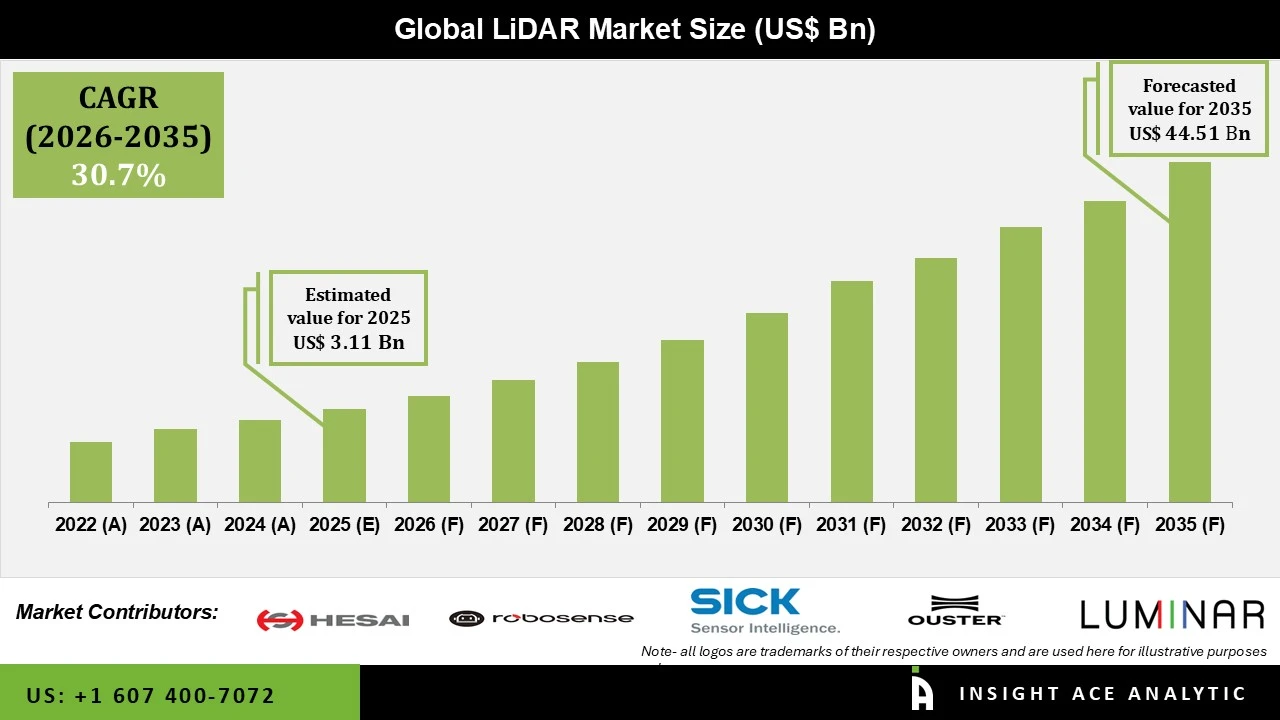
LiDAR Market Key Takeaways:
|
A remote sensing technique called LiDAR (Light Detection and Ranging) measures the separation between a sensor and objects on the surface of the earth using laser pulses. LiDAR creates extremely precise, comprehensive 3D data by sending out fast laser beams and timing how long it takes for the pulses to reflect. This information, referred to as a point cloud, offers accurate measurements of infrastructure, vegetation, surface topography, and more. Since LiDAR can record high-resolution spatial data in a number of scenarios, including both terrestrial and airborne surveys, it is frequently employed in industries such as mapping, forestry, archeology, and environmental monitoring. The rapid commercialization of automobiles, the decline in component costs, the development of FMCW/4D LiDAR technologies, and the applications of LiDAR in mapping, robotics, and drones are all factors contributing to the growth of the global market.
The global market has expanded dramatically in recent years due to LiDAR scanners and systems' enhanced automated processing capabilities, which include faster data processing and better picture resolution than other technologies. Additionally, the LiDAR market is expected to increase due to the increasing need for 3D pictures in applications including topographical surveys, military and defense, civil engineering, and corridor mapping. Planners may visualize prospective developments, evaluate land usage, and enhance infrastructure with the aid of LiDAR's ability to produce intricate 3D models of urban landscapes. The rate at which improved safety features are being installed is increasing exponentially. Furthermore, self-driving cars are legally allowed on the road in countries like the United States; these vehicles are outfitted with LiDAR for GPS and navigation, which will soon accelerate the growth of the global LiDAR market.
In addition, the market is expanding due to developments in LiDAR technology, such as the creation of solid-state LiDARs. Solid-state LiDAR is a more compact, robust, and ultimately less costly option than classic mechanical LiDAR systems because it uses stationary components. LiDAR integration is now more feasible in a number of industries, including the automotive sector. It opens the door for uses like robotics, smart agriculture, and drone-based mapping, which are expected to propel market growth even more. However, a major barrier to the industry is a lack of knowledge regarding the advantages of LiDAR systems. Furthermore, the inclusion of pricey parts in these systems, including navigation systems, laser scanners, and high-resolution 3D cameras, comes with extra expenses that restrict their use and impede the LiDAR market expansion.
Competitive Landscape
Which are the Leading Players in LiDAR Market?
• Hesai Group
• Beijing SureStar Technology Co., Ltd.
• FARO Technologies, Inc.
• RoboSense Technology Co., Ltd.
• Ouster, Inc.
• YellowScan
• Trimble Inc.
• NV5 Geospatial
• Luminar Technologies
• RIEGL Laser Measurement Systems GmbH
• Sick AG
• Leica Geosystems AG
• Teledyne Optech
Market Dynamics
Driver
Growing Need for Autonomous Vehicles (AVs)
One of the main factors of the increased use of LiDAR technology is the rising need for autonomous vehicles (AVs). LiDAR is a crucial part of autonomous vehicle systems because it makes it possible for self-driving cars to precisely sense their environment. As the automotive sector transitions to completely autonomous vehicles, LiDAR's capacity to deliver 360-degree, high-resolution 3D mapping and real-time environmental data is essential for guaranteeing dependability and safety.
Additionally, even in difficult situations such as low light or bad weather, autonomous vehicles can recognize barriers, road signs, people, and other vehicles due to LiDAR sensors, which shoot laser pulses to measure distances and produce accurate 3D images of the environment. Moreover, LiDAR technology advancement is also being fueled by the growing demand for autonomous vehicles. Significant strides have been made in lowering the size, cost, and complexity of LiDAR systems to satisfy the demands of the automobile industry. For instance, solid-state LiDAR provides a more cost-effective and long-lasting substitute for conventional rotating LiDAR systems, which is essential for broad use in consumer automobiles. Furthermore, improved performance and more fluid operation in autonomous systems are made possible by developments in LiDAR's integration with other sensors, such as radar and cameras.
Restrain/Challenge
High Cost Associated with LiDAR System
The LiDAR (Light Detection and Ranging) systems have many uses in fields including autonomous vehicles, construction, agriculture, and environmental monitoring, but their high cost is a major obstacle to their broad acceptance. The high cost of LiDAR systems can be attributed to a number of factors. Specialized parts such as laser scanners, GPS units, and high-performance sensors are necessary for the technology itself, and their production is costly. LiDAR sensors employ sophisticated laser beams to measure distances and record data, and the complexity of production increases due to the accuracy needed for reliable findings. The total cost of the system is also increased by integrating these sensors with sophisticated software for data processing and analysis.
Additionally, LiDAR technology is expensive in part because of the research and development (R&D) required to make it better. Companies spend a lot of money creating systems that are more accurate, efficient, and compact, which frequently necessitates a large initial investment. Furthermore, the total cost is increased by the operational costs of LiDAR systems, which include processing the massive volumes of data generated and training staff to run the equipment. This is therefore expected to restrict the LiDAR market's growth during the forecast period.
Airborne Segment is Expected to Drive the LiDAR Market
The airborne category held the largest share in the LiDAR market in 2025. Its widespread application in the mining exploration, forestry, agricultural, and environmental monitoring sectors accounts for its leadership. Since they can effectively cover huge regions and produce accurate, high-resolution photographs of the earth's surface—even through dense vegetation or over uneven terrain—airborne LiDAR systems are preferred. This skill has been crucial to the advancement of geospatial data collection and is essential for producing precise topographic maps.
Additionally, because of a number of significant benefits, airborne LiDAR technology has been dominating the market. It provides unparalleled data collecting speed and accuracy, which is essential for prompt and well-informed decision-making in urban planning and catastrophe management. Moreover, the cost of implementing Airborne LiDAR systems has steadily dropped as the technology advances, increasing its accessibility for a range of uses.
Short Range Segment is Growing at the Highest Rate in the LiDAR Market
In 2025, the short category dominated the LiDAR market ascribed to its use in industrial automation and manufacturing environments. To improve operating safety and efficiency, short-range LiDARs can sense object proximity and detect objects within the 0–200 m range. Additionally, to improve system safety, short-range LiDAR systems are included in robotics, drones, and self-driving cars to identify and avoid obstacles in the close vicinity. The short-range segment of the LiDAR market is expanding due to the growing use of short-range LiDARs in a variety of industries, including industrial robotics, automotive, and security. For instance, Innoviz Technologies and an OEM worked together to build an enhanced short-range LiDAR for L4 autonomous vehicles in January 2024. The goal of this short-range LiDAR is to improve autonomous driving performance and safety in light commercial vehicles, shuttles, taxis, and trucks.
Why North America Led the LiDAR Market?
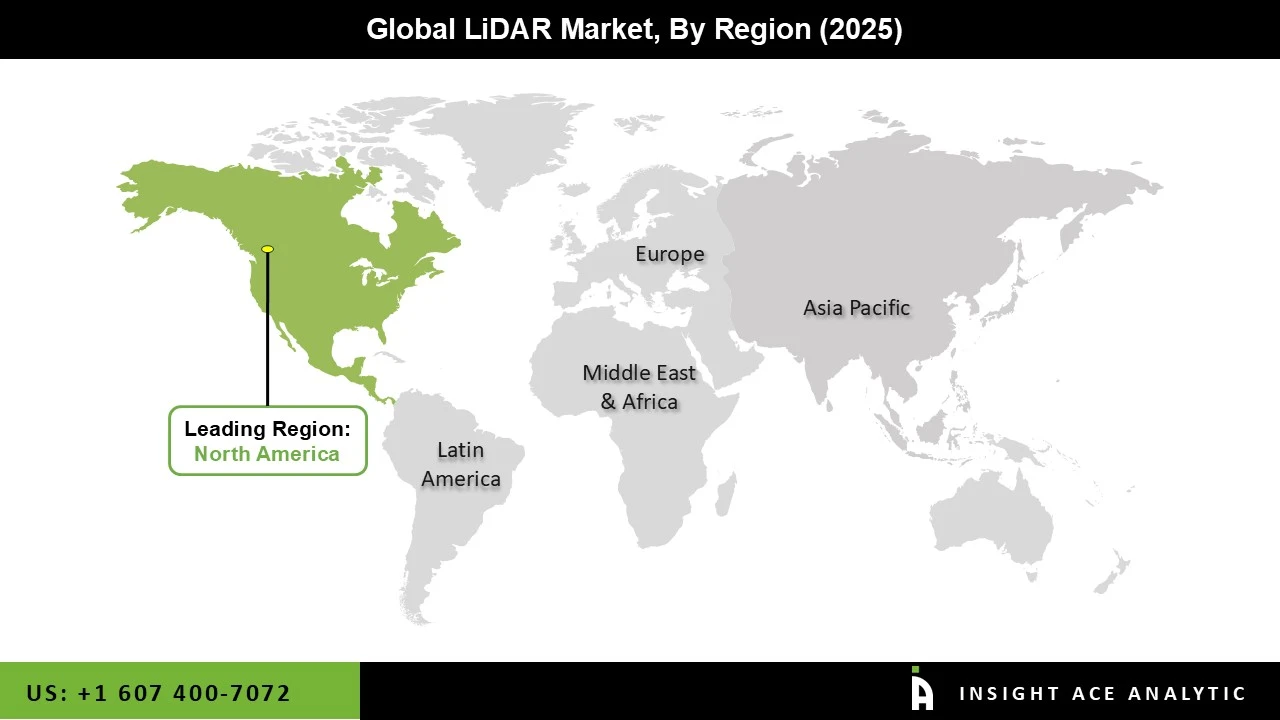
The LiDAR market was dominated by North America region in 2025 propelled by the region's substantial R&D expenditures and cutting-edge technological infrastructure. In particular, the US has led the way in the development and uptake of LiDAR technology, applying it to a variety of fields like environmental monitoring, driverless cars, and smart city initiatives. Additionally, there are a number of reasons why North America leads the LiDAR market. A strong ecosystem for ongoing innovation and development is fostered by the presence of significant LiDAR manufacturers and technological businesses in the area.
Furthermore, the area gains from substantial government funding and support for defense and infrastructure projects that make extensive use of LiDAR technology. For instance, the Federal Emergency Management Agency (FEMA) uses LiDAR for environmental monitoring and disaster management, and the U.S. Department of Transportation is pushing for the development of autonomous vehicles. These projects highlight the significance of this technology in vital applications.
LiDAR Market Report Scope:
| Report Attribute | Specifications |
| Market size value in 2025 | USD 3.11 Bn |
| Revenue forecast in 2035 | USD 44.51 Bn |
| Growth Rate CAGR | CAGR of 30.7% from 2026 to 2035 |
| Quantitative Units | Representation of revenue in US$ Bn and CAGR from 2026 to 2035 |
| Historic Year | 2022 to 2025 |
| Forecast Year | 2026-2035 |
| Report Coverage | The forecast of revenue, the position of the company, the competitive market structure, growth prospects, and trends |
| Segments Covered | Type, Installation, Service, Range, End-user, and By Region |
| Regional Scope | North America; Europe; Asia Pacific; Latin America; Middle East & Africa |
| Country Scope | U.S.; Canada; U.K.; Germany; China; India; Japan; Brazil; Mexico; The UK; France; Italy; Spain; China; Japan; India; South Korea; Southeast Asia; South Korea; Southeast Asia |
| Competitive Landscape | Hesai Group, Beijing SureStar Technology Co., Ltd., FARO Technologies, Inc., RoboSense Technology Co., Ltd., Ouster, Inc., YellowScan, Trimble Inc., NV5 Geospatial, Luminar Technologies, RIEGL Laser Measurement Systems GmbH, Sick AG , Leica Geosystems AG , and Teledyne Optech. |
| Customization Scope | Free customization report with the procurement of the report, Modifications to the regional and segment scope. Geographic competitive landscape. |
| Pricing and Available Payment Methods | Explore pricing alternatives that are customized to your particular study requirements. |
Market Segmentation:
LiDAR Market by Type-
• Solid-state
• Mechanical
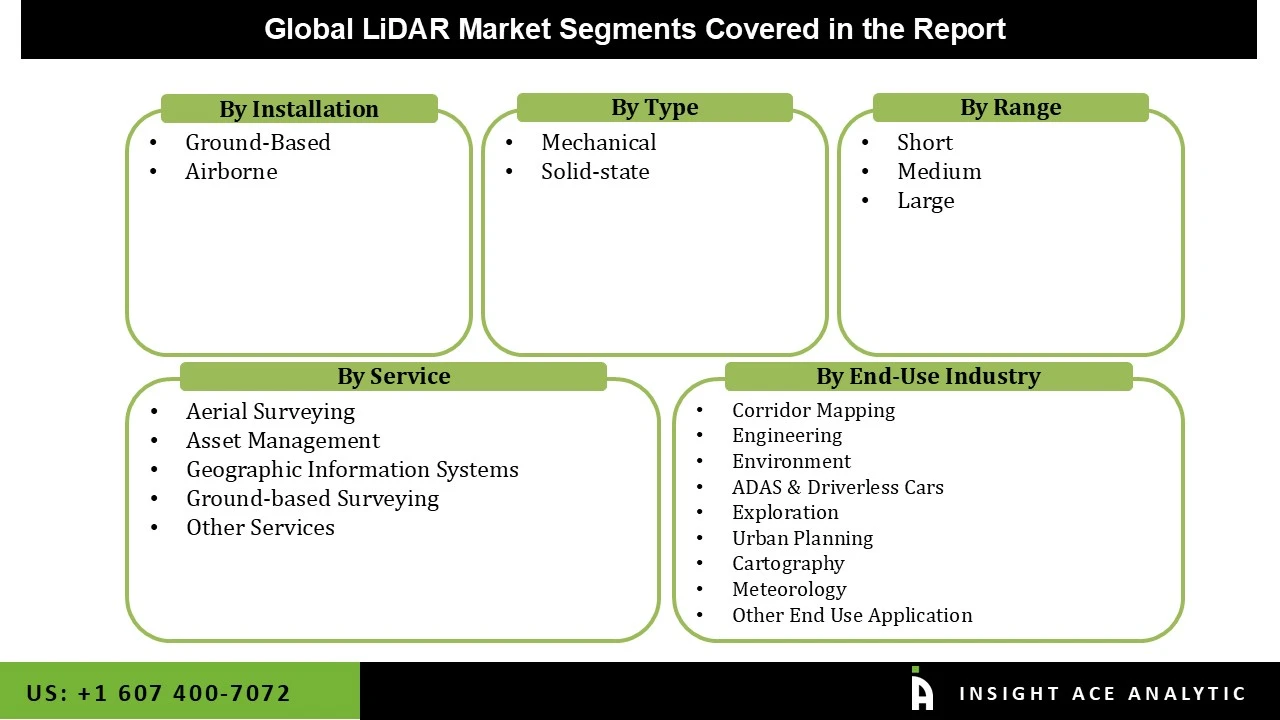
LiDAR Market by Installation-
• Ground-Based
• Airborne
LiDAR Market by Service-
• Aerial Surveying
• Ground-based Surveying
• Asset Management
• Geographic Information Systems
• Others
LiDAR Market by Range-
• Short
• Medium
• Large
LiDAR Market by End-user-
• ADAS & Driverless Cars
• Corridor Mapping
• Environment
• Meteorology
• Exploration
• Urban Planning
• Engineering
• Cartography
• Others
LiDAR Market By Region-
North America-
• The US
• Canada
Europe-
• Germany
• The UK
• France
• Italy
• Spain
• Rest of Europe
Asia-Pacific-
• China
• Japan
• India
• South Korea
• South East Asia
• Rest of Asia Pacific
Latin America-
• Brazil
• Argentina
• Mexico
• Rest of Latin America
Middle East & Africa-
• GCC Countries
• South Africa
• Rest of Middle East and Africa
Research Design and Approach
This study employed a multi-step, mixed-method research approach that integrates:
- Secondary research
- Primary research
- Data triangulation
- Hybrid top-down and bottom-up modelling
- Forecasting and scenario analysis
This approach ensures a balanced and validated understanding of both macro- and micro-level market factors influencing the market.
Secondary Research
Secondary research for this study involved the collection, review, and analysis of publicly available and paid data sources to build the initial fact base, understand historical market behaviour, identify data gaps, and refine the hypotheses for primary research.
Sources Consulted
Secondary data for the market study was gathered from multiple credible sources, including:
- Government databases, regulatory bodies, and public institutions
- International organizations (WHO, OECD, IMF, World Bank, etc.)
- Commercial and paid databases
- Industry associations, trade publications, and technical journals
- Company annual reports, investor presentations, press releases, and SEC filings
- Academic research papers, patents, and scientific literature
- Previous market research publications and syndicated reports
These sources were used to compile historical data, market volumes/prices, industry trends, technological developments, and competitive insights.

Primary Research
Primary research was conducted to validate secondary data, understand real-time market dynamics, capture price points and adoption trends, and verify the assumptions used in the market modelling.
Stakeholders Interviewed
Primary interviews for this study involved:
- Manufacturers and suppliers in the market value chain
- Distributors, channel partners, and integrators
- End-users / customers (e.g., hospitals, labs, enterprises, consumers, etc., depending on the market)
- Industry experts, technology specialists, consultants, and regulatory professionals
- Senior executives (CEOs, CTOs, VPs, Directors) and product managers
Interview Process
Interviews were conducted via:
- Structured and semi-structured questionnaires
- Telephonic and video interactions
- Email correspondences
- Expert consultation sessions
Primary insights were incorporated into demand modelling, pricing analysis, technology evaluation, and market share estimation.
Data Processing, Normalization, and Validation
All collected data were processed and normalized to ensure consistency and comparability across regions and time frames.
The data validation process included:
- Standardization of units (currency conversions, volume units, inflation adjustments)
- Cross-verification of data points across multiple secondary sources
- Normalization of inconsistent datasets
- Identification and resolution of data gaps
- Outlier detection and removal through algorithmic and manual checks
- Plausibility and coherence checks across segments and geographies
This ensured that the dataset used for modelling was clean, robust, and reliable.
Market Size Estimation and Data Triangulation
Bottom-Up Approach
The bottom-up approach involved aggregating segment-level data, such as:
- Company revenues
- Product-level sales
- Installed base/usage volumes
- Adoption and penetration rates
- Pricing analysis
This method was primarily used when detailed micro-level market data were available.

Top-Down Approach
The top-down approach used macro-level indicators:
- Parent market benchmarks
- Global/regional industry trends
- Economic indicators (GDP, demographics, spending patterns)
- Penetration and usage ratios
This approach was used for segments where granular data were limited or inconsistent.
Hybrid Triangulation Approach
To ensure accuracy, a triangulated hybrid model was used. This included:
- Reconciling top-down and bottom-up estimates
- Cross-checking revenues, volumes, and pricing assumptions
- Incorporating expert insights to validate segment splits and adoption rates
This multi-angle validation yielded the final market size.
Forecasting Framework and Scenario Modelling
Market forecasts were developed using a combination of time-series modelling, adoption curve analysis, and driver-based forecasting tools.
Forecasting Methods
- Time-series modelling
- S-curve and diffusion models (for emerging technologies)
- Driver-based forecasting (GDP, disposable income, adoption rates, regulatory changes)
- Price elasticity models
- Market maturity and lifecycle-based projections
Scenario Analysis
Given inherent uncertainties, three scenarios were constructed:
- Base-Case Scenario: Expected trajectory under current conditions
- Optimistic Scenario: High adoption, favourable regulation, strong economic tailwinds
- Conservative Scenario: Slow adoption, regulatory delays, economic constraints
Sensitivity testing was conducted on key variables, including pricing, demand elasticity, and regional adoption.
Request Customization
Add countries, segments, company profiles, or extend forecast — free 10% customization with purchase.
Customize This Report →Enquire Before Buying
Speak with our analyst team about scope, methodology, pricing, or deliverable formats.
Enquire Now →Frequently Asked Questions
LiDAR Market Size is valued at USD 3.11 Bn in 2025 and is predicted to reach USD 44.51 Bn by the year 2035
LiDAR Market is expected to grow at a 30.7% CAGR during the forecast period for 2026 to 2035.
Hesai Group, Beijing SureStar Technology Co., Ltd., FARO Technologies, Inc., RoboSense Technology Co., Ltd., Ouster, Inc., YellowScan, Trimble Inc., NV5 Geospatial, Luminar Technologies, RIEGL Laser Measurement Systems GmbH, Sick AG , Leica Geosystems AG , and Teledyne Optech.
Type, Installation, Service, Range, End-user, and By Region are the key segments of the LiDAR Market.
North America region is leading the LiDAR Market.