Learning Management System Market Size and Scope 2026 to 2035
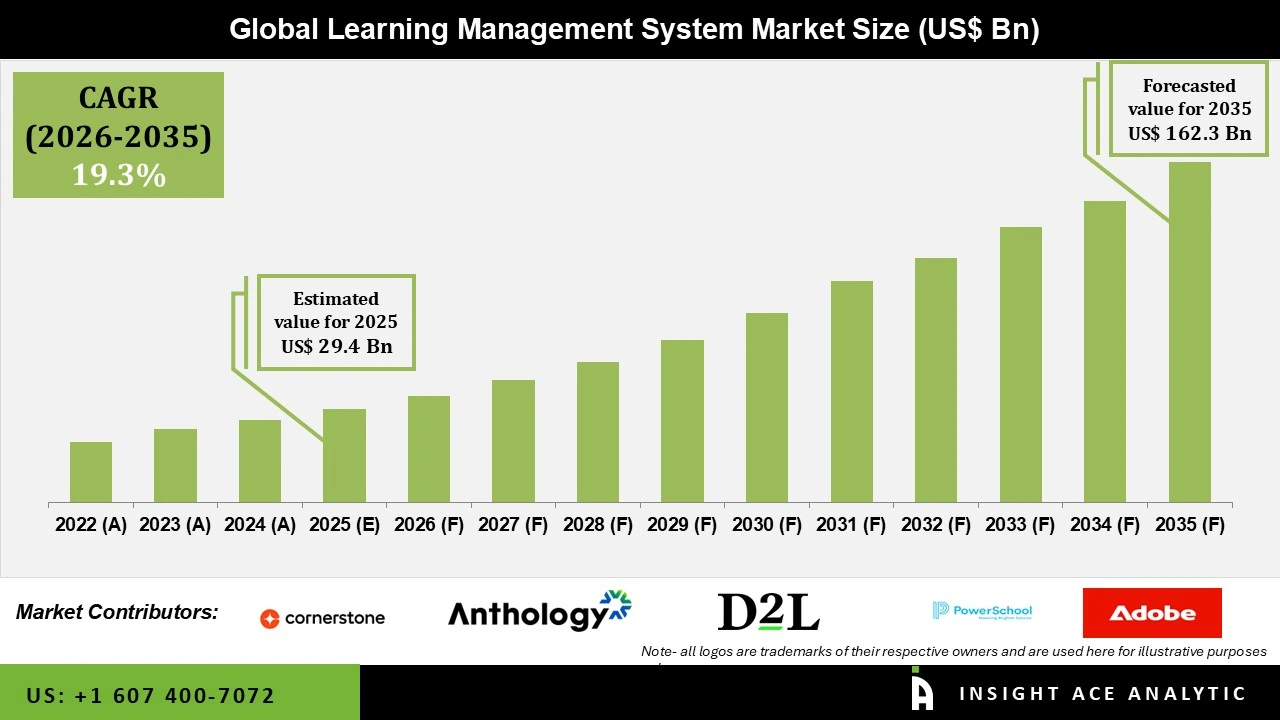
Global Learning Management System Market Size is valued at USD 29.4 Bn in 2025 and is predicted to reach USD 162.3 Bn by the year 2035 at a 19.3% CAGR during the forecast period for 2026 to 2035.
Learning Management System Market Size, Share & Trends Analysis Distribution by Component (Services and Solution), By Deployment Mode (Cloud and On-premises), By Delivery Mode (Distance Learning, Blended Learning, and Instructor-led Training), By Enterprise Size (Small & Medium Enterprises (SMEs) and Large Enterprises), By End-user Academic (K-12, Higher Education) and Corporate (Healthcare, IT and Telecommunication, Banking, Financial Services, and Insurance (BFSI), Retail, Government & Defense, Manufacturing, Others)), and Segment Forecasts, 2026 to 2035
A software program or web-based platform used to plan, carry out, and assess a learning process is referred to as a learning management system (LMS). It is an all-inclusive web platform for creating, disseminating, tracking, and reporting educational materials and outcomes. It can be used to support blended/hybrid and online learning environments as well as traditional in-person training. Pre-built and bespoke courseware, automation, social learning, mobile compatibility, blended learning, and a customizable user interface are all included. Additionally, it offers a unified front-end and back-end experience, improved efficiency, support for various learning styles, and insightful information. The growing use of e-learning platforms in the business, academic, and governmental sectors is driving the learning management system market. While educational institutions are adopting digital tools to improve learning outcomes and reach remote learners, organizations are placing a higher priority on employee training and skill development initiatives.
The learning management system market is expanding more quickly due to the increasing use of mobile devices and the growing need for mobile-first learning solutions. The demand for scalable and adaptable LMS systems has increased because of the move toward remote and hybrid work arrangements. Furthermore, in the upcoming years, the market for learning management systems is anticipated to develop as e-learning becomes more widely used. Numerous educational institutions had to close as a result of the COVID-19 outbreak to contain the virus. As a result, during the pandemic, educational systems adopted e-learning to help students learn remotely.
Additionally, the expansion of the learning management system market worldwide has been greatly aided by the emergence of the bring your own device (BYOD) culture in a number of larger businesses. A bring your own device culture has become more popular among business managers due to its many advantages, which include cost savings, enhanced productivity and creativity, and increased employee happiness and retention. In addition, the learning management system market expansion is also aided by government programs that support online learning and the growing demand for affordable, scalable training options. The market's growth trend is further reinforced by the growing emphasis on analytics-driven insights and personalized learning. However, the learning management system market is subject to a number of constraints that can potentially obstruct its growth trajectory. These include the expensive implementation costs of sophisticated LMS systems, which small and medium-sized businesses could find unaffordable.
Competitive Landscape
Which are the Leading Players in the Learning Management System Market?
- SAP
- Cornerstone
- D2L Corporation
- Moodle
- PowerSchool
- Anthology Inc.
- McGraw Hill
- Instructure, Inc.
- Adobe
- Oracle
Market Dynamics
Driver
Growing Adoption of Smartphones
The learning management system market is likely to grow in the future due to the rising use of smartphones. Smartphones facilitate on-the-go learning and encourage user involvement because of their accessibility and ease. They enhance the effectiveness and attractiveness of LMS systems by facilitating social interaction, microlearning, offline access, and mobile learning. Additionally, push notifications, progress tracking, and affordable learning solutions are made possible by smartphones, expanding the worldwide reach of LMS for a variety of educational and professional applications.
Restrain/Challenge
Insufficient Knowledge of Technology
The demand for more comfort or familiarity with technology is one of the main factors driving the learning management system market. Some teachers, administrators, and students might not have had much experience with digital tools, or they may require sufficient training in order to use LMS platforms efficiently. This unfamiliarity may cause anxiety and a reluctance to adopt new technological approaches to education. Additionally, there are worries about how difficult it is to use digital tools, such as LMS systems. The variety of features and functionalities these platforms offer may overwhelm people, making them think it will take a lot of time and effort to integrate them into their teaching methods. They might therefore oppose adoption in favour of more comfortable and well-known teaching strategies. Therefore, the learning management system market is probably going to hinder growth.
Blended Learning Segment is Expected to Drive the Learning Management System Market
The Blended Learning category held the largest share in the Learning Management System market in 2025. Due to its ability to improve learning outcomes, flexibility, and engagement, blended learning—which blends traditional in-person instruction with online learning activities—plays a critical role in the market for learning management systems (LMS). Blended learning maximizes the advantages of both offline and online learning modes, producing a more thorough and successful learning process. Incorporating blended learning capabilities into learning management systems allows educational institutions and organizations to accommodate students' varied needs, preferences, and learning styles. Additionally, blended learning facilitates real-time engagement, collaboration, and feedback with classmates and instructors while enabling learners to access instructional materials and resources at their own leisure and pace.
Academic Segment is Growing at the Highest Rate in the Learning Management System Market
In 2025, the academic category dominated the Learning Management System market because digital learning platforms are becoming more and more popular in colleges, institutions, and schools. Lockdown scenarios following the COVID-19 pandemic have increased demand for remote and hybrid learning environments, which has led to the need for LMS solutions in the academic sector. These platforms allow educational institutions to provide flexible learning while simultaneously enhancing administrative procedures and student involvement. Additionally, governments have been making significant investments in the field of education, supporting programs that encourage the use of LMS platforms and digital learning.
Why North America Led the Learning Management System Market?
The Learning Management System market was dominated by the North America region in 2025, driven by early adoption of digital learning tools and a strong technological infrastructure. While academic institutions give priority to LMS platforms for hybrid and online education, the region's robust corporate sector uses them for staff training, compliance, and upskilling.

The learning management system market growth is further accelerated by government programs supporting EdTech, high internet penetration, and the use of cloud-based services. Additionally, the market leadership is influenced by the existence of significant LMS providers and ongoing developments in mobile and AI-driven learning technologies. North America continues to lead the world in LMS innovation and uptake thanks to growing investments in worker development and a culture of lifelong learning.
Key Development
- October 2024: Anthology Inc. and Obrizum Group Ltd. collaborated to add AI-driven personalization to Blackboard LMS. Users will gain greater insights and adaptive learning experiences as a result of our partnership. Blackboard will provide students with personalized learning paths by incorporating Obrizum's technologies. With data-driven engagement, the project seeks to transform online learning.
Learning Management System Market Report Scope :
| Report Attribute | Specifications |
| Market size value in 2025 | USD 29.4 Bn |
| Revenue forecast in 2035 | USD 162.3 Bn |
| Growth Rate CAGR | CAGR of 19.3% from 2026 to 2035 |
| Quantitative Units | Representation of revenue in US$ Bn and CAGR from 2026 to 2035 |
| Historic Year | 2021 to 2025 |
| Forecast Year | 2026-2035 |
| Report Coverage | The forecast of revenue, the position of the company, the competitive market structure, growth prospects, and trends |
| Segments Covered | Component, Deployment Mode, Delivery Mode, Enterprise Size, End-user, and By Region |
| Regional Scope | North America; Europe; Asia Pacific; Latin America; Middle East & Africa |
| Country Scope | U.S.; Canada; U.K.; Germany; China; India; Japan; Brazil; Mexico; The UK; France; Italy; Spain; China; Japan; India; South Korea; Southeast Asia; South Korea; Southeast Asia |
| Competitive Landscape | SAP, Cornerstone, D2L Corporation, Moodle, PowerSchool, Anthology Inc., McGraw Hill, Instructure, Inc., Adobe, and Oracle |
| Customization Scope | Free customization report with the procurement of the report, Modifications to the regional and segment scope. Geographic competitive landscape. |
| Pricing and Available Payment Methods | Explore pricing alternatives that are customized to your particular study requirements. |
Segmentation of Learning Management System Market :
Learning Management System Market, by Component-
- Services
- Solution
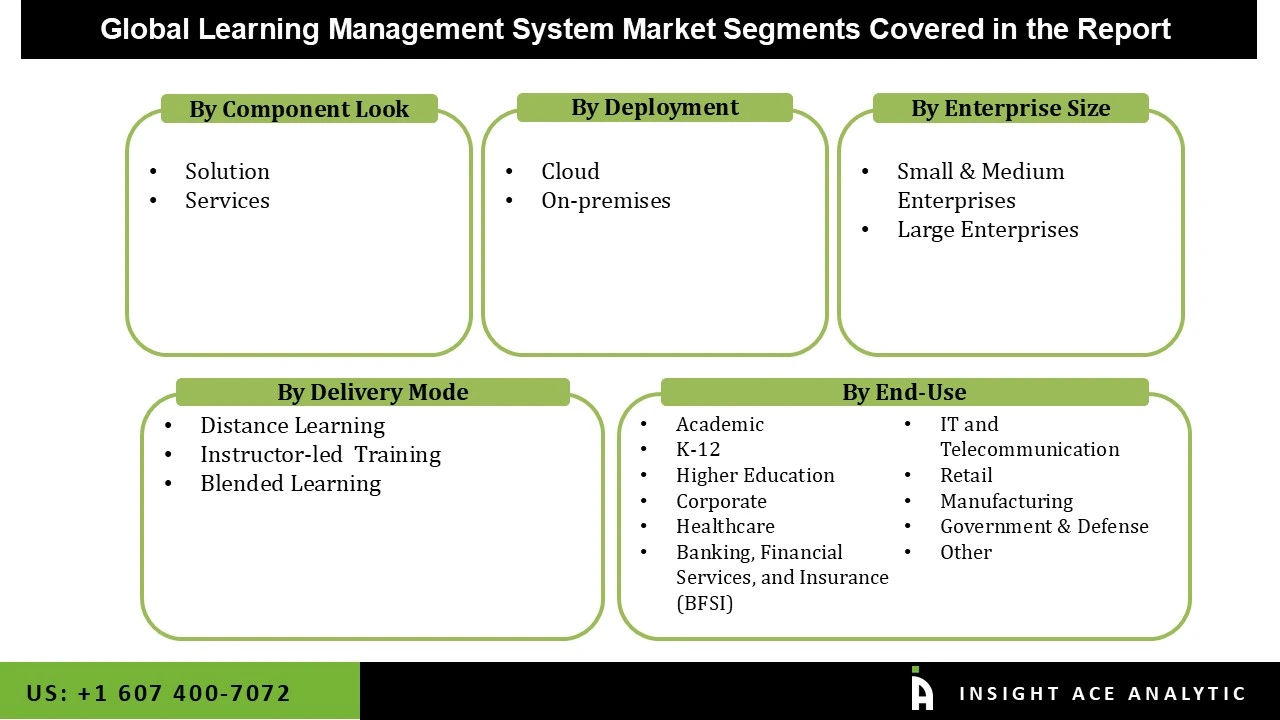
Learning Management System Market, by Deployment Mode-
- Cloud
- On-premises
Learning Management System Market, by Delivery Mode-
- Distance Learning
- Blended Learning
- Instructor-led Training
Learning Management System Market, by Enterprise Size-
- Small & Medium Enterprises (SMEs)
- Large Enterprises
Learning Management System Market, by End-user-
- Academic
- K-12
- Higher Education
- Corporate
- Healthcare
- IT and Telecommunication
- Banking, Financial Services, and Insurance (BFSI)
- Retail
- Government & Defense
- Manufacturing
- Others
Learning Management System Market, by Region-
- North America-
- The US
- Canada
- Europe-
- Germany
- The UK
- France
- Italy
- Spain
- Rest of Europe
- Asia-Pacific-
- China
- Japan
- India
- South Korea
- South East Asia
- Rest of Asia Pacific
- Latin America-
- Brazil
- Argentina
- Mexico
- Rest of Latin America
- Middle East & Africa-
- GCC Countries
- South Africa
- Rest of Middle East and Africa
Research Design and Approach
This study employed a multi-step, mixed-method research approach that integrates:
- Secondary research
- Primary research
- Data triangulation
- Hybrid top-down and bottom-up modelling
- Forecasting and scenario analysis
This approach ensures a balanced and validated understanding of both macro- and micro-level market factors influencing the market.
Secondary Research
Secondary research for this study involved the collection, review, and analysis of publicly available and paid data sources to build the initial fact base, understand historical market behaviour, identify data gaps, and refine the hypotheses for primary research.
Sources Consulted
Secondary data for the market study was gathered from multiple credible sources, including:
- Government databases, regulatory bodies, and public institutions
- International organizations (WHO, OECD, IMF, World Bank, etc.)
- Commercial and paid databases
- Industry associations, trade publications, and technical journals
- Company annual reports, investor presentations, press releases, and SEC filings
- Academic research papers, patents, and scientific literature
- Previous market research publications and syndicated reports
These sources were used to compile historical data, market volumes/prices, industry trends, technological developments, and competitive insights.

Primary Research
Primary research was conducted to validate secondary data, understand real-time market dynamics, capture price points and adoption trends, and verify the assumptions used in the market modelling.
Stakeholders Interviewed
Primary interviews for this study involved:
- Manufacturers and suppliers in the market value chain
- Distributors, channel partners, and integrators
- End-users / customers (e.g., hospitals, labs, enterprises, consumers, etc., depending on the market)
- Industry experts, technology specialists, consultants, and regulatory professionals
- Senior executives (CEOs, CTOs, VPs, Directors) and product managers
Interview Process
Interviews were conducted via:
- Structured and semi-structured questionnaires
- Telephonic and video interactions
- Email correspondences
- Expert consultation sessions
Primary insights were incorporated into demand modelling, pricing analysis, technology evaluation, and market share estimation.
Data Processing, Normalization, and Validation
All collected data were processed and normalized to ensure consistency and comparability across regions and time frames.
The data validation process included:
- Standardization of units (currency conversions, volume units, inflation adjustments)
- Cross-verification of data points across multiple secondary sources
- Normalization of inconsistent datasets
- Identification and resolution of data gaps
- Outlier detection and removal through algorithmic and manual checks
- Plausibility and coherence checks across segments and geographies
This ensured that the dataset used for modelling was clean, robust, and reliable.
Market Size Estimation and Data Triangulation
Bottom-Up Approach
The bottom-up approach involved aggregating segment-level data, such as:
- Company revenues
- Product-level sales
- Installed base/usage volumes
- Adoption and penetration rates
- Pricing analysis
This method was primarily used when detailed micro-level market data were available.

Top-Down Approach
The top-down approach used macro-level indicators:
- Parent market benchmarks
- Global/regional industry trends
- Economic indicators (GDP, demographics, spending patterns)
- Penetration and usage ratios
This approach was used for segments where granular data were limited or inconsistent.
Hybrid Triangulation Approach
To ensure accuracy, a triangulated hybrid model was used. This included:
- Reconciling top-down and bottom-up estimates
- Cross-checking revenues, volumes, and pricing assumptions
- Incorporating expert insights to validate segment splits and adoption rates
This multi-angle validation yielded the final market size.
Forecasting Framework and Scenario Modelling
Market forecasts were developed using a combination of time-series modelling, adoption curve analysis, and driver-based forecasting tools.
Forecasting Methods
- Time-series modelling
- S-curve and diffusion models (for emerging technologies)
- Driver-based forecasting (GDP, disposable income, adoption rates, regulatory changes)
- Price elasticity models
- Market maturity and lifecycle-based projections
Scenario Analysis
Given inherent uncertainties, three scenarios were constructed:
- Base-Case Scenario: Expected trajectory under current conditions
- Optimistic Scenario: High adoption, favourable regulation, strong economic tailwinds
- Conservative Scenario: Slow adoption, regulatory delays, economic constraints
Sensitivity testing was conducted on key variables, including pricing, demand elasticity, and regional adoption.
Request Customization
Add countries, segments, company profiles, or extend forecast — free 10% customization with purchase.
Customize This Report →Enquire Before Buying
Speak with our analyst team about scope, methodology, pricing, or deliverable formats.
Enquire Now →Frequently Asked Questions
Learning Management System Market Size is valued at USD 29.4 Bn in 2025 and is predicted to reach USD 162.3 Bn by the year 2035
Learning Management System Market is expected to grow at a 19.3% CAGR during the forecast period for 2026 to 2035.
SAP, Cornerstone, D2L Corporation, Moodle, PowerSchool, Anthology Inc., McGraw Hill, Instructure, Inc., Adobe, and Oracle
Component, Deployment Mode, Delivery Mode, Enterprise Size and End-user are the key segments of the Learning Management System Market
North America region is leading the Learning Management System Market.