Hydrotreated Vegetable Oil Market Size, Trend, Revenue Report 2026 to 2035
What is Hydrotreated Vegetable Oil Market Size?
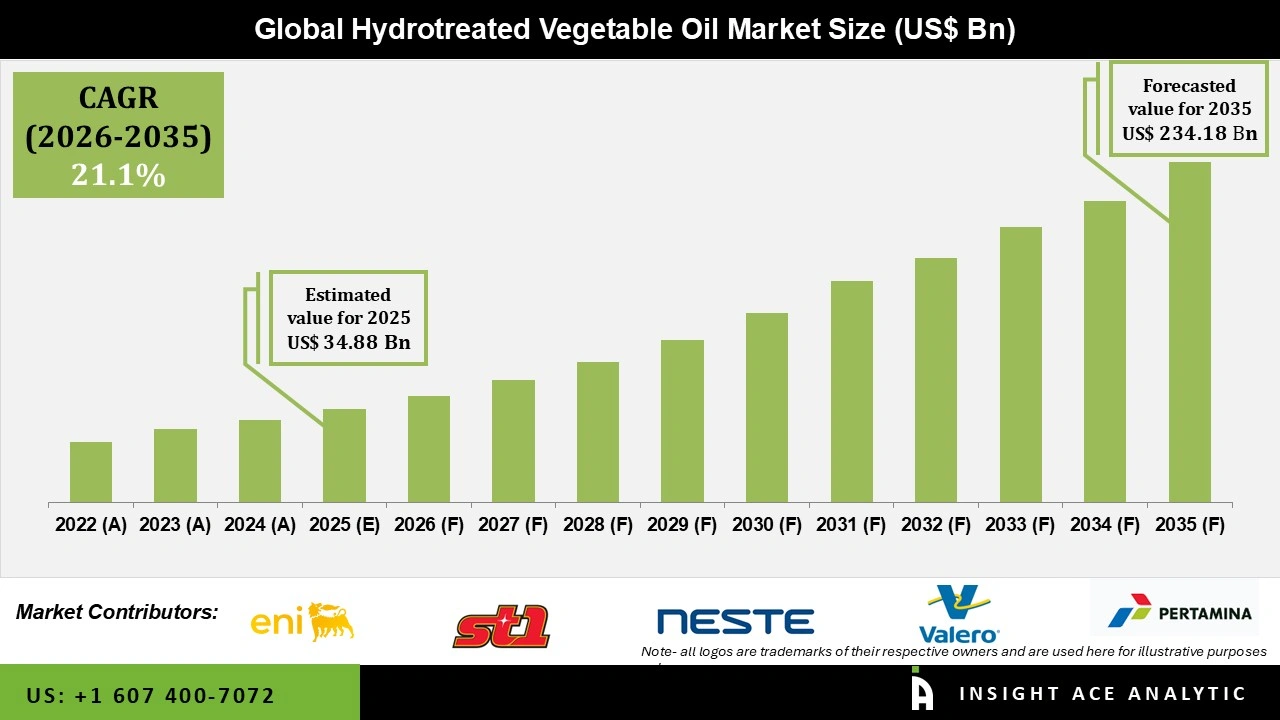
Global Hydrotreated Vegetable Oil Market Size is valued at USD 34.88 Billion in 2025 and is predicted to reach USD 234.18 Billion by the year 2035 at a 21.1% CAGR during the forecast period for 2026 to 2035.
Hydrotreated Vegetable Oil Market Size, Share & Trends Analysis Report By Application (Renewable Diesel And Sustainable Aviation Fuel (SAF)), End-User (Transportation, Agricultural Machinery, Industrial), Feedstock, Technology, By Region and Segment Forecasts, 2026 to 2035.
Hydrotreated Vegetable Oil Market Key Takeaways:
|
A renewable diesel known as hydrotreated vegetable oil (HVO) is made from a variety of vegetable oils and fats that contain triglycerides and fatty acids. Green diesel fuels produced by hydrogenation and hydrocracking of feedstocks such as tall oil, rapeseed oil, leftover cooking oil, and animal fats are referred to as HVO. HVO is totally free of aromatic hydrocarbons, oxygen, and sulfur. Due to the expanding worldwide automotive market, hydrotreated vegetable oil has been adopted more quickly than conventional fuels. Because it offers cheaper maintenance costs due to a decreased risk of degradation and is simple to mix in all quantities with ordinary diesel, the automotive sector employs HVO on a greater scale. The automotive industry is expected to use HVO more frequently in the following years due to its better mileage, less carbon and greenhouse gas emissions, and decreased reliance on non-renewable fossil fuels.
However, the COVID-19 pandemic has maintained a significant impact on companies all across the world. Several countries with rapid economic growth have also experienced economic instability as a result of this crisis. Due to the lack of treatments or vaccines for the viral infection, numerous industry experts and participants have been forced to implement various mitigation strategies. Additionally, the global economy suffered greatly from a sharp decline in mobility and reduced road transport due to the coronavirus outbreak.
Recent Developments:
- In Sept 2023, Petrochemical manufacturer LG Chem and Eni (ENI.MI) are investigating the possibility of building a biorefinery in South Korea. In the next years, Eni thinks biofuels derived from vegetable oil, leftover cooking oil, and grease will be crucial to the decarbonization of the truck, aircraft, and shipping industries.
Competitive Landscape
Some of Hydrotreated Vegetable Oil Market players are:
- Eni S.p.A.
- St1 Oy
- Neste
- Valero Energy Corporation
- PT Pertamina
- Repsol
- TotalEnergies
- UPM
- Phillips 66
- Chevron Renewable Energy Group, Inc.
- Green Biofuels Limited
- Petrobras
- ECB Group
- Preem AB
- Colabit Sweden AB
Market Segmentation:
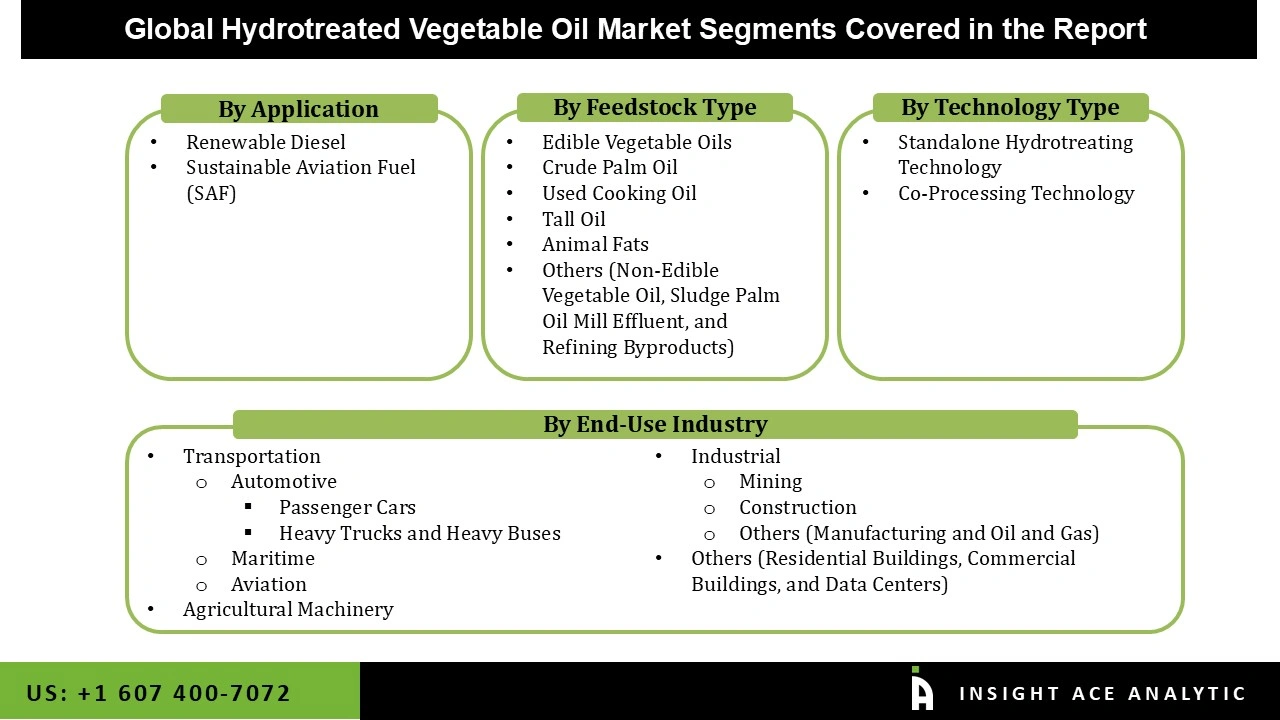
The Hydrotreated Vegetable Oil Market is segmented based on application, end-user, feedstock, and technology. The market is segmented as Renewable Diesel and Sustainable Aviation Fuel (SAF) based on application. The end-user segment includes Transportation, Agricultural Machinery, Industrial, and Others (Residential Buildings, Commercial Buildings, and Data Centers). By feedstock type, the market is segmented into Edible Vegetable Oils, Crude Palm Oil, Used Cooking Oil, Tall Oil, Animal Fats, and Others (Non-Edible Vegetable Oil, Sludge Palm Oil Mill Effluent, and Refining Byproducts). The technology type segment includes Standalone Hydrotreating Technology and Co-Processing Technology.
Based On Application, The Renewable Diesel Segment Is Accounted As A Significant Contributor In The Hydrotreated Vegetable Oil Market
The Renewable Diesel category is expected to hold a significant share of the global Hydrotreated Vegetable Oil Market in 2022. This is because it has a lower impact on the environment than conventional fuel. Pure HVO is made from renewable raw resources; therefore, no additional carbon dioxide (CO2) is released into the atmosphere during production. Co-processing up to 10% renewable feedstock (such as animal fats, leftover cooking oil, and vegetable oil) in an existing hydrotreating plant for little to no capital expenditure is expected to be the starting point for many refiners' biofuel journeys. Before dedicated machines are developed for 100% biofeeds, this might be a low- to no-capital-cost solution for generating hydrotreated vegetable oil (HVO), potentially bridging the gap and meeting standards.
The Transportation Segment Witnessed Growth At A Rapid Rate
The Transportation component is projected to grow at a rapid rate in the global Hydrotreated Vegetable Oil Market owing to more people choosing to use vehicles that emit no pollutants. The HVO promises a more sustainable fuel that can now be utilised in Euro 6 standard diesel engines and can cut a truck's emissions by up to 90%. HVO might serve as a beacon for road transport businesses as emissions rules are allegedly expected to become stricter.
The North America Hydrotreated Vegetable Oil Market Holds A Significant Revenue Share In The Region
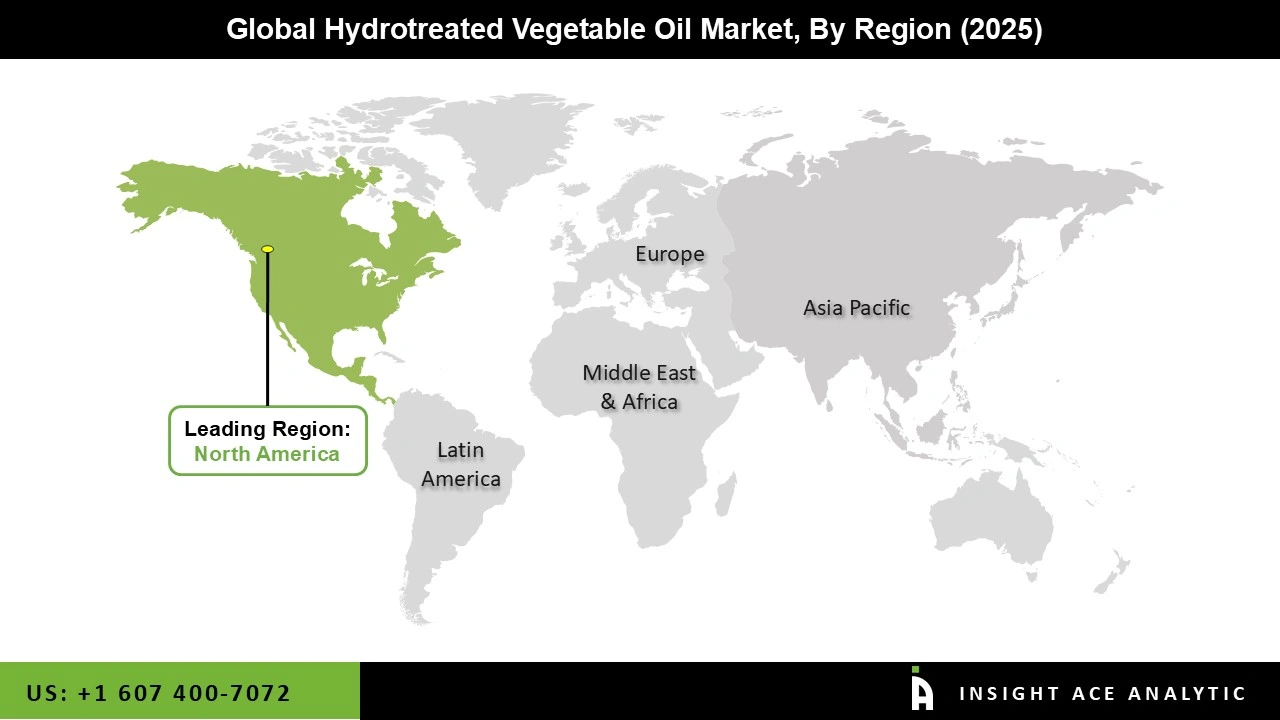
The North America Hydrotreated Vegetable Oil Market is expected to report the highest market share in terms of revenue in the near future. This can be attributed to the governmental restrictions on the use of renewable energy sources. With the support of numerous regulations that encourage HVO investments, such as the costs associated with Renewable Identification Numbers, Renewable Fuel Standards, biodiesel blender credits, and LCFS credits, HVO is expected to experience rapid growth in the United States.
Moreover, some of the significant market contributors to the Asia-Pacific region include Malaysia, China, India, and Indonesia. The price differential between palm oil and crude for biodiesel has increased as prices are at their most significant level in the forecast period.
Hydrotreated Vegetable Oil Market Report Scope :
| Report Attribute | Specifications |
| Market Size Value In 2025 | USD 34.88 billion |
| Revenue Forecast In 2035 | USD 234.18 billion |
| Growth Rate CAGR | CAGR of 21.1% from 2026 to 2035 |
| Quantitative Units | Representation of revenue in US$ Bn, Volume (KT) and CAGR from 2026 to 2035 |
| Historic Year | 2022 to 2024 |
| Forecast Year | 2026-2035 |
| Report Coverage | The forecast of revenue, the position of the company, the competitive market structure, growth prospects, and trends |
| Segments Covered | Application, End-User, Feedstock, and Technology |
| Regional Scope | North America; Europe; Asia Pacific; Latin America; Middle East & Africa |
| Country Scope | U.S.; Canada; U.K.; Germany; China; India; Japan; Brazil; Mexico; France; Italy; South Korea; South East Asia |
| Competitive Landscape | Eni S.p.A., St1 Oy, Neste, Valero Energy Corporation, PT Pertamina, Repsol, TotalEnergies, UPM, Phillips 66, Chevron Renewable Energy Group, Inc., Green Biofuels Limited, Petrobras, ECB Group, Preem AB, and Colabit Sweden AB. |
| Customization Scope | Free customization report with the procurement of the report, Modifications to the regional and segment scope. Particular Geographic competitive landscape. |
| Pricing And Available Payment Methods | Explore pricing alternatives that are customized to your particular study requirements. |
Segmentation of Hydrotreated Vegetable Oil Market :
Hydrotreated Vegetable Oil Market By Application-
- Renewable Diesel
- Sustainable Aviation Fuel (SAF)
Hydrotreated Vegetable Oil Market By End-User-
- Transportation
- Agricultural Machinery
- Industrial
- Others (Residential Buildings, Commercial Buildings, and Data Centers)
- Transportation
- Automotive
- Passenger Cars
- Heavy Trucks and Heavy Buses
- Maritime
- Aviation
- Automotive
- Agricultural Machinery
- Industrial
- Mining
- Construction
- Others (Manufacturing and Oil and Gas)
- Others (Residential Buildings, Commercial Buildings, and Data Centers)
Hydrotreated Vegetable Oil Market By Feedstock Type-
- Edible Vegetable Oils
- Crude Palm Oil
- Used Cooking Oil
- Tall Oil
- Animal Fats
- Others (Non-Edible Vegetable Oil, Sludge Palm Oil Mill Effluent, and Refining Byproducts)
Hydrotreated Vegetable Oil Market By Technology Type-
- Standalone Hydrotreating Technology
- Co-Processing Technology
Hydrotreated Vegetable Oil Market By Region-
- North America-
- The US
- Canada
- Europe-
- Germany
- The UK
- France
- Italy
- Spain
- Rest of Europe
- Asia-Pacific-
- China
- Japan
- India
- South Korea
- South East Asia
- Rest of Asia Pacific
- Latin America-
- Brazil
- Argentina
- Mexico
- Rest of Latin America
- Middle East & Africa-
- GCC Countries
- South Africa
- Rest of Middle East and Africa
Research Design and Approach
This study employed a multi-step, mixed-method research approach that integrates:
- Secondary research
- Primary research
- Data triangulation
- Hybrid top-down and bottom-up modelling
- Forecasting and scenario analysis
This approach ensures a balanced and validated understanding of both macro- and micro-level market factors influencing the market.
Secondary Research
Secondary research for this study involved the collection, review, and analysis of publicly available and paid data sources to build the initial fact base, understand historical market behaviour, identify data gaps, and refine the hypotheses for primary research.
Sources Consulted
Secondary data for the market study was gathered from multiple credible sources, including:
- Government databases, regulatory bodies, and public institutions
- International organizations (WHO, OECD, IMF, World Bank, etc.)
- Commercial and paid databases
- Industry associations, trade publications, and technical journals
- Company annual reports, investor presentations, press releases, and SEC filings
- Academic research papers, patents, and scientific literature
- Previous market research publications and syndicated reports
These sources were used to compile historical data, market volumes/prices, industry trends, technological developments, and competitive insights.

Primary Research
Primary research was conducted to validate secondary data, understand real-time market dynamics, capture price points and adoption trends, and verify the assumptions used in the market modelling.
Stakeholders Interviewed
Primary interviews for this study involved:
- Manufacturers and suppliers in the market value chain
- Distributors, channel partners, and integrators
- End-users / customers (e.g., hospitals, labs, enterprises, consumers, etc., depending on the market)
- Industry experts, technology specialists, consultants, and regulatory professionals
- Senior executives (CEOs, CTOs, VPs, Directors) and product managers
Interview Process
Interviews were conducted via:
- Structured and semi-structured questionnaires
- Telephonic and video interactions
- Email correspondences
- Expert consultation sessions
Primary insights were incorporated into demand modelling, pricing analysis, technology evaluation, and market share estimation.
Data Processing, Normalization, and Validation
All collected data were processed and normalized to ensure consistency and comparability across regions and time frames.
The data validation process included:
- Standardization of units (currency conversions, volume units, inflation adjustments)
- Cross-verification of data points across multiple secondary sources
- Normalization of inconsistent datasets
- Identification and resolution of data gaps
- Outlier detection and removal through algorithmic and manual checks
- Plausibility and coherence checks across segments and geographies
This ensured that the dataset used for modelling was clean, robust, and reliable.
Market Size Estimation and Data Triangulation
Bottom-Up Approach
The bottom-up approach involved aggregating segment-level data, such as:
- Company revenues
- Product-level sales
- Installed base/usage volumes
- Adoption and penetration rates
- Pricing analysis
This method was primarily used when detailed micro-level market data were available.

Top-Down Approach
The top-down approach used macro-level indicators:
- Parent market benchmarks
- Global/regional industry trends
- Economic indicators (GDP, demographics, spending patterns)
- Penetration and usage ratios
This approach was used for segments where granular data were limited or inconsistent.
Hybrid Triangulation Approach
To ensure accuracy, a triangulated hybrid model was used. This included:
- Reconciling top-down and bottom-up estimates
- Cross-checking revenues, volumes, and pricing assumptions
- Incorporating expert insights to validate segment splits and adoption rates
This multi-angle validation yielded the final market size.
Forecasting Framework and Scenario Modelling
Market forecasts were developed using a combination of time-series modelling, adoption curve analysis, and driver-based forecasting tools.
Forecasting Methods
- Time-series modelling
- S-curve and diffusion models (for emerging technologies)
- Driver-based forecasting (GDP, disposable income, adoption rates, regulatory changes)
- Price elasticity models
- Market maturity and lifecycle-based projections
Scenario Analysis
Given inherent uncertainties, three scenarios were constructed:
- Base-Case Scenario: Expected trajectory under current conditions
- Optimistic Scenario: High adoption, favourable regulation, strong economic tailwinds
- Conservative Scenario: Slow adoption, regulatory delays, economic constraints
Sensitivity testing was conducted on key variables, including pricing, demand elasticity, and regional adoption.
Request Customization
Add countries, segments, company profiles, or extend forecast — free 10% customization with purchase.
Customize This Report →Enquire Before Buying
Speak with our analyst team about scope, methodology, pricing, or deliverable formats.
Enquire Now →Frequently Asked Questions
Hydrotreated Vegetable Oil Market Size is valued at USD 34.88 billion in 2025 and is predicted to reach USD 234.18 billion by the year 2035
Hydrotreated Vegetable Oil Market is expected to grow at a 21.1% CAGR during the forecast period for 2026 to 2035.
Eni S.p.A., St1 Oy, Neste, Valero Energy Corporation, PT Pertamina, Repsol, TotalEnergies, UPM, Phillips 66, Chevron Renewable Energy Group, Inc., Green Biofuels Limited, Petrobras, ECB Group, Preem AB, and Colabit Sweden AB. and Others
Hydrotreated Vegetable Oil Market is Segmented in Application (Renewable Diesel And Sustainable Aviation Fuel (SAF)), End-User (Transportation, Agricultural Machinery, Industrial), Feedstock, Technology and Other.
North American region is leading the Hydrotreated Vegetable Oil Market.