Hospital At Home Market Key Players Analysis 2025 to 2034
Global Hospital At Home Market Size is valued at USD 22.8 Bn in 2024 and is predicted to reach USD 1160.6 Bn by the year 2034 at a 48.9% CAGR during the forecast period for 2025 to 2034.
Hospital At Home Market Size, Share & Trends Analysis Report By Service Type (Therapeutic, Diagnostic), Application (Skilled Home Healthcare Service, Unskilled Home Healthcare Service), By Region, And Segment Forecasts, 2025 to 2034

The hospital-at-home business is growing because AI is being used everywhere. Hospital-at-home creates a smart, real-time world where most lines, paperwork, hassles, and drudgery are replaced by fast access to high-quality hospital care when and where it's needed most. Hospital-at-home offers a completely digital area that can be measured and can give the best care. Hospitals are having trouble finding enough beds for patients, so Hospital-at-Home markets are growing quickly.
The hospital-at-home sector offers various medical treatments for illnesses in residential settings. Injuries are treated at home, and overall health is improved. The doctor will decide on the course of treatment and any home treatments the patient might require. Depending on the patient's health, the duration of hospital-at-home might range from brief to long. Due to the rising need for blood glucose monitoring devices, home dialysis machines, and thermometers, there are many options for hospital-at-home devices, which accelerates market expansion.
The majority of developed and developing countries offer some level of partial or complete coverage for in-home services, which promotes market expansion. These services primarily consider geriatric chairs, bed rails, and belts as modes of movement. Nurses restricted patients' freedom of movement by preventing them from using the stairs, getting to their medications, organizing certain areas of the house, and performing other household tasks.
Hospital At Home Market Competitive Analysis :
- Amedisys
- Aurora Enterprises
- Bon Secours Mercy Health
- Brookdale Senior Living
- CenterWell Home Health
- Central Logic
- Conduit Health
- Contessa
- DispatchHealth
- Encompass Health
- HCA
- Humana
- Medalogix
- Massachusetts General Brigham and Women's Hospital
- Mayo Clinic
- Medically Home
- SENA Health
- Senior Helpers
- Trinity Health
- UnitedHealth Group
- Optum
- LHC Group
- AdventHealth
- Virginia Mason Franciscan Health
- Sanford Health
- CareWell Health
- M Health Fairview
- Inspira Health
- BayCare Health System
- North Texas Medical Center
- Boston Medical Center
Market Segmentation:
The hospital-at-home market is divided into Service Type and Application. Based on Service type, the market is segmented as therapeutic, and Diagnostic. By the Application, the market is segmented as Skilled Home Healthcare Service which comprises Physician/primary care, Nursing Care, Physical, Occupational, and/or Speech Therapy, Nutritional Support, Hospice & Palliative Care, Other Skilled Care Services. And another is Unskilled Home Healthcare Service.
Based On Service, The Skilled Nursing Segment Is A Major Contributor To The Hospital-At-Home Market
The skilled nursing category is expected to hold a considerable share of the global hospital-at-home market in 2022. The wide range of daily tasks carried out by nurses to provide sufficient care for patients receiving homecare, the increased adoption of home-based treatments that require technical expertise in operating medical equipment, such as home dialysis equipment, home IV machinery, home oxygen therapy equipment, and the rising demand for home care for the elderly population are all factors contributing to the growth of this market.
The Diabetes Segment Witnessed Growth At A Rapid Rate
The diabetes segment is projected to expand in the global hospital-at-home market growth. The increase in diabetes patients worldwide, who are more vulnerable to conditions like cardiovascular disease and Alzheimer's, is blamed for expanding this market. Additionally, the increased need for monitoring diabetes patients' blood pressure, cholesterol, hemoglobin, and heart rate also adds to the expansion of this market segment.
The North America Hospital-At-Home Market Holds A Significant Regional Revenue Share
The North American region hospital-at-home market is expected to register the highest market share in revenue shortly. The U.S. market is expected to develop due to the population's high disposable incomes, an increase among individuals with chronic illnesses, and government initiatives to promote hospital-at-home. The use of hospital-at-home products and services is growing primarily due to factors like insufficiently developed healthcare systems, expensive in-hospital healthcare facilities, and chronic diseases requiring long-term care; businesses are concentrating on developing countries that will increase hospital-at-home services shortly.
In addition, the Asia Pacific region is projected to rise in the global Hospital-At-Home market. The growing number of older adults, a growing incidence of chronic diseases in developing countries, the growth of hospital-at-home expenditures in developing nations like China and India, and the preference for home-based treatments due to the increased costs of hospital services are all factors contributing to the regional market's expansion. The development of the Asia-Pacific hospital-at-home market is also driven by government efforts supporting home care and the introduction of innovative homecare goods.
Recent Developments
- In June 2023, Emory Healthcare and DispatchHealth, the first full-service in-home healthcare provider in the US, are working together to give patients a new choice for easy follow-up and/or high-acuity medical care in the privacy of their own homes. The partnership aims to increase patient access to healthcare while lowering the overall cost of care in Atlanta, Georgia, and the nearby communities.
- In Mar 2022, Trinity Health declared plans to extend its private-duty footprint and has been actively seeking to purchase a half-dozen private-duty companies in order to care for a broader spectrum of patients and address social determinants of health.
Hospital-At-Home Market Report Scope:
| Report Attribute | Specifications |
| Growth rate CAGR | CAGR of 48.9 % from 2025 to 2034 |
| Quantitative units | Representation of revenue in US$ Billion, and CAGR from 2025 to 2034 |
| Historic Year | 2021 to 2024 |
| Forecast Year | 2025-2034 |
| Report coverage | The forecast of revenue, the position of the company, the competitive market statistics, growth prospects, and trends |
| Segments covered | Products, Services And Disease Indications |
| Regional scope | North America; Europe; Asia Pacific; Latin America; Middle East & Africa |
| Country scope | U.S.; Canada; U.K.; Germany; India; Japan; Brazil; Mexico; France; Italy; Spain; China; South Korea; Southeast Asia |
| Competitive Landscape | Amedisys, Aurora Enterprises, Bon Secours Mercy Health, Brookdale Senior Living, CenterWell Home Health, Central Logic, Conduit Health, Contessa, DispatchHealth, Encompass Health, HCA, Humana, Medalogix, Massachusetts General Brigham and Women's Hospital, Mayo Clinic, Medically Home, SENA Health, Senior Helpers, Trinity Health, UnitedHealth Group, Optum,LHC Group |
| Customization scope | Free customization report with the procurement of the report, Modifications to the regional and segment scope. Particular Geographic competitive landscape. |
| Pricing and available payment methods | Explore pricing alternatives that are customized to your particular study requirements. |
Segmentation of Hospital-At-Home Market-
Hospital-At-Home Market By Service Type -
- Acute Care Services
- Post-surgical recovery
- Acute infections (pneumonia, UTI, cellulitis)
- Exacerbation of chronic conditions (COPD, CHF, diabetes complications)
- Chronic Disease Management
- Diabetes care
- Hypertension and cardiovascular diseases
- Oncology & palliative care
- Neurological & orthopedic conditions
- Post-Operative & Rehabilitation Services
- Orthopedic surgery recovery
- Cardiac rehabilitation
- Neurological rehab (stroke, spinal injury)
- Palliative & End-of-Life Care
- Preventive & Wellness Monitoring
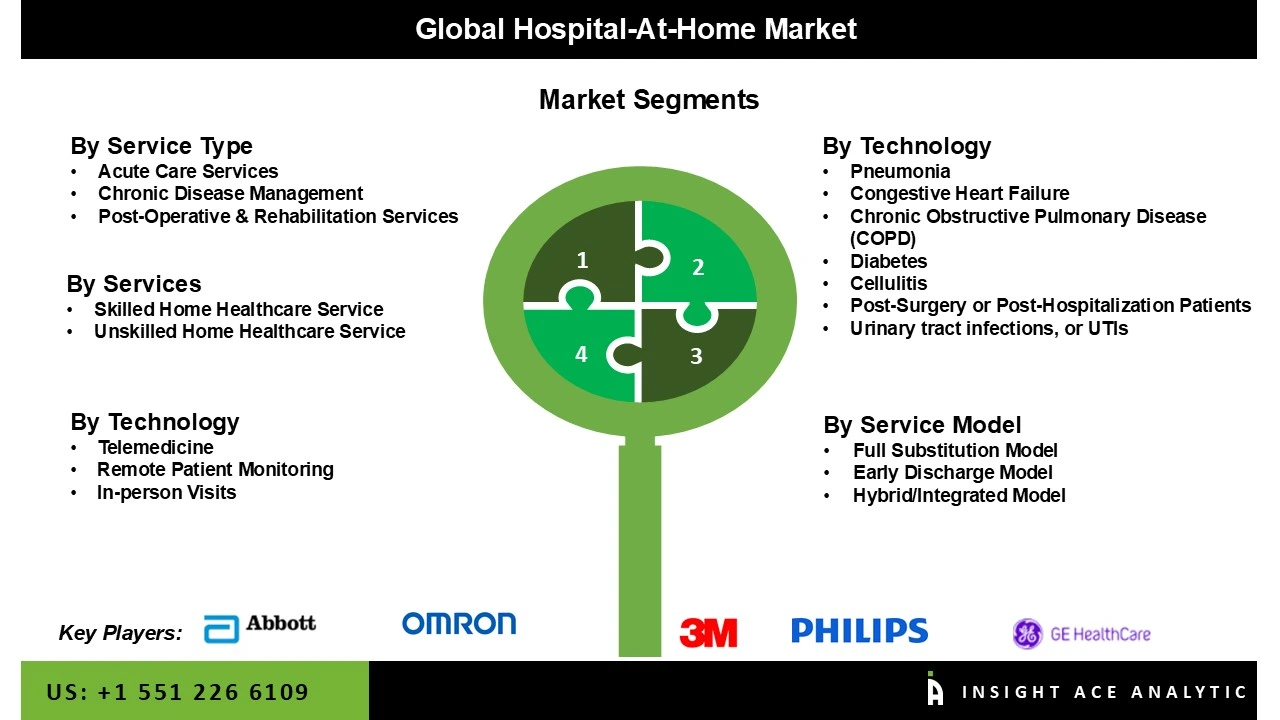
Hospital-At-Home Market By Services-
- Skilled Home Healthcare Service
- Physician/primary care
- Nursing Care
- Physical, Occupational, and/or Speech Therapy
- Nutritional Support
- Hospice & Palliative Care
- Other Skilled Care Services
- Unskilled Home Healthcare Service
Hospital-At-Home Market By Technology-
- Telemedicine
- Remote Patient Monitoring
- In-person Visits
Hospital-At-Home Market By Conditions-
- Pneumonia
- Congestive Heart Failure
- Chronic Obstructive Pulmonary Disease (COPD)
- Diabetes
- Cellulitis
- Post-Surgery or Post-Hospitalization Patients
- Urinary tract infections, or UTIs
Hospital-At-Home Market By Service Model-
- Full Substitution Model
- Early Discharge Model
- Hybrid/Integrated Model
Hospital-At-Home Market Companies:
Health Systems / Providers running HaH programs
- AdventHealth
- BayCare Health System
- Bon Secours Mercy Health
- Boston Medical Center
- HCA Healthcare
- Inspira Health
- LHC Group (now part of Optum/UnitedHealth)
- M Health Fairview
- Massachusetts General Brigham and Women’s Hospital
- Mayo Clinic
- Sanford Health
- Trinity Health
- Virginia Mason Franciscan Health
Specialized HaH & Home Health Companies
- Amedisys
- CenterWell Home Health (Humana subsidiary)
- Contessa (owned by Amedisys)
- DispatchHealth
- Encompass Health
- Medically Home
- SENA Health
- Senior Helpers
Payers / Integrated Care Players
- Humana
- Optum
- UnitedHealth Group
Technology & Enablers (care coordination / analytics)
- Central Logic (now ABOUT Healthcare)
- Conduit Health Partners
- Medalogix
Hospital-At-Home Market By Region-
North America-
- The US
- Canada
- Mexico
Europe-
- Germany
- The UK
- France
- Italy
- Spain
- Rest of Europe
Asia-Pacific-
- China
- Japan
- India
- South Korea
- Southeast Asia
- Rest of Asia Pacific
Latin America-
- Brazil
- Argentina
- Rest of Latin America
Middle East & Africa-
- GCC Countries
- South Africa
- Rest of Middle East and Africa
Research Design and Approach
This study employed a multi-step, mixed-method research approach that integrates:
- Secondary research
- Primary research
- Data triangulation
- Hybrid top-down and bottom-up modelling
- Forecasting and scenario analysis
This approach ensures a balanced and validated understanding of both macro- and micro-level market factors influencing the market.
Secondary Research
Secondary research for this study involved the collection, review, and analysis of publicly available and paid data sources to build the initial fact base, understand historical market behaviour, identify data gaps, and refine the hypotheses for primary research.
Sources Consulted
Secondary data for the market study was gathered from multiple credible sources, including:
- Government databases, regulatory bodies, and public institutions
- International organizations (WHO, OECD, IMF, World Bank, etc.)
- Commercial and paid databases
- Industry associations, trade publications, and technical journals
- Company annual reports, investor presentations, press releases, and SEC filings
- Academic research papers, patents, and scientific literature
- Previous market research publications and syndicated reports
These sources were used to compile historical data, market volumes/prices, industry trends, technological developments, and competitive insights.

Primary Research
Primary research was conducted to validate secondary data, understand real-time market dynamics, capture price points and adoption trends, and verify the assumptions used in the market modelling.
Stakeholders Interviewed
Primary interviews for this study involved:
- Manufacturers and suppliers in the market value chain
- Distributors, channel partners, and integrators
- End-users / customers (e.g., hospitals, labs, enterprises, consumers, etc., depending on the market)
- Industry experts, technology specialists, consultants, and regulatory professionals
- Senior executives (CEOs, CTOs, VPs, Directors) and product managers
Interview Process
Interviews were conducted via:
- Structured and semi-structured questionnaires
- Telephonic and video interactions
- Email correspondences
- Expert consultation sessions
Primary insights were incorporated into demand modelling, pricing analysis, technology evaluation, and market share estimation.
Data Processing, Normalization, and Validation
All collected data were processed and normalized to ensure consistency and comparability across regions and time frames.
The data validation process included:
- Standardization of units (currency conversions, volume units, inflation adjustments)
- Cross-verification of data points across multiple secondary sources
- Normalization of inconsistent datasets
- Identification and resolution of data gaps
- Outlier detection and removal through algorithmic and manual checks
- Plausibility and coherence checks across segments and geographies
This ensured that the dataset used for modelling was clean, robust, and reliable.
Market Size Estimation and Data Triangulation
Bottom-Up Approach
The bottom-up approach involved aggregating segment-level data, such as:
- Company revenues
- Product-level sales
- Installed base/usage volumes
- Adoption and penetration rates
- Pricing analysis
This method was primarily used when detailed micro-level market data were available.

Top-Down Approach
The top-down approach used macro-level indicators:
- Parent market benchmarks
- Global/regional industry trends
- Economic indicators (GDP, demographics, spending patterns)
- Penetration and usage ratios
This approach was used for segments where granular data were limited or inconsistent.
Hybrid Triangulation Approach
To ensure accuracy, a triangulated hybrid model was used. This included:
- Reconciling top-down and bottom-up estimates
- Cross-checking revenues, volumes, and pricing assumptions
- Incorporating expert insights to validate segment splits and adoption rates
This multi-angle validation yielded the final market size.
Forecasting Framework and Scenario Modelling
Market forecasts were developed using a combination of time-series modelling, adoption curve analysis, and driver-based forecasting tools.
Forecasting Methods
- Time-series modelling
- S-curve and diffusion models (for emerging technologies)
- Driver-based forecasting (GDP, disposable income, adoption rates, regulatory changes)
- Price elasticity models
- Market maturity and lifecycle-based projections
Scenario Analysis
Given inherent uncertainties, three scenarios were constructed:
- Base-Case Scenario: Expected trajectory under current conditions
- Optimistic Scenario: High adoption, favourable regulation, strong economic tailwinds
- Conservative Scenario: Slow adoption, regulatory delays, economic constraints
Sensitivity testing was conducted on key variables, including pricing, demand elasticity, and regional adoption.
Request Customization
Add countries, segments, company profiles, or extend forecast — free 10% customization with purchase.
Customize This Report →Enquire Before Buying
Speak with our analyst team about scope, methodology, pricing, or deliverable formats.
Enquire Now →Frequently Asked Questions
The Global Hospital Privacy Screens Market is expected to grow at a 48.9% CAGR during the forecast period for 2025 to 2034.
Amedisys, Aurora Enterprises, Bon Secours Mercy Health, Brookdale Senior Living, CenterWell Home Health, Central Logic, Conduit Health, Contessa
The Global Hospital Privacy Screens Market Size is valued at 22.8 Bn in 2024 and is predicted to reach 1160.6 Bn by the year 2034
Service Type and Application are the key segments of the Hospital-At-Home Market.
North America region is leading the Hospital-At-Home Market.