Sustainable Animal Feed Market Size and Revenue Impact Study 2026 to 2035
Global Sustainable Animal Feed Market Size is valued at USD 20.24 Billion in 2025 and is predicted to reach USD 149.02 Billion by the year 2035 at a 23.10% CAGR during the forecast period for 2026 to 2035.
Sustainable Animal Feed Market Size, Share & Trends Analysis Report By Product Category (Sustainable Feed, Additives & Premixes, Sustainable Feed Ingredients, Sustainable Complete Feed (Finished Feed), By Additive Type (Methane & GHG Mitigation Additives, Enzymes, Amino Acids, Probiotics, Prebiotics & Postbiotics, Mycotoxin Binders & Detoxifiers, Organic / Chelated Trace Minerals, Vitamin Premixes & Functional Blends), by Ingredient Family, by Animal Type, by Sustainability Objective, by Form, By Production System, By Sales Channel, By Region, and Segment Forecasts, 2026 to 2035.
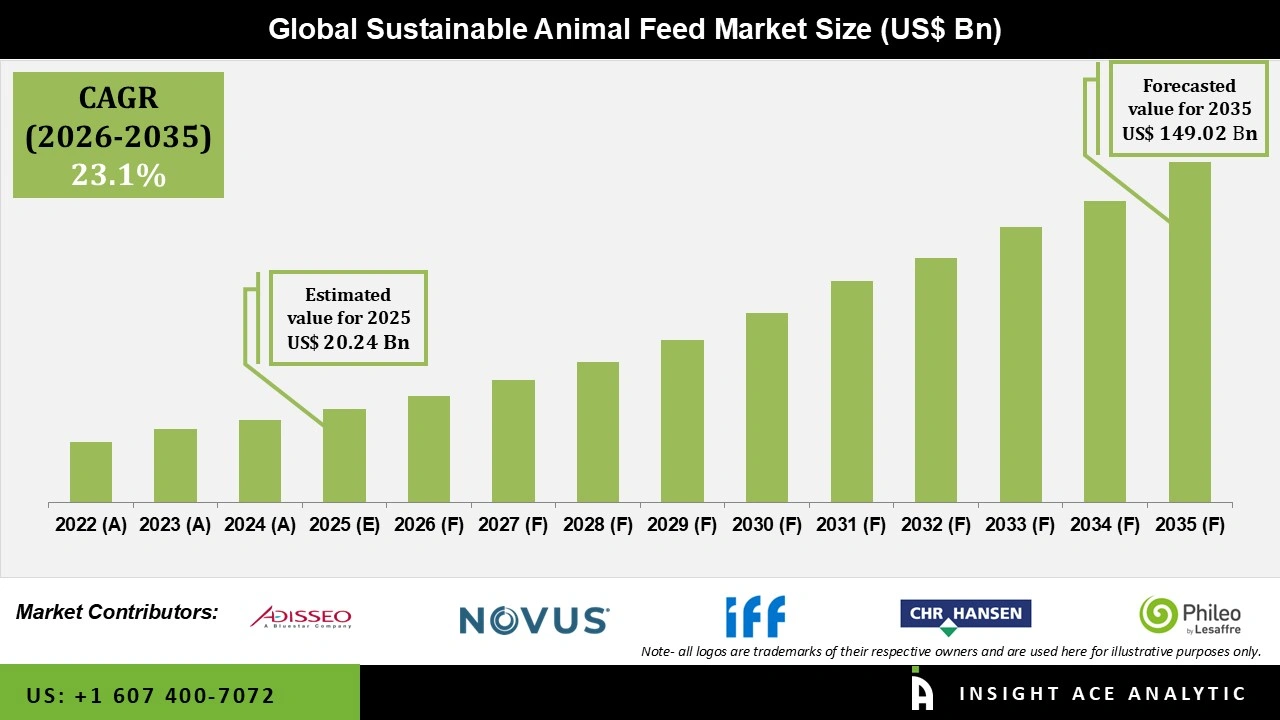
Animal feed is essential to the livestock production system. That's because feeding has a direct impact on the productivity, health, and welfare of animals. Sustainable animal feed solutions accelerate growth feed efficiency and improve animal health and the quality of animal products. They are financially advantageous and bring environmental benefits too. The foremost factors driving the growth of the sustainable animal feed market include the growing consumption of meat and animal-based products across different regions, increasing demand for animal protein, population growth, rising changes in diet, innovation of new sustainable products by companies, growing health awareness among consumers regarding the consumption of animal protein, and the availability of digital resource guides for enhancing the overall sustainability of the animal and environment systems. The increased demand for animal proteins encourages companies and organizations involved in the food supply chain to develop safe and quality animal products. It creates the need for resources and information specific to feed sustainability, thereby boosting the growth of the sustainable animal feed market.
However, the high cost of animal feed, limited knowledge of new medical technologies, and various environmental and safety regulations associated with feed sustainability are expected to hinder the market's growth over the forecast years.
Competitive Landscape
Some Of The Key Players In The Sustainable Animal Feed Market:
- Cargill, Incorporated
- Archer Daniels Midland (ADM)
- dsm-firmenich
- Evonik Industries AG
- BASF SE
- Nutreco N.V.
- Alltech Inc.
- Kemin Industries
- Adisseo
- Novus International
- IFF (Danisco Animal Nutrition)
- Chr. Hansen Holding A/S
- Phileo by Lesaffre
- Elanco Animal Health
- Zoetis
- Protix
- InnovaFeed
- Ynsect
- Entobel
- Hexafly
- nextProtein
- Beta Hatch
- EnviroFlight
- Calysta
- Unibio
- Deep Branch Biotechnology
- String Bio
- Corbion
- Veramaris
- Fermentalg
- Euglena Co., Ltd.
- BlueBioTech
- Algal Scientific
- BioProcess Algae LLC
- MicroBio Engineering (MBE), Inc.
- SabrTech
- Global Algae Innovations
- Culture BioSystems
- Sea Forest
- Symbrosia
- Volta Greentech
- MEGA Tierernaehrung GmbH
- Other Prominant Players
Sustainable feed additives and premixes hold a major market share in 2025
In the sustainable animal feed market, sustainable feed additives and premixes are among the leading product categories. The segmental growth is due to delivering targeted improvements in feed efficiency, animal health, and environmental performance with low inclusion rates and quick integration into existing feed systems. Feed additives enable quick reductions in nutrient excretion, antibiotic use, and methane emissions without altering base feed formulations, supporting regulatory compliance and sustainability goals and thereby accelerating segment growth.
The poultry segment holds the major share.
By animal type, poultry (broilers and layers) clearly leads, driven by massive global demand for affordable, quick-cycle protein sources. Short poultry production cycles enable faster adoption of sustainable feed solutions, thereby driving market growth. Moreover, Aquaculture is anticipated to be the fastest-growing segment, propelled by the urgent need for marine-sparing feeds (e.g., algae and insect replacements for fishmeal/oil) to sustain expansion amid concerns about overfishing and eco-certification demands.
Why North America holds a strong position.
The regional growth is characterized by advanced technological adoption, significant R&D investment in precision nutrition, and growing corporate sustainability commitments from major producers and retailers. The region is rapidly focusing on scaling methane & GHG mitigation additives for ruminants, enzyme applications to improve efficiency, and alternative proteins to enhance feed conversion, while addressing environmental concerns such as nutrient runoff and emissions.
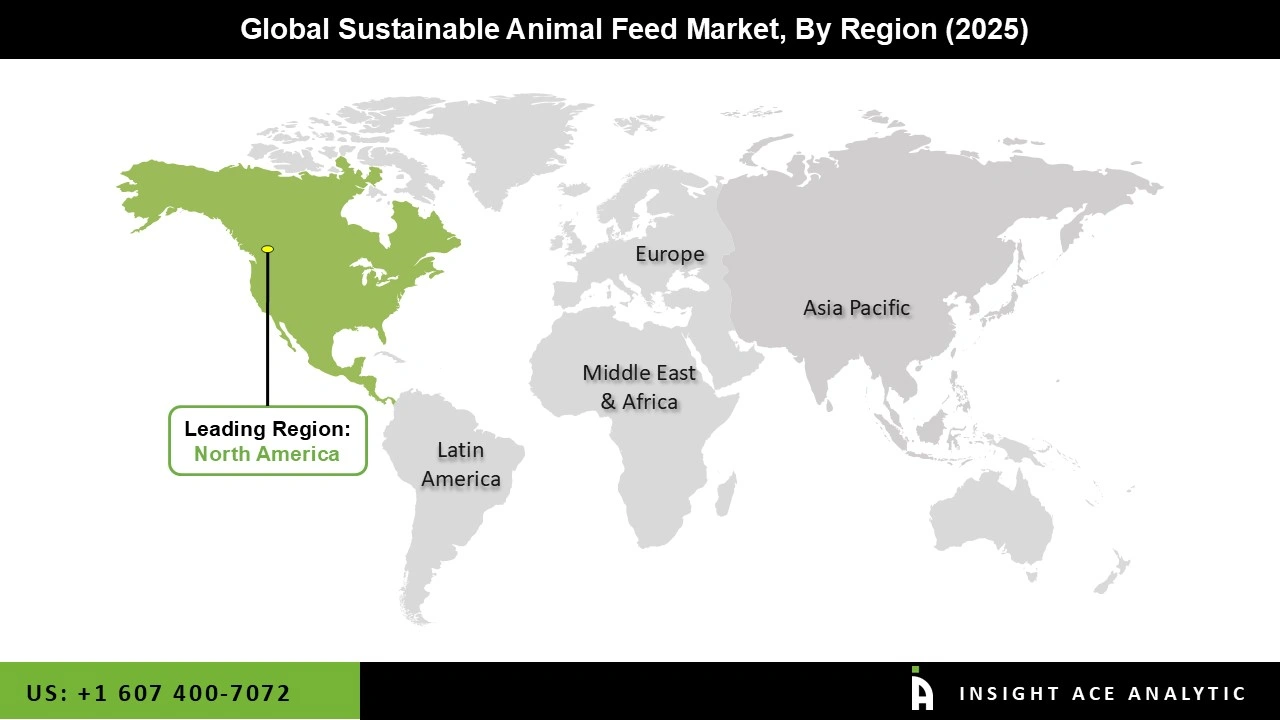
Factors such as high per-capita meat consumption, large-scale commercial operations (especially poultry and beef), and innovation in functional blends are also further driving the regional growth.
Sustainable Animal Feed Market Report Scope :
| Report Attribu | Specifications |
| Market Size Value In 2025 | USD 20.24 Billion |
| Revenue Forecast In 2035 | USD 149.02 Billion |
| Growth Rate CAGR | CAGR of 23.10% from 2026 to 2035 |
| Quantitative Units | Representation of revenue in US$ Mn,and CAGR from 2026 to 2035 |
| Historic Year | 2022 to 2025 |
| Forecast Year | 2026 -2035 |
| Report Coverage | The forecast of revenue, the position of the company, the competitive market structure, growth prospects, and trends |
| Segments Covered | By Ingredient Type, By Product, By Livestock |
| Regional Scope | North America; Europe; Asia Pacific; Latin America; Middle East & Africa |
| Country Scope | U.S.; Canada; U.K.; Germany; China; India; Japan; Brazil; Mexico ;The UK; France; Italy; Spain; South Korea; South East Asia |
| Competitive Landscape | Cargill, Incorporated, Archer Daniels Midland (ADM), dsm-firmenich, Evonik Industries AG, BASF SE, Nutreco N.V., Alltech Inc., Kemin Industries, Adisseo, Novus International, IFF (Danisco Animal Nutrition), Chr. Hansen Holding A/S, Phileo by Lesaffre, Elanco Animal Health, Zoetis, Protix, InnovaFeed, Ynsect, Entobel, Hexafly, nextProtein, Beta Hatch, EnviroFlight, Calysta, Unibio, Deep Branch Biotechnology, String Bio, Corbion, Veramaris, Fermentalg, Euglena Co., Ltd., BlueBioTech, Algal Scientific, BioProcess Algae LLC, MicroBio Engineering (MBE), Inc., SabrTech, Global Algae Innovations, Culture BioSystems, Sea Forest, Symbrosia, Volta Greentech, MEGA Tierernaehrung GmbH and Others. |
| Customization Scope | Free customization report with the procurement of the report, Modifications to the regional and segment scope. Particular Geographic competitive landscape. |
| Pricing And Available Payment Methods | Explore pricing alternatives that are customized to your particular study requirements. |
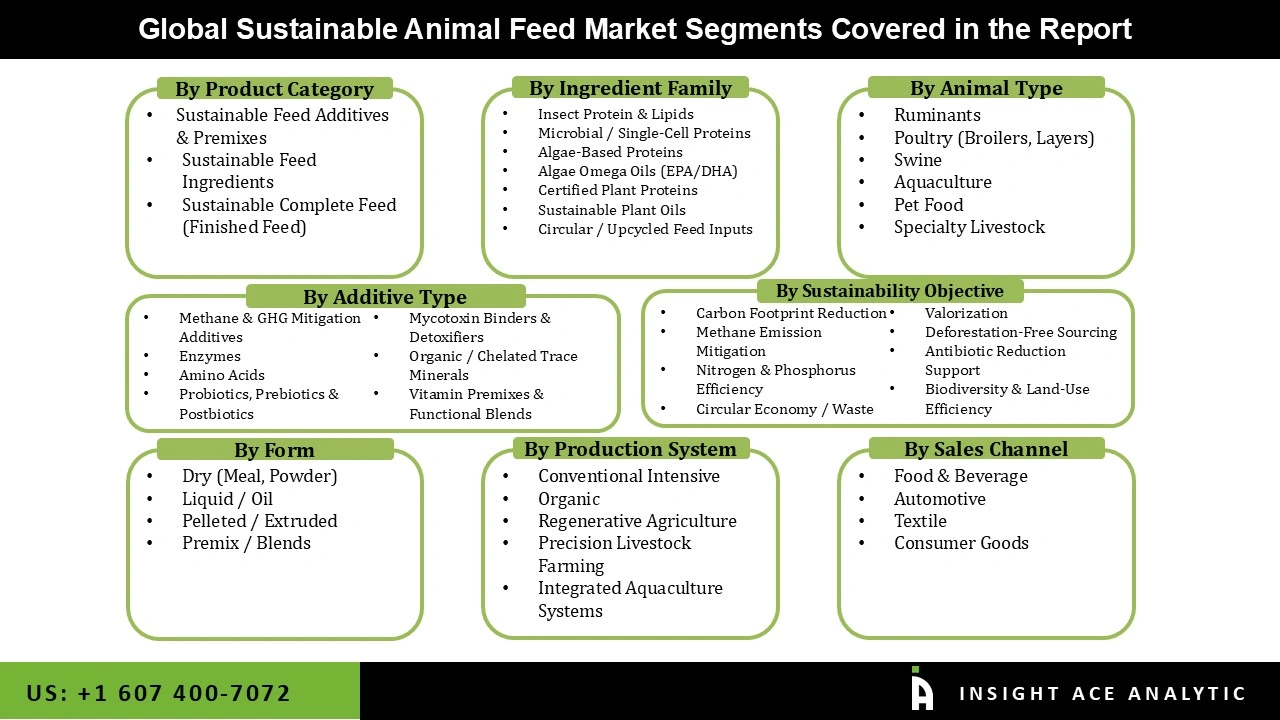
Segmentation of Sustainable Animal Feed Market :
Sustainable Animal Feed Market, by Product Category-
- Sustainable Feed Additives & Premixes
- Sustainable Feed Ingredients
- Sustainable Complete Feed (Finished Feed)
Sustainable Animal Feed Market, By Additive Type-
- Methane & GHG Mitigation Additives
- Enzymes
- Phytase
- Protease
- Carbohydrases
- Amino Acids
- Lysine
- Methionine
- Threonine
- Tryptophan
- Probiotics, Prebiotics & Postbiotics
- Mycotoxin Binders & Detoxifiers
- Organic / Chelated Trace Minerals
- Vitamin Premixes & Functional Blends
Sustainable Animal Feed Market, by Ingredient Family-
- Insect Protein & Lipids
- Microbial / Single-Cell Proteins
- Algae-Based Proteins
- Algae Omega Oils (EPA/DHA)
- Certified Plant Proteins
- Sustainable Plant Oils
- Circular / Upcycled Feed Inputs
Sustainable Animal Feed Market, by Animal Type-
- Ruminants
- Poultry (Broilers, Layers)
- Swine
- Aquaculture
- Pet Food
- Specialty Livestock
Sustainable Animal Feed Market, by Sustainability Objective-
- Carbon Footprint Reduction
- Methane Emission Mitigation
- Nitrogen & Phosphorus Efficiency
- Circular Economy / Waste Valorization
- Deforestation-Free Sourcing
- Antibiotic Reduction Support
- Biodiversity & Land-Use Efficiency
Sustainable Animal Feed Market by Form
- Dry (Meal, Powder)
- Liquid / Oil
- Pelleted / Extruded
- Premix / Blends
Sustainable Animal Feed Market, By Production System-
- Conventional Intensive
- Organic
- Regenerative Agriculture
- Precision Livestock Farming
- Integrated Aquaculture Systems
Sustainable Animal Feed Market, By Sales Channel-
- Direct to Integrators
- Feed Mills / Premix Blenders
- Distributors
- Retail / Pet Specialty
Sustainable Animal Feed Market, By Region-
- North America-
- The US
- Canada
- Europe-
- Germany
- The UK
- France
- Italy
- Spain
- Rest of Europe
- Asia-Pacific-
- China
- Japan
- India
- South Korea
- South East Asia
- Rest of Asia Pacific
- Latin America-
- Brazil
- Argentina
- Mexico
- Rest of Latin America
- Middle East & Africa-
- GCC Countries
- South Africa
- Rest of Middle East and Africa
Research Design and Approach
This study employed a multi-step, mixed-method research approach that integrates:
- Secondary research
- Primary research
- Data triangulation
- Hybrid top-down and bottom-up modelling
- Forecasting and scenario analysis
This approach ensures a balanced and validated understanding of both macro- and micro-level market factors influencing the market.
Secondary Research
Secondary research for this study involved the collection, review, and analysis of publicly available and paid data sources to build the initial fact base, understand historical market behaviour, identify data gaps, and refine the hypotheses for primary research.
Sources Consulted
Secondary data for the market study was gathered from multiple credible sources, including:
- Government databases, regulatory bodies, and public institutions
- International organizations (WHO, OECD, IMF, World Bank, etc.)
- Commercial and paid databases
- Industry associations, trade publications, and technical journals
- Company annual reports, investor presentations, press releases, and SEC filings
- Academic research papers, patents, and scientific literature
- Previous market research publications and syndicated reports
These sources were used to compile historical data, market volumes/prices, industry trends, technological developments, and competitive insights.
Primary Research
Primary research was conducted to validate secondary data, understand real-time market dynamics, capture price points and adoption trends, and verify the assumptions used in the market modelling.
Stakeholders Interviewed
Primary interviews for this study involved:
- Manufacturers and suppliers in the market value chain
- Distributors, channel partners, and integrators
- End-users / customers (e.g., hospitals, labs, enterprises, consumers, etc., depending on the market)
- Industry experts, technology specialists, consultants, and regulatory professionals
- Senior executives (CEOs, CTOs, VPs, Directors) and product managers
Interview Process
Interviews were conducted via:
- Structured and semi-structured questionnaires
- Telephonic and video interactions
- Email correspondences
- Expert consultation sessions
Primary insights were incorporated into demand modelling, pricing analysis, technology evaluation, and market share estimation.
Data Processing, Normalization, and Validation
All collected data were processed and normalized to ensure consistency and comparability across regions and time frames.
The data validation process included:
- Standardization of units (currency conversions, volume units, inflation adjustments)
- Cross-verification of data points across multiple secondary sources
- Normalization of inconsistent datasets
- Identification and resolution of data gaps
- Outlier detection and removal through algorithmic and manual checks
- Plausibility and coherence checks across segments and geographies
This ensured that the dataset used for modelling was clean, robust, and reliable.
Market Size Estimation and Data Triangulation
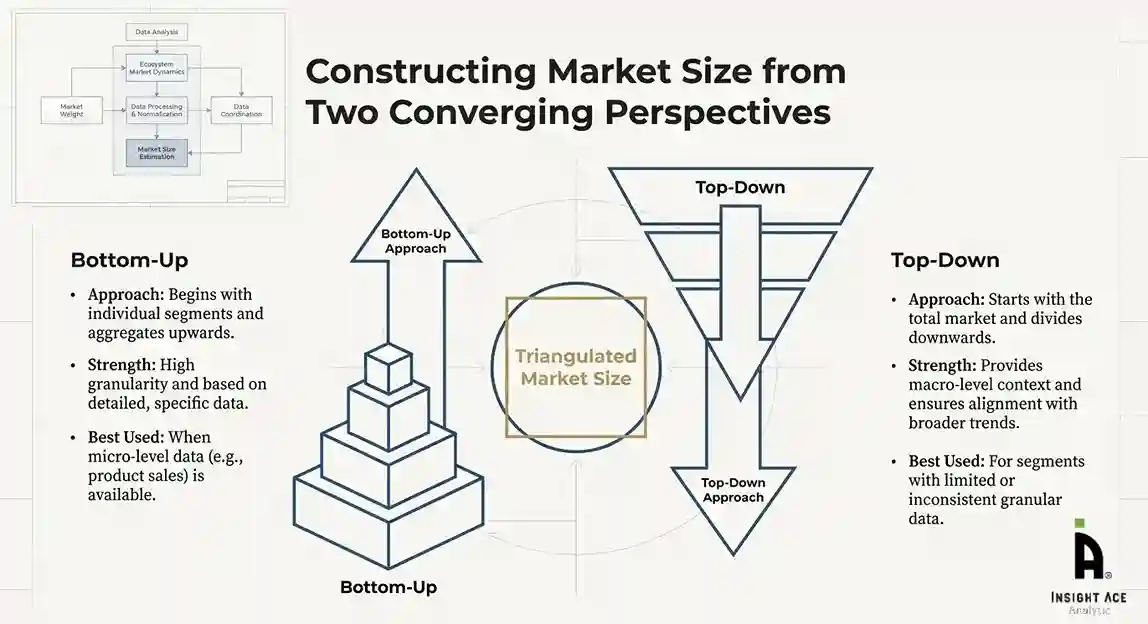
Bottom-Up Approach
The bottom-up approach involved aggregating segment-level data, such as:
- Company revenues
- Product-level sales
- Installed base/usage volumes
- Adoption and penetration rates
- Pricing analysis
This method was primarily used when detailed micro-level market data were available.
Top-Down Approach
The top-down approach used macro-level indicators:
- Parent market benchmarks
- Global/regional industry trends
- Economic indicators (GDP, demographics, spending patterns)
- Penetration and usage ratios
This approach was used for segments where granular data were limited or inconsistent.
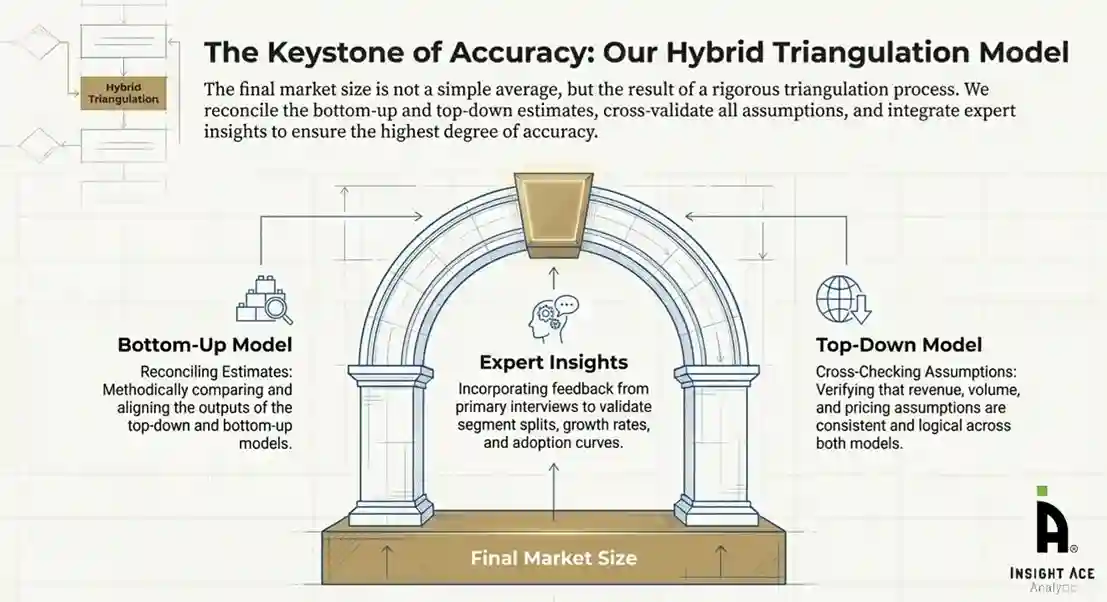
Hybrid Triangulation Approach
To ensure accuracy, a triangulated hybrid model was used. This included:
- Reconciling top-down and bottom-up estimates
- Cross-checking revenues, volumes, and pricing assumptions
- Incorporating expert insights to validate segment splits and adoption rates
This multi-angle validation yielded the final market size.
Forecasting Framework and Scenario Modelling
Market forecasts were developed using a combination of time-series modelling, adoption curve analysis, and driver-based forecasting tools.
Forecasting Methods
- Time-series modelling
- S-curve and diffusion models (for emerging technologies)
- Driver-based forecasting (GDP, disposable income, adoption rates, regulatory changes)
- Price elasticity models
- Market maturity and lifecycle-based projections
Scenario Analysis
Given inherent uncertainties, three scenarios were constructed:
- Base-Case Scenario: Expected trajectory under current conditions
- Optimistic Scenario: High adoption, favourable regulation, strong economic tailwinds
- Conservative Scenario: Slow adoption, regulatory delays, economic constraints
Sensitivity testing was conducted on key variables, including pricing, demand elasticity, and regional adoption.
Request Customization
Add countries, segments, company profiles, or extend forecast — free 10% customization with purchase.
Customize This Report →Enquire Before Buying
Speak with our analyst team about scope, methodology, pricing, or deliverable formats.
Enquire Now →Frequently Asked Questions
Cargill, Incorporated, Archer Daniels Midland (ADM), dsm-firmenich, Evonik Industries AG, BASF SE, Nutreco N.V., Alltech Inc., Kemin Industries, Adisseo, Novus International, IFF (Danisco Animal Nutrition), Chr. Hansen Holding A/S, Phileo by Lesaffre, Elanco Animal Health, Zoetis, Protix, InnovaFeed, Ynsect, Entobel, Hexafly, nextProtein, Beta Hatch, EnviroFlight, Calysta, Unibio, Deep Branch Biotechnology, String Bio, Corbion, Veramaris, Fermentalg, Euglena Co., Ltd., BlueBioTech, Algal Scientific, BioProcess Algae LLC, MicroBio Engineering (MBE), Inc., SabrTech, Global Algae Innovations, Culture BioSystems, Sea Forest, Symbrosia, Volta Greentech, MEGA Tierernaehrung GmbH and Others.
Sustainable Animal Feed Market Size is valued at USD 20.24 Billion in 2025 and is predicted to reach USD 149.02 Billion by the year 2035
Global Sustainable Animal Feed Market is expected to grow at a 23.10% CAGR during the forecast period for 2026 to 2035
Sustainable Animal Feed Market is segmented in Product Category (Sustainable Feed, Additives & Premixes, Sustainable Feed Ingredients, Sustainable Complete Feed (Finished Feed), By Additive Type (Methane & GHG Mitigation Additives, Enzymes, Amino Acids, Probiotics, Prebiotics & Postbiotics, Mycotoxin Binders & Detoxifiers, Organic / Chelated Trace Minerals, Vitamin Premixes & Functional Blends), by Ingredient Family, by Animal Type, by Sustainability Objective, by Form, By Production System, By Sales Channel, and other.
North America region is leading the Sustainable Animal Feed Market.