Gene Edited Livestock and PRRS Resistant Swine Genomics Market Revenue Report 2026 to 2035
What is Gene Edited Livestock and PRRS Resistant Swine Genomics Market Size?
Gene Edited Livestock and PRRS Resistant Swine Genomics Market Size is valued at USD 1.73 Bn in 2025 and is predicted to reach USD 31.01 Bn by the year 2035 at a 22.6% CAGR during the forecast period for 2026 to 2035.
Gene Edited Livestock and PRRS Resistant Swine Genomics Market Size, Share & Trends Analysis By Type (PRRS-Resistant Genetic Lines, Disease-Resistant Animal Genomics, Precision Breeding Regulatory Pathways), by Application (Swine Production Optimization, Outbreak Prevention and Biosecurity, Meat Quality and Welfare Improvement), and Segment Forecasts, 2026 to 2035
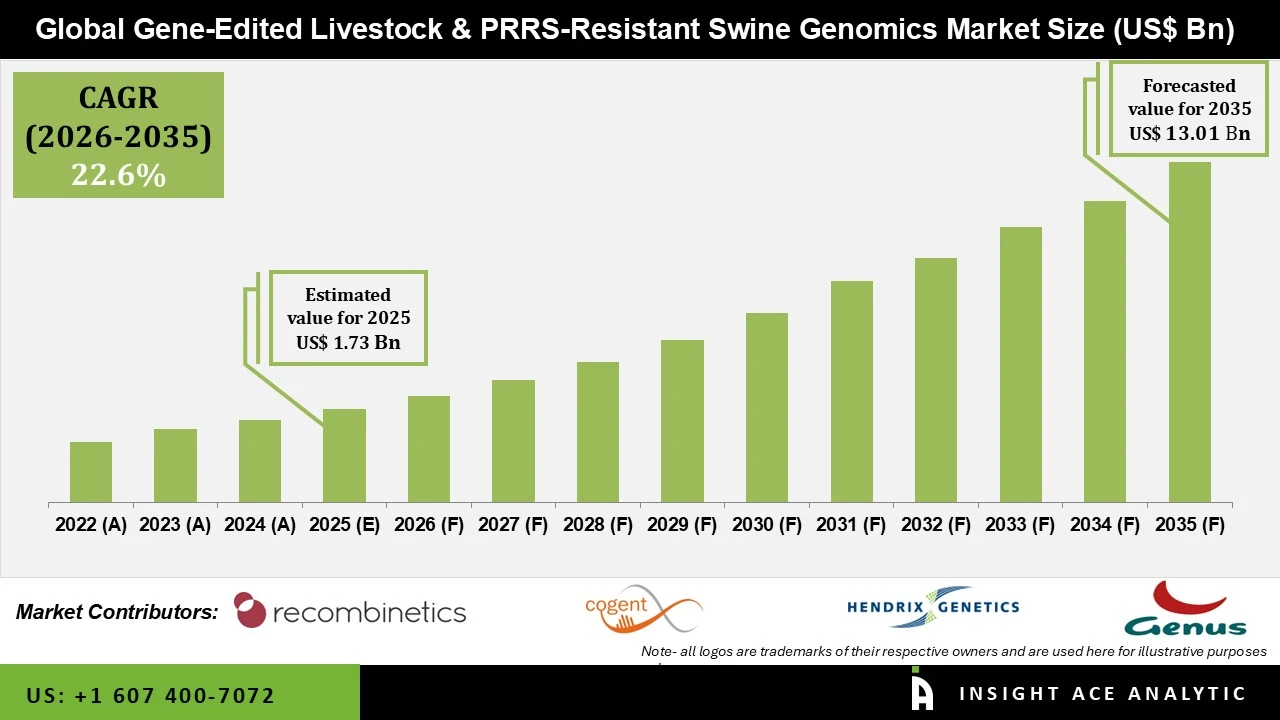
Gene edited livestock includes farm animals which genetic makeup has been altered in an accurate manner through the use of modern genome editing tools such as CRISPR-Cas9, TALENs and zinc finger nucleases (ZFNs). Such editing helps the development of improved livestock which are resistant to various diseases, and adaptable in their environment. The most important advancement in this regard is that of PRRS resistant swine which is made possible by making changes in the CD163 gene resulting in pigs which have a resistance to Porcine Reproductive and Respiratory Syndrome which is a deadly viral disease causing economic loss to the swine industry globally.
The growing
demand for sustainable production of livestock and improved health of animals is considered to be one of the most important factors behind the growth of the Gene Edited Livestock & PRRS Resistant Swine Genomics market. PRRS causes economic losses through reduced efficiency of the animals, increased mortality rate and higher medical expenses. Since vaccines can only provide partial immunity from the PRRS virus, genome editing has become one of the most preferred methods to prevent such diseases in animals.
Furthermore, developments in the regulatory policies of many countries and the increasing willingness of consumers toward biotechnology in agriculture are expected to present new business prospects during the forecast period. The development of precision breeding technologies and the rise of gene-edited livestock are expected to play a vital role in ensuring food security, disease resistance, and sustainability in global livestock production systems.
Competitive Landscape
Which are the Leading Players in Gene-Edited Livestock & PRRS-Resistant Swine Genomics Market?
• Genus plc
• PIC
• Boehringer Ingelheim
• Zoetis
• Hendrix Genetics
• Topigs Norsvin
• Cobb-Vantress
• Aviagen
• Neogen Corporation
• Merck Animal Health
• Thermo Fisher Scientific
• Illumina
• Eurofins Scientific
• Integrated DNA Technologies
• GenScript
• Revvity
• Agilent Technologies
• Charles River Laboratories
• CRISPR Therapeutics
• Editas Medicine
Market Dynamics
Driver
Growing Demand for Disease-Resistant Livestock
The rising incidence of infectious diseases in livestock farming is one of the primary reasons fueling the Gene-Edited Livestock & PRRS-Resistant Swine Genomics market. The emergence of infectious diseases such as Porcine Reproductive and Respiratory Syndrome (PRRS) continues to pose considerable economic losses to swine breeders across the globe due to decreased reproductive efficiency, growth, higher mortality, and veterinary costs. Gene editing technology offers a unique way to create animals that are resistant to certain diseases via genetic modifications that increase their natural immunity without affecting their productivity. Moreover, increasing awareness about antimicrobial resistance and increasing regulation to minimize the use of antibiotics in farm animals are some of the other reasons fueling the adoption of precision breeding technologies. Increasing investments in agriculture biotech, improvements in genomic sequencing, and growing collaborations between research institutes and animal genetics companies will propel the growth of the market.
Restrain/Challenge
Regulatory Complexity and Public Acceptance of Gene-Edited Livestock
Despite the presence of a considerable level of technology developments, the market for Gene-Edited Livestock & PRRS-Resistant Swine Genomics experiences some challenges relating to regulation, commercialization, and public reception. The process of gene editing is different from one country to another; therefore, it takes a longer time and is more costly to meet all required regulations. Commercialization of gene-edited livestock also requires acceptance by regulators in key regions where there is a production and export of such animals.
Moreover, consumers' opinion regarding the gene-edited products is another challenge that can be experienced in several regions of the world. Issues related to food safety, ethics, labeling needs, and environmental effects might hinder adoption of these products in spite of scientific proof regarding the safety of gene-editing methods. Finally, high R&D costs, the need to protect IP rights, and special breeding facilities can make entry barriers for small biotech companies.
Disease Resistance Segment is Expected to Drive the Gene-Edited Livestock & PRRS-Resistant Swine Genomics Market
In 2025, the segment of disease resistance held the highest market share in the Gene Edited Livestock and PRRS Resistant Swine Genomics market. The outbreaks of livestock diseases continue to cause high economic loss in terms of decreased productivity, mortality, veterinary costs, and global food production. With the help of gene editing, animals that are genetically engineered to resist certain infections are developed without compromising their production performance. Among all the applications in the disease resistance, the development of PRRS resistant pigs is one of the commercially advanced precision livestock breeding. By altering the CD163 receptor, the infection of PRRS virus was inhibited without affecting the animal’s growth and reproductive performance.
Increased investment in preventive measures, restriction of antibiotics usage, and increased demands for sustainable livestock are some of the factors that will drive this segment during the forecasted period.
CRISPR-Cas9 Segment is Growing at the Highest Rate in the Gene-Edited Livestock & PRRS-Resistant Swine Genomics Market
CRISPR-Cas9 segment captured the maximum market share in 2025 and is also expected to have the highest growth rate during the forecast period. The CRISPR technology provides an efficient and precise method of gene editing at very low costs compared with previous generation gene editing systems. Its capacity for editing the genome with great precision has led to increased research in several fields such as animal breeding, disease resistance, reproduction improvement, and improved productivity. The successful development of PRRS resistant pigs through the use of CRISPR technology has already revealed its commercial potential in livestock breeding programs.
Improvements in gene editing efficiency, reduced off target effects, and increasing investments in agricultural biotechnology will further enhance its application.
Why North America Led the Gene-Edited Livestock & PRRS-Resistant Swine Genomics Market?
North America was the dominating region in the Gene-Edited Livestock & PRRS-Resistant Swine Genomics market in 2025 due to advances in biotechnology research, efficient livestock production, and investments made in agricultural innovations. The USA has been a pioneer in animal genetics research due to the presence of major biotechnology companies, research centers, and organizations involved in animal breeding. Rising investments in precision animal breeding, collaborations among academicians and industries, and constant advancements in CRISPR technology have boosted product development in this region. An important development in favor of this regional dominance is the FDA (U.S. Food and Drug Administration) approval of the gene edit for the breeding of PIC's PRRS resistant pigs in April 2025. This approval was one of the initial approvals for gene editing for the commercial livestock of the U.S. food supply chain.
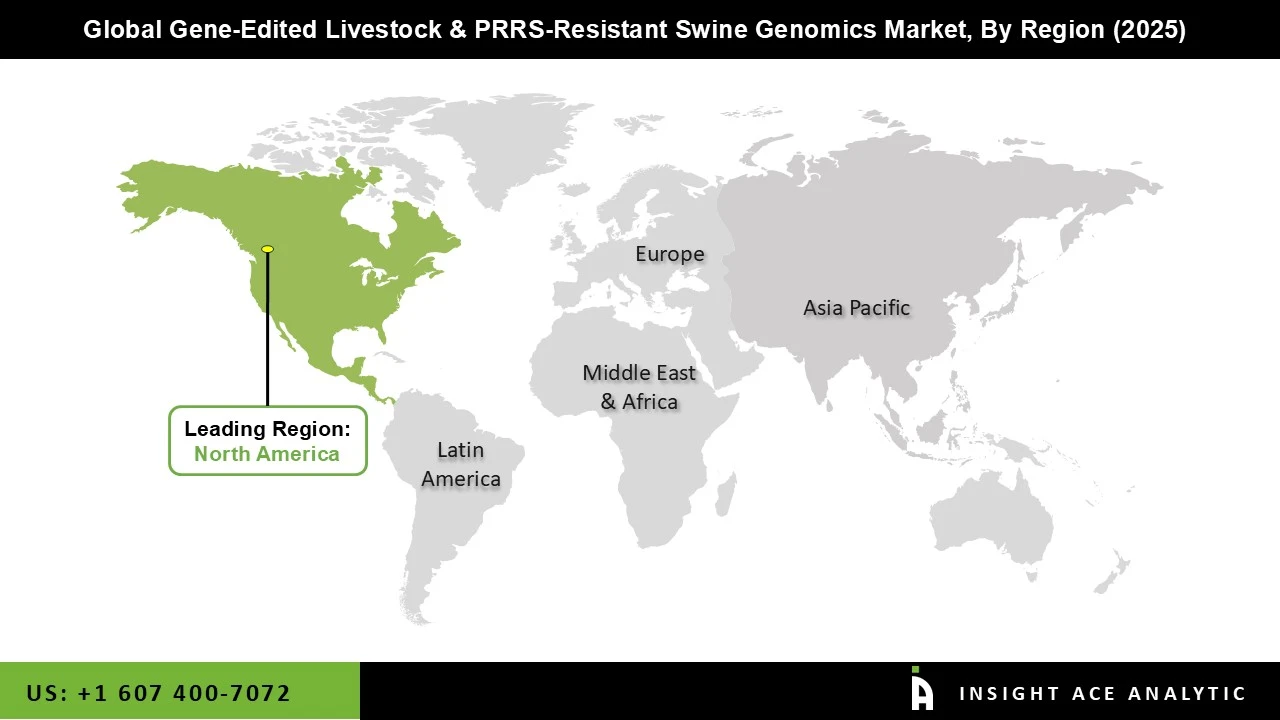
The Asia Pacific region is predicted to show the highest growth rate during the forecast period, owing to increased consumption of pork products, rise in commercial livestock production, and investments made in agricultural biotechnology. Countries such as China, Japan, South Korea, Vietnam, and India have been continuously investing in enhancing animal health and productivity.
Key Development
• In September 2025, Genus plc reported continued progress with regulators in Canada, Mexico, Japan, and other international jurisdictions regarding its PRRS-resistant pig. These were ongoing regulatory processes and should not be described as completed approvals during 2025.
Gene-Edited Livestock & PRRS-Resistant Swine Genomics Market Report Scope:
| Report Attribute | Specifications |
| Market size value in 2025 | USD 1.73 Bn |
| Revenue forecast in 2035 | USD 31.01 Bn |
| Growth Rate CAGR | CAGR of 22.6% from 2026 to 2035 |
| Quantitative Units | Representation of revenue in US$ Bn and CAGR from 2026 to 2035 |
| Historic Year | 2022 to 2025 |
| Forecast Year | 2026-2035 |
| Report Coverage | The forecast of revenue, the position of the company, the competitive market structure, growth prospects, and trends |
| Segments Covered | Type, Application, and By Region |
| Regional Scope | North America; Europe; Asia Pacific; Latin America; Middle East & Africa |
| Country Scope | U.S.; Canada; U.K.; Germany; China; India; Japan; Brazil; Mexico; The UK; France; Italy; Spain; China; Japan; India; South Korea; Southeast Asia; South Korea; Southeast Asia |
| Competitive Landscape | Genus plc, PIC, Boehringer Ingelheim, Zoetis, Hendrix Genetics, Topigs Norsvin, Cobb-Vantress, Aviagen, Neogen Corporation, Merck Animal Health, Thermo Fisher Scientific, Illumina, Eurofins Scientific, Integrated DNA Technologies, GenScript, Revvity, Agilent Technologies, Charles River Laboratories, CRISPR Therapeutics, and Editas Medicine. |
| Customization Scope | Free customization report with the procurement of the report, Modifications to the regional and segment scope. Geographic competitive landscape. |
| Pricing and Available Payment Methods | Explore pricing alternatives that are customized to your particular study requirements. |
Market Segmentation:
Gene-Edited Livestock & PRRS-Resistant Swine Genomics Market by Type-
• PRRS-Resistant Genetic Lines
• Disease-Resistant Animal Genomics
• Precision Breeding Regulatory Pathways
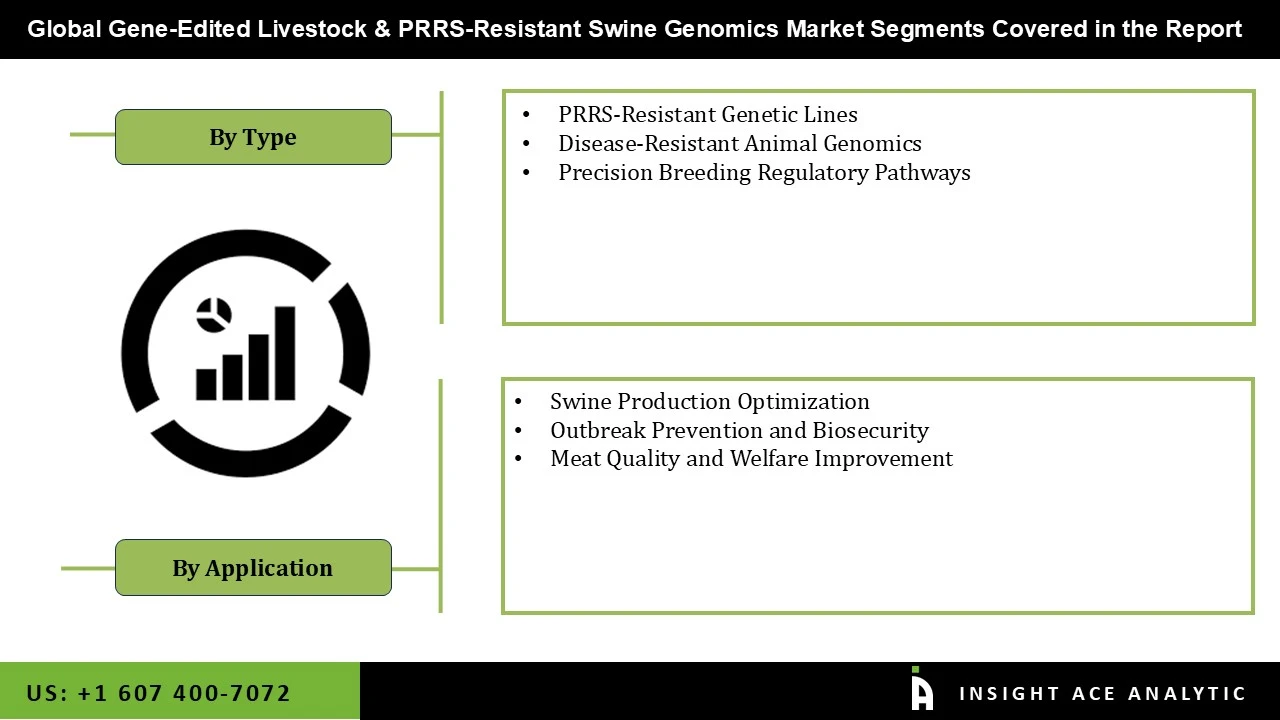
Gene-Edited Livestock & PRRS-Resistant Swine Genomics Market by Application-
• Swine Production Optimization
• Outbreak Prevention and Biosecurity
• Meat Quality and Welfare Improvement
Gene-Edited Livestock & PRRS-Resistant Swine Genomics Market By Region-
North America-
• The US
• Canada
Europe-
• Germany
• The UK
• France
• Italy
• Spain
• Rest of Europe
Asia-Pacific-
• China
• Japan
• India
• South Korea
• South East Asia
• Rest of Asia Pacific
Latin America-
• Brazil
• Argentina
• Mexico
• Rest of Latin America
Middle East & Africa-
• GCC Countries
• South Africa
• Rest of Middle East and Africa
Research Design and Approach
This study employed a multi-step, mixed-method research approach that integrates:
- Secondary research
- Primary research
- Data triangulation
- Hybrid top-down and bottom-up modelling
- Forecasting and scenario analysis
This approach ensures a balanced and validated understanding of both macro- and micro-level market factors influencing the market.
Secondary Research
Secondary research for this study involved the collection, review, and analysis of publicly available and paid data sources to build the initial fact base, understand historical market behaviour, identify data gaps, and refine the hypotheses for primary research.
Sources Consulted
Secondary data for the market study was gathered from multiple credible sources, including:
- Government databases, regulatory bodies, and public institutions
- International organizations (WHO, OECD, IMF, World Bank, etc.)
- Commercial and paid databases
- Industry associations, trade publications, and technical journals
- Company annual reports, investor presentations, press releases, and SEC filings
- Academic research papers, patents, and scientific literature
- Previous market research publications and syndicated reports
These sources were used to compile historical data, market volumes/prices, industry trends, technological developments, and competitive insights.

Primary Research
Primary research was conducted to validate secondary data, understand real-time market dynamics, capture price points and adoption trends, and verify the assumptions used in the market modelling.
Stakeholders Interviewed
Primary interviews for this study involved:
- Manufacturers and suppliers in the market value chain
- Distributors, channel partners, and integrators
- End-users / customers (e.g., hospitals, labs, enterprises, consumers, etc., depending on the market)
- Industry experts, technology specialists, consultants, and regulatory professionals
- Senior executives (CEOs, CTOs, VPs, Directors) and product managers
Interview Process
Interviews were conducted via:
- Structured and semi-structured questionnaires
- Telephonic and video interactions
- Email correspondences
- Expert consultation sessions
Primary insights were incorporated into demand modelling, pricing analysis, technology evaluation, and market share estimation.
Data Processing, Normalization, and Validation
All collected data were processed and normalized to ensure consistency and comparability across regions and time frames.
The data validation process included:
- Standardization of units (currency conversions, volume units, inflation adjustments)
- Cross-verification of data points across multiple secondary sources
- Normalization of inconsistent datasets
- Identification and resolution of data gaps
- Outlier detection and removal through algorithmic and manual checks
- Plausibility and coherence checks across segments and geographies
This ensured that the dataset used for modelling was clean, robust, and reliable.
Market Size Estimation and Data Triangulation
Bottom-Up Approach
The bottom-up approach involved aggregating segment-level data, such as:
- Company revenues
- Product-level sales
- Installed base/usage volumes
- Adoption and penetration rates
- Pricing analysis
This method was primarily used when detailed micro-level market data were available.

Top-Down Approach
The top-down approach used macro-level indicators:
- Parent market benchmarks
- Global/regional industry trends
- Economic indicators (GDP, demographics, spending patterns)
- Penetration and usage ratios
This approach was used for segments where granular data were limited or inconsistent.
Hybrid Triangulation Approach
To ensure accuracy, a triangulated hybrid model was used. This included:
- Reconciling top-down and bottom-up estimates
- Cross-checking revenues, volumes, and pricing assumptions
- Incorporating expert insights to validate segment splits and adoption rates
This multi-angle validation yielded the final market size.
Forecasting Framework and Scenario Modelling
Market forecasts were developed using a combination of time-series modelling, adoption curve analysis, and driver-based forecasting tools.
Forecasting Methods
- Time-series modelling
- S-curve and diffusion models (for emerging technologies)
- Driver-based forecasting (GDP, disposable income, adoption rates, regulatory changes)
- Price elasticity models
- Market maturity and lifecycle-based projections
Scenario Analysis
Given inherent uncertainties, three scenarios were constructed:
- Base-Case Scenario: Expected trajectory under current conditions
- Optimistic Scenario: High adoption, favourable regulation, strong economic tailwinds
- Conservative Scenario: Slow adoption, regulatory delays, economic constraints
Sensitivity testing was conducted on key variables, including pricing, demand elasticity, and regional adoption.
Request Customization
Add countries, segments, company profiles, or extend forecast — free 10% customization with purchase.
Customize This Report →Enquire Before Buying
Speak with our analyst team about scope, methodology, pricing, or deliverable formats.
Enquire Now →Frequently Asked Questions
Gene Edited Livestock and PRRS Resistant Swine Genomics Market Size is valued at USD 1.73 Bn in 2025 and is predicted to reach USD 31.01 Bn by the year 2035
Gene Edited Livestock and PRRS Resistant Swine Genomics Market is expected to grow at a 22.6% CAGR during the forecast period for 2026 to 2035.
Genus plc, PIC, Boehringer Ingelheim, Zoetis, Hendrix Genetics, Topigs Norsvin, Cobb-Vantress, Aviagen, Neogen Corporation, Merck Animal Health, Thermo Fisher Scientific, Illumina, Eurofins Scientific, Integrated DNA Technologies, GenScript, Revvity, Agilent Technologies, Charles River Laboratories, CRISPR Therapeutics, and Editas Medicine.
Gene Edited Livestock and PRRS Resistant Swine Genomics Market is segmented into Type, Application, and By Region.
North America region is leading the Gene Edited Livestock and PRRS Resistant Swine Genomics Market.