Digital Gene Manufacturing Market Size, Trend, Revenue Report 2026 to 2035
What is Digital Gene Manufacturing Market size?
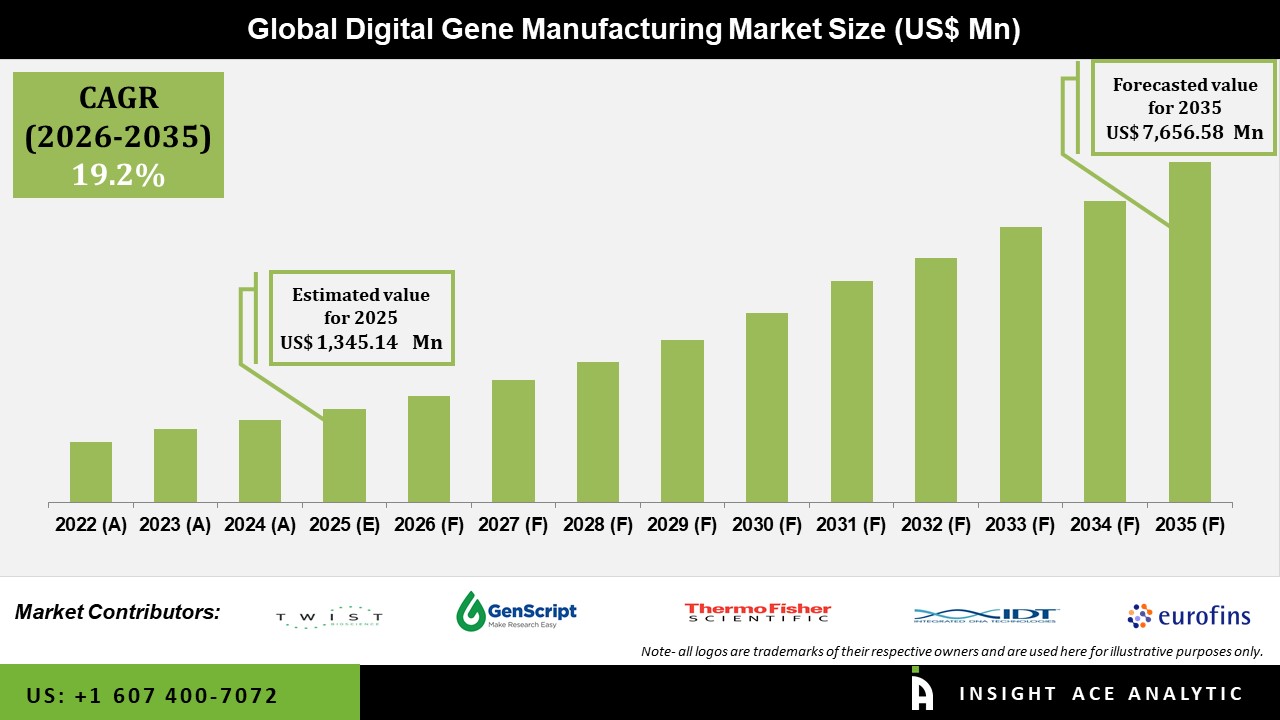
Digital Gene Manufacturing Market Size is valued at USD 1,345.14 Mn in 2025 and is predicted to reach USD 7,656.58 Mn by the year 2035 at an 19.2% CAGR during the forecast period for 2026 to 2035.
Digital Gene Manufacturing Market Size, Share & Trends Analysis by Component (Software and Digital Platforms, Hardware and Equipment, Services), by Technology (DNA Synthesis, Gene Assembly, Gene Editing, Sequence Design and Optimization), by Application (Drug Discovery and Development, Synthetic Biology, Gene and Cell Therapy, Diagnostics, Agricultural Biotechnology, Industrial Biotechnology, Others), by End User (Pharmaceutical and Biotechnology Companies, Academic and Research Institutes, CROs/CMOs, Agricultural and Industrial Biotechnology Companies, Others) and Segment Forecasts, 2026 to 2035
Digital technologies are making it easier to connect genetic design with the production of customised DNA and other genetic materials. This supports progress in biotechnology research and commercial development. Digital gene manufacturing brings together computational biology, DNA synthesis, gene assembly, gene editing, and sequence optimisation to turn genetic designs into real materials for science and industry.
The market covers software and digital platforms, hardware and equipment, and specialised services for making and modifying genetic sequences. Digital gene manufacturing is now widely used in drug discovery, synthetic biology, gene and cell therapy, diagnostics, and both agricultural and industrial biotechnology. These technologies support the development of genetic materials for therapeutic research, molecular testing, engineered organisms, crop improvement, and biological production processes. Major end users include pharmaceutical and biotech companies, academic and research institutes, contract research and manufacturing organisations, and companies in agricultural and industrial biotechnology.
Market growth is supported by rising investment in biotechnology research, expanding synthetic biology applications, demand for customised DNA sequences, and advances in laboratory automation and high-throughput DNA synthesis. Developments in enzymatic DNA synthesis, computational sequence design, artificial intelligence, and integrated digital workflows are improving manufacturing efficiency and enabling more complex genetic engineering projects. However, high equipment costs, technical limits in synthesising complex sequences, quality-control requirements, data-security concerns, and regulatory and biosafety considerations may limit adoption. In the long term, continued advances in DNA synthesis, automation, and digital design are expected to influence market development, with growth depending on cost efficiency, manufacturing reliability, research investment, and the expansion of biotechnology applications.
Competitive Landscape
Which are the Leading Players in the Digital Gene Manufacturing Market ?
• Twist Bioscience Corporation
• GenScript Biotech Corporation
• Thermo Fisher Scientific Inc.
• Integrated DNA Technologies, Inc.
• Eurofins Scientific SE
• Azenta, Inc.
• LGC Limited
• Telesis Bio Inc.
• Bioneer Corporation
• DNA Script
• Other Prominent Players
Driver
Increasing Investment in Biotechnology Research and Synthetic Biology
Growing investment in biotechnology research, synthetic biology, and genetic engineering is driving demand for digital gene-manufacturing technologies. Companies, research institutions, and industrial developers are turning to digital platforms to design, synthesise, assemble, and optimise genetic sequences. Advances in automated DNA synthesis, sequence design, and high-throughput manufacturing are making workflows more efficient and supporting drug discovery, diagnostics, gene and cell therapy, agriculture, and industrial biotechnology.
Restraint/Challenge
Technical Complexity and High Costs of Digital Gene Manufacturing
The digital gene manufacturing market has some challenges, including technical complexity, accuracy, and high costs. Making long or complex DNA sequences often needs extra quality checks, which can add time and expense. Smaller companies and research institutions may struggle with the need for special equipment, labs, materials, software, and skilled staff. Issues like data security, intellectual property, biosafety, and regulations can also make it harder to bring these technologies to market.
Software and Digital Platforms Segment is Expected to Drive the Digital Gene Manufacturing Market
Software and digital platforms are key for designing genetic sequences, running computer analyses, managing workflows, and improving manufacturing. These tools help researchers check sequences before making them, which cuts down on mistakes and makes work more efficient. Connecting these platforms with lab automation and data systems also helps teams work together better as genetic engineering projects get more complex.
DNA Synthesis Segment is Expected to Drive the Digital Gene Manufacturing Market
DNA synthesis segment is expected to remain an important technology area because synthetic DNA is used in drug discovery, synthetic biology, diagnostics, genetic engineering, and research. DNA synthesis technologies enable the production of customised genetic sequences for experiments, engineered systems, and new biotech products. Improved accuracy, higher output, and new methods are helping meet the demand for reliable, complex genetic materials. Still, costs, complexity, and quality checks affect manufacturing efficiency and how widely these technologies are used.
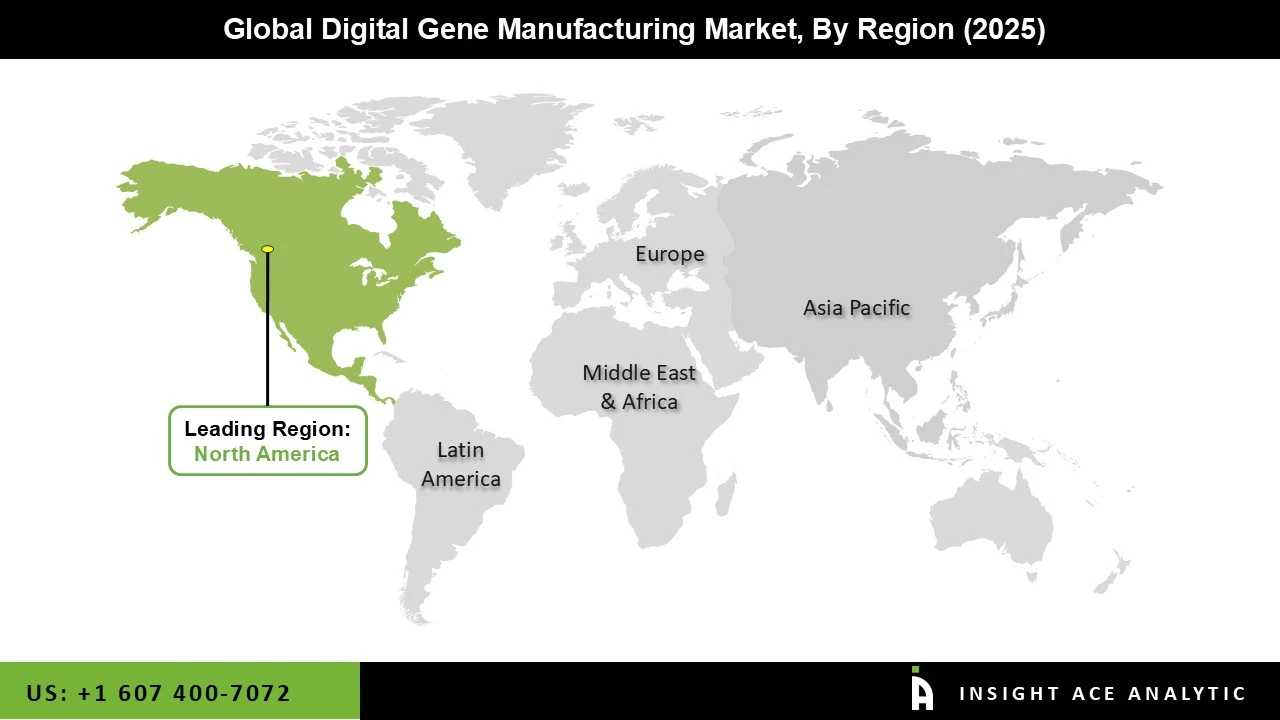
Why North America Leads the Digital Gene Manufacturing Market?
North America is expected to maintain a significant position in the digital gene manufacturing market, supported by its established biotechnology and pharmaceutical industries, research infrastructure, and investment in genetic engineering and synthetic biology. The presence of biotechnology companies, academic research institutions, and specialised DNA synthesis providers supports the development and adoption of digital gene manufacturing technologies. Demand from drug discovery, gene and cell therapy research, diagnostics, and industrial biotechnology also contributes to regional market activity. Continued research investment, advances in laboratory automation, and the development of scalable manufacturing technologies are expected to influence the region's market position, although costs and regulatory requirements may affect adoption.
Key Developments
• In May 2026, Twist Bioscience Corporation expanded its clonal gene portfolio through the early-access launch of Complex Genes, designed to support the synthesis of long, structurally complex, and highly engineered DNA sequences for AI-enabled drug discovery and nucleic acid therapeutics.
• In August 2026, GenScript Biotech Corporation announced a strategic partnership with Tamarind Bio to connect AI-powered molecular design with laboratory-based validation, helping researchers move from computational designs to experimental evidence more efficiently.
Digital Gene Manufacturing Market Report Scope:
| Report Attribute | Specifications |
| Market size value in 2025 | USD 1,345.14 Bn |
| Revenue forecast in 2035 | USD 7,656.58 Bn |
| Growth Rate CAGR | CAGR of 19.2% from 2026 to 2035 |
| Quantitative Units | Representation of revenue in US$ Bn and CAGR from 2026 to 2035 |
| Historic Year | 2021 to 2025 |
| Forecast Year | 2026-2035 |
| Report Coverage | The forecast of revenue, the position of the company, the competitive market structure, growth prospects, and trends |
| Segments Covered | Component, Technology, Application, End User and By Region |
| Regional Scope | North America; Europe; Asia Pacific; Latin America; Middle East & Africa |
| Country Scope | U.S.; Canada; U.K.; Germany; China; India; Japan; Brazil; Mexico;France; Italy; Spain; South Korea; Southeast Asia; |
| Competitive Landscape | Twist Bioscience Corporation, GenScript Biotech Corporation, Thermo Fisher Scientific Inc., Integrated DNA Technologies, Inc., Eurofins Scientific SE, Azenta, Inc., LGC Limited, Telesis Bio Inc., Bioneer Corporation, DNA Script, Other Prominent Players |
| Customization Scope | Free customisation report with the procurement of the report, Modifications to the regional and segment scope. Geographic competitive landscape. |
| Pricing and Available Payment Methods | Explore pricing alternatives that are customised to your particular study requirements. |
Market Segmentation:
Digital Gene Manufacturing Market by Component-
• Software and Digital Platforms
• Hardware and Equipment
• Services
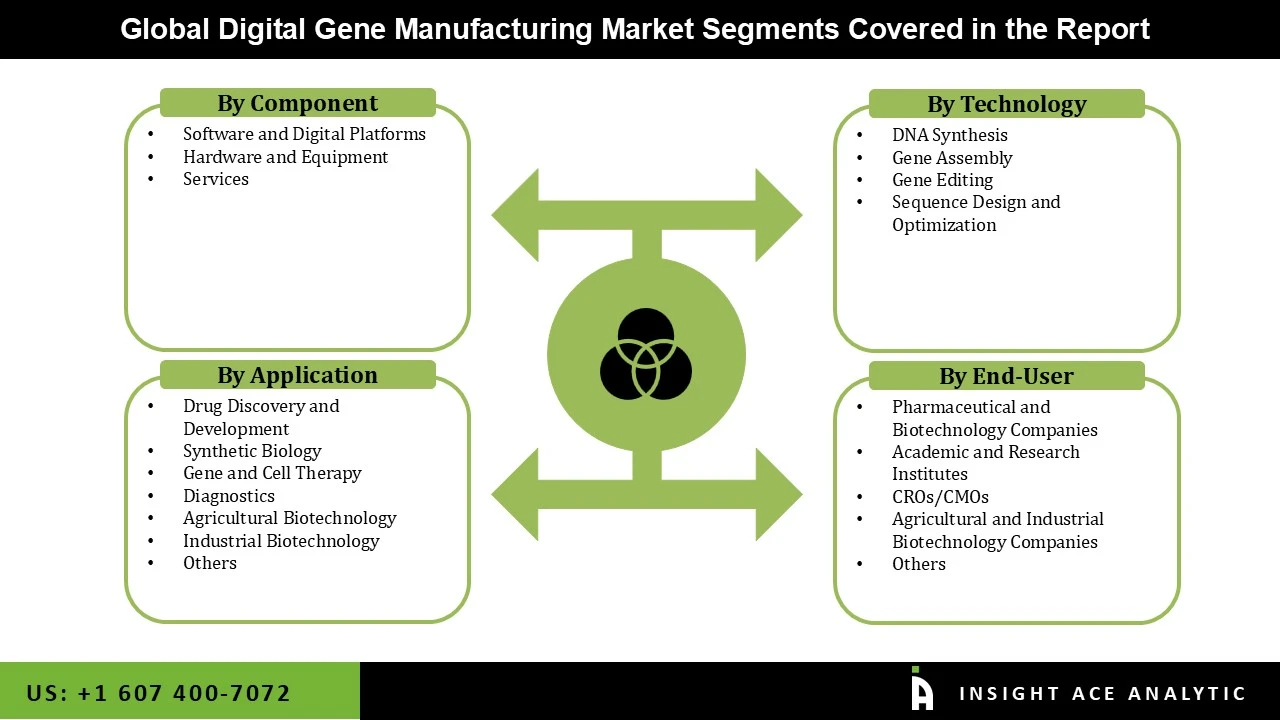
Digital Gene Manufacturing Market by Technology -
• DNA Synthesis
• Gene Assembly
• Gene Editing
• Sequence Design and Optimization
Digital Gene Manufacturing Market by Application -
• Drug Discovery and Development
• Synthetic Biology
• Gene and Cell Therapy
• Diagnostics
• Agricultural Biotechnology
• Industrial Biotechnology
• Others
Digital Gene Manufacturing Market by End User -
• Pharmaceutical and Biotechnology Companies
• Academic and Research Institutes
• CROs/CMOs
• Agricultural and Industrial Biotechnology Companies
• Others
Digital Gene Manufacturing Market by Region-
North America-
• United States
• Canada
Europe-
• Germany
• United Kingdom
• France
• Russia
• Italy
• Spain
• Rest of Europe
Asia Pacific-
• China
• India
• Japan
• South Korea
• Malaysia
• Thailand
• Indonesia
• Rest of APAC
South America-
• Brazil
• Mexico
• Argentina
• Rest of South America
Middle East & Africa (MEA)-
• GCC Countries
• South Africa
• Rest of MEA
Research Design and Approach
This study employed a multi-step, mixed-method research approach that integrates:
- Secondary research
- Primary research
- Data triangulation
- Hybrid top-down and bottom-up modelling
- Forecasting and scenario analysis
This approach ensures a balanced and validated understanding of both macro- and micro-level market factors influencing the market.
Secondary Research
Secondary research for this study involved the collection, review, and analysis of publicly available and paid data sources to build the initial fact base, understand historical market behaviour, identify data gaps, and refine the hypotheses for primary research.
Sources Consulted
Secondary data for the market study was gathered from multiple credible sources, including:
- Government databases, regulatory bodies, and public institutions
- International organizations (WHO, OECD, IMF, World Bank, etc.)
- Commercial and paid databases
- Industry associations, trade publications, and technical journals
- Company annual reports, investor presentations, press releases, and SEC filings
- Academic research papers, patents, and scientific literature
- Previous market research publications and syndicated reports
These sources were used to compile historical data, market volumes/prices, industry trends, technological developments, and competitive insights.
Primary Research
Primary research was conducted to validate secondary data, understand real-time market dynamics, capture price points and adoption trends, and verify the assumptions used in the market modelling.
Stakeholders Interviewed
Primary interviews for this study involved:
- Manufacturers and suppliers in the market value chain
- Distributors, channel partners, and integrators
- End-users / customers (e.g., hospitals, labs, enterprises, consumers, etc., depending on the market)
- Industry experts, technology specialists, consultants, and regulatory professionals
- Senior executives (CEOs, CTOs, VPs, Directors) and product managers
Interview Process
Interviews were conducted via:
- Structured and semi-structured questionnaires
- Telephonic and video interactions
- Email correspondences
- Expert consultation sessions
Primary insights were incorporated into demand modelling, pricing analysis, technology evaluation, and market share estimation.
Data Processing, Normalization, and Validation
All collected data were processed and normalized to ensure consistency and comparability across regions and time frames.
The data validation process included:
- Standardization of units (currency conversions, volume units, inflation adjustments)
- Cross-verification of data points across multiple secondary sources
- Normalization of inconsistent datasets
- Identification and resolution of data gaps
- Outlier detection and removal through algorithmic and manual checks
- Plausibility and coherence checks across segments and geographies
This ensured that the dataset used for modelling was clean, robust, and reliable.
Market Size Estimation and Data Triangulation
Bottom-Up Approach
The bottom-up approach involved aggregating segment-level data, such as:
- Company revenues
- Product-level sales
- Installed base/usage volumes
- Adoption and penetration rates
- Pricing analysis
This method was primarily used when detailed micro-level market data were available.
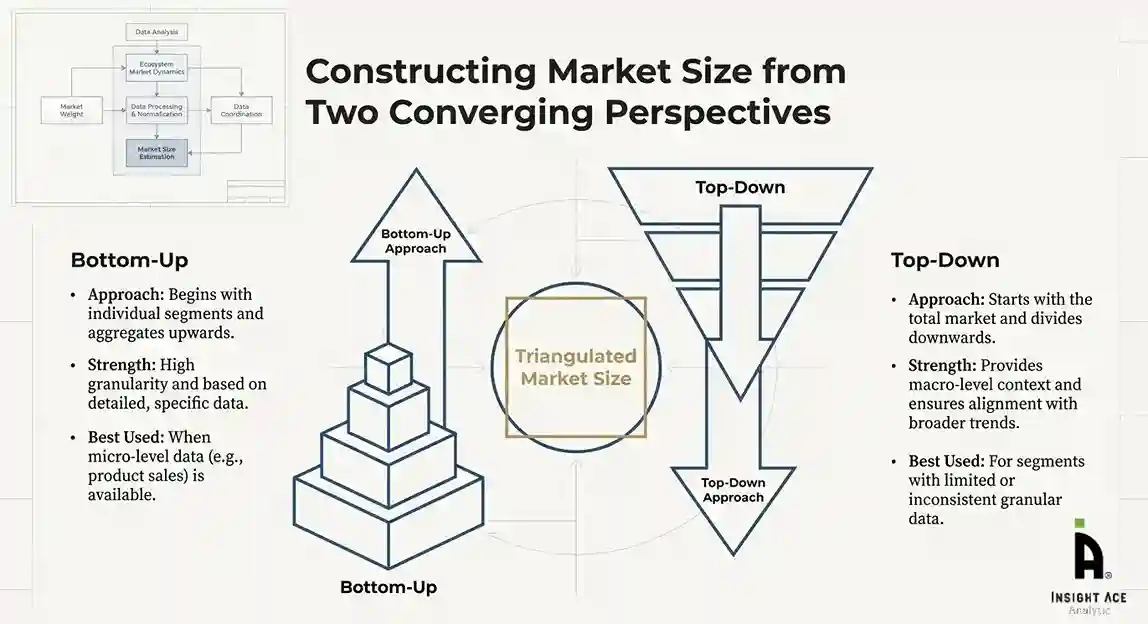
Top-Down Approach
The top-down approach used macro-level indicators:
- Parent market benchmarks
- Global/regional industry trends
- Economic indicators (GDP, demographics, spending patterns)
- Penetration and usage ratios
This approach was used for segments where granular data were limited or inconsistent.
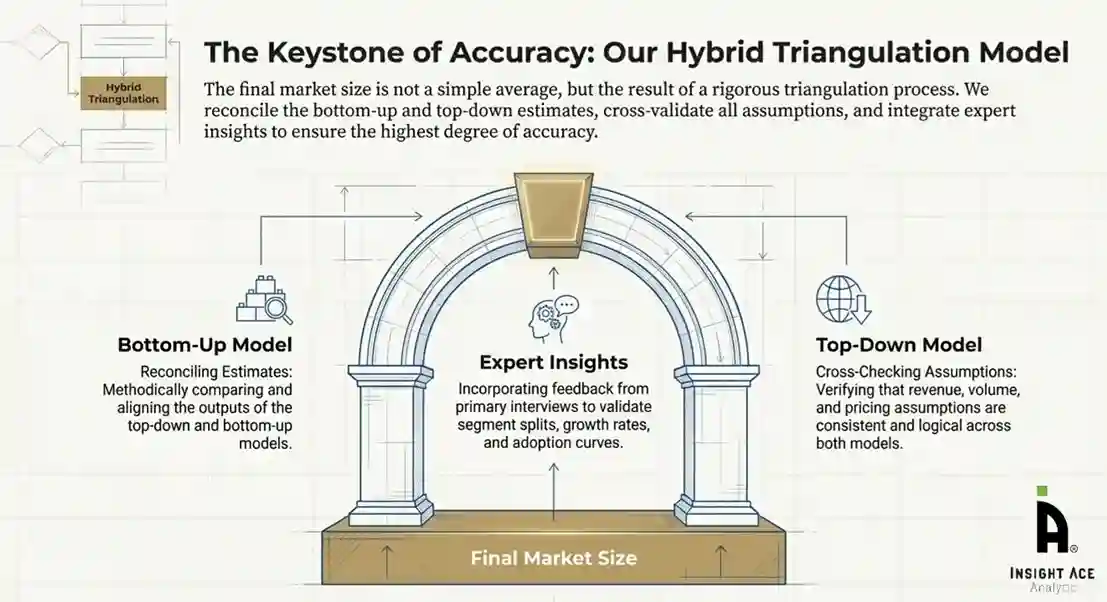
Hybrid Triangulation Approach
To ensure accuracy, a triangulated hybrid model was used. This included:
- Reconciling top-down and bottom-up estimates
- Cross-checking revenues, volumes, and pricing assumptions
- Incorporating expert insights to validate segment splits and adoption rates
This multi-angle validation yielded the final market size.
Forecasting Framework and Scenario Modelling
Market forecasts were developed using a combination of time-series modelling, adoption curve analysis, and driver-based forecasting tools.
Forecasting Methods
- Time-series modelling
- S-curve and diffusion models (for emerging technologies)
- Driver-based forecasting (GDP, disposable income, adoption rates, regulatory changes)
- Price elasticity models
- Market maturity and lifecycle-based projections
Scenario Analysis
Given inherent uncertainties, three scenarios were constructed:
- Base-Case Scenario: Expected trajectory under current conditions
- Optimistic Scenario: High adoption, favourable regulation, strong economic tailwinds
- Conservative Scenario: Slow adoption, regulatory delays, economic constraints
Sensitivity testing was conducted on key variables, including pricing, demand elasticity, and regional adoption.
Request Customization
Add countries, segments, company profiles, or extend forecast — free 10% customization with purchase.
Customize This Report →Enquire Before Buying
Speak with our analyst team about scope, methodology, pricing, or deliverable formats.
Enquire Now →Frequently Asked Questions
Digital Gene Manufacturing Market Size is valued at USD 1,345.14 Mn in 2025 and is predicted to reach USD 7,656.58 Mn by the year 2035
Digital Gene Manufacturing Market is predicted to grow at an 19.2% CAGR during the forecast period for 2026 to 2035.
Twist Bioscience Corporation, GenScript Biotech Corporation, Thermo Fisher Scientific Inc., Integrated DNA Technologies, Inc., Eurofins Scientific SE, Azenta, Inc., LGC Limited, Telesis Bio Inc., Bioneer Corporation, DNA Script, Other Prominent Players
Digital Gene Manufacturing Market is expected to grow into Component, Technology, Application, End User and By Region.
North America region is leading the Digital Gene Manufacturing Market.