



The Fragment-Based Drug Discovery Market is expected to grow at a 11.0 % CAGR during the forecast period for 2023-2031.
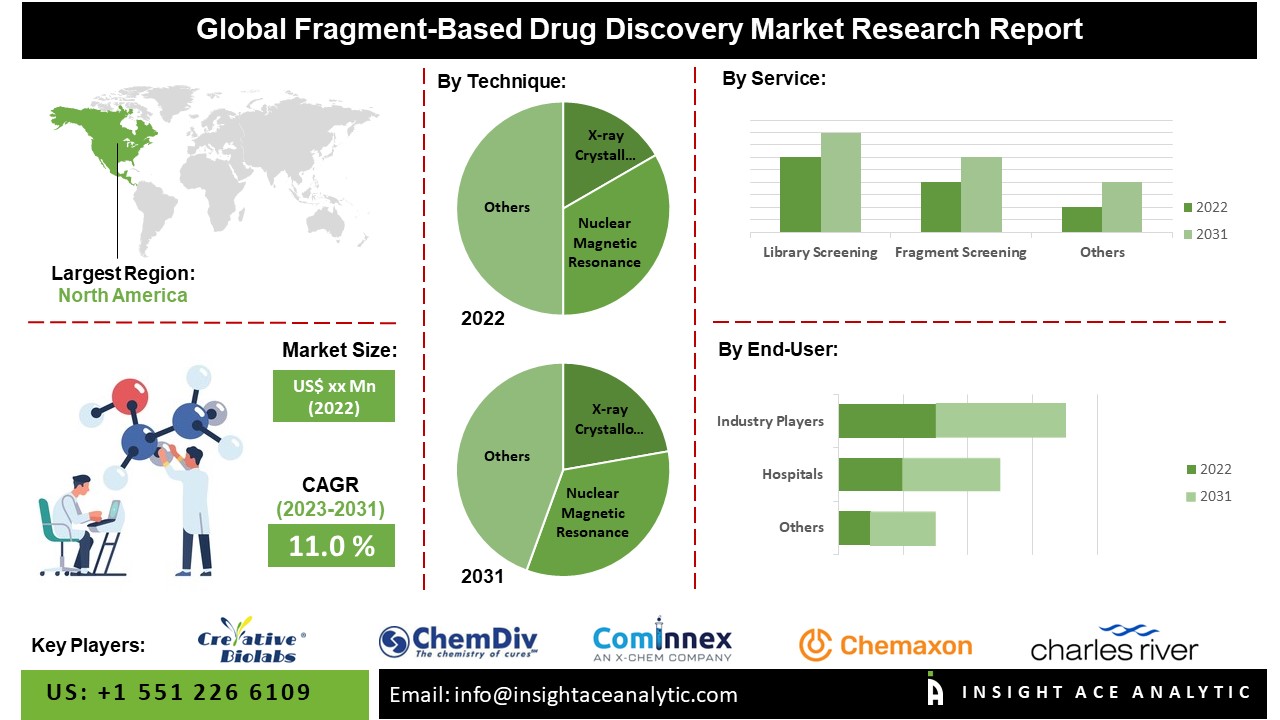
Fragment-based Drug Discovery is being used to find similar compounds like lead in drug discovery process, which is based on identification of chemical fragments, this chemical fragment may be biological target or on combining them produce a lead molecule.
Increasing novel complex medical problems creating the demand for newer fragment-based drug discovery. Moreover, as a result of increasing demand, the market for fragment-based drug discovery dominating the biopharmaceutical companies. The upsurge in technology for biophysical fragment screening is become key drivers of global fragment-based drug discovery market. Moreover, these systems providing promising access in creating chemical with similar properties like lead. Additionally, the fragment-based drug discovery systems found to be useful in marking out chemical series molecule from multiple targets, also pharmaceutical companies have increases the spending on research and development expected to create the lucrative growth in market near the future.
The Global Fragment-based Drug Discovery market is segmented on the basis of technique, service, end users and region. Based on the base technique, the market is divided into x-ray crystallography, nuclear magnetic resonance, surface plasmon resonance and other screening techniques. On the basis of service, the market is segmented into library screening, fragment screening and fragment optimization. Based on the end users, the market is divided into hospitals, industry players and non-industry players. Based on region, the market is studied across North America, Asia-Pacific, Europe, and LAMEA. Among that Europe held the largest share of the market, followed by America and Asia Pacific. On the other hand, North America is expected to dominate the market during the analysis of forecast period.
| Report Attribute | Specifications |
| Growth Rate CAGR | CAGR of 11.0 % from 2023 to 2031 |
| Quantitative Units | Representation of revenue in US$ Million and CAGR from 2023 to 2031 |
| Historic Year | 2019 to 2022 |
| Forecast Year | 2023-2031 |
| Report Coverage | The forecast of revenue, the position of the company, the competitive market structure, growth prospects, and trends |
| Segments Covered | By Technique, By Service, By End Users |
| Regional Scope | North America; Europe; Asia Pacific; Latin America; Middle East & Africa |
| Country Scope | U.S.; Canada; U.K.; Germany; China; India; Japan; Brazil; Mexico; The UK; France; Italy; Spain; China; Japan; India; South Korea; South East Asia; South Korea; South East Asia |
| Competitive Landscape | 2bind, Charles River Laboratories, ChemAxon, ComInnex, ChemDiv, Creative Biolabs, Creative Biostructure, CRELUX, Domainex, Evotec, Red Glead Discovery, SARomics Biostructures, Shanghai ChemPartner, Sygnature Discovery, and Vernalis among others |
| Customization Scope | Free customization report with the procurement of the report, Modifications to the regional and segment scope. Particular Geographic competitive landscape. |
| Pricing and Available Payment Methods | Explore pricing alternatives that are customized to your particular study requirements. |
Global Fragment-based Drug Discovery Market Revenue (US$ Mn) by Technique
Global Fragment-based Drug Discovery Market Revenue (US$ Mn) Based on Service
Global Fragment-based Drug Discovery Market Revenue (US$ Mn) Based on End Users
Global Fragment-based Drug Discovery Market Revenue (US$ Mn) Based on Region
Europe Fragment-based Drug Discovery Market Revenue (US$ Mn) by Country
North America Fragment-based Drug Discovery Market Revenue (US$ Mn) by Country
Asia Pacific Fragment-based Drug Discovery Market Revenue (US$ Mn) by Country
Latin America Fragment-based Drug Discovery Market Revenue (US$ Mn) by Country
Middle East & Africa Fragment-based Drug Discovery Market Revenue (US$ Mn) by Country
This study employed a multi-step, mixed-method research approach that integrates:
This approach ensures a balanced and validated understanding of both macro- and micro-level market factors influencing the market.
Secondary research for this study involved the collection, review, and analysis of publicly available and paid data sources to build the initial fact base, understand historical market behaviour, identify data gaps, and refine the hypotheses for primary research.
Secondary data for the market study was gathered from multiple credible sources, including:
These sources were used to compile historical data, market volumes/prices, industry trends, technological developments, and competitive insights.

Primary research was conducted to validate secondary data, understand real-time market dynamics, capture price points and adoption trends, and verify the assumptions used in the market modelling.
Primary interviews for this study involved:
Interviews were conducted via:
Primary insights were incorporated into demand modelling, pricing analysis, technology evaluation, and market share estimation.
All collected data were processed and normalized to ensure consistency and comparability across regions and time frames.
The data validation process included:
This ensured that the dataset used for modelling was clean, robust, and reliable.
The bottom-up approach involved aggregating segment-level data, such as:
This method was primarily used when detailed micro-level market data were available.

The top-down approach used macro-level indicators:
This approach was used for segments where granular data were limited or inconsistent.
To ensure accuracy, a triangulated hybrid model was used. This included:
This multi-angle validation yielded the final market size.
Market forecasts were developed using a combination of time-series modelling, adoption curve analysis, and driver-based forecasting tools.
Given inherent uncertainties, three scenarios were constructed:
Sensitivity testing was conducted on key variables, including pricing, demand elasticity, and regional adoption.