Exosome Research Market Size, Trend, Revenue Report 2026 to 2035
What is Exosome Research Market Size?
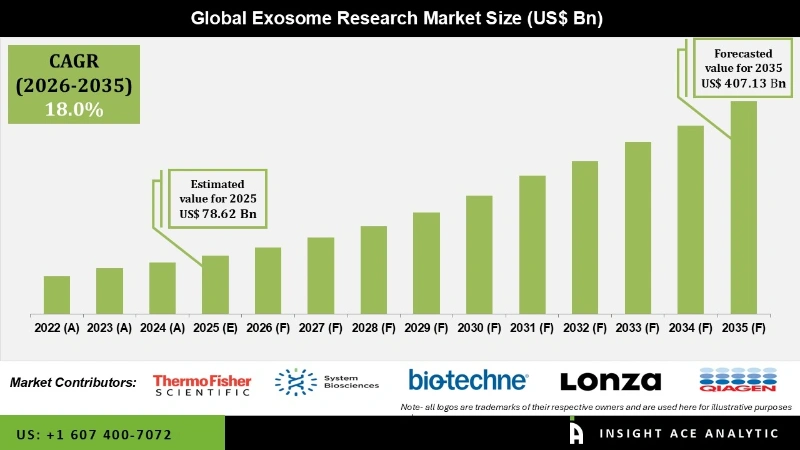
Global Exosome Research Market is valued at USD 78.62 Million in 2025, and it is expected to reach USD 407.13 Million by 2035, with a CAGR of 18.0% during the forecast period of 2026 to 2035.
Exosome Research Market Size, Share & Trends Analysis Report By Products & Services (Kits And Reagents, Instruments And Services), Disease Indications (Cancer, Neurodegenerative Diseases, Cardiovascular Diseases, And Infectious Diseases), Applications (Biomarkers, Vaccine Development, Tissue Regeneration) And End Users, Region And Segment Forecasts, 2026 to 2035.
Exosome Research Market Key Takeaways:
|
The demand for exosome research products has grown due to the growing use of specialized testing services such as liquid chromatography-mass spectrometry, RNA sequencing, wet chemistry, gene expressions, and various other testing services. These testing services are also increasingly used because of their ability to produce precise and accurate results, which has increased their use by end users.
The rising incidence of cancer, improvements in exosome separation and analysis techniques, and increased exosome-based advanced applications are expected to fuel market expansion. The rising number of cancer patients directly impacts the increased demand for exosomes. Exosome use in treating cancer is anticipated to increase due to the increased number of cancer cases, which is anticipated to boost the market. Furthermore, due to their improved passive targeting, enhanced tiny size, native nature, and capacity to traverse biological barriers, exosomes produced from body regions are intriguing candidates for anti-cancer vaccines. As a result, there is a clear correlation between the rise in cancer cases in hospitals and the demand for exosomes for therapeutic and diagnostic purposes.
However, several technological issues must be resolved to integrate exosomes in various applications successfully. One of the main obstacles to expanding the exosome market is this.
Additionally, research and development involving exosomes decreased due to nationwide lockdown regulations, supply chain disruptions, and investment shifts toward COVID-19-related products. Despite the negative effects, the COVID-19 pandemic has created several new opportunities for using exosomes in developing COVID-19 vaccines and therapies. This, in turn, is anticipated to accelerate industrial growth.
Recent Developments:
- The US (FDA) approved a protocol amendment for an ongoing clinical trial of Aethlon Hemopurifier for patients with severe COVID-19 in July 2022, according to an announcement made by Aethlon Medical, Inc., a medical therapy company focused on developing products for the diagnosis and treatment of cancer and life-threatening infectious diseases.
- ExoDX introduced the ExoDx Prostate Test Home Collection Kit in April 2020 for individuals concerned about prostate health. For doctors and their patients who share the frustration, anxiety, and dread of the patient with advanced prostate cancer, the home collection kit offers an immediate and affordable alternative that permits a telemedicine/telehealth option.
Competitive Landscape:
Some of the Exosome Research market players are:
- Thermo Fisher Scientific
- System Bioscience
- Bio-Techne
- Lonza
- QIAGEN
- ExoDx
- Hitachi Chemical
- Medica
- NanoSomiX
- Malvern Panalytical
- Sistemic Scotland Limited
- NX PharmaGen
- Miltenyi Biotec
- AMS Biotechnology
- Norgen Biotek
- Novus Biologicals
- BioVision
- Pall Corporation
- Exopharm
- EverZom
Market Segmentation:
The exosome research market is segmented based on products & services, disease indications, applications and end users. Based on products & Services, the Exosome Research market is segmented as kits and reagents, instruments and services. By indication, the Exosome Research market is segmented into cancer, neurodegenerative diseases, cardiovascular diseases, and infectious diseases. By application, the market is segmented into biomarkers, vaccine development, tissue regeneration and other applications. By end users, the market is segmented into academic & research institutes, pharmaceutical and biotechnology companies, hospitals & clinical testing laboratories.
Based On Product, The Kits & Reagents Segment Is A Major Contributor In The Exosome Research Market
The kits & reagents category will hold a major share of the global Exosome Research market in 2022. Since circulating exosome microRNAs hold great promise as biomarkers, exosomes must be thoroughly characterized. As a result, simple-to-use reagents and kit designs have been created, promoting the usage of these tools in exosome research. The crucial isolation and purification steps are also necessary for exosome research methods, hastening their widespread commercialization. From various biological fluids, such as serum, plasma, and blood, these kits can extract exosomes and EV. Specialty purification and spin-column technology are also used to purify exosomes; these methods outperform traditional isolation methods, such as density gradient centrifugation and ultracentrifugation. Exosomes and other extracellular vesicles can be produced in large quantities with this technology from an incredibly clean cell culture media.
The Neurodegenerative Disorders Segment Witnessed Growth At A Rapid Rate
The neurodegenerative disorders segment is projected to grow rapidly in the global Exosome Research market. The major cause of disability and mortality and a significant financial burden on healthcare systems continue to be neurodegenerative disorders. Exosomes have a role in removing waste products from the nervous system, maintaining myelin sheath, and maintaining intercellular communication. Increased frequency of neurodegenerative disorders, improvements in exosome isolation and analysis methods, and an increase in the number of complex exosome applications are anticipated to be the causes of this rise.
The North America Exosome Research Market Holds A Significant Regional Revenue Share
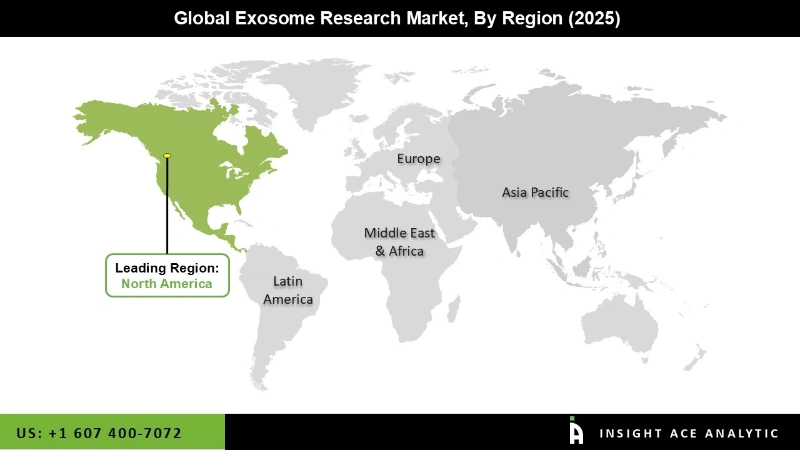
The North America Exosome Research market is expected to register the highest market share due to improved healthcare structures, strong public regulations, many multinational corporations, and significant public awareness of diagnostics and healthcare. The use of exosome-based medications in treating cancers such as cancer of the skin, breast, lung, and pancreatic has been the subject of numerous government-funded studies of research. Clinical trials are being carried out in the United States thanks to sponsorship from businesses like Merck and Exosome Diagnostic and partnerships with schools like Yale and Michigan State.
Furthermore, government funding for these projects is superior, and most of the studies were done for neoplasms. In addition, Asia Pacific is projected to increase in the global Exosome Research market. The rise in government financing for discovering new biomarkers and the growing incidence of chronic diseases like cancer and cardiovascular disease is boosting the regional demand. The category is also expected to rise due to expanding research and development efforts to create novel medications, diagnostic techniques, and treatment choices.
Exosome Research Market Report Scope:
| Report Attribute | Specifications |
| Market size value in 2025 | USD 78.62 Million |
| Revenue forecast in 2035 | USD 407.13 Million |
| Growth rate CAGR | CAGR of 18.0% from 2026 to 2035 |
| Quantitative units | Representation of revenue in US$ Mn,and CAGR from 2026 to 2035 |
| Historic Year | 2022 to 2025 |
| Forecast Year | 2026-2035 |
| Report coverage | The forecast of revenue, the position of the company, the competitive market statistics, growth prospects, and trends |
| Segments covered | Products & Services, Indications, Applications And End Users |
| Regional scope | North America; Europe; Asia Pacific; Latin America; Middle East & Africa |
| Country scope | U.S.; Canada; U.K.; Germany; China; India; Japan; Brazil; Mexico; The UK; France; Italy; Spain; China; Japan; India; South Korea; Southeast Asia; South Korea; Southeast Asia |
| Competitive Landscape | Thermo Fisher Scientific, System Biosciences, Bio-Techne, Lonza, QIAGEN, ExoDx, Hitachi Chemical, Aethlon Medical, NanoSomiX, Malvern Panalytical, Sistemic Scotland Limited, NX PharmaGen, Miltenyi Biotec, AMS Biotechnology, Norgen Biotec, Novus Biologicals, BioVision, Pall Corporation, Exopharm, and EverZom. |
| Customization scope | Free customization report with the procurement of the report, Modifications to the regional and segment scope. Particular Geographic competitive landscape. |
| Pricing and available payment methods | Explore pricing alternatives that are customized to your particular study requirements. |
Segmentation of Exosome Research Market-
Exosome Research Market By Product-
- Kits and Reagents
- Antibodies
- Isolation, Purification, Quantitation Kits & Reagents
- Other Kits & Reagents
- Instruments
- Services
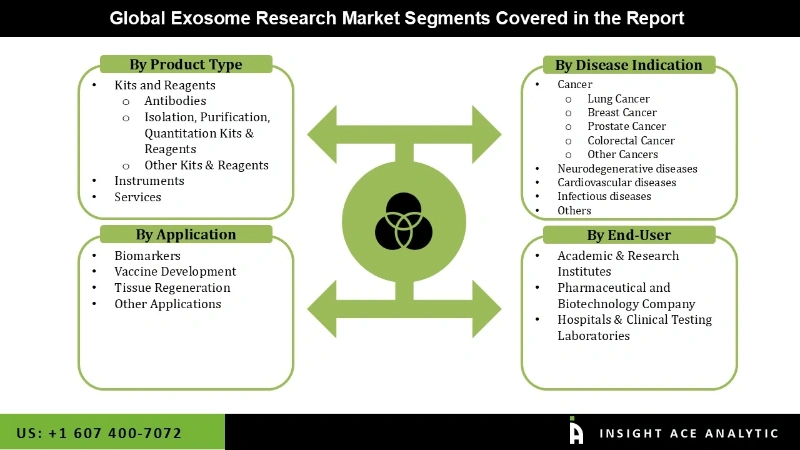
Exosome Research Market By Disease Indication-
- Cancer
- Lung Cancer
- Breast Cancer
- Prostate Cancer
- Colorectal Cancer
- Other Cancers
- Neurodegenerative diseases
- Cardiovascular diseases
- Infectious diseases
- Others
Exosome Research Market By Applications
- Biomarkers
- Vaccine Development
- Tissue Regeneration
- Other Applications
Exosome Research Market By End Users
- Academic & Research Institutes
- Pharmaceutical and Biotechnology Company
- Hospitals & Clinical Testing Laboratories
Exosome Research Market By Region-
North America-
- The US
- Canada
- Mexico
Europe-
- Germany
- The UK
- France
- Italy
- Spain
- Rest of Europe
Asia-Pacific-
- China
- Japan
- India
- South Korea
- Southeast Asia
- Rest of Asia Pacific
Latin America-
- Brazil
- Argentina
- Rest of Latin America
Middle East & Africa-
- GCC Countries
- South Africa
- Rest of Middle East and Africa
Research Design and Approach
This study employed a multi-step, mixed-method research approach that integrates:
- Secondary research
- Primary research
- Data triangulation
- Hybrid top-down and bottom-up modelling
- Forecasting and scenario analysis
This approach ensures a balanced and validated understanding of both macro- and micro-level market factors influencing the market.
Secondary Research
Secondary research for this study involved the collection, review, and analysis of publicly available and paid data sources to build the initial fact base, understand historical market behaviour, identify data gaps, and refine the hypotheses for primary research.
Sources Consulted
Secondary data for the market study was gathered from multiple credible sources, including:
- Government databases, regulatory bodies, and public institutions
- International organizations (WHO, OECD, IMF, World Bank, etc.)
- Commercial and paid databases
- Industry associations, trade publications, and technical journals
- Company annual reports, investor presentations, press releases, and SEC filings
- Academic research papers, patents, and scientific literature
- Previous market research publications and syndicated reports
These sources were used to compile historical data, market volumes/prices, industry trends, technological developments, and competitive insights.
Primary Research
Primary research was conducted to validate secondary data, understand real-time market dynamics, capture price points and adoption trends, and verify the assumptions used in the market modelling.
Stakeholders Interviewed
Primary interviews for this study involved:
- Manufacturers and suppliers in the market value chain
- Distributors, channel partners, and integrators
- End-users / customers (e.g., hospitals, labs, enterprises, consumers, etc., depending on the market)
- Industry experts, technology specialists, consultants, and regulatory professionals
- Senior executives (CEOs, CTOs, VPs, Directors) and product managers
Interview Process
Interviews were conducted via:
- Structured and semi-structured questionnaires
- Telephonic and video interactions
- Email correspondences
- Expert consultation sessions
Primary insights were incorporated into demand modelling, pricing analysis, technology evaluation, and market share estimation.
Data Processing, Normalization, and Validation
All collected data were processed and normalized to ensure consistency and comparability across regions and time frames.
The data validation process included:
- Standardization of units (currency conversions, volume units, inflation adjustments)
- Cross-verification of data points across multiple secondary sources
- Normalization of inconsistent datasets
- Identification and resolution of data gaps
- Outlier detection and removal through algorithmic and manual checks
- Plausibility and coherence checks across segments and geographies
This ensured that the dataset used for modelling was clean, robust, and reliable.
Market Size Estimation and Data Triangulation
Bottom-Up Approach
The bottom-up approach involved aggregating segment-level data, such as:
- Company revenues
- Product-level sales
- Installed base/usage volumes
- Adoption and penetration rates
- Pricing analysis
This method was primarily used when detailed micro-level market data were available.
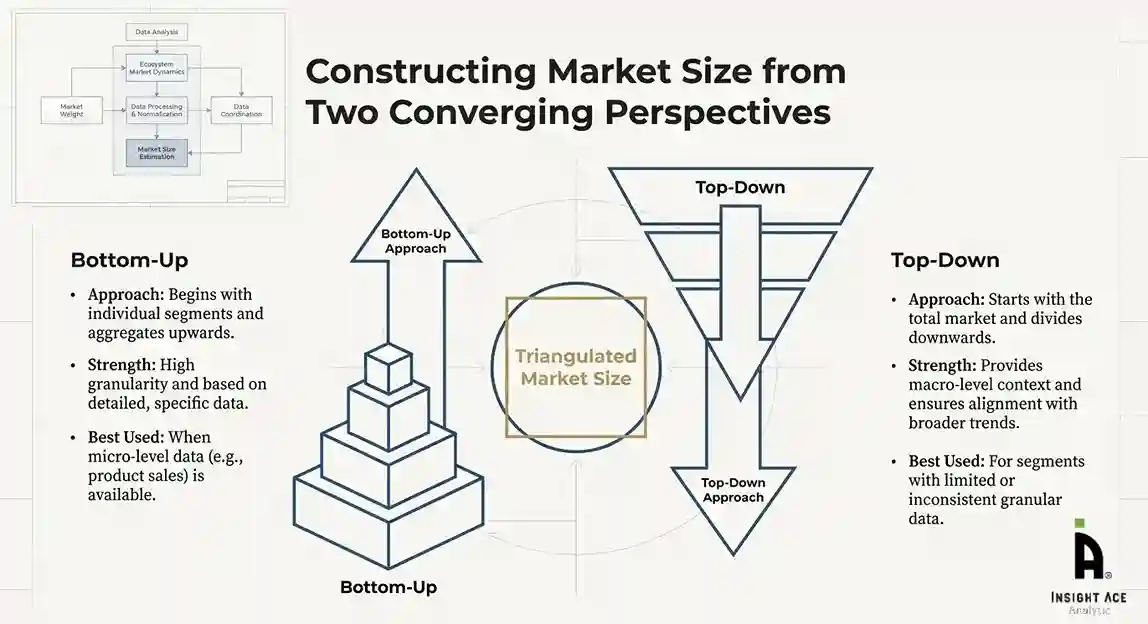
Top-Down Approach
The top-down approach used macro-level indicators:
- Parent market benchmarks
- Global/regional industry trends
- Economic indicators (GDP, demographics, spending patterns)
- Penetration and usage ratios
This approach was used for segments where granular data were limited or inconsistent.
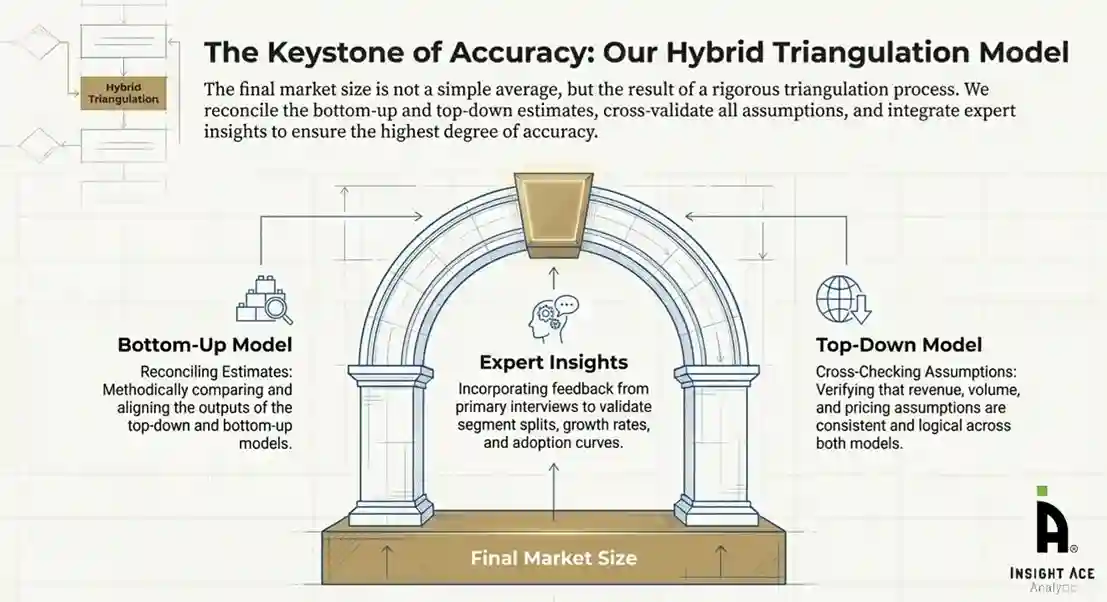
Hybrid Triangulation Approach
To ensure accuracy, a triangulated hybrid model was used. This included:
- Reconciling top-down and bottom-up estimates
- Cross-checking revenues, volumes, and pricing assumptions
- Incorporating expert insights to validate segment splits and adoption rates
This multi-angle validation yielded the final market size.
Forecasting Framework and Scenario Modelling
Market forecasts were developed using a combination of time-series modelling, adoption curve analysis, and driver-based forecasting tools.
Forecasting Methods
- Time-series modelling
- S-curve and diffusion models (for emerging technologies)
- Driver-based forecasting (GDP, disposable income, adoption rates, regulatory changes)
- Price elasticity models
- Market maturity and lifecycle-based projections
Scenario Analysis
Given inherent uncertainties, three scenarios were constructed:
- Base-Case Scenario: Expected trajectory under current conditions
- Optimistic Scenario: High adoption, favourable regulation, strong economic tailwinds
- Conservative Scenario: Slow adoption, regulatory delays, economic constraints
Sensitivity testing was conducted on key variables, including pricing, demand elasticity, and regional adoption.
Request Customization
Add countries, segments, company profiles, or extend forecast — free 10% customization with purchase.
Customize This Report →Enquire Before Buying
Speak with our analyst team about scope, methodology, pricing, or deliverable formats.
Enquire Now →Frequently Asked Questions
Exosome Research Market is valued at USD 78.62 Million in 2025, and it is expected to reach USD 407.13 Million by 2035
Exosome Research Market expected to grow at a 18.0% CAGR during the forecast period for 2026-2035
Thermo Fisher Scientific, System Biosciences, Bio-Techne, Lonza, QIAGEN, ExoDx, Hitachi Chemical, Aethlon Medical, NanoSomiX, Malvern Panalytical, Sis
Exosome research market is segmented based on products & services, disease indications, applications and end users, neurodegenerative diseases, cardiovascular diseases, and infectious diseases.
North America region is leading the Exosome Research Market.