Custom Ophthalmic Injector Devices Market Size, Share, Trend, Scope Report 2026 to 2035
What is Custom Ophthalmic Injector Devices Market Size?
Global Custom Ophthalmic Injector Devices Market Size predicted to grow at a 11.2% CAGR during the forecast period for 2026 to 2035.
Custom Ophthalmic Injector Devices Market Size, Share & Trends Analysis Distribution by Device Type (Intravitreal (IVT) Injector Devices, Suprachoroidal Microinjector Devices, Subretinal Injector Systems, Ocular Implant Injectors, Microlitre Dosing Syringes, Silicone-Oil-Free Prefilled Syringe Systems, Intravitreal Injection Assist / Guide Devices, Connected & Smart Ophthalmic Delivery Devices), By Route of Administration (Intravitreal (IVT), Suprachoroidal, Subretinal, Intracameral, Periocular / Subconjunctival, Ocular Implant Insertion) and Segment Forecasts, 2026 to 2035
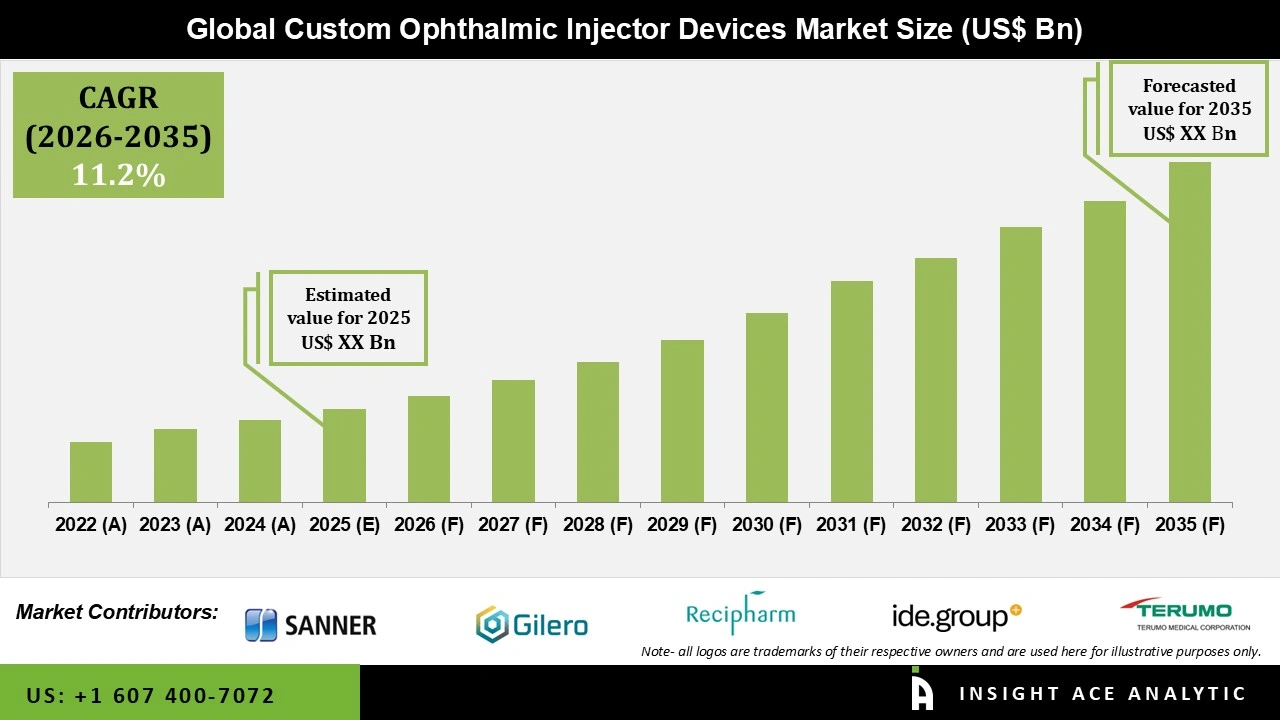
Custom ophthalmic injector devices are specialized drug-delivery systems designed to deliver therapeutic agents into specific eye areas, including the intravitreal, suprachoroidal, subretinal, and intracameral spaces. Unlike standard syringes, these devices are tailor-made for the unique needs of ophthalmic biologics, biosimilars, gene therapies, sustained-release implants, and other complex eye treatments. They feature precise microliter dosing, compatibility with silicone-oil-free prefilled syringes, optimized needle design, and user-friendly delivery systems to improve dosing accuracy, consistency in procedures, and patient safety. These devices are increasingly being created through partnerships between pharmaceutical companies, eye device manufacturers, and contract development and manufacturing organizations (CDMOs). This collaboration sustains the development and marketing of combination products.
The custom ophthalmic injector devices market is growing steadily as the ophthalmology field moves toward advanced injectable therapies that need specialized delivery platforms. The market includes the design, production, and marketing of custom injector systems, prefilled syringe platforms, implant delivery devices, microliter dosing systems, and related engineering and regulatory services for eye applications. The rising use of biologics, biosimilars, gene therapies, and long-acting eye implants is increasing the need for custom delivery technologies. These technologies ensure precise drug delivery and meet strict regulatory and quality standards. Ongoing improvements in injector design, material science, primary container technologies, and combination-product manufacturing are further changing the competitive landscape, creating custom ophthalmic injector devices a key part of next-generation eye drug delivery.
Competitive Landscape
Which are the Leading Players in the Custom Ophthalmic Injector Devices Market?
- Sanner Group GmbH
- Phillips-Medisize, LLC
- IDE Group plc
- Congruence Medical Solutions, Inc.
- Gerresheimer AG
- Terumo Corporation
- West Pharmaceutical Services, Inc.
- Becton, Dickinson and Company
- SCHOTT Pharma AG & Co. KGaA
- Stevanato Group S.p.A.
- Nipro Corporation
- MedOne Surgical, Inc.
- Clearside Biomedical, Inc.
- Nemera SAS
- Recipharm AB
- Vetter Pharma-Fertigung GmbH
- Datwyler Holding AG
- Daikyo Seiko
- Aptar Pharma
- EyePoint Pharmaceuticals, Inc.
Market Dynamics
Driver
Rising Adoption of Intravitreal Therapies
The increasing use of intravitreal therapies for retinal diseases like age-related macular degeneration, diabetic macular edema, and retinal vein occlusion is boosting the need for custom ophthalmic injector devices. The rising demand for biologics, biosimilars, gene therapies, and sustained-release implants calls for precise, safe, and specialized drug delivery systems. Consequently, pharmaceutical companies are investing more in customized injectors and silicone-oil-free prefilled syringe platforms to improve dosing accuracy, support combination products, and improve treatment outcomes.
Restrain/Challenge
Stringent Regulatory and Combination Product Development Requirements
Developing custom ophthalmic injector devices requires following complex rules for drug-device combination products. This includes design controls, human factors engineering, sterility, and safety standards for particulates. Manufacturers must show that the drug, injector, and primary container work well together while also meeting strict quality and performance standards. These extensive processes for validation, testing, and approval lengthen development timelines, raise costs, and add technical challenges. This poses a significant issue for both device manufacturers and pharmaceutical companies.
Intravitreal (IVT) Injector Devices Segment is Expected to Drive the Custom Ophthalmic Injector Devices Market
The Intravitreal (IVT) Injector Devices segment is expected to lead the Custom Ophthalmic Injector Devices Market. This is due to the common use of intravitreal injections for treating retinal conditions like age-related macular degeneration (AMD), diabetic macular edema (DME), diabetic retinopathy (DR), retinal vein occlusion (RVO), and geographic atrophy (GA). The increasing use of anti-VEGF biologics, biosimilars, and high-dose eye treatments is driving the need for customized injector systems. These systems provide accurate drug delivery, work well with prefilled syringes, and improve procedural safety. Ongoing improvements in injector design and the rising demand for specialized eye delivery platforms also support this segment's market position.
Suprachoroidal Segment is Growing at the Highest Rate in the Custom Ophthalmic Injector Devices Market
The Suprachoroidal segment is expected to grow the fastest due to the growing development and marketing of therapies that use the suprachoroidal space, including corticosteroids, small molecules, and gene therapies. This method allows for targeted drug delivery to the back part of the eye while reducing exposure to nearby tissues. This improves how well the treatments work and their safety. The progress of specialized suprachoroidal microinjector platforms, along with the increasing number of ophthalmic gene therapies, is also speeding up the use of this delivery method.
Why North America Led the Custom Ophthalmic Injector Devices Market?
North America is set to lead the Custom Ophthalmic Injector Devices Market. The region has the highest number of ophthalmic biologic manufacturers, advanced retina care centers, and device developers. It also has an early adoption of anti-VEGF therapies, biosimilars, and new ocular drug delivery technologies.
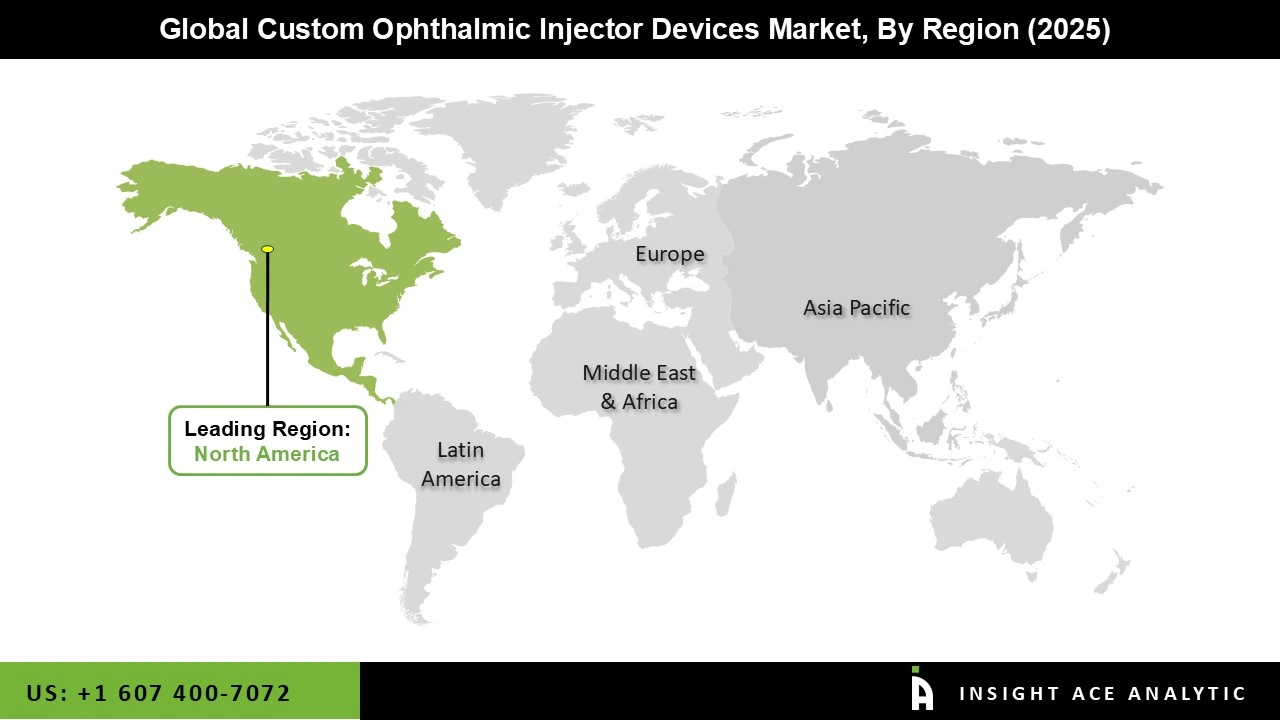
The presence of established pharmaceutical and medical device companies, strong CDMO capabilities, a favorable regulatory environment for combination products, and high volumes of intravitreal injection procedures further boost the region's market position. Additionally, the ongoing commercialization of new therapies, including gene therapies and refillable ocular implant systems, continues to drive demand for custom ophthalmic injector devices throughout the United States and Canada.
Key Development
• September 2024: Sanner Group acquired Gilero LLC to strengthen its global CDMO capabilities in medical devices and drug delivery, expanding its expertise in device design, development, and contract manufacturing.
• January 2025: Molex, the parent company of Phillips Medisize, completed the acquisition of Vectura Group Ltd., expanding its capabilities in drug formulation, device design, combination product development, manufacturing, and inhalation drug delivery technologies.
Custom Ophthalmic Injector Devices Market Report Scope:
| Report Attribute | Specifications |
| Growth Rate CAGR | CAGR of 11.2% from 2026 to 2035 |
| Quantitative Units | Representation of revenue in US$ Bn, Volume (Units) and CAGR from 2026 to 2035 |
| Historic Year | 2022 to 2025 |
| Forecast Year | 2026-2035 |
| Report Coverage | The forecast of revenue, the position of the company, the competitive market structure, growth prospects, and trends |
| Segments Covered | Device Type, Route of Administration, Drug Therapy, Offering / Service, End User and By Region |
| Regional Scope | North America; Europe; Asia Pacific; Latin America; Middle East & Africa |
| Country Scope | U.S.; Canada; U.K.; Germany; China; India; Japan; Brazil; Mexico; The UK; France; Italy; Spain; China; Japan; India; South Korea; Southeast Asia; South Korea; Southeast Asia |
| Competitive Landscape | Sanner Group GmbH, Phillips-Medisize, LLC, IDE Group plc, Congruence Medical Solutions, Inc., Gerresheimer AG, Terumo Corporation, West Pharmaceutical Services, Inc., Becton, Dickinson and Company, SCHOTT Pharma AG & Co. KGaA, Stevanato Group S.p.A. |
| Customization Scope | Free customization report with the procurement of the report, Modifications to the regional and segment scope. Geographic competitive landscape. |
| Pricing and Available Payment Methods | Explore pricing alternatives that are customized to your particular study requirements. |
Custom Ophthalmic Injector Devices Market Segmentation:
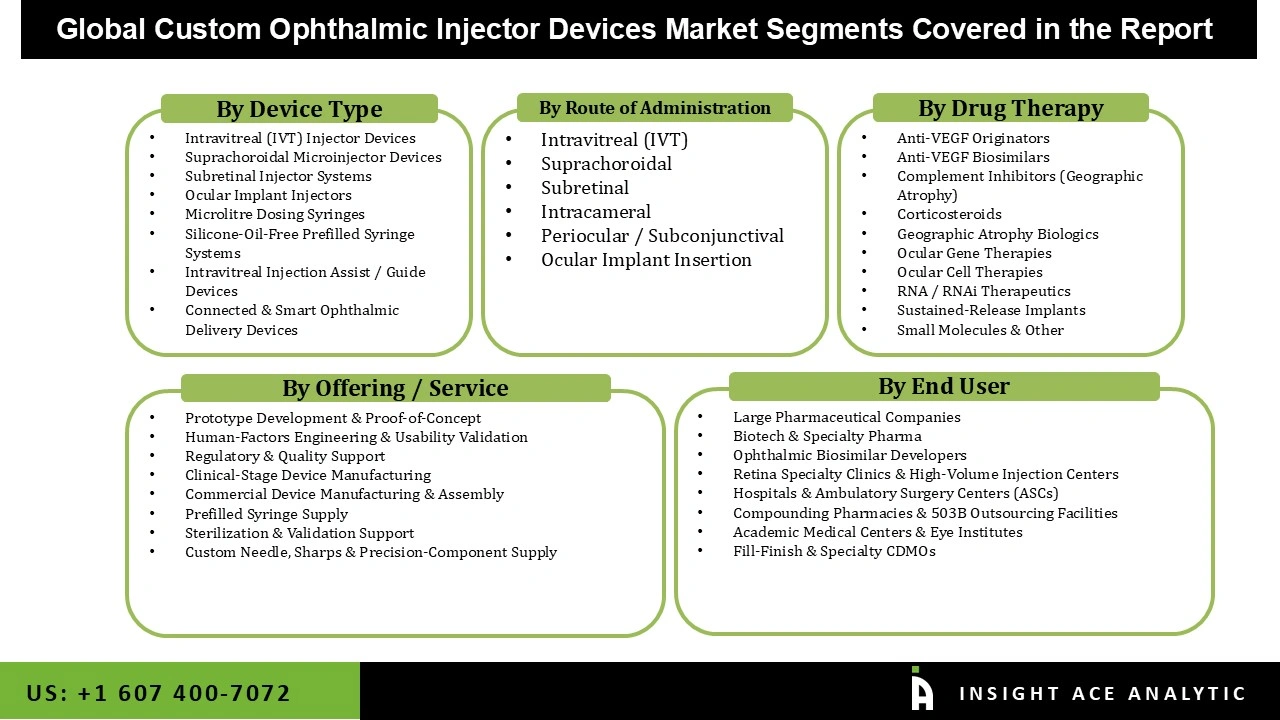
Custom Ophthalmic Injector Devices Market by Device Type -
- Intravitreal (IVT) Injector Devices
- Suprachoroidal Microinjector Devices
- Subretinal Injector Systems
- Ocular Implant Injectors
- Microlitre Dosing Syringes
- Silicone-Oil-Free Prefilled Syringe Systems
- Intravitreal Injection Assist / Guide Devices
- Connected & Smart Ophthalmic Delivery Devices
Custom Ophthalmic Injector Devices Market by Route of Administration -
- Intravitreal (IVT)
- Suprachoroidal
- Subretinal
- Intracameral
- Periocular / Subconjunctival
- Ocular Implant Insertion
Custom Ophthalmic Injector Devices Market by Drug Therapy -
- Anti-VEGF Originators
- Anti-VEGF Biosimilars
- Complement Inhibitors (Geographic Atrophy)
- Corticosteroids
- Geographic Atrophy Biologics
- Ocular Gene Therapies
- Ocular Cell Therapies
- RNA / RNAi Therapeutics
- Sustained-Release Implants
- Small Molecules & Other
Custom Ophthalmic Injector Devices Market by Offering / Service -
- Prototype Development & Proof-of-Concept
- Human-Factors Engineering & Usability Validation
- Regulatory & Quality Support
- Clinical-Stage Device Manufacturing
- Commercial Device Manufacturing & Assembly
- Prefilled Syringe Supply
- Sterilization & Validation Support
- Custom Needle, Sharps & Precision-Component Supply
Custom Ophthalmic Injector Devices Market by End User-
- Large Pharmaceutical Companies
- Biotech & Specialty Pharma
- Ophthalmic Biosimilar Developers
- Retina Specialty Clinics & High-Volume Injection Centers
- Hospitals & Ambulatory Surgery Centers (ASCs)
- Compounding Pharmacies & 503B Outsourcing Facilities
- Academic Medical Centers & Eye Institutes
- Fill-Finish & Specialty CDMOs
Custom Ophthalmic Injector Devices Market by Region-
- North America-
- The US
- Canada
- Europe-
- Germany
- The UK
- France
- Italy
- Spain
- Rest of Europe
- Asia-Pacific-
- China
- Japan
- India
- South Korea
- South East Asia
- Rest of Asia Pacific
- Latin America-
- Brazil
- Argentina
- Mexico
- Rest of Latin America
- Middle East and Africa-
- GCC Countries
- South Africa
- Rest of Middle East and Africa
Research Design and Approach
This study employed a multi-step, mixed-method research approach that integrates:
- Secondary research
- Primary research
- Data triangulation
- Hybrid top-down and bottom-up modelling
- Forecasting and scenario analysis
This approach ensures a balanced and validated understanding of both macro- and micro-level market factors influencing the market.
Secondary Research
Secondary research for this study involved the collection, review, and analysis of publicly available and paid data sources to build the initial fact base, understand historical market behaviour, identify data gaps, and refine the hypotheses for primary research.
Sources Consulted
Secondary data for the market study was gathered from multiple credible sources, including:
- Government databases, regulatory bodies, and public institutions
- International organizations (WHO, OECD, IMF, World Bank, etc.)
- Commercial and paid databases
- Industry associations, trade publications, and technical journals
- Company annual reports, investor presentations, press releases, and SEC filings
- Academic research papers, patents, and scientific literature
- Previous market research publications and syndicated reports
These sources were used to compile historical data, market volumes/prices, industry trends, technological developments, and competitive insights.

Primary Research
Primary research was conducted to validate secondary data, understand real-time market dynamics, capture price points and adoption trends, and verify the assumptions used in the market modelling.
Stakeholders Interviewed
Primary interviews for this study involved:
- Manufacturers and suppliers in the market value chain
- Distributors, channel partners, and integrators
- End-users / customers (e.g., hospitals, labs, enterprises, consumers, etc., depending on the market)
- Industry experts, technology specialists, consultants, and regulatory professionals
- Senior executives (CEOs, CTOs, VPs, Directors) and product managers
Interview Process
Interviews were conducted via:
- Structured and semi-structured questionnaires
- Telephonic and video interactions
- Email correspondences
- Expert consultation sessions
Primary insights were incorporated into demand modelling, pricing analysis, technology evaluation, and market share estimation.
Data Processing, Normalization, and Validation
All collected data were processed and normalized to ensure consistency and comparability across regions and time frames.
The data validation process included:
- Standardization of units (currency conversions, volume units, inflation adjustments)
- Cross-verification of data points across multiple secondary sources
- Normalization of inconsistent datasets
- Identification and resolution of data gaps
- Outlier detection and removal through algorithmic and manual checks
- Plausibility and coherence checks across segments and geographies
This ensured that the dataset used for modelling was clean, robust, and reliable.
Market Size Estimation and Data Triangulation
Bottom-Up Approach
The bottom-up approach involved aggregating segment-level data, such as:
- Company revenues
- Product-level sales
- Installed base/usage volumes
- Adoption and penetration rates
- Pricing analysis
This method was primarily used when detailed micro-level market data were available.

Top-Down Approach
The top-down approach used macro-level indicators:
- Parent market benchmarks
- Global/regional industry trends
- Economic indicators (GDP, demographics, spending patterns)
- Penetration and usage ratios
This approach was used for segments where granular data were limited or inconsistent.
Hybrid Triangulation Approach
To ensure accuracy, a triangulated hybrid model was used. This included:
- Reconciling top-down and bottom-up estimates
- Cross-checking revenues, volumes, and pricing assumptions
- Incorporating expert insights to validate segment splits and adoption rates
This multi-angle validation yielded the final market size.
Forecasting Framework and Scenario Modelling
Market forecasts were developed using a combination of time-series modelling, adoption curve analysis, and driver-based forecasting tools.
Forecasting Methods
- Time-series modelling
- S-curve and diffusion models (for emerging technologies)
- Driver-based forecasting (GDP, disposable income, adoption rates, regulatory changes)
- Price elasticity models
- Market maturity and lifecycle-based projections
Scenario Analysis
Given inherent uncertainties, three scenarios were constructed:
- Base-Case Scenario: Expected trajectory under current conditions
- Optimistic Scenario: High adoption, favourable regulation, strong economic tailwinds
- Conservative Scenario: Slow adoption, regulatory delays, economic constraints
Sensitivity testing was conducted on key variables, including pricing, demand elasticity, and regional adoption.
Request Customization
Add countries, segments, company profiles, or extend forecast — free 10% customization with purchase.
Customize This Report →Enquire Before Buying
Speak with our analyst team about scope, methodology, pricing, or deliverable formats.
Enquire Now →Frequently Asked Questions
The Custom Ophthalmic Injector Devices Market is expected to grow at a 11.2% CAGR during the forecast period for 2026 to 2035
Sanner Group GmbH, Phillips-Medisize, LLC, IDE Group plc, Congruence Medical Solutions, Inc., Gerresheimer AG, Terumo Corporation, West Pharmaceutical Services, Inc., Becton, Dickinson and Company, SCHOTT Pharma AG & Co. KGaA, Stevanato Group S.p.A. and Others.
Custom Ophthalmic Injector Devices Market is segmented into Device Type, Route of Administration, Drug Therapy, Offering / Service, End User and Other.
North America region is leading the Custom Ophthalmic Injector Devices Market.