Contraceptive Market Size and Scope 2026 to 2035
Share With :



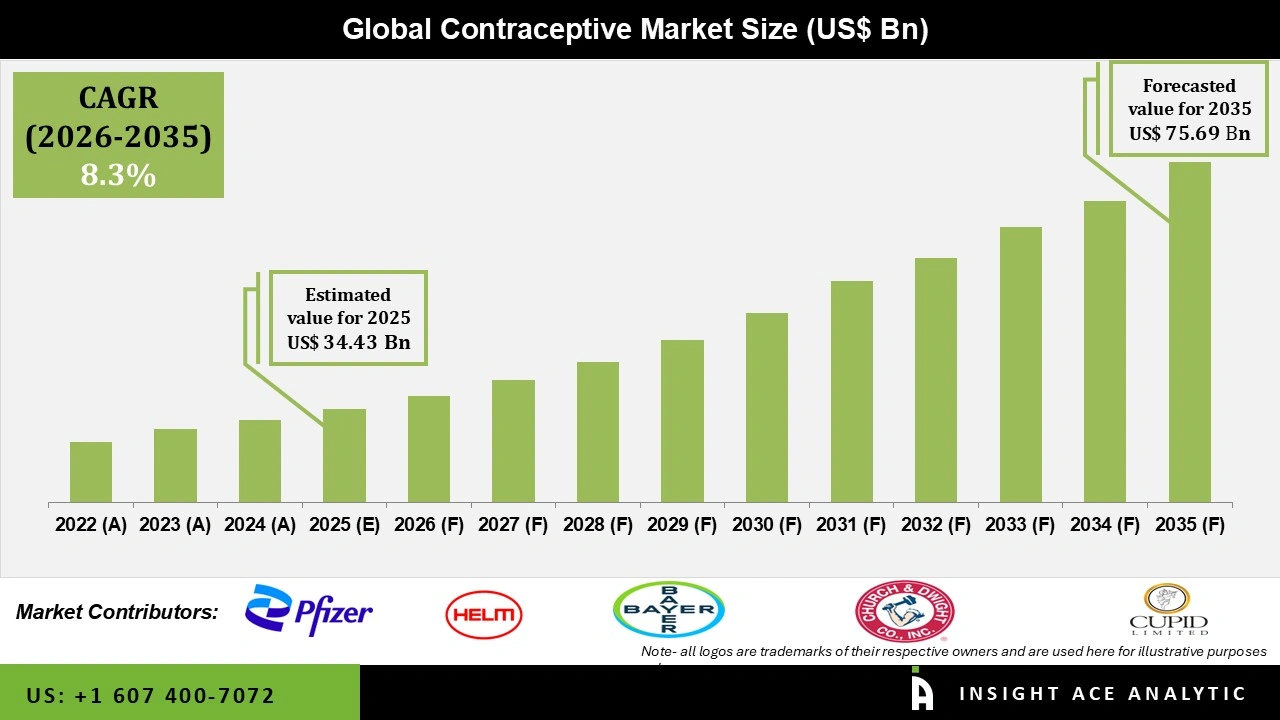
Global Contraceptive Market Size is valued at USD 34.43 Billion in 2025 and is predicted to reach USD 75.69 Billion by the year 2035 at a 8.3% CAGR during the forecast period for 2026 to 2035.
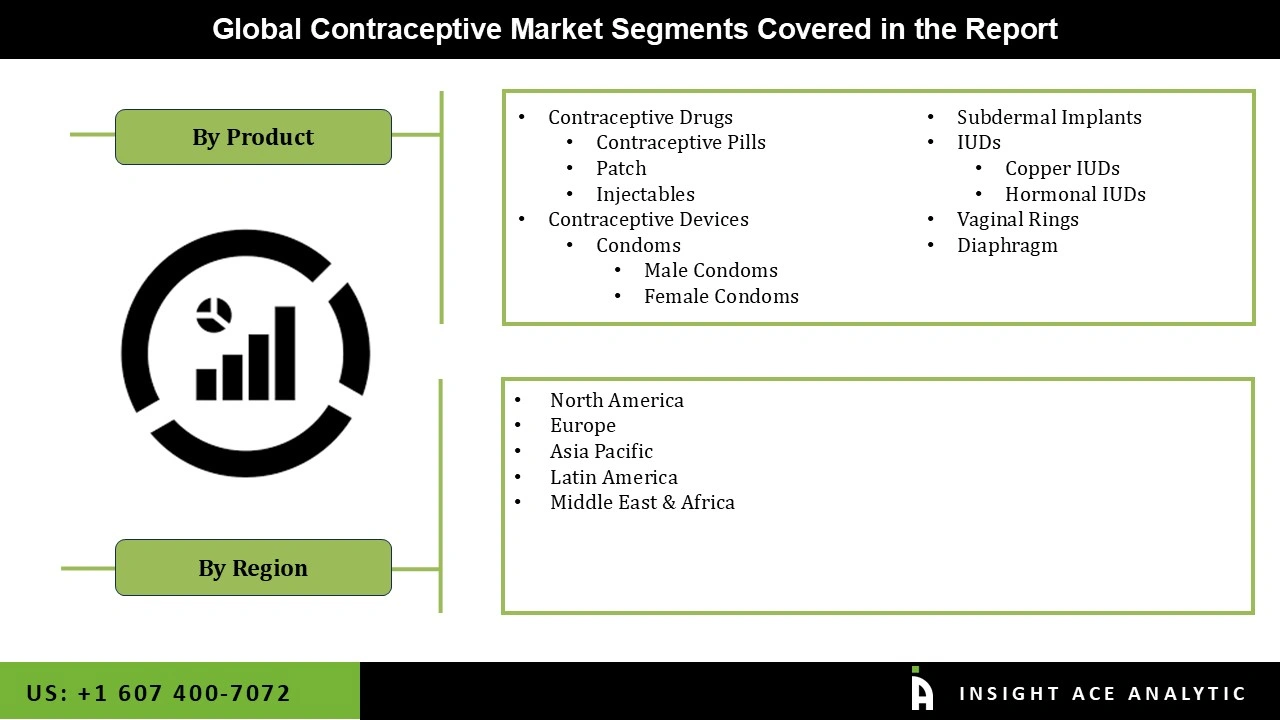
Contraceptive Market Size, Share & Trends Analysis Report By Product( Contraceptive Drugs(Contraceptive Pills, Patch, Injectables), Contraceptive Devices(Condoms(Male Condoms, Female Condoms), Subdermal Implants, IUDs(Copper IUDs, Hormonal IUDs), Vaginal Rings, Diaphragm), By Region, And Segment Forecasts, 2026 to 2035
Contraceptive Market Key Takeaways:
|
The use of contraception has increased, which has improved health outcomes, such as maternal and newborn mortality, and reduced the risk of STDs. Additionally, it is projected that an increase in the number of gynecologists who support these contraceptive methods for birth control would fuel business expansion in the coming years. The market projections for contraceptives consider factors such as rising awareness of modern contraceptives, rising use of secure and reliable oral pills, and health concerns associated with teen pregnancies. Female contraceptives currently dominate the market, but as more men use condoms, the demand for male contraceptives will rise.
Serious adverse effects include liver diseases, gallbladder illness, heart attacks, and blood clots in the legs. Over the foreseeable period, sales will be constrained by these contraceptive-related side effects. The market may be expanding due to various issues, such as increased consumer knowledge of STDs, unwanted pregnancies, and population control. These factors will cause the need for contraceptives to skyrocket, especially in emerging nations. There is a considerable likelihood that the market will expand thanks to the arrival of new vendors and the growing accessibility of sophisticated contraception techniques greatly. Retail pharmacies will continue to dominate the industry due to manufacturers' improved supply chain networks.
The contraceptive market is segmented into Products (drugs and devices). Based on drugs, the market is segmented into oral contraceptive pills, injectable contraceptives and topical contraceptives. Based on devices, the contraceptive market is segmented into condoms (male, female), diaphragms, contraceptive sponges, vaginal rings, subdermal implants and intra-uterine devices (copper, hormonal).
The market's leading segment is contraceptive pills. The main purposes of contraception pills are to prevent unintended pregnancies, regulate birth rates, and reduce the risk of sexually transmitted diseases. As a result, it will increase in the years to come. Additionally, rising contraceptive use among young women and higher education levels supports the growth of the contraceptive drugs market.
The vaginal ring segment is predicted to develop significantly during the forecast period. The segment is growing due to factors including cost-effectiveness and long product life cycles. The availability of new goods and the simplicity of using vaginal rings are anticipated to increase demand for these birth control methods.
The North American Contraceptive market is expected to register the highest market share. Favourable government programs, a high proportion of unwanted pregnancies, a rise in the prevalence of sexually transmitted illnesses, etc. The U.S. government has launched several education campaigns about family planning and contraception, which have boosted the sector's income.
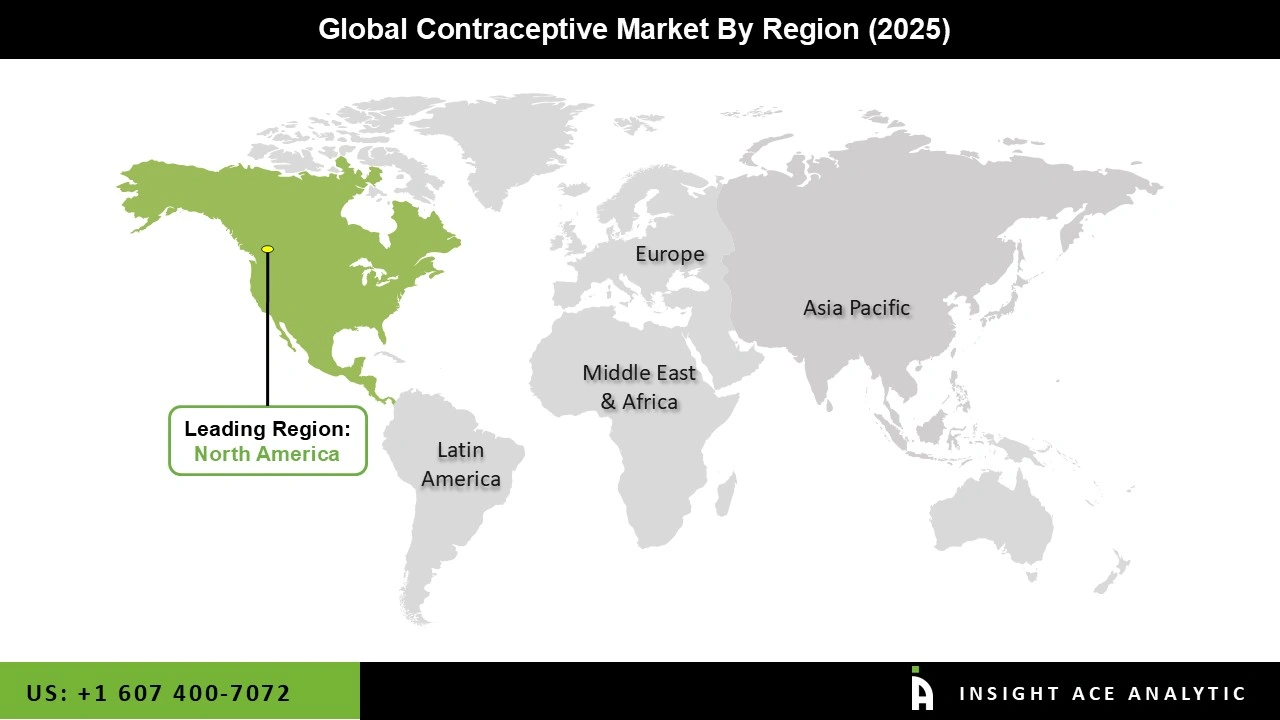
In the United States, there are many unwanted pregnancies. Besides, Asia Pacific had a substantial share of the Contraceptive market. The region's demand for contraceptives is expected to grow due to increased government activities. The market in the Asia Pacific is also anticipated to be driven by an increase in unwanted pregnancies and improved family planning awareness.
| Report Attribute | Specifications |
| Market Size Value In 2025 | USD 34.43 Billion |
| Revenue Forecast In 2035 | USD 75.69 Billion |
| Growth Rate CAGR | CAGR of 8.0% from 2026 to 2035 |
| Quantitative Units | Representation of revenue in US$ Mn, and CAGR from 2026 to 2035 |
| Historic Year | 2022 to 2025 |
| Forecast Year | 2026-2035 |
| Report Coverage | The forecast of revenue, the position of the company, the competitive market structure, growth prospects, and trends |
| Segments Covered | Product (Drugs and devices) |
| Regional Scope | North America; Europe; Asia Pacific; Latin America; Middle East & Africa |
| Country Scope | U.S.; Canada; U.K.; Germany; China; India; Japan; Brazil; Mexico ;The UK; France; Italy; Spain; China; Japan; India; South Korea; South East Asia; South Korea; South East Asia |
| Competitive Landscape | Bayer AG; China Resources Zizhu Pharmaceutical Co., Ltd. (CR Zizhu); Cupid Ltd.; Helm AG; Church & Dwight; Organon Group Of Companies; Pfizer Inc.; Viatris (Mylan); Abbvie, Inc.; Afaxys, Inc.; Agile Therapeutics; Janssen Pharmaceuticals, Inc.; Veru, Inc. |
| Customization Scope | Free customization report with the procurement of the report, Modifications to the regional and segment scope. Particular Geographic competitive landscape. |
| Pricing And Available Payment Methods | Explore pricing alternatives that are customized to your particular study requirements. |
This study employed a multi-step, mixed-method research approach that integrates:
This approach ensures a balanced and validated understanding of both macro- and micro-level market factors influencing the market.
Secondary research for this study involved the collection, review, and analysis of publicly available and paid data sources to build the initial fact base, understand historical market behaviour, identify data gaps, and refine the hypotheses for primary research.
Secondary data for the market study was gathered from multiple credible sources, including:
These sources were used to compile historical data, market volumes/prices, industry trends, technological developments, and competitive insights.

Primary research was conducted to validate secondary data, understand real-time market dynamics, capture price points and adoption trends, and verify the assumptions used in the market modelling.
Primary interviews for this study involved:
Interviews were conducted via:
Primary insights were incorporated into demand modelling, pricing analysis, technology evaluation, and market share estimation.
All collected data were processed and normalized to ensure consistency and comparability across regions and time frames.
The data validation process included:
This ensured that the dataset used for modelling was clean, robust, and reliable.
The bottom-up approach involved aggregating segment-level data, such as:
This method was primarily used when detailed micro-level market data were available.

The top-down approach used macro-level indicators:
This approach was used for segments where granular data were limited or inconsistent.
To ensure accuracy, a triangulated hybrid model was used. This included:
This multi-angle validation yielded the final market size.
Market forecasts were developed using a combination of time-series modelling, adoption curve analysis, and driver-based forecasting tools.
Given inherent uncertainties, three scenarios were constructed:
Sensitivity testing was conducted on key variables, including pricing, demand elasticity, and regional adoption.