Climate Adaptive Microbial Consortia Market Size, Scope, Revenue Report 2026 to 2035
What is Climate Adaptive Microbial Consortia Market Size?
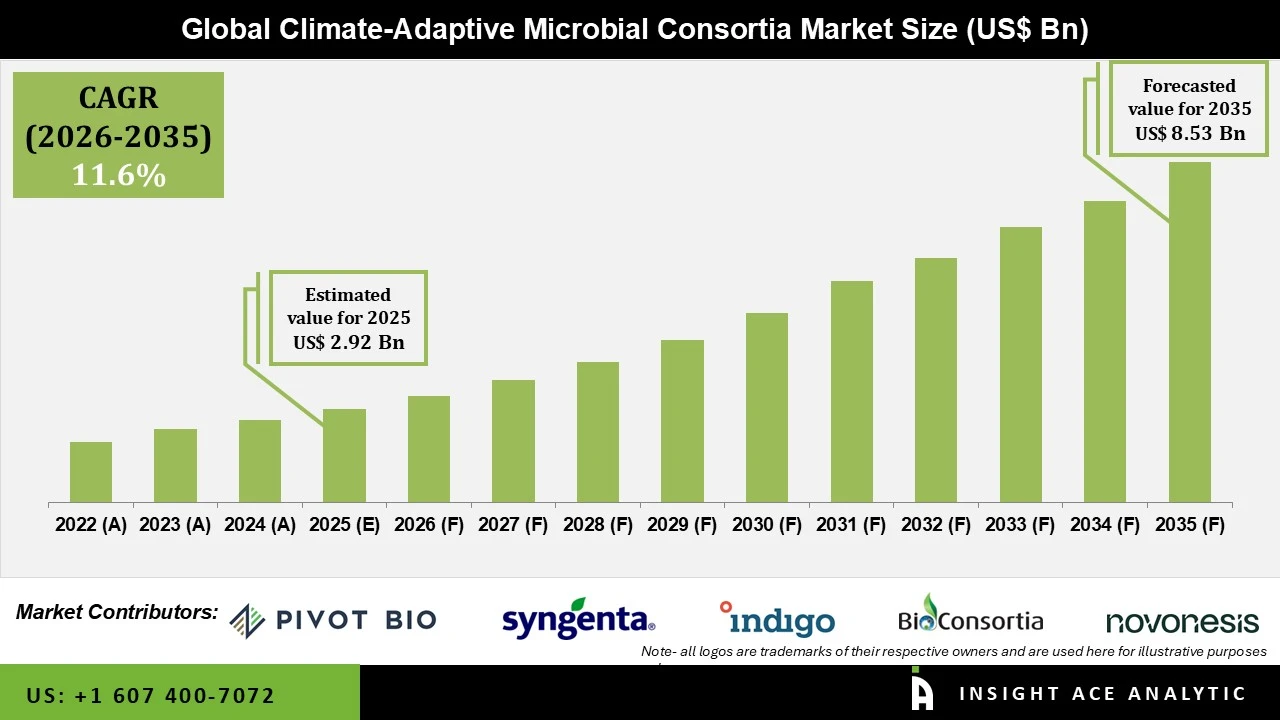
Climate Adaptive Microbial Consortia Market Size is valued at USD 2.92 Bn in 2025 and is predicted to reach USD 8.53 Bn by the year 2035 at a 11.6% CAGR during the forecast period for 2026 to 2035.
Climate Adaptive Microbial Consortia Market Size, Share & Trends Analysis Distribution by Application (Drought Stress Management, Soil Health & Fertility Enhancement, Carbon Sequestration, Salinity & Temperature Stress Tolerance, Multi-Stress / Broad Spectrum), By Product Type (Biofertilizers, Biostimulants, Soil Conditioners, Microbial Inoculants), By Crop Type (Cereals & Grains, Fruits & Vegetables, Oilseeds & Pulses, Specialty Crops) and Segment Forecasts, 2026 to 2035
Climate resilient microbial consortia involve carefully engineered or naturally occurring communities of beneficial microorganisms that include both bacteria, fungi, and archaea. The beneficial microorganism communities work together to improve crop performance during fluctuating climate conditions. In contrast to single-strain formulations, microbial consortia operate as biological systems with multiple properties including nitrogen fixation, nutrient mineralization, and stress tolerance among others. Microbial consortia are specifically formulated to assist crops in coping with non-biological factors such as drought, salinity, temperature, and soil degradation while ensuring that there is a balance in soil microflora and increased soil fertility. Such biotechnology approaches can be used as a sustainable replacement for chemical inputs within agriculture.
These microbial consortia are applied extensively in various sectors including management of abiotic stress, improving soil quality, climate-smart agriculture, and sustainable/organic farming practices. They play a crucial role in promoting nutrient uptake, boosting root growth, and ensuring consistent crop yields in the face of unfavorable environmental conditions. Furthermore, they facilitate carbon fixation and soil restoration through higher microbial activity and organic carbon accumulation in soils. In light of the current global climatic changes affecting agricultural systems and the scientific developments associated with microbiomes, climate-ready microbial consortia represent an important focus within the larger biologicals industry of agriculture.
Key Market Trends
Competitive Landscape
Which are the Leading Players in the Climate-Adaptive Microbial Consortia Market?
• Pivot Bio
• Syngenta (includes Valagro)
• Indigo Ag
• BioConsortia
• Novonesis
• Corteva
• Rizobacter
• Koppert
• BASF
• UPL (Natural Plant Protection – NPP division)
• Sound Agriculture
• Groundwork BioAg
• Locus Agriculture
• Ginkgo Bioworks (with Joyn Bio)
• Kula Bio
• Concentric Ag
• Lallemand Plant Care
• AgBiome
• Solena Group
• Terraformation
Market Dynamics
Driver
Rising Climate Stress on Agriculture Driving Market Growth
The leading growth driver in the Climate-Adaptive Microbial Consortia Market comes from the mounting effect of climate change on agriculture output due to increasingly prevalent cases of drought, salt in the soil, heat stress, and unpredictable weather that negatively impacts crop yield and the condition of the soil. These factors have led to a growing need for biological solutions that will make the crops resilient against the abiotic stress while ensuring their productivity even under unfavorable conditions. In this context, climate-adaptive microbial consortia ensure the enhanced ability to absorb nutrients and build strong root systems to stabilize production. Furthermore, the worldwide move towards sustainable farming and decreased use of chemicals, as well as regulatory efforts in this regard, contribute to market growth.
Restrain/Challenge
Inconsistent Field Performance and Limited Standardization
The key factor driving the Climate-Adaptive Microbial Consortia Market is the rising influence of climate change on the production of crops, with the frequency of events such as droughts, saline soils, heat stress, and unpredictable weather patterns becoming major factors influencing the growth of crops and their soil health. The need for more robust and biological-based technologies that not only increase plant resistance against abiotic stress but also continue to produce crops despite the environmental conditions has led to an increased demand for climate-adaptive microbial consortia. Furthermore, the worldwide transition towards sustainable farming practices with minimal use of chemicals, along with regulatory support and soil health awareness, has added to this demand.
Soil Health & Fertility Enhancement Segment is Expected to Drive the Climate-Adaptive Microbial Consortia Market
Within the segments of applications, soil health & fertility enhancement is the main driving force behind the Climate-Adaptive Microbial Consortia market as it forms the most popular and commercially feasible application scenario. In particular, microorganisms are widely applied for improving nutrient uptake, enhancing soil structure, and replenishing microbial communities, which ultimately lead to increased yields and decreased dependency on chemical fertilizers. Although the applications associated with drought stress management and salinity/temperature stress tolerance are becoming increasingly popular owing to climate change, the aforementioned applications remain regional specific. Furthermore, Carbon Sequestration and Multi-Stress/Broad Spectrum applications have yet to establish themselves within the market.
Biostimulants Segment is Growing at the Highest Rate in the Climate-Adaptive Microbial Consortia Market
Among the product types, the biostimulants segment is experiencing the fastest growth in the climate-adaptive microbial consortia market, owing to their versatile nature and alignment with sustainable farming practices. Biostimulants play an effective role in improving plant growth, nutrient assimilation, and tolerance towards stressful conditions but can perform more than one task at a time, giving them greater adaptability to different types of soils and environmental factors. In addition, the use of biostimulants to cope with issues including drought stresses, degraded soil, and enhanced yield capacity is boosting their demand in the marketplace.
Why North America Led the Climate-Adaptive Microbial Consortia Market?
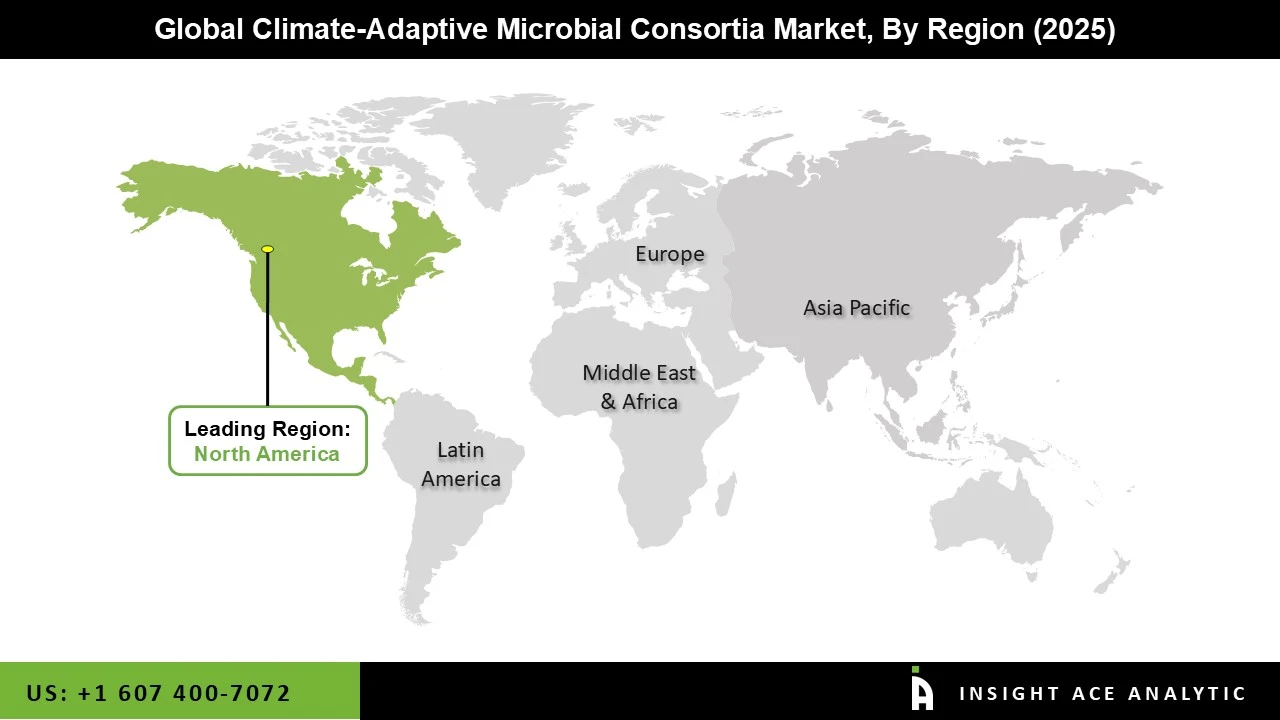
North America leads the Climate-Adaptive Microbial Consortia Market, primarily driven by the strong presence of advanced agricultural biotechnology, high adoption of sustainable farming practices, and significant investments in microbiome research. The region benefits from well-established players, robust R&D infrastructure, and early commercialization of microbial-based agricultural inputs. Additionally, increasing awareness among farmers regarding soil health, coupled with supportive regulatory frameworks for biological products, has accelerated market penetration. The rising need to combat climate-induced stress on crops and reduce dependence on chemical fertilizers further strengthens North America’s dominant position in the market.
Key Development
March 2026: Syngenta announced a $130 million BioSTaR research center in the UK to advance biological sciences, AI-driven innovation, and next-generation sustainable agriculture solutions, with operations expected by 2028.
Climate Adaptive Microbial Consortia Market Report Scope:
| Report Attribute | Specifications |
| Market size value in 2025 | USD 2.92 Bn |
| Revenue forecast in 2035 | USD 8.53 Bn |
| Growth Rate CAGR | CAGR of 11.6% from 2026 to 2035 |
| Quantitative Units | Representation of revenue in US$ Bn and CAGR from 2026 to 2035 |
| Historic Year | 2021 to 2025 |
| Forecast Year | 2026-2035 |
| Report Coverage | The forecast of revenue, the position of the company, the competitive market structure, growth prospects, and trends |
| Segments Covered | Application, Product Type, Crop Type and By Region |
| Regional Scope | North America; Europe; Asia Pacific; Latin America; Middle East & Africa |
| Country Scope | U.S.; Canada; U.K.; Germany; China; India; Japan; Brazil; Mexico; The UK; France; Italy; Spain; China; Japan; India; South Korea; Southeast Asia; South Korea; Southeast Asia |
| Competitive Landscape | Pivot Bio, Syngenta (includes Valagro), Indigo Ag, BioConsortia, Novonesis, Corteva, Rizobacter, Koppert, BASF, UPL (Natural Plant Protection – NPP division), Sound Agriculture,Groundwork BioAg, Locus Agriculture, Ginkgo Bioworks (with Joyn Bio), Kula Bio, Concentric Ag, Lallemand Plant Care, AgBiome, Solena Group, Terraformation |
| Customization Scope | Free customization report with the procurement of the report: modifications to the regional and segment scope. Geographic competitive landscape. |
| Pricing and Available Payment Methods | Explore pricing alternatives that are customized to your particular study requirements. |
Market Segmentation:
Climate-Adaptive Microbial Consortia Market by Application -
• Drought Stress Management
• Soil Health & Fertility Enhancement
• Carbon Sequestration
• Salinity & Temperature Stress Tolerance
• Multi-Stress / Broad Spectrum
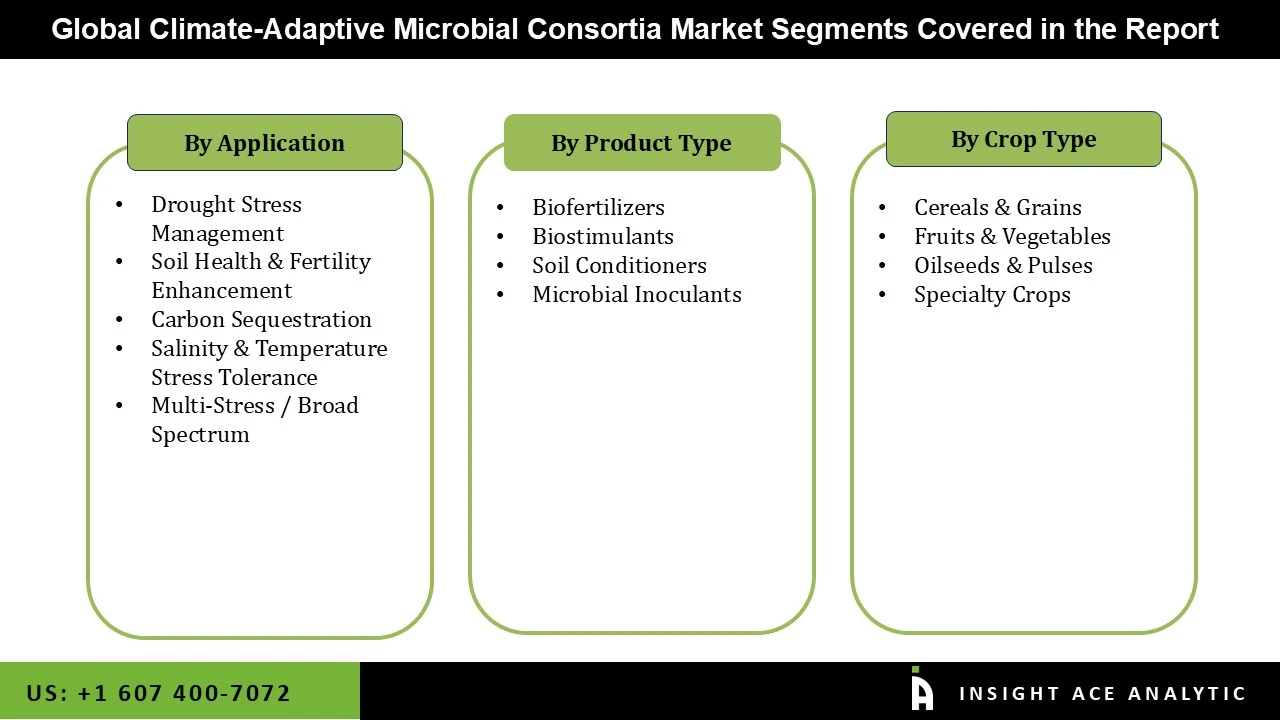
Climate-Adaptive Microbial Consortia Market by Product Type -
• Biofertilizers
• Biostimulants
• Soil Conditioners
• Microbial Inoculants
Climate-Adaptive Microbial Consortia Market by Crop Type -
• Cereals & Grains
• Fruits & Vegetables
• Oilseeds & Pulses
• Specialty Crops
Climate-Adaptive Microbial Consortia Market by Region-
North America-
• The US
• Canada
Europe-
• Germany
• The UK
• France
• Italy
• Spain
• Rest of Europe
Asia-Pacific-
• China
• Japan
• India
• South Korea
• South East Asia
• Rest of Asia Pacific
Latin America-
• Brazil
• Argentina
• Mexico
• Rest of Latin America
Middle East & Africa-
• GCC Countries
• South Africa
• Rest of Middle East and Africa
Research Design and Approach
This study employed a multi-step, mixed-method research approach that integrates:
- Secondary research
- Primary research
- Data triangulation
- Hybrid top-down and bottom-up modelling
- Forecasting and scenario analysis
This approach ensures a balanced and validated understanding of both macro- and micro-level market factors influencing the market.
Secondary Research
Secondary research for this study involved the collection, review, and analysis of publicly available and paid data sources to build the initial fact base, understand historical market behaviour, identify data gaps, and refine the hypotheses for primary research.
Sources Consulted
Secondary data for the market study was gathered from multiple credible sources, including:
- Government databases, regulatory bodies, and public institutions
- International organizations (WHO, OECD, IMF, World Bank, etc.)
- Commercial and paid databases
- Industry associations, trade publications, and technical journals
- Company annual reports, investor presentations, press releases, and SEC filings
- Academic research papers, patents, and scientific literature
- Previous market research publications and syndicated reports
These sources were used to compile historical data, market volumes/prices, industry trends, technological developments, and competitive insights.

Primary Research
Primary research was conducted to validate secondary data, understand real-time market dynamics, capture price points and adoption trends, and verify the assumptions used in the market modelling.
Stakeholders Interviewed
Primary interviews for this study involved:
- Manufacturers and suppliers in the market value chain
- Distributors, channel partners, and integrators
- End-users / customers (e.g., hospitals, labs, enterprises, consumers, etc., depending on the market)
- Industry experts, technology specialists, consultants, and regulatory professionals
- Senior executives (CEOs, CTOs, VPs, Directors) and product managers
Interview Process
Interviews were conducted via:
- Structured and semi-structured questionnaires
- Telephonic and video interactions
- Email correspondences
- Expert consultation sessions
Primary insights were incorporated into demand modelling, pricing analysis, technology evaluation, and market share estimation.
Data Processing, Normalization, and Validation
All collected data were processed and normalized to ensure consistency and comparability across regions and time frames.
The data validation process included:
- Standardization of units (currency conversions, volume units, inflation adjustments)
- Cross-verification of data points across multiple secondary sources
- Normalization of inconsistent datasets
- Identification and resolution of data gaps
- Outlier detection and removal through algorithmic and manual checks
- Plausibility and coherence checks across segments and geographies
This ensured that the dataset used for modelling was clean, robust, and reliable.
Market Size Estimation and Data Triangulation
Bottom-Up Approach
The bottom-up approach involved aggregating segment-level data, such as:
- Company revenues
- Product-level sales
- Installed base/usage volumes
- Adoption and penetration rates
- Pricing analysis
This method was primarily used when detailed micro-level market data were available.

Top-Down Approach
The top-down approach used macro-level indicators:
- Parent market benchmarks
- Global/regional industry trends
- Economic indicators (GDP, demographics, spending patterns)
- Penetration and usage ratios
This approach was used for segments where granular data were limited or inconsistent.
Hybrid Triangulation Approach
To ensure accuracy, a triangulated hybrid model was used. This included:
- Reconciling top-down and bottom-up estimates
- Cross-checking revenues, volumes, and pricing assumptions
- Incorporating expert insights to validate segment splits and adoption rates
This multi-angle validation yielded the final market size.
Forecasting Framework and Scenario Modelling
Market forecasts were developed using a combination of time-series modelling, adoption curve analysis, and driver-based forecasting tools.
Forecasting Methods
- Time-series modelling
- S-curve and diffusion models (for emerging technologies)
- Driver-based forecasting (GDP, disposable income, adoption rates, regulatory changes)
- Price elasticity models
- Market maturity and lifecycle-based projections
Scenario Analysis
Given inherent uncertainties, three scenarios were constructed:
- Base-Case Scenario: Expected trajectory under current conditions
- Optimistic Scenario: High adoption, favourable regulation, strong economic tailwinds
- Conservative Scenario: Slow adoption, regulatory delays, economic constraints
Sensitivity testing was conducted on key variables, including pricing, demand elasticity, and regional adoption.
Request Customization
Add countries, segments, company profiles, or extend forecast — free 10% customization with purchase.
Customize This Report →Enquire Before Buying
Speak with our analyst team about scope, methodology, pricing, or deliverable formats.
Enquire Now →Frequently Asked Questions
Climate Adaptive Microbial Consortia Market Size is valued at USD 2.92 Bn in 2025 and is predicted to reach USD 8.53 Bn by the year 2035
Climate Adaptive Microbial Consortia Market Size is predicted to be at an 11.6% CAGR during the forecast period for 2026 to 2035.
Pivot Bio, Syngenta (includes Valagro), Indigo Ag, BioConsortia, Novonesis, Corteva, Rizobacter, Koppert, BASF, UPL (Natural Plant Protection – NPP division), Sound Agriculture,Groundwork BioAg, Locus Agriculture, Ginkgo Bioworks (with Joyn Bio), Kula Bio, Concentric Ag, Lallemand Plant Care, AgBiome, Solena Group, Terraformation
Climate Adaptive Microbial Consortia Market is segmented into Application, Product Type, crop type, and By Region.
North America region is leading the Climate Adaptive Microbial Consortia Market.