Renewable Energy in Agriculture Biofuels Solar Farms and Sustainable Practices Market 2026 to 2035
What is Renewable Energy in Agriculture Biofuels, Solar Farms, and Sustainable Practices Market Size?
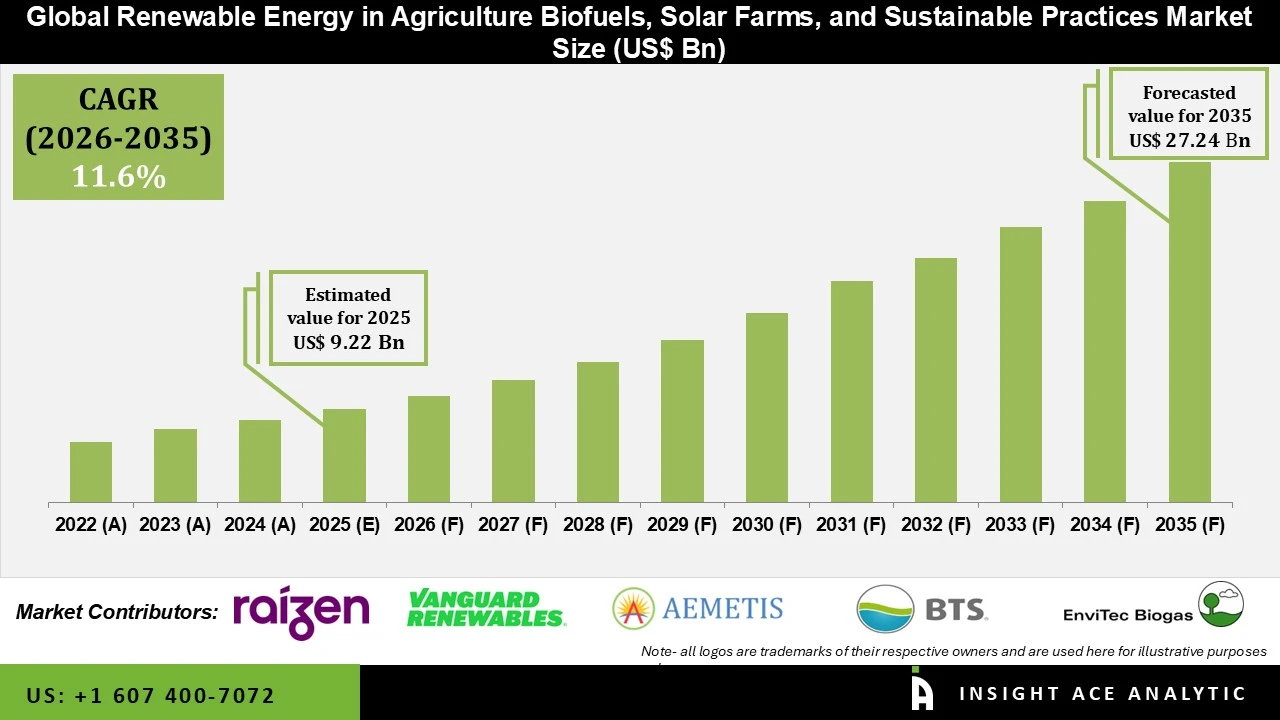
Renewable Energy in Agriculture Biofuels, Solar Farms, and Sustainable Practices Market Size is valued at USD 9.22 Bn in 2025 and is predicted to reach USD 27.24 Bn by the year 2035 at a 11.6% CAGR during the forecast period for 2026 to 2035.
Renewable Energy in Agriculture Biofuels, Solar Farms, and Sustainable Practices Market Size, Share & Trends Analysis Distribution by Type of Farming Entity (Co-operative Farms, Single Ownership or Family Farms, Corporation/Private Ownership, Government Ownership), By Type of Farm (Crop Farming, Livestock, Pasture and Forestry, Others), By Energy Type (Biofuels (Ethanol & Biodiesel), Biogas (Farm-Based Anaerobic Digestion), Agrivoltaics (Solar PV on Farmland), Wind Energy Systems on Farmland, Other Renewable Practices (Geothermal, Small Hydro, etc.)) and Segment Forecasts, 2026 to 2035
The renewable energy in agriculture market operates at the convergence of the energy transition, food security, and sustainable land management. As farmers face rising energy costs and regulatory pressure to reduce emissions, agricultural producers are increasingly investing in on-farm renewable generation—from solar-powered irrigation to anaerobic digesters converting manure into biogas. The adoption of agrivoltaics (co-locating solar panels with crop production) is gaining traction as a land-use efficient solution that generates revenue while maintaining agricultural output.
Biofuel production from agricultural residues is expanding, supported by government blending mandates and carbon intensity scoring systems that reward low-carbon feedstocks. The integration of precision agriculture with renewable energy systems—such as sensor-driven irrigation powered by on-site solar—improves both energy and water efficiency. As climate policies intensify and carbon markets mature, agriculture is transitioning from a focus on emissions reduction to net-zero and carbon-negative models enabled by renewable energy integration.
The Renewable Energy in Agriculture Biofuels, Solar Farms, and Sustainable Practices market comprises the integrated ecosystem involved in the development, deployment, and commercialization of these solutions across the agricultural value chain. It includes activities such as feedstock sourcing, biofuel processing, solar infrastructure installation, energy storage integration, and the implementation of sustainable farming technologies. The market is structured across multiple segments, including energy type (biofuels, solar energy, and other renewable solutions), application areas (on-farm energy use, grid-connected energy generation, and rural electrification), and end users such as individual farmers, agribusinesses, cooperatives, and institutional farming operations. It also involves a diverse set of stakeholders, including technology providers, energy companies, equipment manufacturers, project developers, and service providers, forming a comprehensive framework that supports the transition toward energy-efficient and sustainable agricultural systems.
Competitive Landscape
Which are the Leading Players in the Renewable Energy in Agriculture Biofuels, Solar Farms, and Sustainable Practices Market?
• Raízen
• Aemetis, Inc.
• California Bioenergy LLC
• Vanguard Renewables Holdings, LLC
• EnviTec Biogas AG
• BTS Biogas Srl
• Sun’Agri
• Nexamp, Inc.
• OYA Solar Corp.
• Q ENERGY Solutions SE
• Husk Power Systems
Market Dynamics
Driver
Rising Need for Cost Reduction and Energy Independence in Agriculture
The primary driver of the renewable energy in agriculture biofuels, solar farms, and sustainable practices Market is the growing need to reduce energy costs and achieve energy independence in farming operations. Agriculture relies heavily on energy for irrigation, machinery, storage, and processing, making it highly sensitive to fluctuations in fuel and electricity prices. By adopting renewable solutions such as Solar energy and Biofuels, farmers can generate their own power, reduce dependence on external energy sources, and stabilize long-term operational expenses. This shift not only improves cost predictability but also enhances resilience against energy supply disruptions, making it a critical factor driving adoption across the agricultural sector.
Restrain/Challenge
High Initial Capital Investment and Payback Uncertainty
The key restraint counteracting the cost-reduction and energy independence driver is the high upfront capital investment coupled with uncertain payback periods, as renewable solutions like Solar energy systems and Biofuels infrastructure require significant initial spending on installation and equipment, which can be difficult for farmers and small agribusinesses with limited financing access, while variability in energy output, maintenance costs, and policy changes further create uncertainty around returns, ultimately slowing adoption despite clear long-term economic benefits.
Co-operative Farms Segment is Expected to Drive the Renewable Energy in Agriculture Biofuels, Solar Farms, and Sustainable Practices Market
Large agribusinesses and privately owned commercial farms have greater financial capacity to invest in renewable solutions such as solar energy systems and biofuels infrastructure. They also operate at a scale where energy costs are substantial, making the return on investment more attractive and measurable. Additionally, these entities are more likely to adopt integrated energy strategies, including large-scale solar farms, waste-to-energy systems, and advanced sustainable practices, to optimize operational efficiency and meet sustainability goals. Their ability to deploy projects at scale and integrate them across the value chain positions them as the leading segment driving market adoption.
Crop Farming Segment is Growing at the Highest Rate in the Renewable Energy in Agriculture Biofuels, Solar Farms, and Sustainable Practices Market
The crop farming segment is growing at the highest rate, driven by its strong compatibility with renewable energy solutions such as Solar energy and Biofuels, as large open land areas enable easy deployment of solar installations and agrivoltaic systems, while abundant crop residues provide consistent feedstock for biofuel production, and the high energy demand for irrigation and processing further accelerates adoption, making it the fastest-expanding segment in the market.
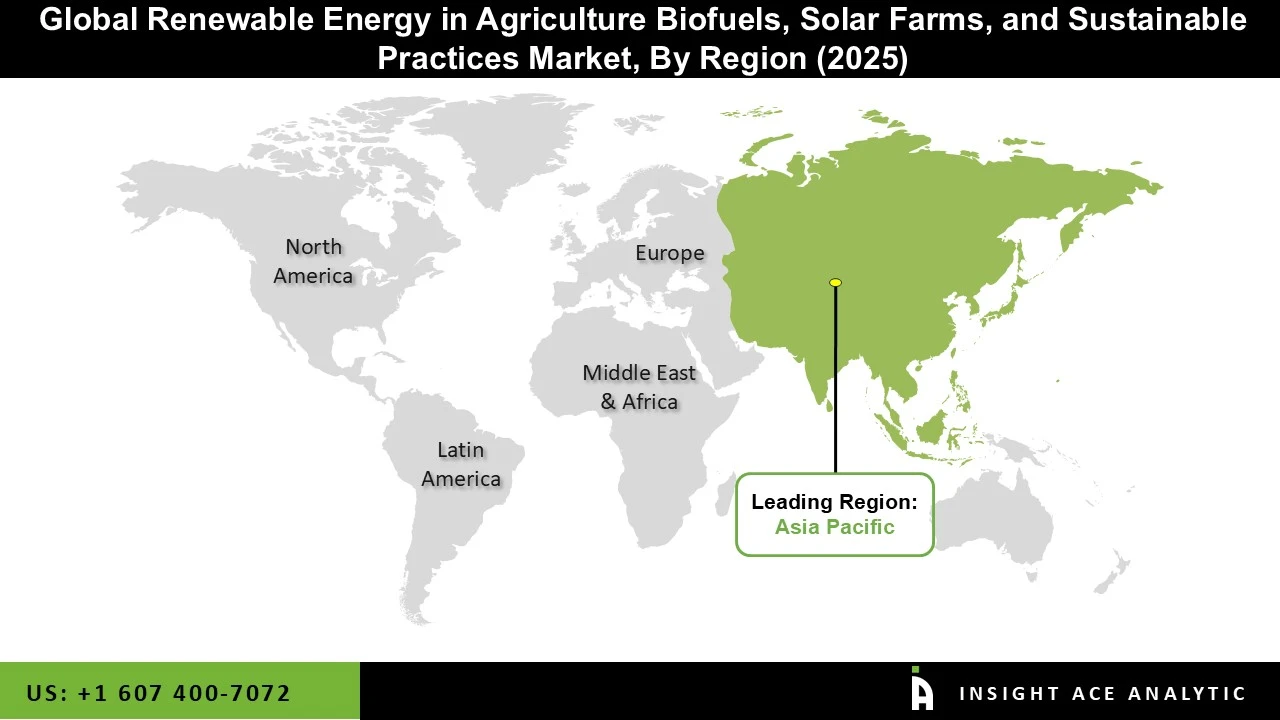
Why North America Led the Renewable Energy in Agriculture Biofuels, Solar Farms, and Sustainable Practices Market?
North America has become a dominant player in the market for renewable energy in agriculture biofuels, solar farms, and sustainable practices because of its advanced agricultural industry and incorporation of technology. This makes it possible to implement renewable energy on a large scale because there are many commercial farms and agribusinesses which are using renewable energy systems. These include Solar energy systems used for irrigation, production of power on-site, and solar farms for generating electricity for grids. Biofuels made using crop residue and waste from agriculture are another form of renewable energy that is being adopted by farmers in North America.
Key Development
October 2024: Aemetis, Inc. announced that Aemetis Biogas has completed initial construction of a multi-dairy anaerobic digester in California, processing waste from ~14,000 dairy cows, with operations expected by end-2024 and annual production exceeding 200,000 MMBtu of renewable natural gas, supported by low-carbon fuel credits and tax incentives.
October 2024: GAIL (India) Limited and VERBIO India Private Limited have signed an MoU to explore setting up agricultural residue-based compressed biogas (CBG) plants in India through a joint venture model, including feasibility studies, site identification, and potential investment approvals, with GAIL also considering equity participation in VERBIO’s existing CBG plant in Punjab.
Renewable Energy in Agriculture Biofuels, Solar Farms, and Sustainable Practices Market Report Scope:
| Report Attribute | Specifications |
| Market size value in 2025 | USD 9.22 Bn |
| Revenue forecast in 2035 | USD 27.24 Bn |
| Growth Rate CAGR | CAGR of 11.6% from 2026 to 2035 |
| Quantitative Units | Representation of revenue in US$ Bn and CAGR from 2026 to 2035 |
| Historic Year | 2022 to 2025 |
| Forecast Year | 2026-2035 |
| Report Coverage | The forecast of revenue, the position of the company, the competitive market structure, growth prospects, and trends |
| Segments Covered | Type of Farming Entity, Type of Farm, Energy Type and By Region |
| Regional Scope | North America; Europe; Asia Pacific; Latin America; Middle East & Africa |
| Country Scope | U.S.; Canada; U.K.; Germany; China; India; Japan; Brazil; Mexico; The UK; France; Italy; Spain; China; Japan; India; South Korea; Southeast Asia; South Korea; Southeast Asia |
| Competitive Landscape | Raízen, Aemetis, Inc., California Bioenergy LLC, Vanguard Renewables Holdings, LLC, EnviTec Biogas AG, BTS Biogas Srl, Sun’Agri, Nexamp, Inc., OYA Solar Corp., Q ENERGY Solutions SE, Husk Power Systems |
| Customization Scope | Free customization report with the procurement of the report, Modifications to the regional and segment scope. Geographic competitive landscape. |
| Pricing and Available Payment Methods | Explore pricing alternatives that are customized to your particular study requirements. |
Market Segmentation:
Renewable Energy in Agriculture Biofuels, Solar Farms, and Sustainable Practices Market by Type of Farming Entity -
• Co-operative Farms
• Single Ownership or Family Farms
• Corporation/Private Ownership
• Government Ownership
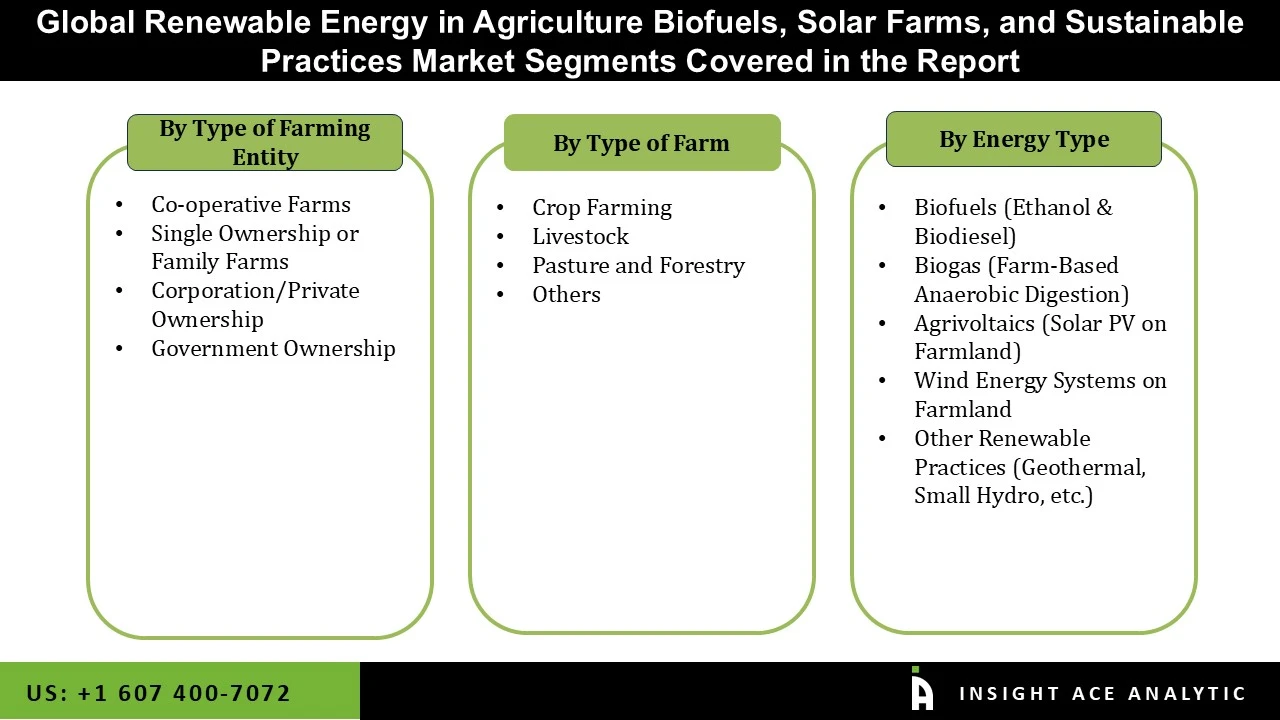
Renewable Energy in Agriculture Biofuels, Solar Farms, and Sustainable Practices Market by Type of Farm -
• Crop Farming
• Livestock
• Pasture and Forestry
• Others
Renewable Energy in Agriculture Biofuels, Solar Farms, and Sustainable Practices Market by Energy Type -
• Biofuels (Ethanol & Biodiesel)
• Biogas (Farm-Based Anaerobic Digestion)
• Agrivoltaics (Solar PV on Farmland)
• Wind Energy Systems on Farmland
• Other Renewable Practices (Geothermal, Small Hydro, etc.)
Renewable Energy in Agriculture Biofuels, Solar Farms, and Sustainable Practices Market by Region-
North America-
• The US
• Canada
• Mexico
Europe-
• Germany
• The UK
• France
• Italy
• Spain
• Rest of Europe
Asia-Pacific-
• China
• Japan
• India
• South Korea
• South East Asia
• Rest of Asia Pacific
Latin America-
• Brazil
• Argentina
• Rest of Latin America
Middle East & Africa-
• GCC Countries
• South Africa
• Rest of Middle East and Africa
Research Design and Approach
This study employed a multi-step, mixed-method research approach that integrates:
- Secondary research
- Primary research
- Data triangulation
- Hybrid top-down and bottom-up modelling
- Forecasting and scenario analysis
This approach ensures a balanced and validated understanding of both macro- and micro-level market factors influencing the market.
Secondary Research
Secondary research for this study involved the collection, review, and analysis of publicly available and paid data sources to build the initial fact base, understand historical market behaviour, identify data gaps, and refine the hypotheses for primary research.
Sources Consulted
Secondary data for the market study was gathered from multiple credible sources, including:
- Government databases, regulatory bodies, and public institutions
- International organizations (WHO, OECD, IMF, World Bank, etc.)
- Commercial and paid databases
- Industry associations, trade publications, and technical journals
- Company annual reports, investor presentations, press releases, and SEC filings
- Academic research papers, patents, and scientific literature
- Previous market research publications and syndicated reports
These sources were used to compile historical data, market volumes/prices, industry trends, technological developments, and competitive insights.

Primary Research
Primary research was conducted to validate secondary data, understand real-time market dynamics, capture price points and adoption trends, and verify the assumptions used in the market modelling.
Stakeholders Interviewed
Primary interviews for this study involved:
- Manufacturers and suppliers in the market value chain
- Distributors, channel partners, and integrators
- End-users / customers (e.g., hospitals, labs, enterprises, consumers, etc., depending on the market)
- Industry experts, technology specialists, consultants, and regulatory professionals
- Senior executives (CEOs, CTOs, VPs, Directors) and product managers
Interview Process
Interviews were conducted via:
- Structured and semi-structured questionnaires
- Telephonic and video interactions
- Email correspondences
- Expert consultation sessions
Primary insights were incorporated into demand modelling, pricing analysis, technology evaluation, and market share estimation.
Data Processing, Normalization, and Validation
All collected data were processed and normalized to ensure consistency and comparability across regions and time frames.
The data validation process included:
- Standardization of units (currency conversions, volume units, inflation adjustments)
- Cross-verification of data points across multiple secondary sources
- Normalization of inconsistent datasets
- Identification and resolution of data gaps
- Outlier detection and removal through algorithmic and manual checks
- Plausibility and coherence checks across segments and geographies
This ensured that the dataset used for modelling was clean, robust, and reliable.
Market Size Estimation and Data Triangulation
Bottom-Up Approach
The bottom-up approach involved aggregating segment-level data, such as:
- Company revenues
- Product-level sales
- Installed base/usage volumes
- Adoption and penetration rates
- Pricing analysis
This method was primarily used when detailed micro-level market data were available.

Top-Down Approach
The top-down approach used macro-level indicators:
- Parent market benchmarks
- Global/regional industry trends
- Economic indicators (GDP, demographics, spending patterns)
- Penetration and usage ratios
This approach was used for segments where granular data were limited or inconsistent.
Hybrid Triangulation Approach
To ensure accuracy, a triangulated hybrid model was used. This included:
- Reconciling top-down and bottom-up estimates
- Cross-checking revenues, volumes, and pricing assumptions
- Incorporating expert insights to validate segment splits and adoption rates
This multi-angle validation yielded the final market size.
Forecasting Framework and Scenario Modelling
Market forecasts were developed using a combination of time-series modelling, adoption curve analysis, and driver-based forecasting tools.
Forecasting Methods
- Time-series modelling
- S-curve and diffusion models (for emerging technologies)
- Driver-based forecasting (GDP, disposable income, adoption rates, regulatory changes)
- Price elasticity models
- Market maturity and lifecycle-based projections
Scenario Analysis
Given inherent uncertainties, three scenarios were constructed:
- Base-Case Scenario: Expected trajectory under current conditions
- Optimistic Scenario: High adoption, favourable regulation, strong economic tailwinds
- Conservative Scenario: Slow adoption, regulatory delays, economic constraints
Sensitivity testing was conducted on key variables, including pricing, demand elasticity, and regional adoption.
Request Customization
Add countries, segments, company profiles, or extend forecast — free 10% customization with purchase.
Customize This Report →Enquire Before Buying
Speak with our analyst team about scope, methodology, pricing, or deliverable formats.
Enquire Now →Frequently Asked Questions
Renewable Energy in Agriculture Biofuels, Solar Farms, and Sustainable Practices Market Size is valued at USD 9.22 Bn in 2025 and is predicted to reach USD 27.24 Bn by the year 2035
Renewable Energy in Agriculture Biofuels, Solar Farms, and Sustainable Practices Market is expected to grow at a 11.6% CAGR during the forecast period for 2026 to 2035.
Raízen, Aemetis, Inc., California Bioenergy LLC, Vanguard Renewables Holdings, LLC, EnviTec Biogas AG, BTS Biogas Srl, Sun’Agri, Nexamp, Inc., OYA Solar Corp., Q ENERGY Solutions SE, Husk Power Systems
Automotive Cybersecurity Homologation Market is segmented into Type of Farming Entity, Type of Farm, Energy Type and By Region
North America region is leading the Renewable Energy in Agriculture Biofuels, Solar Farms, and Sustainable Practices Market.