Automotive Wiring Harness Market Size, Revenue, Trend Report 2026 to 2035
What is Automotive Wiring Harness Market Size?
Global Automotive Wiring Harness Market Size is valued at USD 42.7 Bn in 2025 and is predicted to reach USD 57.4 Bn by the year 2035 at a 3.1% CAGR during the forecast period for 2026 to 2035.
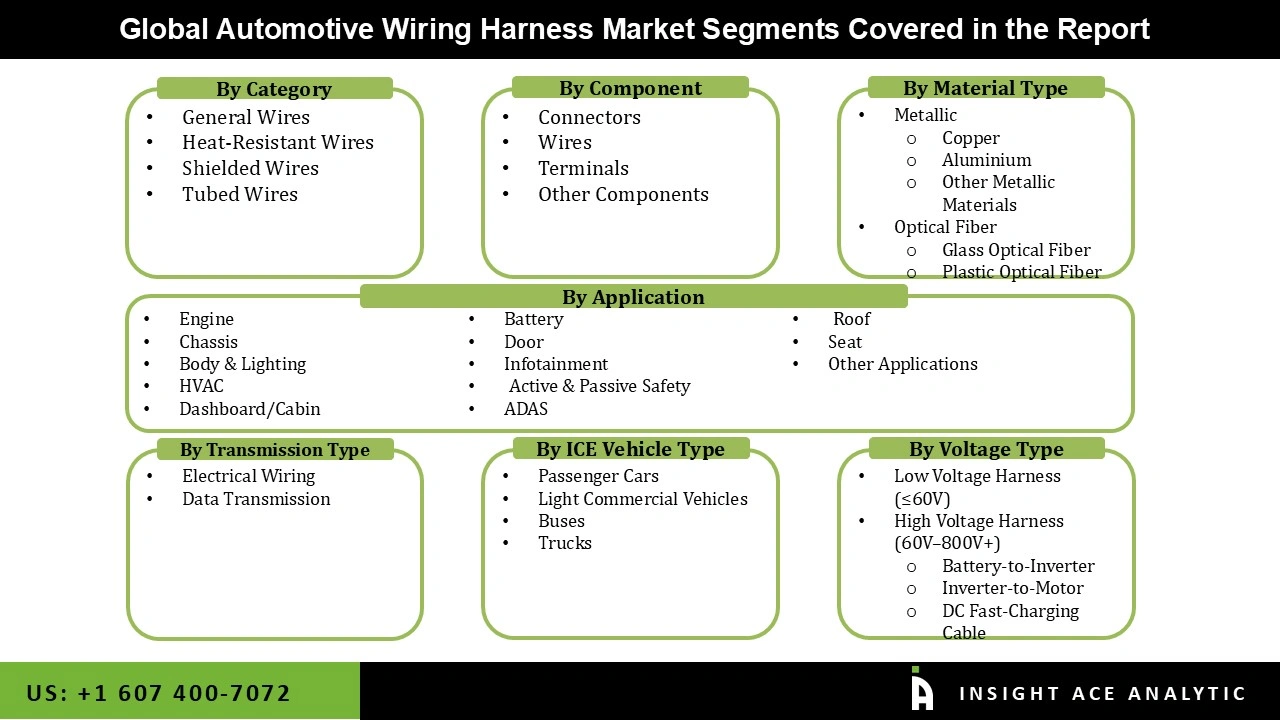
Automotive Wiring Harness Market Size, Share and Trends Analysis Distribution by Category (General Wires, Heat-Resistant Wires, Shielded Wires, Tubed Wires), by Application (Engine, Chassis, Body & Lighting, HVAC, Dashboard/Cabin, Battery, Door, Infotainment, Active & Passive Safety, ADAS, Roof, Seat, Other Applications), by Component (Connectors, Wires, Terminals, Other Components), by Material Type (Metallic (Copper, Aluminum, Other Metallic Materials), Optical Fiber (Glass Optical Fiber, Plastic Optical Fiber), by Transmission Type (Electrical Wiring, Data Transmission), by ICE Vehicle Type (Passenger Cars, Light Commercial Vehicles, Buses, Trucks), by EV Type (Battery Electric Vehicles (BEV), Plug-in Hybrid Electric Vehicles (PHEV), Hybrid Electric Vehicles (HEV), by Voltage Type (Low Voltage Harness (≤60V), High Voltage Harness (60V–800V+) (Battery-to-Inverter, Inverter-to-Motor, DC Fast-Charging Cable)) and Segment Forecasts, 2026 to 2035
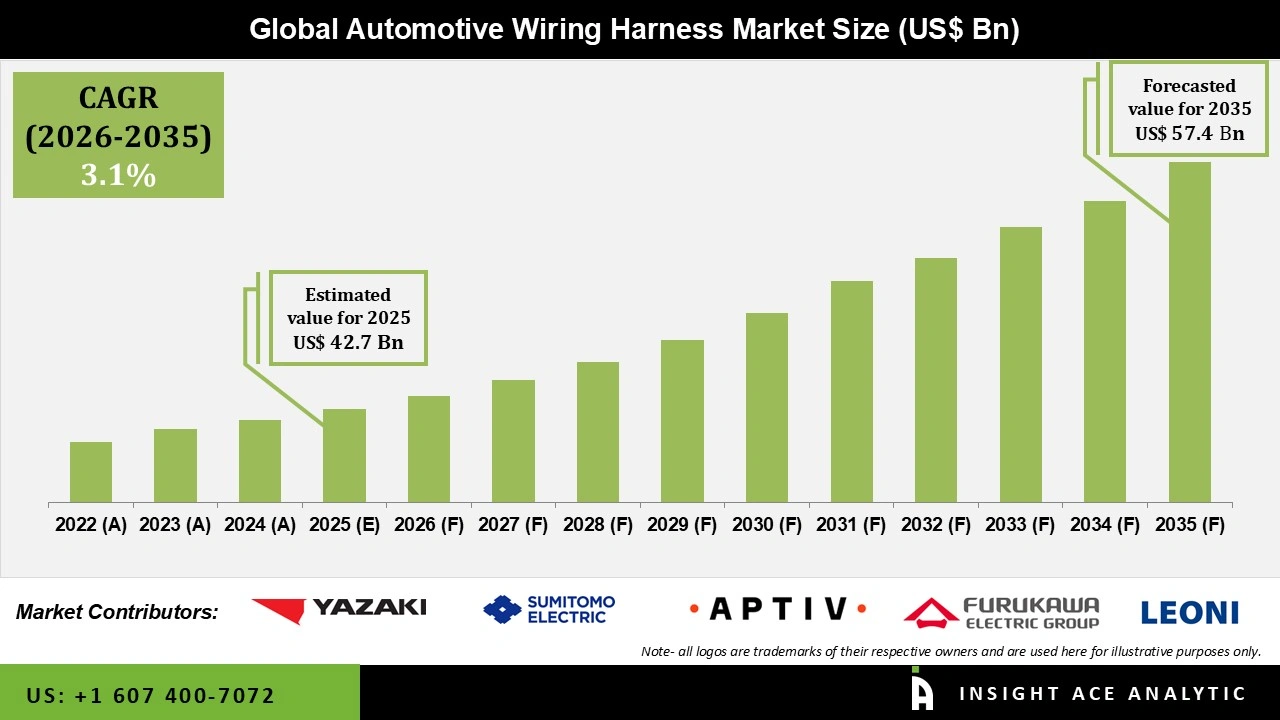
Automotive wiring harness is an integral part of electrical components in automobiles that facilitates the connection and transmission of signals or power through wires, terminals, connectors, relays, and protective coatings for electrical communication between different parts or components. The automotive wiring harnesses provide the ability to manage various electrical connections of different critical components in vehicles such as engines, lights, infotainment systems, air conditioning systems, battery systems, sensors, safety features, advanced driving-assistance systems (ADAS) among others. With the development of increasingly electrified and connected cars, the use of wiring harnesses has expanded beyond merely connecting electrical components in traditional vehicles to facilitate high-speed data transfer, high voltage and complex vehicle architectures among other things.
The advancement in automotive wiring harnesses is aimed at Automotive wiring harness is an integral part of electrical components in automobiles that facilitates the connection and transmission of signals or power through wires, terminals, connectors, relays, and protective coatings for electrical communication between different parts or components.
The automotive wiring harnesses provide the ability to manage various electrical connections of different critical components in vehicles such as engines, lights, infotainment systems, air conditioning systems, battery systems, sensors, safety features, advanced driving-assistance systems (ADAS) among others. With the development of increasingly electrified and connected cars, the use of wiring harnesses has expanded beyond merely connecting electrical components in traditional vehicles to facilitate high-speed data transfer, high voltage and complex vehicle architectures among other things. The advancement in automotive wiring harnesses is aimed at increased investments by global auto OEMs in electrification of automobiles, demand for advanced automotive wiring harnesses is expected to rise. Additionally, the rapid adoption of autonomous and connected driving systems is another factor stimulating the automotive wiring harness market.
One of the key factors that will support market growth is the production of automobiles, both passenger and commercial. Car manufacturers always strive to incorporate various innovations into the design of their vehicles to ensure improved performance. They incorporate more electrical and electronic equipment in their automobiles to achieve this objective. As a result, there is a high demand for sophisticated and advanced wiring systems that can cope with the complexities of new vehicle electrical architecture. Moreover, car manufacturers are incorporating light metals and optical fibres in the manufacturing process of new vehicles to make them lightweight. These innovations will also help enhance energy efficiency in electric cars as they have direct implications on their performance. Another major driver contributing to growth is innovation in the field of automotive electronics. With the increasing adoption of features such as lane departure warning, adaptive cruise control, parking assistance, collision avoidance systems, and vehicle connectivity systems, the automotive industry has been forced to come up with complex wiring systems to manage the operations of these vehicles.
On the other hand, car manufacturers are employing modular design of wires and adopting automated manufacturing technologies, among others, to enhance vehicle performance. In addition to the drivers, one of the major trends that is likely to play a role in the growth of the market is the proliferation of charging technology and infrastructure. The introduction of next-generation electric vehicles has made it essential to introduce advanced high-voltage wiring systems that can enable fast charging and power distribution in the automobiles. Moreover, government regulations and policies aimed at promoting the adoption of electric vehicles will contribute significantly to growth in this regard. Car manufacturers are investing heavily in researching advanced wiring systems for next-gen vehicles.
As noted earlier, the market is witnessing several challenges. For instance, fluctuations in the price of raw materials such as copper and aluminium may have an adverse impact on the costs involved in manufacturing automotive wires. Besides, the increased complexity of the vehicle's electrical system may pose certain challenges to manufacturers as they try to cope with the requirements. The labour-intensive nature of wire harness production may cause supply chain problems in certain circumstances. However, progressive innovations in electric mobility and automotive electronics are anticipated to open up enormous growth opportunities in the market.
Competitive Landscape
Which are the Leading Players in the Automotive Wiring Harness Market?
- Yazaki Corporation
- Sumitomo Electric Industries
- Aptiv
- Furukawa Electric
- Leoni AG
- Nexans
- Motherson Group
- Fujikura Ltd.
- Lear Corporation
- Gebauer & Griller Group
- General Cable Technologies Corporation
- Prysmian Group
- Pacific Insight Electronics
- Kromberg & Schubert GmbH
- Yura Corporation
- Draxlmaier
- Spark Minda
- THB Group
- Hesto Harnesses
- Brascabos
Market Dynamics
Driver
Rapid Growth of Electric Vehicles (EVs)
The key factors driving the market for automotive wiring harnesses include fast growth in the number of electric vehicles (EVs). Wiring harnesses that are advanced in nature are needed by electric and hybrid cars in order to effectively control complex electrical systems, batteries, energy distribution, charging, and data transfer. As compared to regular automobiles, electric cars have more and better harnessing systems, owing to the complexity in managing batteries, inverters, electric motors, smart sensors, and smart vehicle controls. In addition, the rising interest shown by governments in the use of EVs owing to subsidies and emission regulations is further fueling demand for vehicles that have been powered by electricity. The demand for lighter, higher voltage, and heat-resistant automotive wiring harnesses is expected to see a significant increase in the coming years.
Restrain/Challenge
Fluctuations in Raw Material Prices
The key challenges influencing the automotive wiring harness industry include fluctuations in the prices of the raw materials, such as copper and aluminium, which are commonly employed in the production of wire harnesses. Fluctuations in the price of commodities in the international market, logistical disruptions, geopolitical concerns, and increased cost of transport could have a negative effect on production costs for the manufacture of wire harnesses for automobiles. The demand for large amounts of conductive material in the wire harness system means that an increase in the prices of these raw materials can have a negative effect on their profits and lead to pressure on pricing. Further, there is an ongoing push towards developing lightweight yet efficient harness systems that conform to the stringent safety standards of the automotive industry.
The Heat-resistant wires segment is expected to drive the Automotive Wiring Harness Market
The heat-resistant wires segment is set to lead the automotive wiring harness market, driven by the increasing complexity of vehicle electrical systems and the need for durable, high-performance parts. Modern vehicles, especially electric and hybrid models, operate at higher temperatures due to advanced electronics, batteries, turbocharged engines, and high-voltage systems. As a result, heat-resistant wires are being used more often to ensure reliable electrical performance and safety in tough conditions.Car makers are focusing on better insulation materials and wiring that can handle high temperatures to boost reliability, energy efficiency, and durability. The rise of ADAS, infotainment, connected vehicle technologies, and battery management systems is also increasing the need for strong wiring harnesses that work well in demanding environments.More electric and premium vehicles being produced is expected to further strengthen the position of heat-resistant wires in the market.
ADAS Application Segment is expected to drive the Automotive Wiring Harness Market
The ADAS segment is expected to grow quickly in the automotive wiring harness market as more vehicles adopt advanced safety, automation, and connected technologies. Systems like lane departure warning, adaptive cruise control, blind spot detection, automatic emergency braking, and parking assistance all need complex wiring harnesses to support sensors, cameras, radar, and real-time data. Car makers are adding these features to improve safety, comfort, and meet regulations. As vehicles rely more on software and electronic connections, the need for fast, lightweight, and durable wiring is rising. Increased consumer focus on safety and stricter government rules are also speeding up the use of ADAS wiring. The growth of autonomous driving and connected mobility is expected to create more opportunities for the ADAS segment in the future.
Why Asia Pacific Led the Automotive Wiring Harness Market?
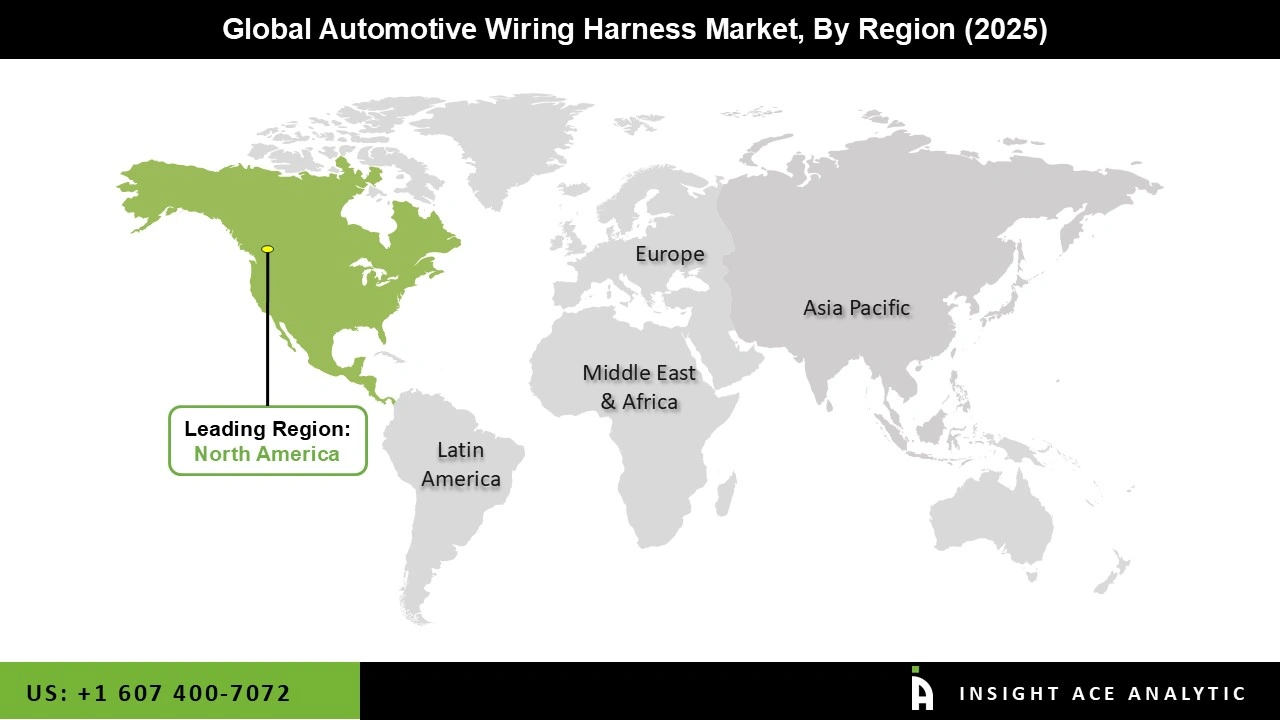
Asia Pacific leads the automotive wiring harness market refers to its strong car manufacturing base, fast-growing vehicle production, and rising use of electric vehicles in countries like China, Japan, India, and South Korea. The region has many top car makers and parts suppliers, which drives demand for wiring harness systems in all types of vehicles. China and Japan are especially important because of their large production capacity, advanced technology, and big investments in electric and smart mobility. The rapid growth of the electric vehicle industry is a key factor, with governments supporting EV adoption through subsidies, tax breaks, charging infrastructure, and strict emission rules. Electric and hybrid vehicles need more advanced, high-voltage wiring than regular cars, so the growing EV market is boosting demand for lightweight, durable, high-performance wiring. More people in the region want connected vehicles, advanced safety features, infotainment, and ADAS, which is leading to more complex electrical systems.
Asia Pacific also benefits from low-cost manufacturing, a strong supply network, and skilled workers, making it a top choice for global car makers and wiring harness companies. Many international firms are expanding their factories and supply chains in the region to meet demand and improve efficiency. Urbanization, higher incomes, and more car ownership in countries like India, Indonesia, Thailand, and Vietnam are also helping the market grow. Ongoing investment in new automotive technology and smart mobility is another reason for the region’s dominance. Car makers in Asia Pacific are focusing on electric mobility, autonomous driving, vehicle connectivity, and software-based platforms, all of which need advanced wiring harnesses for power, sensors, and fast data. Growing exports from China, Japan, and South Korea are expected to further strengthen Asia Pacific’s leadership in the global market in the coming years.
Key Developments
• In January 2025, Aptiv announced plans to separate its Electrical Distribution Systems (EDS) business into an independent company focused on EV power and signal distribution systems.
• In February 2025, Furukawa Electric increased its focus on lightweight aluminium wiring harness technologies to reduce EV weight and improve energy efficiency.
Automotive Wiring Harness Market Report Scope:
| Report Attribute | Specifications |
| Market size value in 2025 | USD 42.7 Bn |
| Revenue forecast in 2035 | USD 57.4 Bn |
| Growth Rate CAGR | CAGR of 3.1% from 2026 to 2035 |
| Quantitative Units | Representation of revenue in US$ Bn and CAGR from 2026 to 2035 |
| Historic Year | 2021 to 2025 |
| Forecast Year | 2026-2035 |
| Report Coverage | The forecast of revenue, the position of the company, the competitive market structure, growth prospects, and trends |
| Segments Covered | Category Type, Application, Component Type, Material Type, Transmission Type, ICE Vehicle Type, EV Type, Voltage Type, and By Region |
| Regional Scope | North America; Europe; Asia Pacific; Latin America; Middle East & Africa |
| Country Scope | US, Canada, UK, Germany, France, Italy, Spain, Rest of Europe, China, Japan, South Korea, India, Australia, Rest of Asia-Pacific, Brazil, Mexico, Argentina, Saudi Arabia, UAE, Egypt |
| Competitive Landscape | Yazaki Corporation, Sumitomo Electric Industries, Aptiv, Furukawa Electric, Leoni AG, Nexans, Motherson Group, Fujikura Ltd., Lear Corporation, Gebauer & Griller Group, General Cable Technologies Corporation, Prysmian Group, Pacific Insight Electronics, Kromberg & Schubert GmbH, Yura Corporation, Draxlmaier, Spark Minda, THB Group, Hesto Harnesses, Brascabos |
| Customization Scope | Free customization report with the procurement of the report, Modifications to the regional and segment scope. Geographic competitive landscape. |
| Pricing and Available Payment Methods | Explore pricing alternatives that are customized to your particular study requirements. |
Segmentation of Automotive Wiring Harness Market :
Automotive Wiring Harness Market by Category -
- General Wires
- Heat-Resistant Wires
- Shielded Wires
- Tubed Wires
Automotive Wiring Harness Market by Application-
- Engine
- Chassis
- Body & Lighting
- HVAC
- Dashboard/Cabin
- Battery
- Door
- Infotainment
- Active & Passive Safety
- ADAS
- Roof
- Seat
- Other Applications
Automotive Wiring Harness Market by Component-
- Connectors
- Wires
- Terminals
- Other Components
Automotive Wiring Harness Market by Material Type-
- Metallic
- Copper
- Aluminum
- Other Metallic Materials
- Optical Fiber
- Glass Optical Fiber
- Plastic Optical Fiber
Automotive Wiring Harness Market by Transmission Type-
- Electrical Wiring
- Data Transmission
Automotive Wiring Harness Market by ICE Vehicle Type-
- Passenger Cars
- Light Commercial Vehicles
- Buses
- Trucks
Automotive Wiring Harness Market by EV Type-
- Battery Electric Vehicles (BEV)
- Plug-in Hybrid Electric Vehicles (PHEV)
- Hybrid Electric Vehicles (HEV)
Automotive Wiring Harness Market by Voltage Type-
- Low Voltage Harness (≤60V)
- High Voltage Harness (60V–800V+)
- Battery-to-Inverter
- Inverter-to-Motor
- DC Fast-Charging Cable
Automotive Wiring Harness Market by Region-
- North America-
- The US
- Canada
- Europe-
- Germany
- The UK
- France
- Italy
- Spain
- Rest of Europe
- Asia-Pacific-
- China
- Japan
- India
- South Korea
- South East Asia
- Rest of Asia Pacific
- Latin America-
- Brazil
- Argentina
- Mexico
- Rest of Latin America
- Middle East and Africa-
- GCC Countries
- South Africa
- Rest of Middle East and Africa
Research Design and Approach
This study employed a multi-step, mixed-method research approach that integrates:
- Secondary research
- Primary research
- Data triangulation
- Hybrid top-down and bottom-up modelling
- Forecasting and scenario analysis
This approach ensures a balanced and validated understanding of both macro- and micro-level market factors influencing the market.
Secondary Research
Secondary research for this study involved the collection, review, and analysis of publicly available and paid data sources to build the initial fact base, understand historical market behaviour, identify data gaps, and refine the hypotheses for primary research.
Sources Consulted
Secondary data for the market study was gathered from multiple credible sources, including:
- Government databases, regulatory bodies, and public institutions
- International organizations (WHO, OECD, IMF, World Bank, etc.)
- Commercial and paid databases
- Industry associations, trade publications, and technical journals
- Company annual reports, investor presentations, press releases, and SEC filings
- Academic research papers, patents, and scientific literature
- Previous market research publications and syndicated reports
These sources were used to compile historical data, market volumes/prices, industry trends, technological developments, and competitive insights.

Primary Research
Primary research was conducted to validate secondary data, understand real-time market dynamics, capture price points and adoption trends, and verify the assumptions used in the market modelling.
Stakeholders Interviewed
Primary interviews for this study involved:
- Manufacturers and suppliers in the market value chain
- Distributors, channel partners, and integrators
- End-users / customers (e.g., hospitals, labs, enterprises, consumers, etc., depending on the market)
- Industry experts, technology specialists, consultants, and regulatory professionals
- Senior executives (CEOs, CTOs, VPs, Directors) and product managers
Interview Process
Interviews were conducted via:
- Structured and semi-structured questionnaires
- Telephonic and video interactions
- Email correspondences
- Expert consultation sessions
Primary insights were incorporated into demand modelling, pricing analysis, technology evaluation, and market share estimation.
Data Processing, Normalization, and Validation
All collected data were processed and normalized to ensure consistency and comparability across regions and time frames.
The data validation process included:
- Standardization of units (currency conversions, volume units, inflation adjustments)
- Cross-verification of data points across multiple secondary sources
- Normalization of inconsistent datasets
- Identification and resolution of data gaps
- Outlier detection and removal through algorithmic and manual checks
- Plausibility and coherence checks across segments and geographies
This ensured that the dataset used for modelling was clean, robust, and reliable.
Market Size Estimation and Data Triangulation
Bottom-Up Approach
The bottom-up approach involved aggregating segment-level data, such as:
- Company revenues
- Product-level sales
- Installed base/usage volumes
- Adoption and penetration rates
- Pricing analysis
This method was primarily used when detailed micro-level market data were available.

Top-Down Approach
The top-down approach used macro-level indicators:
- Parent market benchmarks
- Global/regional industry trends
- Economic indicators (GDP, demographics, spending patterns)
- Penetration and usage ratios
This approach was used for segments where granular data were limited or inconsistent.
Hybrid Triangulation Approach
To ensure accuracy, a triangulated hybrid model was used. This included:
- Reconciling top-down and bottom-up estimates
- Cross-checking revenues, volumes, and pricing assumptions
- Incorporating expert insights to validate segment splits and adoption rates
This multi-angle validation yielded the final market size.
Forecasting Framework and Scenario Modelling
Market forecasts were developed using a combination of time-series modelling, adoption curve analysis, and driver-based forecasting tools.
Forecasting Methods
- Time-series modelling
- S-curve and diffusion models (for emerging technologies)
- Driver-based forecasting (GDP, disposable income, adoption rates, regulatory changes)
- Price elasticity models
- Market maturity and lifecycle-based projections
Scenario Analysis
Given inherent uncertainties, three scenarios were constructed:
- Base-Case Scenario: Expected trajectory under current conditions
- Optimistic Scenario: High adoption, favourable regulation, strong economic tailwinds
- Conservative Scenario: Slow adoption, regulatory delays, economic constraints
Sensitivity testing was conducted on key variables, including pricing, demand elasticity, and regional adoption.
Request Customization
Add countries, segments, company profiles, or extend forecast — free 10% customization with purchase.
Customize This Report →Enquire Before Buying
Speak with our analyst team about scope, methodology, pricing, or deliverable formats.
Enquire Now →Frequently Asked Questions
Automotive Wiring Harness Market Size is valued at USD 42.7 Bn in 2025 and is predicted to reach USD 57.4 Bn by the year 2035
The Automotive Wiring Harness Market is expected to grow at a 3.1% CAGR during the forecast period for 2026 to 2035
Yazaki Corporation, Sumitomo Electric Industries, Aptiv, Furukawa Electric, Leoni AG, Nexans, Motherson Group, Fujikura Ltd., Lear Corporation, Gebauer & Griller Group, General Cable Technologies Corporation, Prysmian Group, Pacific Insight Electronics, Kromberg & Schubert GmbH, Yura Corporation, Draxlmaier, Spark Minda, THB Group, Hesto Harnesses, Brascabos and Others.
Automotive Wiring Harness Market is segmented into Category Type, Application, Component Type, Material Type, Transmission Type, ICE Vehicle Type, EV Type, Voltage Type and Others.
North America region is leading the Automotive Wiring Harness Market.