Antibiotic Coated Surgical Implant Drug Market Forecast with Size and Share Analysis 2025 to 2034
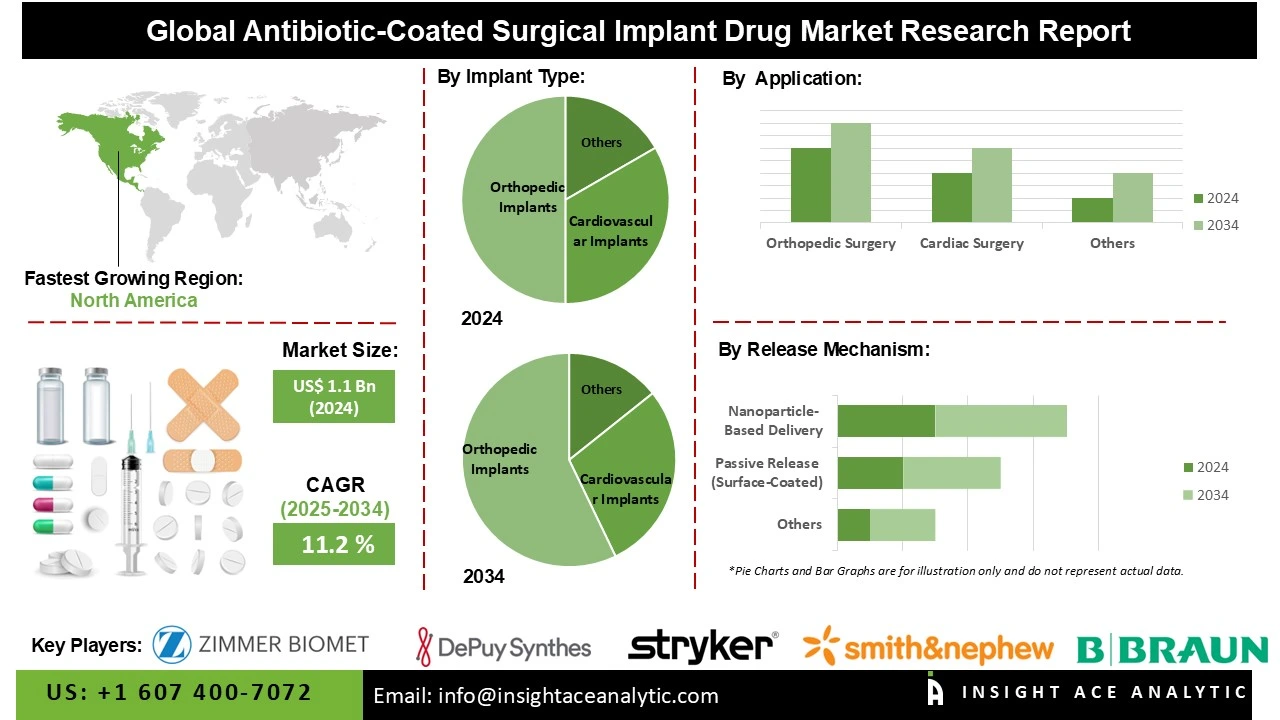
Global Antibiotic-Coated Surgical Implant Drug Market Size is valued at US$ 1.1 Bn in 2024 and is predicted to reach US$ 3.2 Bn by the year 2034 at an 11.2% CAGR during the forecast period for 2025 to 2034.
Antibiotic-Coated Surgical Implant Drug Market Size, Share & Trends Analysis Distribution by Coating Antibiotic Agent (Gentamicin, Tobramycin, Minocycline, Combination Antibiotics, Daptomycin, Vancomycin, Rifampin, and Others), Implant Type, Material of Implant, Application, Release Mechanism, End-use (Hospitals, Dental Clinics, Ambulatory Surgical Centers, Specialty Clinics, and Others), and Segment Forecasts, 2025 to 2034
The antibiotic-coated surgical implant market is a specialized, high-growth segment of the pharmaceutical and medical device industries dedicated to preventing postoperative infections. These implants including orthopedic joint replacements, fracture fixation devices, vascular grafts, and neurosurgical shunts are coated, impregnated, or loaded with antibiotics such as gentamicin, vancomycin, tobramycin, rifampin, or combinations thereof. By releasing antimicrobial agents directly at the implant-tissue interface, they achieve local drug concentrations hundreds to thousands of times higher than systemic antibiotics can safely provide, effectively inhibiting bacterial adhesion, colonization, and biofilm formation the primary culprits behind surgical site infections (SSIs) and difficult-to-treat periprosthetic joint infections (PJIs).
Growth of the market is propelled primarily by the global increase in implant procedures. An aging population, rising prevalence of chronic diseases (osteoarthritis, diabetes, cardiovascular conditions), and higher rates of trauma from road traffic accidents have dramatically increased surgical volume. Robust clinical evidence from randomized trials, registries, and meta-analyses demonstrating 40–70 % reductions in infection rates with antibiotic-loaded bone cement and pre-coated devices has driven widespread adoption, especially in high-risk cases such as revision arthroplasty, open fractures, and immunocompromised patients. Continued public and private investment in infection-prevention technologies further fuels innovation and market expansion.
A prominent emerging trend is the shift toward next-generation, sustainable antimicrobial coatings. Researchers and manufacturers are developing bio-based, biodegradable carriers (e.g., calcium sulfate, hydrogels, and antimicrobial peptides) and environmentally friendly alternatives to traditional synthetic antibiotics and non-resorbable polymers. These innovations address mounting regulatory and societal concerns about antimicrobial resistance and medical waste while maintaining or improving efficacy and biocompatibility. As healthcare systems worldwide prioritize both patient safety and environmental responsibility, these advanced, eco-conscious solutions are poised to play a central role in the continued evolution of the antibiotic-coated implant market.
Competitive Landscape
Some of the Key Players in Antibiotic-Coated Surgical Implant Drug Market:
- Zimmer Biomet Holdings, Inc.
- Smith & Nephew plc
- B. Braun Melsungen AG
- Medtronic plc
- Orthofix Medical Inc.
- Heraeus Holding GmbH
- DePuy Synthes (Johnson & Johnson)
- Stryker Corporation
- Aesculap Inc.
- MicroPort Scientific Corporation
- Xtant Medical Holdings, Inc.
- BioHorizons IPH, Inc.
- Dentsply Sirona Inc.
- RTI Surgical Holdings
- Evonik Industries AG
- Globus Medical Inc.
- BioVentrix Inc.
- Collagen Matrix Inc.
- OsteoRemedies, LLC
- Biocomposites Ltd
Market Segmentation:
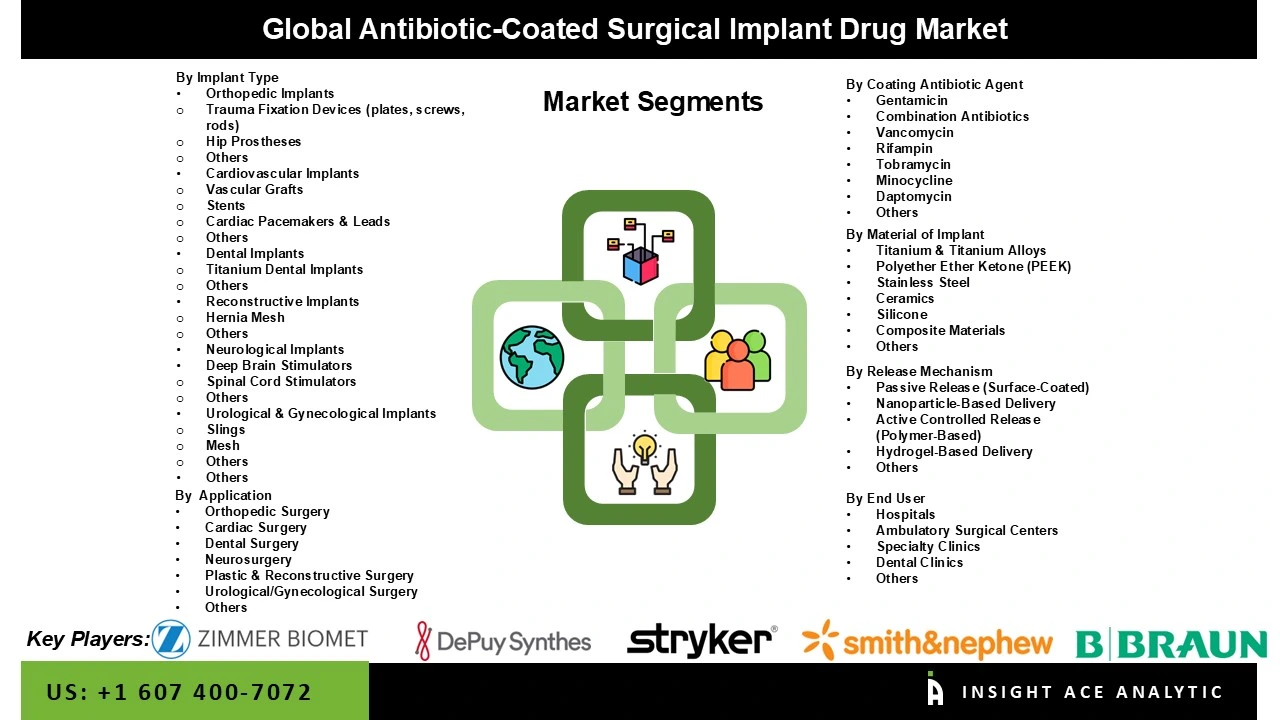
The antibiotic-coated surgical implant drug market is segmented by coating antibiotic agent, implant type, material of implant, application, release mechanism, and end-use. By coating antibiotic agent, the market is segmented into gentamicin, tobramycin, minocycline, combination antibiotics, daptomycin, vancomycin, rifampin, and others. By implant type, the market is segmented into orthopedic implants (trauma fixation devices (plates, screws, rods), knee prostheses, hip prostheses, spinal implants, others), dental implants (titanium dental implants, zirconia dental implants, others), cardiovascular implants (stents, vascular grafts, cardiac pacemakers & leads, others), reconstructive implants (breast implants, he ia mesh, facial implants, others), urological & gynecological implants (mesh, slings, others), neurological implants (spinal cord stimulators, deep brain stimulators, others), and others. By material of implant, the market is segmented into stainless steel, ceramics, titanium & titanium alloys, polyether ether ketone (peek), silicone, composite materials, and others. The application segment is categorised into cardiac surgery, neurosurgery, orthopedic surgery, dental surgery, plastic & reconstructive surgery, urological/gynecological surgery, and others. As per the release mechanism, the market is segmented into passive release (surface-coated), active controlled release (polymer-based), hydrogel-based delivery, nanoparticle-based delivery, and others. Whereas the end-use segment consists of hospitals, dental clinics, ambulatory surgical centers, specialty clinics, and others.
By Implant Type, the Orthopedic Implants Segment is Expected to Drive the Antibiotic-Coated Surgical Implant Drug Market
In 2024, the market for antibiotic-coated surgical implant drugs was dominated by the orthopedic implants segment. This is because a damaged bone has to be supported, and a missing joint or bone needs to be replaced. Orthopedic implants are frequently made of polymers, ceramics, and metallic alloys. In order to lower toxicity levels and lower the possibility of host rejection, researchers are creating innovative orthopedic implants using biomaterials. Three techniques anti-adhesion, contact-killing, and releasing-type are used to apply antibiotic coatings to orthopedic implants.
Orthopedic Surgery Segment by Application is Growing at the Highest Rate in the Antibiotic-Coated Surgical Implant Drug Market
In 2024, the global market for antibiotic-coated surgical implant drugs was led by the orthopedic surgery segment in terms of application. The growing number of accidents and orthopedic conditions contributes to the segment's expansion. Around 30.5 million orthopedic procedures are anticipated to be carried out worldwide in 2024, a 4.5% increase over 2023. Common orthopedic conditions include rheumatoid arthritis, osteoarthritis, and osteoporosis. The segment's expansion is also driven by the rising number of post-menopausal women and the aging population.
Regionally, North America Led the Antibiotic-Coated Surgical Implant Drug Market
The antibiotic-coated surgical implant drug market is dominated by North America in 2024. A successful decrease in HAIs and rising surgical equipment spending in the healthcare industry are predicted to increase demand for antibiotic-coated surgical implant drugs in the region. Furthermore, the region's market is expanding as a result of rising medical device exports, improvements in medical technology, and an increase in the demand for in-home healthcare services. Additionally, the US and Canadian medical device sectors have a strong cooperation due to their similar quality, proximity, and safety norms, which should encourage the expansion of the regional antibiotic-coated surgical implant drug market.
During the projected period, the antibiotic-coated surgical implant drug market is anticipated to expand at the quickest compound annual growth rate (CAGR) in Asia-Pacific. The necessity for surgery is exacerbated by the growing number of older adults and the increasing incidence of chronic illnesses. The market is growing as a result of the expanding medical device and healthcare industries. Government agencies finance the adoption and installation of cutting-edge medical technology in healthcare facilities. Additionally, foreign manufacturers are encouraged to establish their medical device production facilities in China by the Chinese National Medical Products Administration (NMPA). Furthermore, favorable trade rules that allow for the import and export of surgical implants have a positive effect on the antibiotic-coated surgical implant drug market expansion.
Antibiotic-Coated Surgical Implant Drug Market Report Scope:
Segmentation of Antibiotic-Coated Surgical Implant Drug Market :
Antibiotic-Coated Surgical Implant Drug Market by Coating Antibiotic Agent-
· Gentamicin
· Tobramycin
· Minocycline
· Combination Antibiotics
· Daptomycin
· Vancomycin
· Rifampin
· Others
Antibiotic-Coated Surgical Implant Drug Market by Implant Type -
· Orthopedic Implants
o Trauma Fixation Devices (plates, screws, rods)
o Knee Prostheses
o Hip Prostheses
o Spinal Implants
o Others
· Dental Implants
o Titanium Dental Implants
o Zirconia Dental Implants
o Others
· Cardiovascular Implants
o Stents
o Vascular Grafts
o Cardiac Pacemakers & Leads
o Others
· Reconstructive Implants
o Breast Implants
o He ia Mesh
o Facial Implants
o Others
· Urological & Gynecological Implants
o Mesh
o Slings
o Others
· Neurological Implants
o Spinal Cord Stimulators
o Deep Brain Stimulators
o Others
· Others
Antibiotic-Coated Surgical Implant Drug Market by Material of Implant-
· Stainless Steel
· Ceramics
· Titanium & Titanium Alloys
· Polyether Ether Ketone (PEEK)
· Silicone
· Composite Materials
· Others
Antibiotic-Coated Surgical Implant Drug Market by Application-
· Cardiac Surgery
· Neurosurgery
· Orthopedic Surgery
· Dental Surgery
· Plastic & Reconstructive Surgery
· Urological/Gynecological Surgery
· Others
Antibiotic-Coated Surgical Implant Drug Market by Release Mechanism-
· Passive Release (Surface-Coated)
· Active Controlled Release (Polymer-Based)
· Hydrogel-Based Delivery
· Nanoparticle-Based Delivery
· Others
Antibiotic-Coated Surgical Implant Drug Market by End-use-
· Hospitals
· Dental Clinics
· Ambulatory Surgical Centers
· Specialty Clinics
· Others
Antibiotic-Coated Surgical Implant Drug Market by Region-
North America-
· The US
· Canada
Europe-
· Germany
· The UK
· France
· Italy
· Spain
· Rest of Europe
Asia-Pacific-
· China
· Japan
· India
· South Korea
· Southeast Asia
· Rest of Asia Pacific
Latin America-
· Brazil
· Argentina
· Mexico
· Rest of Latin America
Middle East & Africa-
· GCC Countries
· South Africa
· Rest of the Middle East and Africa
Research Design and Approach
This study employed a multi-step, mixed-method research approach that integrates:
- Secondary research
- Primary research
- Data triangulation
- Hybrid top-down and bottom-up modelling
- Forecasting and scenario analysis
This approach ensures a balanced and validated understanding of both macro- and micro-level market factors influencing the market.
Secondary Research
Secondary research for this study involved the collection, review, and analysis of publicly available and paid data sources to build the initial fact base, understand historical market behaviour, identify data gaps, and refine the hypotheses for primary research.
Sources Consulted
Secondary data for the market study was gathered from multiple credible sources, including:
- Government databases, regulatory bodies, and public institutions
- International organizations (WHO, OECD, IMF, World Bank, etc.)
- Commercial and paid databases
- Industry associations, trade publications, and technical journals
- Company annual reports, investor presentations, press releases, and SEC filings
- Academic research papers, patents, and scientific literature
- Previous market research publications and syndicated reports
These sources were used to compile historical data, market volumes/prices, industry trends, technological developments, and competitive insights.

Primary Research
Primary research was conducted to validate secondary data, understand real-time market dynamics, capture price points and adoption trends, and verify the assumptions used in the market modelling.
Stakeholders Interviewed
Primary interviews for this study involved:
- Manufacturers and suppliers in the market value chain
- Distributors, channel partners, and integrators
- End-users / customers (e.g., hospitals, labs, enterprises, consumers, etc., depending on the market)
- Industry experts, technology specialists, consultants, and regulatory professionals
- Senior executives (CEOs, CTOs, VPs, Directors) and product managers
Interview Process
Interviews were conducted via:
- Structured and semi-structured questionnaires
- Telephonic and video interactions
- Email correspondences
- Expert consultation sessions
Primary insights were incorporated into demand modelling, pricing analysis, technology evaluation, and market share estimation.
Data Processing, Normalization, and Validation
All collected data were processed and normalized to ensure consistency and comparability across regions and time frames.
The data validation process included:
- Standardization of units (currency conversions, volume units, inflation adjustments)
- Cross-verification of data points across multiple secondary sources
- Normalization of inconsistent datasets
- Identification and resolution of data gaps
- Outlier detection and removal through algorithmic and manual checks
- Plausibility and coherence checks across segments and geographies
This ensured that the dataset used for modelling was clean, robust, and reliable.
Market Size Estimation and Data Triangulation
Bottom-Up Approach
The bottom-up approach involved aggregating segment-level data, such as:
- Company revenues
- Product-level sales
- Installed base/usage volumes
- Adoption and penetration rates
- Pricing analysis
This method was primarily used when detailed micro-level market data were available.

Top-Down Approach
The top-down approach used macro-level indicators:
- Parent market benchmarks
- Global/regional industry trends
- Economic indicators (GDP, demographics, spending patterns)
- Penetration and usage ratios
This approach was used for segments where granular data were limited or inconsistent.
Hybrid Triangulation Approach
To ensure accuracy, a triangulated hybrid model was used. This included:
- Reconciling top-down and bottom-up estimates
- Cross-checking revenues, volumes, and pricing assumptions
- Incorporating expert insights to validate segment splits and adoption rates
This multi-angle validation yielded the final market size.
Forecasting Framework and Scenario Modelling
Market forecasts were developed using a combination of time-series modelling, adoption curve analysis, and driver-based forecasting tools.
Forecasting Methods
- Time-series modelling
- S-curve and diffusion models (for emerging technologies)
- Driver-based forecasting (GDP, disposable income, adoption rates, regulatory changes)
- Price elasticity models
- Market maturity and lifecycle-based projections
Scenario Analysis
Given inherent uncertainties, three scenarios were constructed:
- Base-Case Scenario: Expected trajectory under current conditions
- Optimistic Scenario: High adoption, favourable regulation, strong economic tailwinds
- Conservative Scenario: Slow adoption, regulatory delays, economic constraints
Sensitivity testing was conducted on key variables, including pricing, demand elasticity, and regional adoption.
Request Customization
Add countries, segments, company profiles, or extend forecast — free 10% customization with purchase.
Customize This Report →Enquire Before Buying
Speak with our analyst team about scope, methodology, pricing, or deliverable formats.
Enquire Now →Frequently Asked Questions
The Antibiotic-Coated Surgical Implant Drug Market Size is valued at US$ 1.1 Bn in 2024 and is predicted to reach US$ 3.2 Bn by the year 2034 at an 11.2% CAGR over the forecast period.
The major players in the Antibiotic-Coated Surgical Implant Drug market are Zimmer Biomet Holdings, Inc., Smith & Nephew plc, B. Braun Melsungen AG, Medtronic plc, Orthofix Medical Inc., Heraeus Holding GmbH, DePuy Synthes (Johnson & Johnson), Stryker Corporation, Aesculap Inc., MicroPort Scientific Corporation, Xtant Medical Holdings, Inc., BioHorizons IPH, Inc., Dentsply Sirona Inc., RTI Surgical Holdings, Evonik Industries AG, Globus Medical Inc., BioVentrix Inc., Collagen Matrix Inc., OsteoRemedies, LLC, and Biocomposites Ltd
The primary Antibiotic-Coated Surgical Implant Drug market segments are Coating Antibiotic Agent, Implant Type, Material of Implant, Application, Release Mechanism, and End-use
North America leads the market for Antibiotic-Coated Surgical Implant Drug in order to decrease the rate of HAIs and as a result of rising surgical equipment spending in the healthcare industry.